Cardinals are among the easiest backyard birds to recognize, thanks to their vivid red plumage, prominent crests, and distinctive thick bills. The Northern Cardinal (Cardinalis cardinalis) is especially familiar across much of North America, where males are famous for their brilliant red feathers and black facial mask. But several other birds can look surprisingly similar at first glance.
Some cardinal look-alikes share the same red or reddish-orange coloration, while others resemble cardinals because of their pointed crests, body shape, or stout conical bills. A few may even appear almost identical from a distance, particularly when seen briefly at a feeder or perched high in a tree.
The easiest way to tell these birds apart is to look beyond color. Geographic range, wing markings, bill shape, crest size, facial patterns, and the presence or absence of red on the female can provide valuable clues. Here are 15 birds that may be mistaken for cardinals and the features that help distinguish each one.
1. Pyrrhuloxia
The Pyrrhuloxia (Cardinalis sinuatus) is probably one of the closest relatives and visual look-alikes of the Northern Cardinal. It belongs to the same genus and has a similar upright posture, prominent crest, and thick, conical bill.
Male Pyrrhuloxias are predominantly gray with striking red coloration on the face, crest, breast, wings, and tail. This combination can make them look like a muted or gray version of a male cardinal.
The biggest clue is habitat. Pyrrhuloxias are primarily birds of the arid southwestern United States and Mexico, where their gray plumage provides a useful contrast to the brighter red appearance of Northern Cardinals.
2. Scarlet Tanager
The male Scarlet Tanager (Piranga olivacea) is another spectacular red bird that can be confused with a cardinal. During the breeding season, males have brilliant red bodies with contrasting black wings and tails.
Unlike cardinals, Scarlet Tanagers do not have the large pointed crest that gives cardinals their distinctive silhouette. Their bills are also more slender and their body shape is somewhat different.
Another useful clue is behavior. Scarlet Tanagers often spend considerable time high in mature trees, whereas Northern Cardinals are frequently seen around shrubs, woodland edges, and backyard feeders.
3. Summer Tanager
Male Summer Tanagers (Piranga rubra) are completely red, making them obvious candidates when looking for birds that resemble cardinals. Their warm red plumage can look particularly similar when the bird is seen from a distance.
However, Summer Tanagers lack the cardinal’s prominent crest and black mask. Their bill is relatively stout but does not have quite the same distinctive cardinal profile.
Female Summer Tanagers are yellowish rather than red, which provides another useful identification clue. They are also strongly associated with open woodland and forest edges.
4. Vermilion Flycatcher
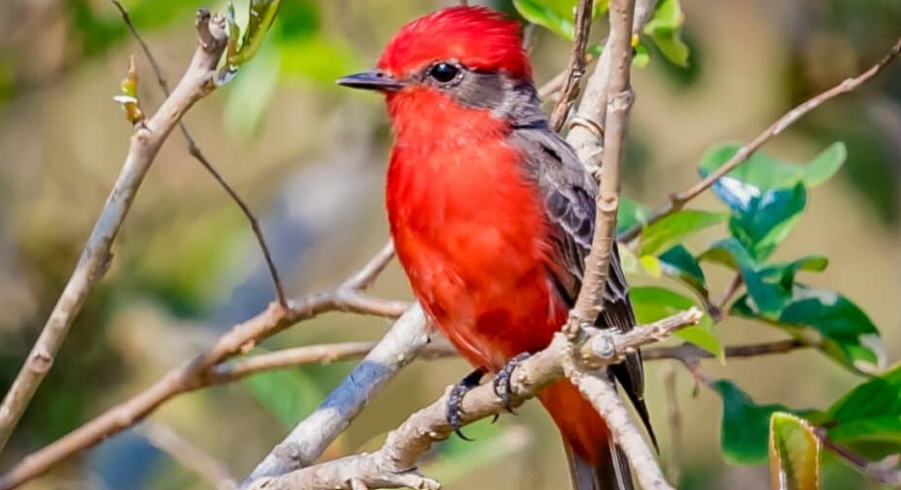
The male Vermilion Flycatcher (Pyrocephalus rubinus) has vivid red plumage that can immediately attract attention. Its brilliant red crown and underparts make it one of the most colorful small birds in its range.
At first glance, the red coloration can suggest a cardinal, but the body shape is quite different. Vermilion Flycatchers have a smaller, slimmer appearance and lack the cardinal’s large conical bill and obvious crest.
Their feeding behavior is also distinctive. They commonly perch in exposed locations before flying out to catch insects, rather than behaving like seed-eating cardinals.
Also Read: Birds That Look Like Penguins
5. House Finch
Male House Finches (Haemorhous mexicanus) are common backyard birds with reddish heads and breasts. Their red coloration makes them frequent cardinal look-alikes, especially when viewed around bird feeders.
The House Finch is generally smaller and more slender than a cardinal. Its red coloration is concentrated around the head, throat, and upper breast, while the rest of the body is brownish and streaked.
The female House Finch is brown and heavily streaked, without the cardinal’s reddish appearance. House Finches also have a more rounded head profile because they lack the cardinal’s prominent crest.
6. Purple Finch
Male Purple Finches (Haemorhous purpureus) have a distinctive raspberry-red or reddish-purple wash across the head, breast, and back. Their coloring can make them look surprisingly similar to male cardinals.
They are smaller than cardinals and lack the cardinal’s crest. Their coloration also tends to look more pinkish or raspberry-colored rather than the intense scarlet-red associated with a male Northern Cardinal.
Purple Finches are common in wooded areas and can visit backyard feeders. Looking at the bird’s silhouette and bill is often more reliable than color alone.
Also Read: Different Types of Cardinal Birds
7. Cassin’s Finch
The male Cassin’s Finch (Haemorhous cassinii) has a rosy-red crown and throat combined with a brownish body. Its colorful head can create a superficial resemblance to a cardinal.
Cassin’s Finches are smaller and slimmer, and they do not have a crest. Their red coloration is also more concentrated toward the head and upper body.
This species is associated primarily with mountainous forests of western North America. Location is therefore an especially useful clue when separating it from the widespread Northern Cardinal.
8. Rose-breasted Grosbeak
The male Rose-breasted Grosbeak (Pheucticus ludovicianus) has a bold red or rose-colored breast patch set against black-and-white plumage. Its substantial conical bill is another feature that can make it seem cardinal-like.
Unlike a cardinal, the male Rose-breasted Grosbeak has a strongly patterned black, white, and red appearance rather than an almost entirely red body. It also lacks the cardinal’s crest.
Its large bill is especially useful for identification. Rose-breasted Grosbeaks are seed-eating birds and may visit feeders, where their contrasting plumage is usually easy to see.
9. Pine Grosbeak
Male Pine Grosbeaks (Pinicola enucleator) can have extensive rosy-red or red plumage, making them look somewhat like oversized cardinals.
They are considerably larger and have a more rounded body shape. Their bills are also short and powerful, while their heads lack the cardinal’s prominent pointed crest.
Pine Grosbeaks are birds of northern forests and mountainous regions. Their geographic range provides an important clue when identifying a large red finch-like bird.
10. White-winged Crossbill
Male White-winged Crossbills (Loxia leucoptera) can show striking red plumage. The bright coloration may initially remind observers of a cardinal.
Their crossed bill immediately separates them from cardinals, however. This unusual bill is specialized for extracting seeds from conifer cones.
They also have obvious white wing markings. Together, the crossed bill and wing pattern make this northern conifer-forest bird relatively easy to distinguish once it is seen clearly.
11. Red Crossbill
The male Red Crossbill (Loxia curvirostra) can be reddish-orange overall and may catch the eye in a similar way to a cardinal.
Its crossed bill is the defining identification feature. Instead of the smooth, thick conical bill of a cardinal, the two halves of a Red Crossbill’s bill cross at the tips.
Red Crossbills are strongly associated with coniferous forests and feed heavily on conifer seeds. Their specialized bill makes them one of the easiest cardinal look-alikes to distinguish once you know what to look for.
12. Hepatic Tanager
The male Hepatic Tanager (Piranga flava) has deep red plumage that can resemble a cardinal at a distance. Its overall color can range from rich red to reddish-orange.
The species lacks the cardinal’s crest and has a more streamlined body. Its bill is also shaped more like a typical tanager’s bill rather than the heavy seed-crushing bill of a cardinal.
Hepatic Tanagers occur primarily in the southwestern United States and parts of Central and South America. Range is therefore a useful identification tool.
13. Western Tanager
Male Western Tanagers (Piranga ludoviciana) have a bright red-orange face and yellow body combined with black wings. Their vivid colors can cause brief confusion with a cardinal.
However, the Western Tanager has no prominent crest and displays several colors rather than the mostly red plumage of a male cardinal. Its bill is also slimmer.
Western Tanagers are common in western North America, particularly during the breeding season. Their yellow body is one of the quickest ways to distinguish them from cardinals.
14. Vermilion Cardinal
The Vermilion Cardinal (Cardinalis phoeniceus) is a true cardinal and therefore naturally resembles the Northern Cardinal. It is native to northern South America, particularly parts of Colombia and Venezuela.
Its bright red plumage, crest, and stout bill give it the familiar cardinal silhouette. These characteristics make it particularly interesting for anyone comparing cardinal species.
Its distribution is the biggest distinction. Unlike the Northern Cardinal, it is not a regular wild bird of most of the United States or Canada.
15. Red-crested Cardinal
The Red-crested Cardinal (Paroaria coronata) is another bird whose name and appearance can lead people to confuse it with the Northern Cardinal. It has a striking red head and crest combined with grayish-white underparts.
Despite its common name, it belongs to a different group of birds from the Northern Cardinal. Its larger red crest is particularly noticeable.
Red-crested Cardinals are native to South America and have also become established in some introduced locations. Their gray body and red head provide a useful distinction from the uniformly red male Northern Cardinal.
How to Tell a Cardinal From Similar Red Birds
Color alone is not the most reliable way to identify a cardinal look-alike. Start with the bill. Northern Cardinals have a large, thick, conical orange-red bill designed for cracking seeds. Birds such as tanagers and flycatchers generally have noticeably different bill shapes.
Next, look for the crest. A prominent pointed crest is one of the Northern Cardinal’s most recognizable characteristics. Many red birds, including Scarlet Tanagers, Summer Tanagers, and House Finches, lack this feature.
Finally, consider location and behavior. A red bird in a southwestern desert habitat may be a Pyrrhuloxia, while a red bird high in a forest canopy may be a tanager. A bird with a crossed bill feeding on conifer cones is likely a crossbill rather than a cardinal.
Frequently Asked Questions
What bird looks most like a cardinal?
The Pyrrhuloxia is one of the closest visual relatives of the Northern Cardinal. It has a similar crest, body shape, and thick bill because both species belong to the genus Cardinalis.
What red bird is commonly mistaken for a cardinal?
Several birds can be mistaken for cardinals, including Scarlet Tanagers, Summer Tanagers, House Finches, Purple Finches, and Vermilion Flycatchers. The key is to examine the bird’s crest, bill, wing markings, and overall body shape.
What bird looks like a cardinal but is not red?
The Pyrrhuloxia is a good example. Males have mostly gray plumage with areas of red, giving them a muted appearance compared with the brilliant red male Northern Cardinal.
Are all red birds related to cardinals?
No. Red plumage has evolved in many unrelated bird groups. Tanagers, finches, grosbeaks, flycatchers, and crossbills can all contain red-colored species without being close relatives of the Northern Cardinal.
References
- Cornell Lab of Ornithology — All About Birds: Northern Cardinal — Identification, range, habitat, behavior, and comparison with similar birds. Cornell Lab of Ornithology — Northern Cardinal
- Cornell Lab of Ornithology — All About Birds: Summer Tanager — Detailed information on appearance, identification, habitat, and behavior. Cornell Lab of Ornithology — Summer Tanager
- Cornell Lab of Ornithology — All About Birds: Scarlet Tanager — Identification information and details about the red plumage and habitat of Scarlet Tanagers. Cornell Lab of Ornithology — Scarlet Tanager
- National Audubon Society — Pyrrhuloxia Field Guide — Identification, range, habitat, behavior, and differences between Pyrrhuloxias and Northern Cardinals. Audubon — Pyrrhuloxia Field Guide