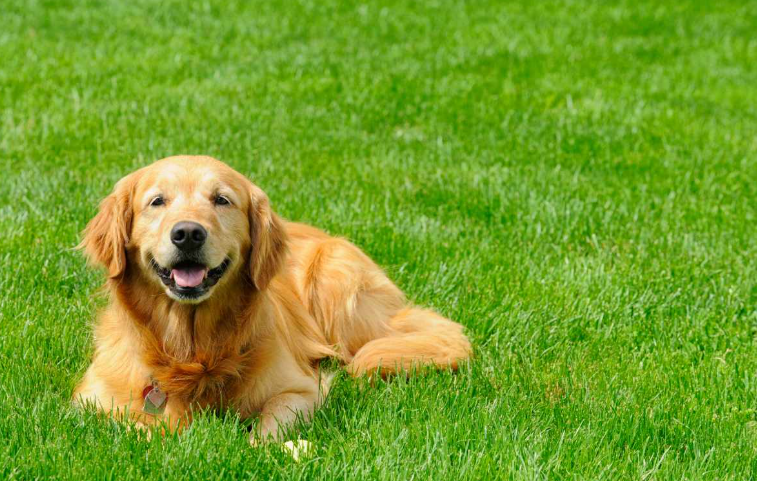
Those dead, straw-colored circles that show up in a dog owner’s lawn every spring aren’t caused by disease or poor mowing, they’re caused by nitrogen and, according to more recent research, lactic acid concentrated in a small, repeated urination spot. The damage has a distinctive look: a dead patch 3 to 6 inches across ringed by grass that’s actually darker and more lush than the rest of the lawn, since the diluted edges of that same urine act as a mild fertilizer even as the concentrated center kills the grass outright. It’s easy to mistake for a lawn disease, which is part of why so many dog owners assume something is wrong with their soil rather than simply their dog’s favorite spot.
Grass species genuinely differ in how well they handle that combination of nitrogen and lactic acid. Cool-season turf splits out clearly by tolerance, with tall fescue handling it best, followed by creeping red fescue, then perennial ryegrass, and Kentucky bluegrass trailing behind as the most easily damaged of the group. Warm-season grasses generally outperform all of them, with bermudagrass and zoysiagrass showing meaningfully better tolerance for both lactic acid and concentrated nitrogen than any common cool-season species.
None of that means a species choice alone solves the problem entirely, and no grass is genuinely immune to a dog that returns to the exact same spot every day. The NC State Extension publication on dogs and turfgrass interactions recommends training a dog to use a mulched area or the lawn’s periphery, or flushing a fresh urine spot with water shortly after it happens, as more effective long-term fixes than grass selection by itself. What follows covers 12 grasses that hold up well to dogs, along with one honest non-grass alternative worth knowing about.
Tall Fescue
Tall fescue has the best documented tolerance for both the nitrogen and lactic acid in dog urine among common cool-season turfgrasses, making it the standard recommendation for a cool-climate yard with dogs. Its deep root system also gives it genuinely strong wear tolerance against digging and running.
It grows in bunches rather than spreading, so a damaged spot needs reseeding to fill back in rather than repairing itself the way a rhizome-spreading grass would.
Creeping Red Fescue
Creeping red fescue ranks just behind tall fescue in documented urine tolerance, offering a genuine step up from perennial ryegrass or Kentucky bluegrass for a dog-heavy lawn. Its fine texture is also reasonably soft underfoot and under paw.
It spreads slowly by rhizome, giving it a mild self-repairing ability that straight bunch-type fescues lack, though it’s still not as fast to recover as a true spreading warm-season grass.
Perennial Ryegrass
Perennial ryegrass sits in the middle of the cool-season urine-tolerance ranking, handling dog urine better than Kentucky bluegrass but not as well as either fescue type. Its real strength for a dog lawn is speed, since it germinates and fills in a damaged spot faster than almost any other cool-season option.
It’s commonly blended with fescue specifically to combine that quick-repair quality with fescue’s stronger baseline urine tolerance, rather than relied on alone.
Kentucky Bluegrass
Kentucky bluegrass has the weakest documented urine tolerance among the common cool-season grasses, more prone to visible dog spots than tall fescue, creeping red fescue, or perennial ryegrass. Its real advantage is a rhizome-based spreading habit that helps it repair itself over time even after urine damage.
It’s rarely recommended as the sole species for a dog-heavy lawn, more often included as one part of a blended seed mix where fescue or ryegrass carries more of the urine-tolerance burden.
Bermudagrass
Bermudagrass shows meaningfully better tolerance for the lactic acid in dog urine than cool-season grasses generally, according to research comparing warm- and cool-season species side by side. Its aggressive spread via stolons and rhizomes also lets it recover from digging and running damage faster than nearly any other turf option.
It needs full sun to perform well, so it’s a poor match for a shaded yard regardless of how well it otherwise handles dogs.
TifTuf Bermudagrass
TifTuf, a specific hybrid bermudagrass cultivar, is frequently singled out for refilling urine spots and general dig damage faster than other turfgrass options available. It combines that rapid recovery with genuinely low water needs compared to older bermudagrass varieties.
Like other bermudagrass types, it needs consistent full sun and won’t perform nearly as well in any meaningfully shaded part of a yard.
Zoysiagrass
Zoysiagrass’s dense growth habit works specifically in its favor with dog urine, since the thick canopy prevents urine from reaching the soil all in one concentrated spot the way it would on a thinner lawn. It also tolerates general wear and tear from running and digging reasonably well once established.
It establishes more slowly than bermudagrass, so a newly seeded zoysia lawn will be more vulnerable to dog damage during that first season before it fills in completely.
Centipedegrass
Centipedegrass’s naturally high water needs work out to a genuine advantage with dog urine, since the frequent watering the grass already requires helps dilute urine before it can concentrate enough to cause real damage. It’s also a low-maintenance, disease-resistant option overall.
It has more modest wear tolerance than bermudagrass or zoysia, so it’s a better match for a lower-energy dog than one that runs and digs constantly.
Buffalograss
Buffalograss tolerates sporadic heavy traffic reasonably well and needs 50 to 75 percent less irrigation than Kentucky bluegrass, making it a strong low-water option for a dog owner in a drier climate. Its deep, fibrous root system gives it a real edge in recovering from digging damage compared to a shallower-rooted alternative.
It performs best in full sun and drier regions like the Great Plains and Mountain West, so it’s not a universal fit outside that general climate.
St. Augustinegrass
St. Augustinegrass offers a notably soft, thick texture that’s comfortable for a dog to walk and lie on, spreading via stolons that help it recover from moderate wear over time. It’s a common warm-climate choice for a dog-friendly Southern lawn.
Its urine tolerance is more moderate than bermudagrass or zoysia, so a heavily used dog spot may still show some damage even on an otherwise healthy St. Augustine lawn.
Tall Fescue and Perennial Ryegrass Blend
A blended seed mix of tall fescue and perennial ryegrass is a common real-world recommendation for a cool-season dog lawn, pairing fescue’s stronger urine tolerance with ryegrass’s faster germination for quicker recovery after damage. It’s a practical compromise rather than relying on either species’ individual weaknesses alone.
This kind of blend also spreads disease risk across 2 species rather than one, a secondary benefit beyond its urine and wear tolerance specifically.
Microclover
Microclover isn’t actually a grass at all, it’s a low-growing legume, but it’s included here because it’s genuinely one of the most urine-tolerant living ground covers available and is frequently recommended alongside or blended into a dog owner’s lawn. It fixes its own nitrogen, tolerates urine considerably better than any true turfgrass, and isn’t on the ASPCA’s list of plants toxic to dogs.
It’s commonly blended with creeping fescue specifically to combine clover’s urine resistance with fescue’s deeper root structure and more traditional lawn appearance, rather than planted as a pure clover monoculture.
Key Takeaway
The best grass for dogs should be able to tolerate regular foot traffic, running, digging, and the general wear that comes with active pets. The right choice also depends on the local climate, soil type, sunlight, drainage, and how much time dogs spend on the lawn.
Different grasses vary in their ability to recover from wear, tolerate drought, and remain dense under frequent use. A durable grass with good root development can help maintain coverage, while proper drainage can reduce muddy areas after rain or watering. It is also important to avoid plants or lawn treatments that may be harmful to dogs.
With suitable grass selection and regular maintenance, a lawn can remain attractive and functional in a dog-friendly yard. Appropriate mowing, watering, fertilization, soil care, and prompt repair of damaged areas can help the grass recover from pet activity and maintain healthy growth.