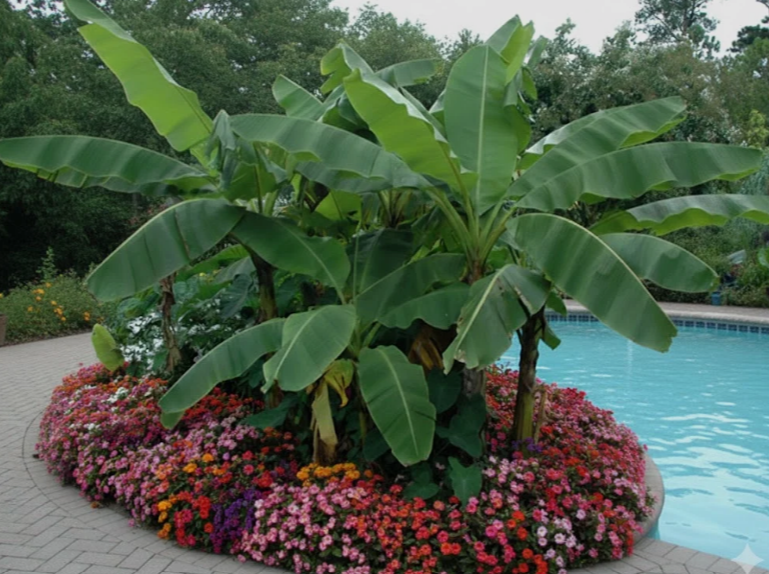
Cold hardy banana varieties let gardeners far from the tropics grow one of the world’s most recognizable plants. The banana is native to Southeast Asia and is not a tree at all, but a giant herb. Its trunk is a tight roll of leaf bases, and the true stem lies underground.
Bananas are among the most important food crops on Earth. Global production is about 135 million metric tons a year, and India alone grows roughly 35 million tons. A single variety, Cavendish, accounts for about half of the world crop and nearly all exports.
The United States has been the world’s leading banana importer since 1961, and about 99% of the bananas eaten there are imported. Frost kills the leaves and trunk of every banana. In hardy types, though, the underground stem survives and sends up new growth in spring.
Surviving winter and producing fruit are different things. Most bananas need 10 to 12 frost-free months to flower and ripen a bunch, so in cold regions the hardiest kinds are grown only for their foliage. The 15 bananas below run from ornamental species that survive deep freezes to edible varieties for mild-winter areas.
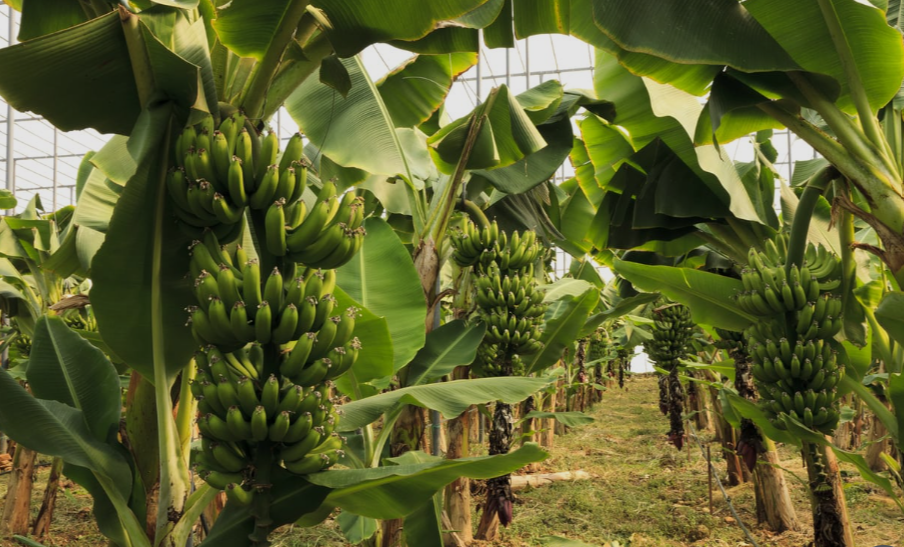
1. Japanese Fiber Banana
The Japanese fiber banana is the hardiest banana in cultivation. It grows 15 to 18 feet tall in a single season, with bright green leaves several feet long. North Carolina State University notes that the top dies back to the ground in winter in the colder zones and regrows in spring. The fruit is 2 to 4 inches long, full of seeds and inedible. The plant’s fibers have long been woven into a fabric known as banana cloth.
Despite its name, the plant is native to Sichuan in China. Nurseries report that it is hardy to about 0°F without protection. Under a deep mulch, clumps have survived -20°F in Nebraska and Massachusetts. It is grown from the southern United States to New England and southern Canada. It is also the standard garden banana in Britain and northern Europe.
2. Darjeeling Banana
The Darjeeling banana comes from high-altitude forests in the northeastern Himalayas. It is a stout plant with thick, waxy leaves. Some forms have striking maroon stripes on the foliage. It reaches about 10 to 14 feet in cool climates. The fruit is small and filled with hard seeds.
Its mountain origin gives it considerable resistance to cold, though it is slightly less hardy than the Japanese fiber banana. It survives winters with mulch in the middle of the country. If frost cuts it down, it regrows quickly from below ground and can pass 6 feet by the end of the year. Its thick leaves resist wind better than most bananas. It is grown in Britain, the Pacific Northwest and the upper South.
3. Yunnan Banana
The Yunnan banana is a tall, slender species from southern China and Southeast Asia. The best-known form, Mekong Giant, has waxy stems blotched with purple and black. It can exceed 20 feet in warm areas. The leaves are long and narrow. The fruit is small and seedy.
Unlike most bananas, it spreads by long underground runners and can travel several feet from the parent clump. Growers describe it as a rampant horizontal spreader. One gardener reports that it has come through at least two winters in a climate where lows reach about -5°F. It needs room and should not be planted near borders. It is grown in the southeastern United States and the Pacific Northwest.
4. Pink Banana
The pink banana is a small ornamental species from northeastern India. It grows only 4 to 6 feet tall. It bears upright pink flowers followed by clusters of fuzzy, bright pink fruit. The fruits peel themselves open when ripe. The flesh is sweet but packed with hard, black seeds.
Garden writers describe it as nearly as hardy as the Japanese fiber banana. Because it flowers early in the season, it is far more likely to fruit in a short summer than other bananas. Hardiness varies from plant to plant, and some strains are much tougher than others. It can also be grown in a large container. It is grown across the southern United States and in conservatories farther north.
5. Chinese Yellow Banana
The Chinese yellow banana is grown for its extraordinary flower. It produces a large, golden-yellow bloom shaped like a lotus that lasts for months. The plant is short and stout, only 3 to 6 feet tall. The leaves are gray-green and stiff. It does not produce edible fruit.
It is native to the mountains of Yunnan in southwestern China, where it grows at high elevations. It is sometimes called the golden lotus banana. Garden references rate it for the upper South and northward, and occasionally one zone colder with protection. Its compact size suits small gardens and containers. It is grown in the southeastern United States, the Pacific Northwest and Britain.
6. Snow Banana
The snow banana is a relative of the true bananas with a swollen, waxy, blue-green trunk. The trunk is widest at the base, which gives the plant a bottle shape. One grower reports it reaching 7 feet in its first season, and it is said to grow to 15 feet. The leaves are broad and pale. The fruit is dry and seedy.
It is native to the Himalayan foothills from Nepal to southern China. At best it is rated hardy where winter lows stay above about 5°F. Unlike true bananas, it does not produce offshoots, so it is raised from seed. The plant dies after flowering. It is grown in the warmer parts of the South and on the West Coast.
7. Helen’s Hybrid
Helen’s Hybrid is thought to be a cross between the Darjeeling banana and an edible Indian variety. It is one of the few hardy bananas with fruit worth eating. The fruit is described as sweet but seedy. The leaves have a red midrib, and new foliage is flushed red beneath. The plant grows 15 to 25 feet tall.
It takes its cold tolerance from its Himalayan parent. Nurseries rate it hardy to about 5°F to 10°F, with heavy mulching or wrapping in winter. It offers the possibility of fruit outdoors in mild temperate climates. It remains rare and is sought mainly by collectors. It is grown in Britain, the Pacific Northwest and the coastal South.
8. Black Thai
Black Thai is a tall banana with dramatic, dark purple to nearly black stems. The leaves are large and deep green. It grows 15 to 20 feet tall. It belongs to a wild species from Southeast Asia that is one of the two ancestors of most edible bananas. The fruit is short and full of seeds.
Relatives of this species are regarded as fairly cold-hardy among large bananas. Nurseries generally recommend it for areas where lows stay above about 10°F. The thick stems stand up well to wind. It is planted mainly as a landscape specimen. It is grown along the Gulf Coast, in Florida and in southern California.
9. Orinoco
Orinoco is the classic hardy eating banana of the American South. The fruit is thick, angular and 6 to 8 inches long. It can be cooked like a plantain or eaten fresh when fully ripe. The plant grows 12 to 20 feet tall. The flavor is mild, with a slight tang.
Georgia researchers note that it is reported to be one of the two most cold-hardy varieties in southern Texas. It is also one of the few bananas commonly grown in Georgia. Growers consider it reliable where winter lows stay above about 15°F to 20°F. The plants are vigorous and tolerate wind and poor soil. It is grown along the Gulf Coast, in Florida, Texas and California.
10. Dwarf Orinoco
Dwarf Orinoco is a compact form of Orinoco that grows only 5 to 8 feet tall. The fruit is the same thick, angular type as its parent. Its short, sturdy trunk resists wind damage. It was rated among the most attractive medium-height bananas in a Georgia trial. The bunches are easy to reach and protect.
Garden references list it among the tough edible bananas for mild-winter areas. Its small size makes it simple to wrap or mulch for winter. It also fruits somewhat sooner than tall types. It is well suited to small yards and large containers. It is grown in Texas, Louisiana, Florida and coastal Georgia.
11. Raja Puri
Raja Puri is a compact Indian banana with small, sweet fruit. The plant grows 8 to 10 feet tall, with a thick trunk and broad leaves. It flowers quickly, often within a year of planting. The fruit is 4 to 5 inches long, with thin skin. The flavor is sweet and mild.
In a trial of 33 varieties near Savannah, it was one of only three that produced palatable fruit before frost. The University of Georgia has studied cold-hardy and short-cycle bananas for the state since 2003. Researchers also report it as one of the two most cold-hardy varieties in southern Texas. Its speed gives it a real chance of ripening fruit in a short season. It is grown in Georgia, Florida, Texas and California.
12. Dwarf Namwah
Dwarf Namwah is a compact form of one of the most popular bananas in Thailand. The fruit is short, plump and very sweet, with a slight apple-like tang. The flesh is dense and creamy. The plant grows 8 to 10 feet tall. It is used fresh, fried and in desserts.
It was among the most successful varieties in the Georgia trials. Garden references list it with the tough edible bananas for mild-winter regions. The plants tolerate drought and cool weather better than Cavendish types. It also resists several common diseases. It is grown in Florida, the Gulf Coast, Texas and southern California.
13. Ice Cream
Ice Cream, also called Blue Java, is known for its unusual fruit. The unripe bananas are silvery blue-green. The ripe flesh is soft and creamy, with a flavor often compared to vanilla custard. The plant is tall, reaching 15 feet or more. The leaves are silvery-green.
It was among the more successful varieties in the Georgia trials, though the season there was slightly too short. The University of Florida publishes a guide to growing bananas in the home landscape. Growers regard it as more cold-tolerant than supermarket types. Its height makes it vulnerable to wind, so a sheltered site is best. It is grown in Florida, Hawaii, the Gulf Coast and southern California.
14. Goldfinger
Goldfinger is a modern banana bred in Honduras for disease resistance. The fruit resembles a Cavendish banana but has a slight apple-like tang. It can be eaten fresh or cooked green. The plant grows 10 to 14 feet tall. The bunches are large and heavy.
It was rated among the most attractive medium-height varieties in the Georgia trial. Growers value it for its tolerance of cool weather and poor soil. It resists the main fungal diseases of bananas. The cut fruit is slow to brown, which suits it to fruit salads. It is grown in Australia, Central America, Florida and California.
15. Veinte Cohol
Veinte Cohol takes a different approach to cold by finishing its crop quickly. It is a short-cycle banana that can be planted in spring and bear a bunch in about 6 months. Its fruit needs only 4 to 6 weeks to mature, compared with about 3 months for most bananas. The bananas are smaller and tangier than Cavendish, with a slight citrus taste. The plant is of moderate height.
University of Georgia researchers identified it as well suited to Georgia and the Southeast. Like all bananas, its green top does not tolerate freezing. Its speed allows it to ripen fruit between the last spring frost and the first fall frost. The fruit has sold for as much as $1.99 a pound in specialty markets. It is grown on a small scale in southern Georgia, Florida and along the Gulf Coast.
Key Takeaways:
- Cold-hardy banana varieties tolerate cooler temperatures better than typical tropical bananas, making them suitable for subtropical gardens and some temperate regions with winter protection.
- Japanese fiber banana (Musa basjoo) is one of the best-known cold-hardy varieties, valued for its large green leaves and ability to regrow from underground rhizomes after its foliage is damaged by frost.
- Cold tolerance varies significantly among banana varieties. Some can survive brief cold spells when their roots are protected, while others require warm conditions and may suffer damage at relatively mild temperatures.
- Most cold-hardy bananas are grown for their ornamental foliage rather than their fruit. Although some varieties can produce bananas in favorable conditions, short growing seasons and cool weather may prevent fruits from fully developing.
- Winter protection can improve the survival of banana plants in colder climates. Mulching around the root zone, planting in sheltered locations, and protecting the underground rhizomes can help plants recover when warmer weather returns.
- Choosing the right cold-hardy banana depends on local climate and growing goals. Consider minimum winter temperatures, frost duration, growing-season length, mature plant size, and whether you want ornamental foliage or edible fruit before selecting a variety.
Sources:
- North Carolina State University: Japanese Fiber Banana
- University of Georgia: South Georgia bananas drawing attention
- University of Florida: Banana Growing in the Florida Home Landscape
- HortTechnology: Evaluation of Commercial Banana Cultivars in Southern Georgia
- Florida Gulf Coast University: Georgia banana cultivar evaluation abstract
- University of Minnesota AgEcon Search: Banana Trials in Georgia
- Walter Reeves: New Banana for Georgia Beats Cold
- Oregon Association of Nurseries: Musa basjoo
- Gardening Know How: Cold Hardy Banana Trees
- Gardenia: Banana hardiness by zone
- Rusty Blackhaw: A banner year for bananas
- Phoenix Perennials: Helen’s Hybrid
- Devon Subtropical Garden: Bananas
- lovemoney: Inside the banana industry
- FAO: The world banana economy