The Fragrant Shrub With a Famous Reputation for Being Fussy
Gardenia is one of the most beloved fragrant shrubs in the American South, prized for waxy white blooms whose sweet, spicy scent can drift across an entire yard on a warm evening. It’s also one of the most notoriously temperamental, a plant that rewards the right conditions with spectacular flowers and punishes the wrong ones with yellow leaves and dropped buds.
That contrast is the real story of this plant. A shrub grown in China for more than 1,000 years, carried across oceans on the strength of its perfume, and named for a Charleston physician who never even sent it to the botanists who honored him, gardenia has a history as interesting as its flowers. Understanding what it wants, and why it so often doesn’t get it, is the difference between a thriving hedge and a pot of disappointment.
This guide covers the genus’s classification and naming history, how to identify it, where it comes from, its popular uses, and the practical details of growing it: soil, light, feeding, pests, and the problems that trip up even experienced gardeners.
Botanical Classification
Gardenia belongs to the Rubiaceae family, better known as the coffee family, which also includes coffee itself and a long list of other tropical and subtropical shrubs and trees. The genus contains more than 200 species spread across tropical and subtropical regions of Africa, Asia, and the Pacific, though the plant most American gardeners mean when they say gardenia is a single Asian species, also sold as cape jasmine, common gardenia, or simply gardenia.
In the United States, that one species accounts for nearly every gardenia planted outdoors. Florida’s extension service notes that, despite the genus’s 200-plus species, this single plant is used almost exclusively across the state, and North Carolina State’s plant database lists it among the favorites for sensory, nighttime, cutting, and children’s gardens. A handful of other species show up occasionally, including a Tahitian gardenia and a white-flowered gardenia from South Africa, but they remain specialty plants rather than everyday landscape choices.
Brief History and Naming
Gardenias were being cultivated in China long before Europeans encountered them, with Clemson University’s Home and Garden Information Center noting that the Chinese have grown them for more than 1,000 years. The plant reached England in the mid-1700s, arriving around 1750, and a persistent mix-up about its origin gave it the name cape jasmine. Early growers believed it came from the Cape of Good Hope in South Africa, when it was actually native to southern China, Taiwan, and Japan.
The genus name came a few years later, in 1761, when the English naturalist John Ellis dissected the flower and realized it wasn’t closely related to true jasmine at all and deserved a genus of its own. He chose to honor Alexander Garden, a Scottish-born physician and naturalist living in Charleston, South Carolina, who lived from 1730 to 1791 and corresponded regularly with Ellis and with Carl Linnaeus. The honor came with an irony: Garden shipped all manner of Carolina plants and animals across the Atlantic, but this particular plant was not among them. Ellis convinced Linnaeus to use the name anyway, and the first gardenia grown in America is generally credited to Garden’s own Charleston garden in 1762.
Identifying Characteristics
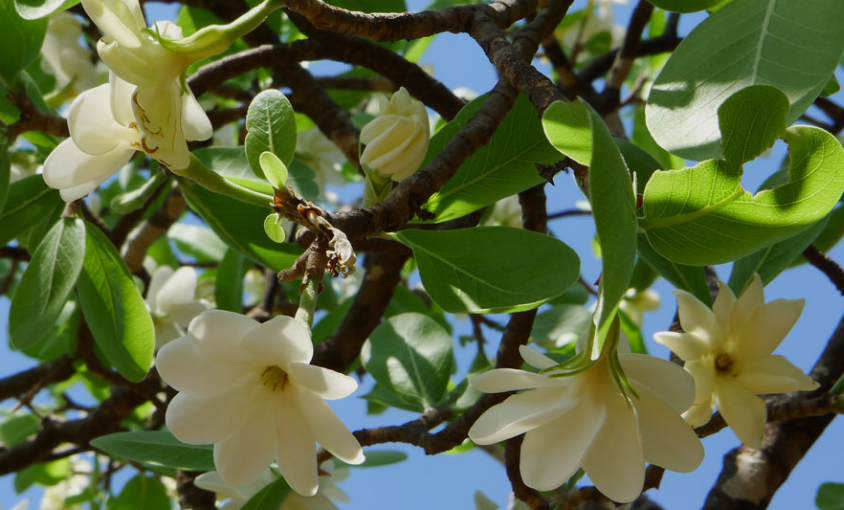
Gardenia grows as a rounded evergreen shrub with glossy, dark green leaves that run 2 to 4 inches long and about half as wide, arranged in opposite pairs along the stem. In the wild, plants range from about 1 foot to 10 feet tall, while garden cultivars typically settle between 3 and 8 feet, with a spread roughly equal to their height.
The flowers are what everyone remembers. They’re waxy, white, and intensely fragrant, and they can be single, with a simple ring of petals, or double, packed with layers like a small rose. As they age, the blooms fade from bright white to cream and finally to a yellowish tan. After flowering, some plants produce orange fruits that Clemson calls gardenia hips, which appear in fall and attract birds and other wildlife. Wax-like petals and that unmistakable sweet scent are the quickest ways to confirm you’re looking at a gardenia rather than a similar white-flowered shrub.
Native Range and Habitat
The common gardenia originated along stream banks in southern China and Japan, with its range extending through Taiwan and into Southeast Asia, including Vietnam, Myanmar, and India. That native habitat explains most of the plant’s care requirements: it evolved in warm, humid, acidic, organically rich soil beside moving water, not in the dry, alkaline, nutrient-poor ground that many American yards actually provide.
Hardiness is the other limit. Most older cultivars are cold hardy to USDA zone 8, though newer and more compact selections have been bred to survive in zone 7a. Beyond those zones, gardenias are usually grown in containers and moved indoors before freezing weather arrives, which is also how many northern gardeners enjoy them.
Uses in the Landscape
Gardenia works best where its fragrance can be appreciated, which is why Clemson recommends planting it near doorways, windows, patios, and walkways rather than tucked away at the back of a border. Smaller cultivars grow well in containers placed on a porch or deck, bringing the scent right to the seating area. Because the plant tolerates pruning well, a light trim right after the main bloom period keeps it dense and encourages fresh growth, though cutting too late in summer can remove next year’s flower buds.
Beyond fragrance, the plant offers year-round structure thanks to its glossy evergreen foliage, and it makes a dense, attractive hedge in climates where it thrives. The flowers are popular as cut blooms, floating in a bowl of water or tucked into corsages, and the fruit has a long history in China as a source of yellow dye. Dwarf selections such as the trailing form, hardy in zones 8 through 10 according to the University of Florida, work as groundcovers or cascading edging plants in warm climates.
Soil and pH: The Make-or-Break Factor
If one detail explains why gardenias have a reputation for being difficult, it’s soil pH. The University of Florida’s extension service states plainly that an acidic soil pH between 5.0 and 6.5 is required, or the foliage will yellow. Where soil pH climbs above 7.0, which is common in areas with limestone or crushed shell in the soil, UF recommends considering a different plant or growing the gardenia in a container filled with the right mix.
The yellowing itself is a nutrient problem. In soil that isn’t acidic enough, the plant can’t take up iron, and new leaves turn pale yellow while the veins stay green, a condition called chlorosis. Root damage from nematodes or disease can cause the same symptom. Testing your soil through a local extension office before planting costs very little and answers the most important question about whether a gardenia will thrive in your yard.
Light, Water, and Feeding
Gardenias grow in full sun or partial shade, and in hotter regions a spot with morning sun and afternoon shade usually produces the healthiest plants. Space them far enough apart for good air circulation, since crowded plants invite the pests and diseases that cause the most trouble.
Consistent moisture matters more than almost anything else. Gardenias dislike drying out completely, but they also resent soggy, poorly drained ground, so a loose, organically rich soil amended with compost or peat moss is ideal. For feeding, UF/IFAS suggests fertilizing 2 or 3 times a year, with one application in late winter or early spring and another in early fall, and Clemson notes that products containing iron can correct yellowed new growth when it appears during the growing season. Using a fertilizer formulated for acid-loving plants keeps the soil chemistry where gardenias want it.
The Bud Drop Problem
Few gardening frustrations compare to watching a gardenia form dozens of plump flower buds and then drop them just before they open. Clemson identifies several causes: low humidity, overwatering, underwatering, insufficient light, and high temperatures. Flower bud formation also depends on cooler nights, with temperatures between 50 and 55 degrees Fahrenheit necessary for buds to develop properly.
That temperature detail explains why container gardenias kept in a warm, dry house often bloom poorly through winter while the same plant outdoors in a mild fall sets buds heavily. Moving a potted plant to a cooler, bright, humid spot during bud formation, and keeping watering steady rather than erratic, solves the problem for most growers. Grouping containers together or setting them on a tray of damp pebbles raises humidity around the leaves, a simple fix that helps indoor plants hold their buds through the critical weeks before opening.
Pests and Diseases
Gardenias attract a long list of insects. The University of Florida names scales, aphids, spider mites, flower thrips, and whiteflies as the most damaging, with mealybugs close behind. Whiteflies and aphids leave behind sticky honeydew, which grows a black fungus called sooty mold across the leaves, leaving plants looking dirty even though the mold itself doesn’t directly attack the plant. Controlling the insects, usually with horticultural oil or insecticidal soap applied thoroughly to the undersides of the leaves, clears the mold over time.
In parts of Florida, root-knot nematodes pose a different threat, damaging roots below ground and producing the same chlorosis as high soil pH. Grafted gardenias resistant to nematodes are available for Central and South Florida, though they’re too cold tender for the northern part of the state. Hardier newer varieties also resist problems like sooty mold better than older selections, which is worth knowing when choosing a plant.
A Caution for Pets
North Carolina State’s plant database flags gardenia as a problem plant for cats, dogs, and horses, a detail worth knowing if animals share your yard or if you keep potted gardenias indoors. Keeping the plant out of reach of curious pets, and contacting a veterinarian if an animal chews on the leaves or fruit, is a sensible precaution.
The Bottom Line
Gardenia earns its reputation as a high-maintenance shrub, but most of the difficulty comes down to a short list of requirements: acidic soil, consistent moisture, good air circulation, cool nights for bud set, and a warm enough climate. Meet those, and a gardenia delivers one of the most memorable fragrances in the garden, from a plant that’s been admired for more than 1,000 years. Skip them, and the yellow leaves and dropped buds will tell you exactly which one you missed.