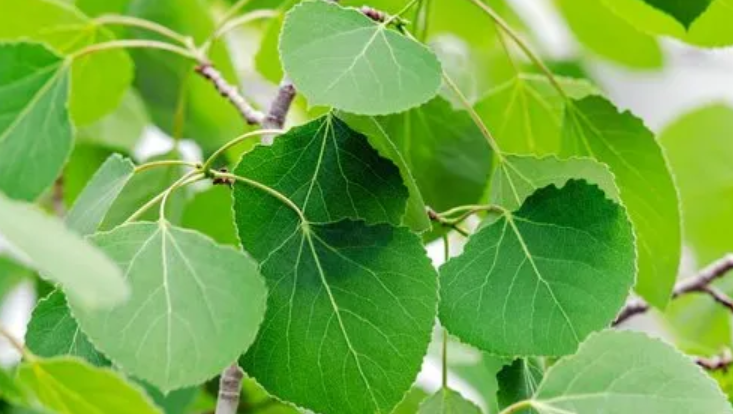
The Himalayan poplar tree is a towering, fast-growing hardwood native to the high mountain forests of South and Central Asia, valued for centuries across its native range for timber, fodder, and traditional medicine. Distinguished by its tall, straight trunk and wide, rounded crown, this cold-adapted tree thrives at elevations where few other broadleaf species can compete.
This article covers everything to know about the Himalayan poplar, from its botanical background to its identifying traits, growing needs, and landscape applications.
Botanical Classification
The Himalayan poplar belongs to the willow family, placing it alongside willows, cottonwoods, and other poplars within one of the most widespread plant families found across temperate and mountain climates. Within that family, it sits in the poplar genus, a group of roughly 25 to 35 recognized species distributed throughout the Northern Hemisphere. The Himalayan poplar is a deciduous broadleaf tree and, like nearly all its poplar relatives, is dioecious, meaning individual trees are either male or female, with only female trees producing the seed-bearing capsules the species relies on for natural reproduction.
The species carries a conservation status of least concern, reflecting its wide natural distribution across the Himalayan region, though local populations in parts of its range have faced pressure from human disturbance, including grazing, fuelwood collection, and land conversion.
Brief History
The Himalayan poplar has grown across the mountain forests of the Himalayan region for thousands of years, forming a natural component of mixed montane woodlands alongside oak, deodar cedar, and pine at elevations typically between 2,200 and 3,400 meters. Long before formal forestry programs existed, communities throughout Kashmir, Himachal Pradesh, Nepal, Bhutan, and neighboring regions relied on the tree for timber, fodder for livestock, and traditional medicinal preparations derived from its bark and buds.
Colonial-era foresters working in British India during the 19th century documented the species extensively, and Dietrich Brandis and other early forestry officials recognized its value for both timber production and slope stabilization in the steep, erosion-prone terrain characteristic of much of its range. This early scientific attention helped establish the Himalayan poplar as one of the better-studied native tree species of the region throughout the following century.
Over the 20th century, the Himalayan poplar became a focus of active forestry research across India, Pakistan, and neighboring countries, with numerous studies conducted on provenance variation, growth performance, and clonal seed orchard development aimed at improving the species for both commercial forestry and reforestation programs. Ongoing research into its ecological role, including its documented ability to establish itself as both a climax forest species and an early colonizer following disturbance, has continued to refine understanding of the tree’s adaptability across the varied ecological zones of the Himalayan foothills and mid-elevation slopes.
Identifying Characteristics
The Himalayan poplar is a large tree, typically growing with a tall, clean, straight trunk topped by a wide, rounded crown, reaching heights of up to 65 feet in cultivation, with taller specimens recorded in favorable native forest conditions. This straight-trunked growth habit has made the species particularly valued for timber compared to some of its more irregularly branched poplar relatives.
Bark on young trees is smooth and greenish-gray, gradually transitioning to a dark brown color marked with prominent vertical cracks as the tree matures, creating a rougher, more heavily textured appearance on older specimens. The leaves are broadly ovate to heart-shaped, typically 4 to 7 inches long, with finely serrated, hairy margins and a distinctive two-tone coloring, appearing dull green and smooth on the upper surface while the underside is greyish-green and covered in fine hairs along the veins.
Flowers appear as drooping, raceme-like catkins emerging before or alongside the leaves in spring, with male catkins reaching 2 to 4 inches long and female catkins considerably longer, sometimes extending to nearly a foot in length. Because the species is dioecious, only female trees produce the four-valved seed capsules that follow flowering, with each capsule enclosing an average of 100 to 150 tiny seeds covered in long, silky hairs that aid in wind dispersal across the steep mountain terrain the species favors.
Habitat and Distribution
The Himalayan poplar is native to a broad stretch of the Himalayan mountain range and surrounding regions, with documented populations across Pakistan, India, Nepal, Bhutan, Myanmar, and parts of western China, making it one of the more widely distributed native tree species across South and Central Asia’s high mountain zones. Within India specifically, the species is found across Jammu and Kashmir, Himachal Pradesh, Uttarakhand, Sikkim, and Arunachal Pradesh, reflecting its adaptation to the varied mid- to high-elevation ecosystems found along the length of the mountain range.
The species typically occurs in montane woodland settings between roughly 2,200 and 3,400 meters in elevation, growing in mixed forest alongside oak, deodar cedar, and pine, though it also demonstrates notable ecological flexibility, having been documented occurring as a climax forest species in some locations, as part of riparian communities alongside willows in others, and as a pioneering colonizer forming pure, stunted stands on disturbed or marginal sites elsewhere within its range.
This ecological versatility, confirmed through field surveys conducted in temperate regions like Kashmir, has helped the Himalayan poplar persist across a wide range of site conditions despite facing localized pressure from human disturbance, grazing, and fuelwood harvesting in parts of its native distribution.
USDA Hardiness Zone and Growing Needs
The Himalayan poplar is generally considered suitable for USDA hardiness zone 8 and similar cool temperate climates, reflecting its native adaptation to high-elevation mountain conditions with cold winters and moderate growing-season rainfall, though its documented cultivation history in cooler parts of Britain suggests some tolerance for a broader range of temperate conditions than the zone rating alone might suggest.
For those planting or managing the species, several growing considerations are especially important.
Full sun exposure is essential, since the species cannot tolerate shaded growing conditions and requires open, well-lit sites to develop properly. Soil preferences lean toward deep, rich, well-drained soils with a mildly acidic to mildly alkaline pH, though the species demonstrates reasonable adaptability across light sandy soils, medium loams, and heavier clay soils provided drainage is adequate.
Soil moisture needs are consistently high, with the species performing best in moist conditions and showing notably reduced growth on thin, dry sites or poor acidic soils. Site exposure matters considerably, since the species does not perform well in highly exposed upland locations despite its native origin in mountainous terrain, suggesting a preference for somewhat sheltered growing sites within that broader elevation range.
Growth rate is fast, consistent with the broader poplar genus, allowing the species to reach substantial size relatively quickly under favorable conditions. Spacing should account for the tree’s aggressive root system, with cultivation guidance recommending the species not be planted within roughly 40 feet of buildings, particularly on clay soils, since poplar roots are known to damage foundations by drawing moisture from surrounding soil.
Pollination requirements are a practical consideration for anyone hoping to collect seed, since the species is dioecious, not self-fertile, and male trees are notably scarce in some cultivated populations, meaning seed production depends on having both sexes present in reasonably close proximity.
Pest pressures documented in native forestry research include poplar shoot borer and various leaf-feeding insects, issues that have been the subject of ongoing pest management research across parts of its native range. Hybridization tendency is notable, since the species crosses freely with other members of the poplar genus, a trait that has been leveraged in regional breeding programs aimed at improving growth and disease resistance in cultivated poplar varieties.
Landscape Uses
Within its native range, the Himalayan poplar has long served multiple practical landscape and land-management functions, most notably as a source of fodder for livestock during lean seasons, a role that has made the species particularly valuable to mountain communities practicing traditional agropastoral land use.
The tree’s straight growth habit and substantial size have also made it a valued timber species, historically used in construction and general woodworking applications throughout its native range, while its extensive root system has supported its use in slope stabilization projects aimed at reducing erosion on the steep terrain characteristic of much of the Himalayan foothill region.
Regional forestry programs across India and Pakistan have incorporated the Himalayan poplar into clonal seed orchard development and plus-tree selection initiatives, reflecting sustained institutional interest in improving the species for both commercial forestry and broader reforestation objectives across degraded or disturbed mountain landscapes.
Outside its native range, the species has seen more limited ornamental cultivation, primarily in parts of Britain where its fast growth and tolerance for cool, moist conditions have made it an occasional choice for parkland and estate planting, though its aggressive root system and considerable mature size mean it is generally reserved for large properties rather than typical residential landscaping.
Fun Facts and Additional Notes
A single seed capsule of the Himalayan poplar can contain up to 150 individual seeds, each equipped with fine silky hairs that allow effective wind dispersal across the steep, often windy mountain terrain the species naturally inhabits.
The species has been documented growing in three distinct ecological roles within the same general region, functioning as a climax forest species in mature stands, as part of riparian plant communities alongside willows near streams, and as a pioneering colonizer forming pure, stunted stands on disturbed ground, a level of ecological flexibility not shared by all its poplar relatives.
Male trees of the Himalayan poplar are notably scarce in some cultivated populations outside its native range, an unusual imbalance that has occasionally complicated efforts to produce viable seed from ornamental plantings in places like Britain.
Historical forestry records from colonial-era India document extensive early scientific interest in the species, reflecting its long-recognized value for both timber and slope stabilization across the steep terrain of the Himalayan foothills.
The Himalayan poplar remains a defining tree of the high mountain forests across South and Central Asia, valued for its timber, its fodder value, and its important role in slope stabilization across some of the world’s most challenging terrain. For those within its suitable growing range considering the species, its fast growth and adaptability make it a compelling option, provided its considerable size, aggressive roots, and specific pollination requirements are planned for from the outset.