Japanese Stewartia: Classification, Characteristics, Uses, and Growing Guide
Japanese stewartia (Stewartia pseudocamellia) is a small to medium-sized deciduous tree prized for something relatively unusual in the landscape: four-season ornamental interest. In summer, it produces elegant white flowers with golden-orange centers. In autumn, its foliage can turn shades of red, orange, purple, and yellow. During winter, when many deciduous trees have little to offer, its smooth, exfoliating bark becomes the main attraction.
Native to Japan and South Korea, Japanese stewartia belongs to the tea family, Theaceae. Although it can become a substantial tree in favorable conditions, cultivated specimens are more commonly grown as small trees, often reaching roughly 15–25 feet tall. Virginia Tech, for example, describes a typical landscape specimen as approximately 20 feet tall and 8 feet wide.
Its relatively slow growth and somewhat demanding establishment make it less common than dogwoods, maples, or crabapples. However, for gardeners willing to give it the right conditions, Japanese stewartia can become one of the most distinctive ornamental trees in the garden.
Botanical Classification of Japanese Stewartia
The accepted scientific name is Stewartia pseudocamellia Maxim.
Its classification is:
- Kingdom: Plantae
- Order: Ericales
- Family: Theaceae
- Genus: Stewartia
- Species: Stewartia pseudocamellia
Plants of the World Online recognizes Stewartia pseudocamellia as an accepted species and gives its native range as South Korea and central and southern Japan.
Theaceae is commonly known as the tea family, the same family that contains Camellia and the tea plant (Camellia sinensis). This relationship becomes particularly obvious when Japanese stewartia is in bloom because its flowers have a distinctly camellia-like appearance.
The genus name Stewartia honors John Stuart, a Scottish botanist and patron of botany. The spelling “Stewartia” arose from a historical transcription error and eventually became the accepted spelling.
The species name pseudocamellia means essentially “false camellia,” referring to the resemblance between its flowers and those of camellias.
History and Native Range
Japanese stewartia is naturally distributed across parts of Japan and South Korea, where it occurs in temperate forest environments. Kew lists the species as a tree of the temperate biome.
The tree has an interesting history in horticulture. As Japan became more accessible to Western plant collectors during the 19th century, Japanese plants began entering European and North American gardens.
Historical records from the Arnold Arboretum indicate that Thomas Hogg Jr. sent Japanese stewartia to New York around 1866 after spending several years in Japan.
The species subsequently attracted attention because it combined unusual hardiness with ornamental bark, attractive autumn foliage, and showy flowers.
The Arnold Arboretum has also played an important role in studying the species. Two notable Japanese stewartias there originated from seeds collected by plant explorer Ernest Henry Wilson in 1917, although those particular plants came from South Korea. They eventually reached approximately 32 feet and 27 feet tall, demonstrating that the species can become considerably larger than the typical garden specimen.
Interestingly, Korean populations were historically classified separately as Stewartia koreana. Modern taxonomic treatment generally places them within S. pseudocamellia, although Korean-origin plants are known to be somewhat hardier in cultivation.
Size and Growth Habit
Japanese stewartia is generally a slow-growing, deciduous small tree.
In landscapes, a mature specimen commonly reaches around 15–25 feet, although larger trees are possible under excellent conditions. Virginia Tech lists approximately 20 feet in height and 8 feet in spread as a representative landscape size.
The tree typically develops an upright, oval, pyramidal, or vase-shaped crown. It can grow with a single trunk, but multiple trunks and low branching are also common.
The growth rate is relatively slow. This is one reason Japanese stewartia is not usually chosen when a gardener needs a large shade tree quickly.
Its slower development, however, can be an advantage in smaller landscapes because the tree is less likely to overwhelm its surroundings rapidly.
How to Identify Japanese Stewartia
Japanese stewartia has several characteristics that make identification relatively straightforward once the tree is familiar.
Leaves
The leaves are simple and alternate, rather than compound. They are generally elliptical to obovate and have finely serrated margins.
Leaves are commonly around 2–4 inches long, although measurements vary with growing conditions and plant age. Virginia Tech describes the foliage as approximately 2 inches long.
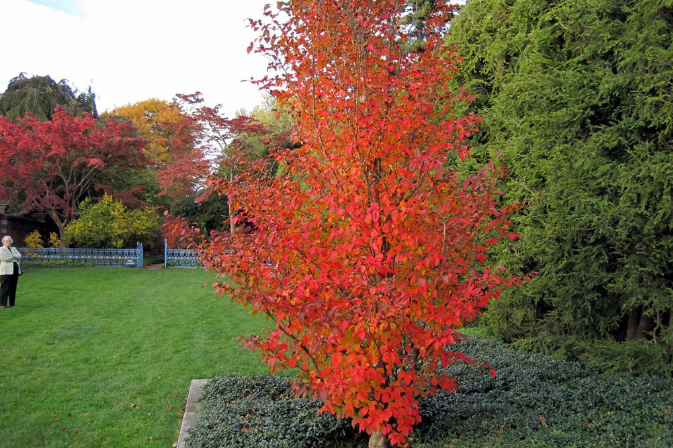
During summer, the foliage is typically deep or medium green. In autumn, however, it can become spectacular.
Depending on the tree and climate, leaves may turn yellow, orange, red, purple, or burgundy. The Morton Arboretum and other horticultural references particularly value the species for this combination of summer foliage and strong autumn color.
Flowers
The flowers are among the tree’s most recognizable features.
Japanese stewartia produces white, camellia-like flowers with golden-yellow to orange stamens. Individual blooms can reach approximately 2–3 inches across, although some cultivated selections produce larger flowers.
Flowering generally begins in early or midsummer, often around June in temperate climates. Individual flowers are relatively short-lived, but new flowers open successively over a period of several weeks.
This succession is important because it means the tree does not necessarily have one brief flowering event. Instead, it can maintain an attractive display for an extended portion of the summer.
The white petals surrounding the orange-yellow stamens create a strong contrast against the dark green foliage.
Fruit
After flowering, Japanese stewartia produces small brown, pointed capsules.
The fruits are typically four- or five-angled and can persist into autumn. They are considerably less ornamental than the flowers or bark, but they can assist with identification.
Bark
The bark may ultimately be the most remarkable characteristic of the tree.
As Japanese stewartia matures, the outer bark begins to exfoliate, revealing patches of different colors beneath. Depending on the individual specimen, these colors can include gray, cream, tan, orange, copper, and reddish-brown.
The result resembles a natural patchwork pattern.
The Arnold Arboretum describes mature Japanese stewartia bark as exfoliating in smooth patches that reveal contrasting gray and copper tones.
Virginia Tech similarly notes that mature bark develops a patchwork of brown, orange-brown, and cream.
Because the leaves disappear during winter, the bark becomes particularly valuable at this time of year.
Why Japanese Stewartia Has Four-Season Interest
Many ornamental trees have one outstanding season. Japanese stewartia is different because several features take turns throughout the year.
Spring: New foliage emerges and the tree develops its fresh green canopy.
Summer: White, camellia-like flowers appear against the green foliage.
Autumn: The leaves can become brilliant shades of red, orange, purple, burgundy, and yellow.
Winter: The exfoliating, multicolored bark becomes the dominant feature.
This progression explains why the species is frequently described as a four-season tree. The Arnold Arboretum specifically highlights the combination of summer flowers, colorful bark, and year-round ornamental value.
Landscape Uses
Japanese stewartia is particularly effective when planted where people can observe it throughout the year.
Specimen Tree
Its best use is often as a specimen tree.
A single tree placed in a lawn, courtyard, or prominent garden location can showcase its flowers, fall foliage, and bark.
Because it grows relatively slowly and remains modest in size compared with large shade trees, it can work particularly well in residential landscapes.
Small Garden
Japanese stewartia can be useful where a gardener wants a genuine tree rather than a large shrub but does not have room for an enormous canopy.
Its eventual size still needs to be considered, but it is considerably more manageable than many mature oaks, maples, and other large shade trees.
Woodland Garden
Its natural woodland associations make Japanese stewartia a strong candidate for woodland-style gardens.
It can be combined with ferns, shade-tolerant perennials, woodland shrubs, and other plants that prefer rich, moisture-retentive but well-drained soil.
Lawn Planting
A tree grown in a lawn can be particularly attractive because the surrounding open space allows its branching pattern and bark to be viewed from a distance.
Near a Patio or Walkway
Because the flowers are attractive and the tree remains relatively compact, it can also be planted near an outdoor sitting area or walkway.
However, the site should be large enough to accommodate the mature root system and crown.
Growing Considerations
Japanese stewartia is beautiful but somewhat particular about its growing conditions.
Sunlight
The tree grows best in full sun to partial shade.
In regions with hot summers, some protection from intense afternoon sunlight can be beneficial. North Carolina State Extension recommends light afternoon shade in very hot, humid climates.
In cooler climates, more sunlight can generally be tolerated.
A location receiving approximately 4–6 hours or more of sunlight while avoiding extreme afternoon heat is often a useful compromise.
Soil
Soil quality is one of the most important considerations.
Japanese stewartia prefers moist, fertile, organically rich, well-drained soil.
It does not perform well in extremely dry, rocky, or poorly drained ground.
Adding organic matter before planting can improve soil structure and help provide the consistent moisture the tree needs.
Moisture
Although Japanese stewartia does not want waterlogged roots, it should not be allowed to experience prolonged drought.
North Carolina State Extension describes the species as drought intolerant.
This is particularly important during the first few years after planting. A deep layer of organic mulch can help moderate soil temperature and reduce moisture loss.
Mulch should be kept slightly away from the trunk rather than piled directly against it.
Hardiness
Japanese stewartia is generally considered suitable for approximately USDA Zones 5–8, with some sources extending its range toward Zone 9 under appropriate conditions.
The Dawes Arboretum lists it as hardy to Zone 5, while other horticultural databases similarly place it among the cold-hardy stewartias.
Korean-origin plants may offer somewhat greater cold tolerance than some Japanese-origin material. Research summarized by the Arnold Arboretum indicates that Korean stewartias diverged from Japanese relatives roughly 10 million years ago and that Korean-origin plants are somewhat hardier.
Watering
Newly planted trees should be watered consistently, especially during periods of hot or dry weather.
Once established, Japanese stewartia can require less supplemental irrigation, but it still benefits from evenly moist soil.
The goal is not constantly wet soil; it is consistent moisture combined with good drainage.
Pruning
Japanese stewartia generally requires little corrective pruning.
Young trees can be selectively pruned to develop a desirable trunk structure, particularly if a single-trunk tree is preferred.
Remove dead, damaged, crossing, or poorly positioned branches as necessary. Heavy pruning is usually unnecessary and can detract from the tree’s naturally attractive form.
Transplanting and Establishment
One of the biggest drawbacks of Japanese stewartia is that it can be difficult to establish after transplanting.
The University of Connecticut notes that it does not establish easily, while North Carolina State Extension describes it as slow-growing and potentially difficult to transplant.
For this reason, purchasing a relatively young, healthy tree and planting it carefully in its permanent location can be preferable to moving an older specimen.
Once planted, avoid unnecessary disturbance around the root zone.
Pests and Diseases
Japanese stewartia is not generally regarded as a tree plagued by major pest or disease problems. Its larger challenges are usually environmental rather than pest-related.
Drought, excessive heat, poor drainage, and transplant stress can cause more trouble than routine insect infestations.
Good soil preparation, adequate moisture, appropriate sunlight, and protection from harsh conditions are therefore central to successful cultivation.
Is Japanese Stewartia a Good Landscape Tree?
Japanese stewartia is an excellent choice for gardeners who value beauty across multiple seasons rather than rapid growth.
Its typical landscape height of around 20 feet, elegant summer flowers, colorful autumn foliage, and distinctive exfoliating bark make it particularly useful as a specimen tree.
The principal drawback is patience. This is not a tree that should be planted with the expectation of rapid growth. It also needs consistent moisture, good drainage, organically rich soil, and protection from extreme heat or drought.
But those requirements are rewarded with an unusually sophisticated ornamental display.
Few small deciduous trees can offer white camellia-like flowers in summer, brilliant foliage in autumn, and multicolored bark in winter. That combination is what makes Stewartia pseudocamellia such a prized landscape tree.
For a gardener with the right site and a willingness to wait for the tree to mature, Japanese stewartia can become a permanent focal point—one that changes character with virtually every season.