Chinese Fringe Tree: Classification, Characteristics, Uses, and Growing Guide
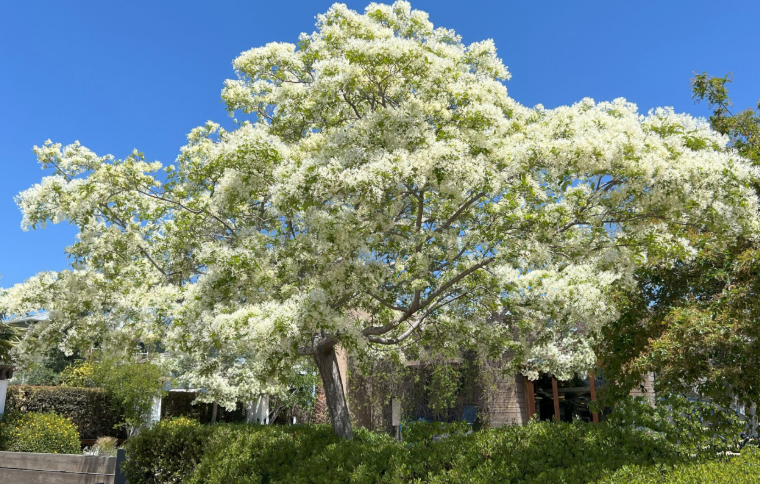
The Chinese fringe tree (Chionanthus retusus) is a small deciduous tree or large shrub prized for its spectacular display of fragrant white flowers. When the tree reaches peak bloom, the flowers can almost obscure the foliage, creating the impression of a cloud of snow hanging among the branches. Its attractive gray-brown bark, dark green leaves, bluish-black fruits, and occasional yellow fall color give it interest beyond the flowering season.
Native to China, Korea, Japan, and Taiwan, Chinese fringe tree belongs to the olive family, Oleaceae. It has become a valued ornamental plant in North America and other temperate regions because it combines a relatively manageable size with exceptional spring-to-early-summer flowering.
Botanical Classification of Chinese Fringe Tree
The scientific name of Chinese fringe tree is Chionanthus retusus Lindl. & Paxton. The species was formally published in 1852, according to the Royal Botanic Gardens, Kew.
Its botanical classification is:
- Kingdom: Plantae
- Order: Lamiales
- Family: Oleaceae
- Genus: Chionanthus
- Species: Chionanthus retusus
The family Oleaceae is the same plant family that includes familiar plants such as olive, ash, forsythia, jasmine, privet, and lilac.
The genus name Chionanthus comes from Greek words meaning “snow flower,” a reference to the masses of white flowers produced by fringe trees. The name is particularly appropriate when a mature tree is in full bloom.
The species name retusus refers to the characteristic shape of the leaf tip, which can appear rounded or shallowly notched.
History and Native Range
Chinese fringe tree has a broad distribution in eastern Asia. Kew lists its native range as central and southern China, Taiwan, South Korea, and Japan, including Honshu and the Tsushima Islands.
In the wild, the species can occur in mixed forests, thickets, and along riversides. In China, it has been recorded from elevations reaching approximately 3,000 meters (9,840 feet), demonstrating the considerable geographic range of the species.
The tree has a particularly interesting horticultural history outside Asia. According to the Arnold Arboretum, Chinese fringe tree reached Europe during the mid-19th century, with Robert Fortune collecting material from a garden in Fuzhou, China. The species subsequently entered wider cultivation through additional introductions.
It reached North American cultivation by at least 1901, although it remained relatively uncommon for many decades.
Today, it is increasingly appreciated as an ornamental tree, especially in gardens where its spring flowering can be displayed prominently.
Size and Growth Habit
Chinese fringe tree is often grown as a large shrub or small ornamental tree. Missouri Botanical Garden gives a typical cultivated size of about 10–20 feet tall and wide, although plants trained as trees can eventually reach 30–40 feet under favorable conditions.
Other horticultural references commonly place mature plants around 15–25 feet, particularly in garden settings.
The difference in reported size reflects the tree’s considerable variation in growth habit. Some specimens naturally develop multiple stems and remain shrub-like, while others form a more obvious trunk and become small trees.
Its crown is generally rounded and broadly spreading.
The species is also considered slow-growing, which is important when deciding where to plant it. A young Chinese fringe tree may take several years to develop the impressive structure seen in mature specimens.
How to Identify Chinese Fringe Tree
Several characteristics can help distinguish Chinese fringe tree from other ornamental trees.
Leaves
Chinese fringe tree has simple, opposite leaves, unlike trees with compound foliage. The leaves are generally oval, elliptic, or obovate and have a thick, somewhat leathery texture.
They commonly measure about 3–8 inches long. Their upper surfaces are glossy or lustrous green, while the undersides are paler.
Leaf margins can vary. Some leaves have smooth edges, while others—particularly on younger plants—may show serration. This variability can make leaf identification alone somewhat unreliable.
The tree may develop yellowish fall color, although the quality of autumn color depends strongly on climate. In some warm regions, the leaves can remain green late into the year.
Flowers
The flowers are the defining feature of Chinese fringe tree.
They are pure white, fragrant, and composed of narrow, strap-like petals. Individual flowers have four slender petal lobes and are produced in clusters at the ends of branches.
Flower clusters are generally around 3–4 inches long, although individual plants can produce considerably larger-looking displays because numerous clusters occur throughout the crown.
When the tree is in full bloom, the white flowers can nearly hide the foliage. This is the feature responsible for the plant’s reputation as one of the more spectacular small flowering trees.
Flowering generally occurs in late spring or early summer, although timing varies considerably with climate. In warmer areas, flowering may begin much earlier.
Fruit
After flowering, female or fruit-producing plants may develop small, olive-like fruits.
The fruits are bluish-black drupes, generally about ½ inch long, and ripen toward late summer or fall.
These fruits are attractive to birds and add another seasonal feature to the tree.
However, not every Chinese fringe tree produces fruit.
Male and Female Plants
Chinese fringe tree has an unusual reproductive characteristic. Plants can have functionally male flowers or hermaphroditic flowers, and horticultural sources sometimes describe the species in terms of separate male and female plants.
For gardeners, the practical point is simple: some trees produce attractive blue-black fruits while others may not.
Nursery plants are also not always sold with their reproductive characteristics clearly identified. Therefore, someone specifically interested in fruiting should not automatically assume that every Chinese fringe tree will produce berries.
The fruits can nevertheless provide food for birds and small wildlife.
Bark and Winter Interest
Chinese fringe tree is not solely a spring-flowering plant.
Young trees can have pale buff or gray-brown bark that peels in papery strips. As trees mature, the bark becomes tighter and develops more noticeable ridges and furrows.
The bark gives the tree additional visual interest after the leaves have fallen.
Because the plant can have multiple trunks, mature specimens can also develop an attractive sculptural appearance, particularly when planted where the branching structure can be viewed from several angles.
Landscape Uses
Chinese fringe tree works particularly well in residential landscapes because of its moderate size and strong ornamental qualities.
Specimen Tree
Its most obvious use is as a specimen tree.
Planting one in an open lawn or garden allows the white flowers to become the central attraction in late spring. A specimen can also be positioned where the fragrance can be enjoyed from a patio, walkway, or window.
Shrub Border
Because the species naturally develops as a large shrub in many situations, it can be incorporated into a mixed shrub border.
Its white flowers contrast well with plants that bloom in pink, purple, blue, or red.
Woodland Garden
Chinese fringe tree is also useful in naturalistic or woodland-style landscapes. Its ability to grow in full sun to partial shade makes it more versatile than many flowering trees.
Group Planting
Several plants can be grouped to create a stronger flowering display. However, sufficient room should be allowed for mature plants to spread.
Urban Landscapes
The species has demonstrated tolerance of air pollution and can adapt to urban settings.
This makes it useful for some city gardens, provided soil moisture and rooting conditions are suitable.
Growing Considerations
Sunlight
Chinese fringe tree grows in full sun to partial shade.
For the best flowering, full sun is generally preferable. Missouri Botanical Garden specifically notes that maximum flowering occurs in full sun.
A site receiving around 6 hours or more of direct sunlight is a useful target when the primary goal is abundant flowering.
Partial shade can still produce a healthy tree, but flowering may be less impressive.
Soil
The tree prefers deep, moist, fertile, well-drained soil, particularly soils that are somewhat acidic.
It is reasonably adaptable, but persistently dry soil is a weakness.
Good drainage is important because the plant prefers moisture without remaining in saturated ground.
Water
Chinese fringe tree is more moisture-sensitive than some drought-tolerant ornamental trees.
Established plants can tolerate periods of moderate dryness according to the Arnold Arboretum, but prolonged drought can cause stress. Missouri Botanical Garden specifically describes the species as intolerant of prolonged dry conditions.
Young trees should therefore receive regular watering during dry periods, particularly while their root systems are becoming established.
Hardiness
Chinese fringe tree is commonly recommended for approximately USDA Zones 5–9, although some references place its reliable hardiness closer to Zone 6 and warmer parts of Zone 5.
Its broad geographic adaptability is notable. Arnold Arboretum specimens have grown successfully in climates corresponding roughly to Zone 5 in New England and Zone 9 in southern California.
Nevertheless, local winter temperatures, summer heat, soil moisture, and exposure can all influence performance.
Pruning
One of the advantages of Chinese fringe tree is that it generally requires little pruning once established.
Pruning is mainly useful for removing dead, damaged, or crossing branches and for shaping young plants.
Gardeners who want a tree form can gradually remove selected lower branches while the plant is young. Those who prefer its natural shrub-like appearance can allow multiple stems to develop.
Pests and Diseases
Chinese fringe tree is generally considered a relatively trouble-free ornamental.
Missouri Botanical Garden reports no serious insect or disease problems, although mites, scale, and borers can occasionally affect plants. Potential diseases include leaf spots, canker, and powdery mildew.
Healthy plants growing in suitable soil and receiving adequate moisture are usually less likely to experience serious problems.
Transplanting and Establishment
One consideration that is sometimes overlooked is transplanting.
The Morton Arboretum describes Chinese fringe tree as a tree that does not transplant particularly well, while the University of Connecticut also lists it as potentially difficult to transplant.
This makes choosing the planting location carefully especially important.
Rather than planting it temporarily with the intention of moving it later, it is better to select a permanent location with adequate room for the mature crown.
Chinese Fringe Tree vs. American Fringe Tree
Chinese fringe tree is closely related to the native North American American fringe tree (Chionanthus virginicus), and the two are frequently confused.
Chinese fringe tree generally has broader, thicker, more leathery leaves and often develops a somewhat different growth habit. Its flowers are produced in terminal clusters and can create an exceptionally dense white display.
Chinese fringe tree also tends to flower somewhat earlier than American fringe tree in many cultivation settings, although flowering dates vary by climate.
Both species, however, are excellent ornamental trees when planted under suitable conditions.
Is Chinese Fringe Tree a Good Choice for the Landscape?
Chinese fringe tree is an excellent choice for gardeners looking for a small flowering tree with multiple seasons of interest.
Its relatively modest typical garden dimensions—often around 10–25 feet, depending on growing conditions and whether it is cultivated as a shrub or tree—make it suitable for many residential landscapes.
The main attraction is undoubtedly its fragrant white flowers, but the tree offers considerably more: glossy foliage, occasional yellow fall color, bluish-black fruits, textured bark, and an attractive branching structure.
Its slow growth means patience is required, and its preference for consistent moisture makes site selection important. Still, once established in a suitable location, Chinese fringe tree is relatively low-maintenance.
For gardeners who want a spring flowering display that looks more like falling snow than a conventional mass of blossoms, Chionanthus retusus is difficult to overlook. Its combination of fragrance, unusual flowers, ornamental bark, wildlife value, and manageable size makes it one of the more distinctive small trees for temperate gardens.