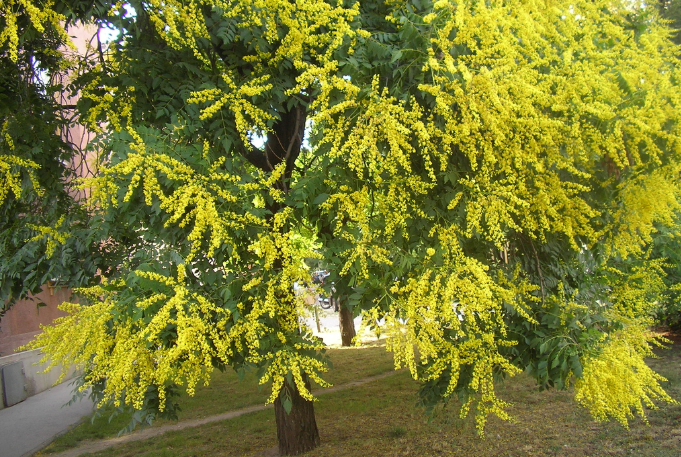
Golden Rain Tree: Classification, Characteristics, Uses, and Growing Guide
The golden rain tree (Koelreuteria paniculata) is a deciduous ornamental tree valued for its clouds of yellow summer flowers, attractive compound foliage, papery seed capsules, and relatively adaptable nature. Unlike many flowering trees that put on their main display in spring, golden rain tree often saves its most noticeable show for early to mid-summer, when its bright flowers stand out against the green canopy.
Native to parts of eastern Asia, particularly China and Korea, the species has become a popular landscape tree in many temperate regions. It generally reaches about 30–40 feet in height and width, making it large enough to provide shade without becoming one of the enormous canopy trees commonly planted in parks and estates.
Botanical Classification of Golden Rain Tree
Golden rain tree belongs to the soapberry family, Sapindaceae, a diverse plant family that also includes maples (Acer), horse chestnuts (Aesculus), and several other woody plants.
Its botanical classification is:
- Kingdom: Plantae
- Clade: Angiosperms
- Clade: Eudicots
- Order: Sapindales
- Family: Sapindaceae
- Genus: Koelreuteria
- Species: Koelreuteria paniculata
The genus name Koelreuteria honors Joseph Gottlieb Koelreuter (1733–1806), a German botanist and pioneer in experimental studies of plant hybridization. The specific name paniculata refers to the tree’s flowers being arranged in panicles, or branched clusters.
The tree is also known by several common names, including golden raintree, golden rain tree, and pride-of-India in some horticultural references.
History and Natural Range
Golden rain tree originated in eastern Asia, with China being particularly important to its natural distribution. It is one of the ornamental trees associated with the extraordinarily diverse Chinese flora. The Missouri Botanical Garden notes that China has roughly 31,500 species of vascular plants, representing about 8% of the world’s estimated total.
The species attracted attention outside its native range because of its combination of attractive flowers, unusual fruits, manageable size, and ability to tolerate challenging urban conditions.
Today, golden rain tree is cultivated as an ornamental tree in numerous parts of North America and elsewhere. In suitable climates it can be used along streets, in lawns, gardens, patios, and other designed landscapes.
However, its adaptability has also created concerns in some regions. For example, the Missouri Botanical Garden lists Koelreuteria paniculata among invasive species in the St. Louis region. This means gardeners should check local invasive-plant guidance before planting it, particularly where naturalization is a concern.
What Does a Golden Rain Tree Look Like?
Golden rain tree has an open, rounded to irregular crown and relatively airy branching structure. It does not usually create the dense, heavy canopy associated with large shade trees such as mature oaks.
A typical mature tree is approximately 30–40 feet tall with a similar spread, although size varies according to climate, soil, cultivar, and growing conditions.
Leaves
One of the easiest ways to identify golden rain tree is by examining its foliage.
The leaves are pinnately or bipinnately compound, giving them a somewhat feathery appearance. Individual leaves can reach approximately 18 inches long and may contain 7–17 irregularly lobed leaflets.
New leaves can emerge with pinkish, bronze, or purplish tones before becoming bright green during summer. In autumn, the foliage may turn yellow, although fall color can be inconsistent from one tree or location to another.
This changing foliage gives the tree several seasonal points of interest rather than making it dependent entirely on its flowers.
Flowers
The flowers are perhaps the tree’s most famous feature.
Golden rain tree produces numerous bright yellow flowers in branched terminal clusters called panicles. Individual flowers are relatively small—around ½ inch across—but they occur in large clusters that can measure approximately 12–15 inches long.
When the tree is in full bloom, these yellow panicles can appear to cover portions of the canopy. Fallen flowers may accumulate beneath the tree, creating the visual effect that inspired the common name “golden rain tree.”
Flowering generally occurs in early summer, although timing can vary with climate. Some cultivars flower later; for example, the cultivar ‘September’ can bloom during August and September.
Seed Capsules
After flowering, golden rain tree develops another distinctive feature: papery, lantern-like seed capsules.
These capsules are initially greenish but mature toward yellow-brown or brown shades. Their unusual three-sided appearance can make the tree recognizable even after its flowers have disappeared.
The capsules may persist on the branches and provide additional ornamental interest into the later part of the growing season.
Why Is It Called a “Golden Rain” Tree?
The common name describes the tree’s appearance when it is flowering.
The long clusters of yellow flowers hang among the branches, and as individual flowers drop from the canopy, they can scatter across the ground underneath. The combination of yellow blossoms in the tree and fallen petals below creates the impression of a golden shower or rain.
The name is therefore primarily descriptive rather than botanical.
Landscape Uses
Golden rain tree is particularly useful where a gardener wants an ornamental tree that provides several different features throughout the year.
Specimen Tree
One of its best uses is as a specimen tree in a lawn or open garden. Its relatively open crown allows the branching structure and flowers to remain visible.
Placing it where there is plenty of surrounding space can make the flowering display more noticeable.
Street Tree
Golden rain tree can also be used as a street tree. Its tolerance of urban conditions and relatively moderate size make it useful in settings where an extremely large tree would be unsuitable. Missouri Botanical Garden specifically lists it as a potential street tree.
Nevertheless, local conditions should be considered before planting it along streets because soil compaction, restricted rooting space, overhead utilities, and local invasive-plant regulations can affect suitability.
Small Shade Tree
Although it is not a giant shade tree, a mature golden rain tree can provide useful filtered shade. Its open canopy produces a lighter shade pattern than many dense-canopied species.
It can therefore work well in larger residential gardens, lawns, terraces, and other spaces where moderate shade is desirable.
Patio and Garden Accent
The tree’s flowers and unusual seed capsules make it an effective focal point near patios and outdoor living areas, provided adequate space is available for its mature size.
Its seasonal changes can also complement gardens containing flowering shrubs and perennial plants.
Growing Requirements
Golden rain tree is generally considered relatively easy to grow when planted in an appropriate location.
Sunlight
For the strongest flowering and healthy development, plant golden rain tree in full sun. A location receiving approximately 6 or more hours of direct sunlight per day is generally preferable.
More sunlight usually means better flowering and a stronger, more balanced crown.
Soil
The species adapts to a relatively broad range of soils. It performs best in well-drained soil, but established trees can tolerate less-than-ideal conditions better than many ornamental species.
Missouri Botanical Garden notes that it can tolerate clay soil and a range of dry to medium moisture conditions.
The most important consideration is avoiding persistently waterlogged ground. Poor drainage can increase the likelihood of root problems.
Water
Young trees need consistent moisture while establishing their root systems. Once established, golden rain tree has useful drought tolerance, making it an option for landscapes where supplemental watering is limited.
That does not mean a newly planted tree should be neglected during dry weather. Deep watering during establishment helps encourage a stronger root system.
Hardiness
Golden rain tree is commonly grown in approximately USDA Zones 5–9, although exact performance depends on the cultivar and local conditions.
Gardeners in colder areas should pay particular attention to cultivar selection and winter exposure.
Pruning
Golden rain tree generally requires relatively little pruning once properly established. The main objective is to develop a strong structure and remove branches that are dead, damaged, crossing, or poorly positioned.
Young trees benefit from formative pruning rather than repeated heavy cutting. Because the species naturally develops an open and somewhat irregular crown, trying to force it into an unnaturally formal shape may create unnecessary maintenance.
Pests and Diseases
One advantage of golden rain tree is its generally good resistance to serious pest and disease problems. Missouri Botanical Garden reports no serious insect or disease problems as a general characteristic of the species.
Nevertheless, problems can occur. Potential issues include root rot, leaf spot, and canker. The risk of root-related problems is particularly relevant when the tree is planted in poorly drained soil.
Good site selection, adequate drainage, appropriate watering, and sensible pruning are therefore more important than attempting to maintain the tree through intensive routine treatments.
Golden Rain Tree and Its Seeds
One characteristic that deserves consideration before planting is its ability to produce abundant seeds.
The attractive papery capsules contain seeds that can fall around the parent tree. In regions where golden rain tree has demonstrated invasive tendencies, these seeds can contribute to unwanted naturalization. Missouri Botanical Garden specifically identifies the species as invasive in the St. Louis region.
For this reason, gardeners should not assume that a tree considered well behaved in one region will behave identically everywhere.
Checking state, county, or regional invasive-species recommendations before planting is particularly important.
Advantages and Disadvantages
Golden rain tree offers a combination of qualities that explains its popularity.
Advantages include:
- Attractive yellow summer flowers
- Interesting papery seed capsules
- Distinctive compound foliage
- Moderate mature size
- Useful shade
- Good drought tolerance once established
- Adaptability to several soil types
- Tolerance of many urban conditions
- Generally low maintenance
Potential disadvantages include:
- Seed production can be abundant
- Fall color can be inconsistent
- The crown can become irregular
- Poor drainage can contribute to root problems
- It may be invasive in certain regions
The Missouri Botanical Garden rates the species as suitable for uses ranging from shade and street trees to flowering-tree applications and notes its tolerance of drought, clay soil, and urban conditions.
Is Golden Rain Tree a Good Tree for a Home Garden?
For the right location, golden rain tree can be an excellent ornamental tree. Its approximately 30–40-foot mature dimensions, bright summer flowers, unusual fruit capsules, and relatively modest maintenance requirements give it considerable landscape value.
It is especially appealing to gardeners who want something different from the more familiar flowering trees that bloom in spring.
The biggest question is not simply whether the tree grows well in a particular climate. It is whether golden rain tree is an appropriate species for the local ecosystem. Because it is considered invasive in some areas, local regulations and recommendations should be checked before planting.
When planted where it is appropriate, given plenty of sunlight, and grown in reasonably well-drained soil, Koelreuteria paniculata can become a striking multi-season landscape tree. Its golden flowers provide the main summer spectacle, while its feathery foliage and lantern-like seed capsules extend its ornamental interest beyond the flowering period.