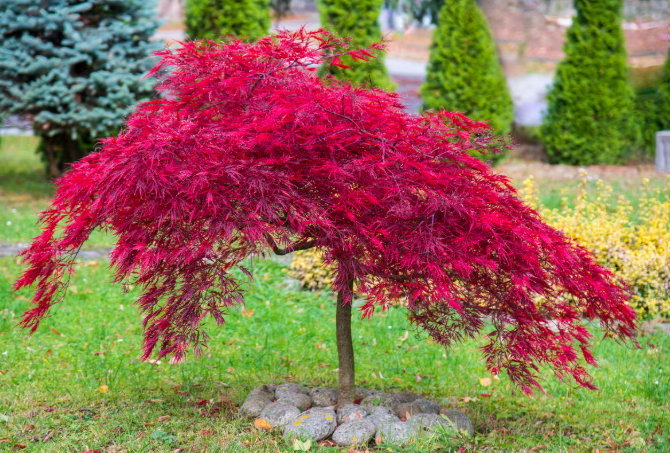
Small trees for landscaping near the house solve a problem that full-sized shade trees create the moment they’re planted too close to a foundation: aggressive roots, canopy overreach, and eventual conflicts with gutters, siding, and utility lines. A tree that tops out at 15 to 25 feet, by contrast, can be planted within a reasonable distance of a home without becoming a structural liability a decade later.
Root aggressiveness matters just as much as mature height when choosing a tree for close-in planting. Several species on this list were selected specifically because their root systems stay comparatively shallow and non-invasive, reducing the risk of foundation or pipe damage that taller, faster-growing trees are known for.
This list groups trees loosely by what they contribute to a home landscape — flowering specimens for spring and summer color, trees with strong fall foliage, and evergreen options that hold structure through winter — so it functions as a planning tool rather than a random catalog of species.
Hardiness and mature size below reflect typical performance across USDA zones 4 through 9 in the continental United States, with regional notes flagged wherever climate meaningfully affects a tree’s suitability for planting close to a house.
Small Trees for Landscaping Near the House
Japanese Maple
Japanese maple typically reaches 15 to 20 feet, with finely dissected foliage that shifts from red or green in spring to brilliant orange and crimson by fall. Its modest, non-invasive root system makes it one of the safest choices for planting within 10 feet of a foundation.
It prefers some afternoon shade in hotter climates, where full, unrelenting sun can scorch its delicate leaves. Its slow growth rate means a young tree takes a decade or more to reach full size, which suits gardeners planning a long-term, low-maintenance planting.
Crape Myrtle
Crape myrtle grows 15 to 25 feet depending on cultivar, producing dense clusters of pink, red, white, or purple flowers that bloom continuously from early summer through fall. Few small trees in the South deliver this many weeks of uninterrupted color.
Its smooth, mottled bark adds winter interest once the leaves drop, peeling in patches of gray, tan, and cinnamon. It thrives in the heat and humidity of southern states but struggles in colder zones below 6, where dieback is common after harsh winters.
Flowering Dogwood
Flowering dogwood reaches 15 to 25 feet, covered in spring with white or pink bracts that open before the leaves fully emerge. It’s one of the most widely planted native ornamental trees in the eastern United States.
Red berries follow the spring bloom, persisting into fall and providing a reliable food source for birds. It performs best with some afternoon shade and consistently moist, well-drained soil, and can develop stress-related disease if planted in full, reflected heat near a south-facing wall.
Eastern Redbud
Eastern redbud grows 20 to 25 feet, producing a dense cover of small pink or purple pea-like flowers directly along bare branches in early spring. The effect is striking against a still-dormant garden before most other trees have leafed out.
Heart-shaped leaves emerge after the flowers fade, turning yellow in fall before dropping. It tolerates a wide range of soil types and light conditions, making it one of the more forgiving trees for a spot near the house that gets inconsistent sun.
Serviceberry
Serviceberry reaches 15 to 25 feet, opening delicate white flowers in early spring followed by edible purple berries in early summer that are popular with both birds and home gardeners. Fall color rounds out orange and red, giving the tree three distinct seasons of interest.
Multiple species are sold under the serviceberry name, with some growing as multi-stemmed shrubs and others trained as single-trunk trees, so checking the specific cultivar matters when height and form are a priority. It adapts to a wide range of soils and tolerates partial shade better than many flowering trees on this list.
Flowering Crabapple
Flowering crabapple typically reaches 15 to 20 feet, covered in spring with a dense flush of pink, red, or white blossoms followed by small ornamental fruit that persists into winter. The fruit display alone can last three to four months longer than the spring bloom itself.
Persistent fruit attracts birds well into the colder months, adding wildlife value long after the flowers are gone. Choosing a disease-resistant cultivar matters considerably, since older varieties are prone to scab and rust that newer breeding has largely addressed.
Star Magnolia
Star magnolia stays compact at 15 to 20 feet, opening fragrant, star-shaped white flowers in very early spring, often before most other trees have even budded. It’s frequently the first significant bloom of the season in a home landscape.
Its slow, dense growth habit makes it well-suited to smaller side yards or foundation plantings where a wider-spreading tree wouldn’t fit. Late frosts can occasionally damage its early blooms, a tradeoff for being first to flower each year.
Saucer magnolia reaches 20 to 25 feet, producing large, cup-shaped pink and white blooms that can measure up to 10 inches across. Few small trees produce individual flowers this dramatic in size.
Bloom occurs in early to mid-spring, slightly later than star magnolia, which somewhat reduces its risk of frost damage. It needs room to spread its broad, multi-stemmed canopy, so placement a bit further from the house than some other entries on this list is worth considering.
Japanese lilac tree grows 20 to 25 feet, producing large, fragrant creamy-white flower clusters in early summer, notably later than shrub-form lilacs finish blooming. That later bloom window extends the lilac season in a home garden by several weeks.
Its reddish-brown, cherry-like bark provides attractive texture through the winter months once the flowers and leaves are gone. It’s considerably more resistant to the powdery mildew that commonly affects traditional lilac shrubs.
Chaste tree reaches 15 to 20 feet, with long spikes of lavender-blue, pink, or white flowers blooming from early summer through fall. Its aromatic, palm-like leaves release a distinct scent when brushed against.
It dies back to the ground in colder winters within its hardiness range but reliably regrows and reblooms the same season, functioning almost like a woody perennial in zones 6 and cooler. It tolerates heat, drought, and poor soil better than most flowering trees on this list.
Smoke tree grows 15 to 20 feet, named for the airy, smoke-like plumes of tiny flowers that cover the tree through summer. Purple-leaved cultivars add a second layer of color contrast throughout the growing season.
Fall brings a final shift to orange and red foliage before the leaves drop. It tolerates poor, rocky soil and drought exceptionally well, often performing worse rather than better when planted in rich, heavily amended garden soil.
Japanese snowbell reaches 20 to 25 feet, with delicate, bell-shaped white flowers dangling beneath horizontal branches in late spring. The flowers are best appreciated from underneath the canopy, looking upward.
Its graceful, layered branching structure gives it four-season appeal even without flowers or fall color. It prefers slightly acidic, well-drained soil and some protection from harsh afternoon sun in hotter climates.
Fringe tree grows 15 to 20 feet, covered in late spring with wispy, fragrant white flowers that give the entire canopy a soft, feathery appearance. The bloom is often compared to a light dusting of snow across the branches.
Female trees produce dark blue, olive-like fruit in late summer that attracts birds. It’s slow-growing and tolerates urban pollution and a range of soil conditions better than many native ornamentals.
Amur maple stays compact at 15 to 20 feet, with small leaves that turn brilliant red to orange in fall, rivaling far larger maple species for autumn color. Its modest size makes that dramatic fall display achievable in yards too small for a full-sized maple.
Clusters of fragrant, small yellow-white flowers appear in spring, followed by winged seed pods later in the season. It tolerates cold, wind, and poor soil better than most ornamental maples, making it a common choice in harsher northern climates.
Paperbark maple reaches 15 to 25 feet, prized primarily for its cinnamon-colored bark that peels in thin, papery curls year-round. That bark display makes it one of the few trees on this list with its strongest visual feature in winter rather than spring or fall.
Its three-part leaves turn red to bronze in autumn, adding a secondary season of interest. It’s slow-growing and relatively resistant to pests and disease compared to more commonly planted maple species.
Kousa dogwood grows 15 to 25 feet, blooming several weeks later than flowering dogwood with star-shaped white or pink bracts that sit above the foliage rather than appearing on bare branches. That later bloom timing extends the dogwood season into early summer.
Pink, raspberry-like fruit follows in late summer, edible though rarely eaten by humans, and popular with birds. It’s notably more resistant to the disease pressures that have significantly reduced native flowering dogwood populations in parts of the eastern US.
Winter King Hawthorn
Winter King hawthorn reaches 20 to 25 feet, producing white spring flowers followed by orange-red berries that persist on bare branches all winter long. That extended fruit display gives it one of the longest seasons of ornamental interest on this list.
Silvery bark adds further winter appeal once the berries eventually drop or are consumed by birds. It’s notably more disease-resistant than many other hawthorn species, tolerating urban conditions and drought well.
American Hophornbeam
American hophornbeam grows 20 to 25 feet, with drooping clusters of papery, hop-like seed pods in summer that give the tree its common name. Its fine-textured foliage turns yellow in fall.
It tolerates shade better than most trees on this list, making it a rare small-tree option for a spot near the house that doesn’t get much direct sun. Its slow growth and tough wood make it exceptionally wind-resistant once established.
Vine Maple
Vine maple, native to the Pacific Northwest, typically reaches 15 to 20 feet with a graceful, multi-stemmed form and star-shaped leaves that turn brilliant orange, red, and yellow in fall. Its native range makes it an especially strong choice for West Coast home gardens.
It tolerates shade well, often growing as an understory tree in its native forest habitat, and adapts readily to a shaded side yard. It prefers consistent moisture and can struggle in hot, dry, exposed locations.
Sweetbay magnolia reaches 15 to 25 feet, producing creamy white, lemon-scented flowers through summer, considerably later than most magnolia species finish blooming. That extended summer bloom window sets it apart from the earlier-flowering magnolias on this list.
Its foliage is silvery on the underside, catching the wind in a way that adds subtle movement to the canopy. It tolerates wet, poorly drained soil better than nearly any other magnolia, making it useful in low spots near a house’s downspouts.
Persian Ironwood
Persian ironwood grows 20 to 25 feet, with exceptional fall color that shifts through yellow, orange, red, and purple, often on the same tree simultaneously. Few small trees offer this much color variation in a single autumn display.
Exfoliating bark in patches of gray, green, and cream provides winter interest once the leaves drop. It’s highly adaptable to different soil types and shows strong resistance to pests and disease compared to more commonly planted ornamentals.
Seven-Son Flower
Seven-son flower reaches 15 to 20 feet, blooming in late summer and early fall with fragrant white flowers at a time when most other small trees have finished flowering for the year. That late bloom window fills a gap in the ornamental garden calendar.
After the flowers fade, the calyxes turn a showy pink-red, creating a second colorful display that can last for weeks. Exfoliating tan bark adds further interest through winter, and the tree tolerates urban conditions and drought well.
Japanese Stewartia
Japanese stewartia grows 20 to 25 feet, with camellia-like white flowers in summer, followed by orange and red fall foliage and exfoliating, multicolored bark in winter. It’s considered by many landscape designers to offer the most complete four-season interest of any small tree available.
Its slow growth rate and refined, layered branching structure make it a popular choice for formal or Japanese-inspired garden designs. It prefers slightly acidic, well-drained soil and some protection from harsh afternoon sun.
Amur Maackia
Amur maackia reaches 15 to 20 feet, producing upright spikes of creamy white flowers in mid to late summer, later than most flowering trees on this list. Its ability to fix nitrogen in the soil is an unusual trait among ornamental trees.
Coppery, peeling bark provides winter interest, and its compound leaves give the canopy a fine, ferny texture through the growing season. It tolerates urban pollution, poor soil, and drought exceptionally well.
Trident maple stays compact at 15 to 20 feet, with three-lobed leaves that turn a strong orange-red in fall. Its dense, rounded canopy makes it a popular choice for small urban lots and street plantings.
Flaking, textured bark develops with age, adding visual interest even in winter. It tolerates urban pollution, compacted soil, and drought better than many other small ornamental maples.
Little Gem Magnolia
Little Gem magnolia is a dwarf cultivar of southern magnolia, reaching just 15 to 20 feet compared to the 60-plus feet of a standard southern magnolia. That compact size brings the classic glossy evergreen foliage and large white blooms into yards that could never accommodate the full-sized species.
It blooms intermittently from late spring through fall, with large, fragrant white flowers appearing sporadically rather than in one concentrated flush. Its evergreen foliage provides year-round screening, though it’s only reliably hardy in zones 7 and warmer.
Purple-Leaf Plum
Purple-leaf plum grows 15 to 20 feet, opening pale pink flowers in early spring before leafing out in deep, consistent purple that holds its color through the entire growing season. Few small trees offer this much sustained foliage color rather than just a seasonal flower display.
Small, inedible purple fruit sometimes follows the spring bloom, adding minor additional interest in summer. It’s relatively short-lived compared to other trees on this list, typically living 15 to 20 years, and prefers full sun to maintain its deepest foliage color.
Chinese Fringe Tree
Chinese fringe tree reaches 15 to 20 feet, blooming slightly later than native fringe tree with similar wispy white flower clusters and a more refined, compact habit. Its bloom is often described as even showier than its native counterpart.
Deep blue, olive-like fruit follows on female trees in fall, drawing birds through the season. It adapts well to a range of soil conditions and shows good resistance to pests and disease.
Sourwood grows 20 to 25 feet, with drooping clusters of small white, bell-shaped flowers in summer that give way to some of the most reliably brilliant red fall foliage of any small tree native to the eastern US. Few trees this size put on as dramatic an autumn display.
Its common name comes from the sour taste of its leaves, historically used in folk remedies. It prefers acidic, well-drained soil and struggles in the alkaline conditions found near concrete foundations unless the soil is specifically amended.
American hornbeam reaches 20 to 25 feet, with smooth, muscle-like gray bark that gives it the common nickname musclewood. Its dense, fine-textured foliage turns orange to red in fall.
It tolerates shade and wet soil better than most trees on this list, making it useful in a spot near a house that stays consistently damp. Its slow growth and sturdy wood make it highly resistant to storm damage.
Columnar European Hornbeam
Columnar European hornbeam grows 20 to 25 feet but stays remarkably narrow, often just 10 to 15 feet wide, making it one of the most space-efficient trees on this list for tight side yards. Its narrow, upright form has made it a popular choice for formal, structured plantings.
Foliage holds late into fall, often turning yellow before finally dropping, and young trees frequently retain dried leaves through much of winter. It tolerates urban pollution, compacted soil, and pruning into formal shapes better than almost any other tree here.
Yaupon holly, when trained as a small tree rather than a shrub, reaches 15 to 20 feet, with small evergreen leaves and bright red berries that persist through winter on female plants. It’s one of the few native evergreen options on this list for year-round screening near a house.
Its fine texture and tolerance for pruning make it a popular choice for both formal hedging and single-specimen planting. It tolerates drought, salt spray, and poor soil exceptionally well, making it a common choice in coastal southern landscapes.
Tea Olive
Tea olive, also called fragrant osmanthus, reaches 15 to 20 feet when trained as a small tree, with small, inconspicuous flowers that release an intensely sweet, apricot-like fragrance detectable from a considerable distance. The scent, rather than visual impact, is the main reason it’s planted so close to houses and patios.
It blooms intermittently through fall and into winter in milder climates, extending its fragrant display well beyond a single season. Its dense, evergreen foliage also makes it useful for screening, and it tolerates urban pollution and a range of soil types well.
Golden rain tree reaches 20 to 25 feet, producing large, showy clusters of yellow flowers in summer, a season when few other trees on this list are still blooming. Papery, lantern-like seed pods follow, turning from green to pink to brown across the fall.
It tolerates heat, drought, and poor soil better than most flowering trees, making it a reliable choice in hot, exposed sites near a driveway or south-facing wall. It can self-seed somewhat aggressively in warmer climates, so monitoring for volunteer seedlings is worth the minor extra maintenance.
Camellia (Tree Form)
Camellia trained as a small tree reaches 15 to 20 feet, with glossy evergreen leaves and large, rose-like flowers in white, pink, or red that bloom during the cooler months of fall, winter, or early spring depending on the variety. That off-season bloom timing fills a color gap when most other trees on this list are dormant.
Its dense, evergreen structure provides year-round privacy screening in addition to its seasonal flowers. It’s only reliably hardy in zones 7 through 9, and prefers some afternoon shade and consistently moist, well-drained, acidic soil.
Witch hazel reaches 15 to 20 feet, producing spidery, ribbon-like yellow, orange, or red flowers in late fall or even the depths of winter, depending on cultivar. It’s one of the only trees on this list that reliably blooms when almost nothing else in the garden is flowering.
Its fall foliage color often overlaps with or immediately precedes the flower display, adding a second wave of interest in the same season. It tolerates partial shade and a range of soil conditions, though it prefers consistent moisture over drought.
Pagoda Dogwood
Pagoda dogwood grows 15 to 20 feet, with distinctive horizontal, layered branching that gives the entire tree a tiered, pagoda-like silhouette. Clusters of small white flowers appear in late spring, followed by blue-black berries on red stems in summer.
Fall brings a shift to reddish-purple foliage that complements the still-visible berry stems. It tolerates partial shade well and prefers cooler, moist conditions, sometimes struggling in prolonged summer heat in the deep South.
Cornelian Cherry Dogwood
Cornelian cherry dogwood reaches 15 to 20 feet, opening small, bright yellow flowers on bare branches in very early spring, often before forsythia and well before most other dogwoods bloom. That early flowering makes it one of the first true signs of spring in a home landscape.
Bright red, cherry-like fruit follows in summer, edible and often used in preserves, though rarely grown for that purpose in ornamental settings. It tolerates a wide range of soil conditions and is notably more resistant to the diseases that affect flowering and kousa dogwood.
Panicle Hydrangea (Tree Form)
Panicle hydrangea trained as a small tree reaches 15 to 20 feet, producing large, cone-shaped flower clusters that open white in summer and gradually deepen to pink or burgundy by fall. Few small trees offer this much color transition from a single, long-lasting bloom.
The dried flower heads often persist into winter, adding structural interest even after the color has faded. It tolerates a wide range of soil and light conditions and is considerably more forgiving of pruning mistakes than most trees on this list.
Japanese Flowering Apricot
Japanese flowering apricot grows 15 to 20 feet, opening intensely fragrant pink or white flowers in the dead of winter or earliest spring, often blooming while snow is still possible in colder parts of its range. That extremely early bloom time makes it a favorite for gardeners eager for the first sign of the coming season.
Small, sour fruit sometimes follows the flowers, though the tree is grown almost entirely for its ornamental winter bloom rather than for fruit production. It prefers full sun and well-drained soil, and its early flowers can occasionally be damaged by a late, hard freeze.