Few color combinations in the plant world are as immediately appealing as the pairing of pink flowers with the sculptural, often silver-toned or blue-green foliage of succulents. Pink is a color of remarkable range and versatility — from the palest, most translucent blush to the deepest, most saturated magenta — and succulents exploit this entire spectrum with extraordinary variety. Whether soft and romantic or bold and electric, pink-flowering succulents bring a warmth and femininity to gardens and interiors that few other plant groups can replicate.
Pink flowers in succulents have evolved primarily as signals to specific pollinators. Bees, butterflies, and certain hummingbird and sunbird species show strong preferences for pink and magenta flowers, and many of the succulents in this group have developed their characteristic coloring through millions of years of co-evolution with these animals. In the arid landscapes of southern Africa, the Americas, the Canary Islands, and the Mediterranean, pink-flowering succulents are often keystone plants in their ecosystems, providing nectar and pollen at times of year when other food sources are scarce.
The ornamental succulent market has seen sustained growth over the past decade, with pink-flowering and pink-foliaged varieties consistently ranking among the top sellers. A 2022 survey of ornamental plant trends in the United States found that pink remained the most popular flower color among succulent buyers, ahead of red, orange, and white. Social media has played a significant role in driving this preference — pink succulents photograph exceptionally well and have generated billions of impressions across Instagram, Pinterest, and TikTok, introducing new generations of plant enthusiasts to the joys of succulent cultivation.
Growing pink-flowering succulents is accessible to gardeners and indoor plant keepers at every level of experience. Many of the species and cultivars in this group are among the easiest plants in cultivation, requiring minimal watering, modest feeding, and little more than bright light to reward their growers with reliable, beautiful blooms season after season. The following 40 plants cover the full breadth of pink-flowering succulents, from beloved classics to rare collector’s treasures.
1. Pink Ice Plant (Drosanthemum floribundum)
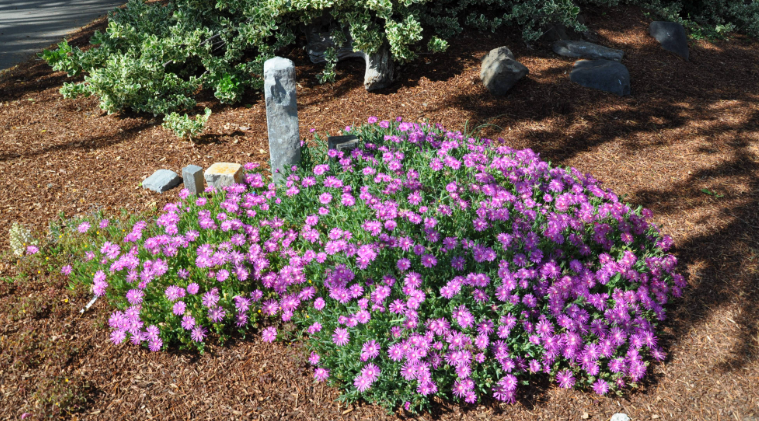
Pink ice plant is a low-growing, spreading South African succulent with slender, cylindrical leaves covered in tiny, glistening water-storage cells that give the foliage a frosted, crystalline appearance in sunlight. In spring, it covers itself so completely in small, vivid pink daisy-like flowers that the foliage is almost entirely hidden beneath the bloom. It is one of the most reliable and floriferous ground cover succulents for Mediterranean-climate gardens, dry slopes, and coastal landscapes, and requires virtually no irrigation once established.
2. Trailing Ice Plant (Lampranthus spectabilis)
Trailing ice plant is a sprawling South African succulent with narrow, fleshy, three-angled leaves on long, trailing stems and large, vivid magenta-pink to purple-pink daisy flowers produced in breathtaking abundance during late winter and spring. The flowers are intensely iridescent, shimmering with a jewel-like quality in full sunlight that earns ice plants their evocative common name. It is widely used in Californian and Mediterranean landscape design for slope stabilization, ground cover, and bank planting, where its spreading habit and prolific blooming create spectacular seasonal displays.
Also Read: Succulents With Long Stems
3. Rose Pincushion Cactus (Mammillaria zeilmanniana)
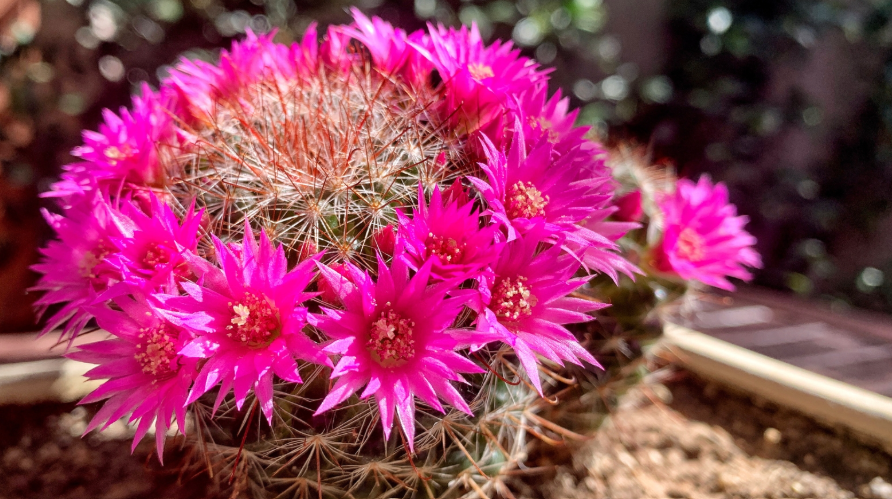
Rose pincushion cactus is a small, cylindrical Mexican cactus densely covered in neat rings of white radial spines and longer, hooked central spines. In spring and summer it produces a crown of vivid rose-pink to magenta flowers arranged in a ring around the upper portion of the stem, a characteristic blooming pattern shared by many mammillaria species. It is one of the most free-flowering and easy-to-grow of all cacti, blooming reliably from an early age and requiring only bright light and excellent drainage to perform at its best.
4. Lace Cactus (Echinocereus reichenbachii)
Lace cactus is a columnar, solitary or clustering cactus from the grasslands and rocky hills of Texas and Oklahoma, covered in dense, interlocking, comb-like spines of white and pink that create a beautiful lace-like surface texture. In late spring, it produces large, brilliant pink to magenta flowers with pale centers that can reach 3 inches across — remarkably large relative to the plant’s modest size. It is one of the most cold-hardy of the echinocereus species, tolerating temperatures well below freezing when kept dry during winter dormancy.
5. Beavertail Cactus (Opuntia basilaris)
Beavertail cactus is a low-growing prickly pear from the Mojave and Sonoran Deserts, producing broad, flat, blue-gray to purple pads armed with clusters of tiny, almost invisible glochids rather than conventional spines. In spring, it produces large, cup-shaped flowers in vivid rose-pink to magenta that are among the most beautiful blooms produced by any North American cactus. It is increasingly used in xeriscape and drought-tolerant landscape design across the American Southwest, where it thrives in poor, rocky soils with no supplemental irrigation.
6. Pink Torch Cactus (Echinopsis huascha)
Pink torch cactus is a columnar Argentine cactus with ribbed, spiny stems producing large, brilliant pink to red funnel-shaped flowers of extraordinary beauty in summer. The flowers can reach 4 inches across and are produced in flushes throughout the warm season, opening during the day — unlike many echinopsis relatives whose blooms are nocturnal. It is a popular garden cactus in warm, frost-free and lightly frost-prone climates, growing vigorously and blooming reliably from a relatively young age.
7. Living Rock Cactus (Ariocarpus fissuratus)
Living rock cactus is a remarkable, slow-growing cactus from the Chihuahuan Desert of Texas and Mexico, with a completely flat, ground-level body composed of rough, gray-green tubercles that blend almost perfectly with the surrounding limestone rocks. In autumn, it produces surprisingly large, vivid pink to magenta flowers that emerge directly from the crown of the plant, contrasting dramatically with the camouflaged body below. It is one of the most sought-after cacti among collectors but requires patience — growth rates are extremely slow, with plants taking many years to reach flowering size.
Also Read: Succulents With Orange Flowers
8. Claret Cup Cactus (Echinocereus triglochidiatus var. roseus)
The roseus variety of claret cup cactus produces vivid, deep pink to rose-red flowers rather than the typical scarlet of the species, creating a softer but equally spectacular spring display. Like the standard form, it is a clustering cactus from the rocky mountains and mesas of the American Southwest and northern Mexico, forming dense clumps of ribbed, spiny stems that can eventually spread several feet across. It is exceptionally drought and cold tolerant, surviving temperatures as low as -20°F (-29°C) when well-drained.
9. Flaming Katy Pink (Kalanchoe blossfeldiana)
Among the many cultivated color forms of Flaming Katy, pink varieties ranging from soft blush to vivid hot pink are among the most widely sold and gifted. These compact houseplants produce dense clusters of long-lasting, four-petaled flowers above thick, glossy, scallop-edged leaves throughout the winter and spring season. Kalanchoe blossfeldiana in all its color forms is one of the top three best-selling flowering houseplants globally, with production concentrated in the Netherlands, Denmark, and the United States.
10. Copper Rose (Echeveria multicaulis)
Copper rose is a small, branching echeveria from Guerrero, Mexico, with loose rosettes of copper-green to bronze leaves that develop vivid red margins and tips in full sun. In winter and spring, it produces arching stems bearing small, bell-shaped flowers in coral-pink to orange-red, the warm blooms complementing the metallic foliage beautifully. It is a compact, easy-to-grow species that performs well on sunny windowsills and in outdoor container displays in frost-free climates.
11. Hens and Chicks (Sempervivum tectorum)
Hens and chicks is one of the most ancient and widely cultivated of all succulents in European gardens, forming tight, geometric rosettes of pointed, green to reddish-purple leaves that spread steadily by producing numerous offsets — the “chicks” clustered around the parent “hen.” In summer, mature rosettes send up tall flower stems bearing star-shaped flowers in pink to rose-red before dying in the natural monocarpic cycle. Sempervivums are extraordinarily cold-hardy, surviving temperatures as low as -30°F (-34°C), making them among the most widely adaptable succulents for temperate gardens.
12. Cobweb Houseleek (Sempervivum arachnoideum)
Cobweb houseleek is one of the most distinctive and charming of all sempervivum species, with small, neat rosettes covered in a dense web of white, hair-like fibers stretched between the leaf tips — an adaptation that may help protect the plant from intense mountain sunlight and desiccation. In summer, mature rosettes produce stems bearing clusters of vivid pink to cerise, star-shaped flowers. Native to the European Alps, it is exceptionally cold-hardy and thrives in rock gardens, alpine troughs, wall crevices, and green roof plantings.
13. Ghost Plant (Graptopetalum paraguayense)
Ghost plant is a popular Mexican succulent with loose, open rosettes of thick, triangular, waxy leaves in pale lavender-pink to silvery gray — a coloring so ethereal that the common name seems perfectly chosen. In spring, arching stems carry small, star-shaped flowers in white to pale pink with fine red spotting, adding a delicate floral note to the plant’s already beautiful foliage. It is one of the most forgiving and easy-to-propagate succulents available, rooting readily from individual leaves and tolerating irregular watering and a wide range of light conditions.
Also Read: Succulent Plants With Red Flowers
14. Pink Moonstones (Pachyphytum oviferum)
Pink moonstones is one of the most beloved and widely collected small succulents in the world, producing compact rosettes of thick, egg-shaped leaves in soft, powdery lavender-pink to pale lilac — a color so gentle and beautiful that the plant has become a staple of succulent arrangements and container displays globally. In late winter and spring, arching stems carry small, bell-shaped flowers in coral-pink to orange-red that contrast attractively with the pale foliage. The powdery coating on the leaves is easily marked by water or touch and is best preserved by handling the plant as little as possible.
15. Pork and Beans (Sedum rubrotinctum)
Pork and beans is a cheerful, easy-to-grow Mexican succulent with trailing stems bearing plump, jelly-bean-shaped leaves in bright green that develop vivid red to pink tips in full sun — a coloring that inspired its charming common name. In late winter and spring, clusters of small, star-shaped, yellow to pale pink flowers appear at the stem tips. It is one of the most widely grown and recognizable small sedums, popular in mixed succulent arrangements and as a standalone container plant for sunny windowsills and outdoor rock gardens.
16. Hen Widdecombe (Echeveria ‘Pink Champagne’)
‘Pink Champagne’ is an exquisite echeveria hybrid producing large, symmetrical rosettes of powdery, pale lavender-pink leaves with slightly wavy, darker pink margins. In spring and summer, tall, arching stems carry bell-shaped flowers in coral-pink to salmon, complementing the soft foliage coloring beautifully. It is a popular subject for succulent arrangements, wedding centerpieces, and premium gift plant displays, and its photogenic qualities have made it a frequent subject in succulent-themed social media content.
17. Calico Hearts (Adromischus maculatus)
Calico hearts is a compact South African succulent with thick, rounded, paddle-shaped leaves in gray-green heavily marked with irregular brownish-purple spots and blotches — a pattern that gives it the calico appearance its common name describes. Slender flower stems carry small, tubular flowers in pale pink to white with pink striping in summer. It is a slow-growing, low-maintenance species that performs well on sunny windowsills and in shallow containers, prized primarily for its unusual, spotted foliage but appreciated equally for its modest seasonal blooms.
18. Burro’s Tail (Sedum morganianum)
Burro’s tail is one of the most popular trailing succulents in cultivation, with long, pendulous stems densely packed with plump, blue-green, overlapping leaves. In summer, mature stems occasionally produce small clusters of star-shaped flowers in deep pink to red at the tips, a relatively infrequent occurrence that makes the blooms all the more appreciated when they appear. Native to Mexico and Honduras, the stems can reach 2 to 4 feet in length over several years, creating dramatic, cascading displays from hanging baskets and elevated containers.
19. Baby Necklace (Crassula rupestris)
Baby necklace is a charming South African crassula with upright to sprawling stems threaded with pairs of thick, triangular, green to reddish leaves stacked tightly along the stem in a pattern that closely resembles a beaded necklace. In late spring and summer, dense clusters of tiny, star-shaped flowers in pale pink to white are produced at the stem tips, attractive to small bees and flies. It is a compact, easy-to-grow species well-suited to small containers, rock gardens, and mixed succulent arrangements.
20. Stonecrop (Sedum spurium ‘Pink Jewel’)
‘Pink Jewel’ is a low-growing, mat-forming sedum cultivar producing small, rounded, bronze-green leaves on spreading stems and abundant clusters of star-shaped, bright pink flowers in midsummer. It is one of several pink-flowered cultivars developed from Sedum spurium and is valued for its reliable flowering, excellent cold hardiness, and dense ground-covering habit. Like other sedum spurium cultivars, it is widely used in rock gardens, green roof plantings, and as a low-maintenance lawn alternative in dry, sunny areas.
21. Crown of Thorns Pink (Euphorbia milii)
Pink-bracted forms of crown of thorns are among the most popular cultivars of this widely grown Madagascan succulent, with the small but vivid pink cyathia bracts providing months of continuous color above the spiny, succulent stems. Modern pink cultivars have been developed with considerably larger bracts than the original species, some approaching an inch across — a significant improvement on the small, pea-sized bracts of wild plants. Crown of thorns is noted for its exceptional longevity as a houseplant, with well-maintained specimens known to bloom for decades.
22. Pink Sand Dollar Cactus (Astrophytum asterias ‘Super Kabuto’)
The ‘Super Kabuto’ form of sand dollar cactus is a prized collector’s cactus from Japan, a cultivated selection of the Mexican star cactus (Astrophytum asterias) developed to have enhanced, denser white flecking on the flat, star-shaped body. The large, silky flowers produced in summer range from yellow with a red center to soft pink in certain selections, the petals having a delicate, tissue-paper quality. Japan has become one of the world’s leading centers of cactus breeding, and ‘Super Kabuto’ selections fetch premium prices in specialist collector markets globally.
23. Fairy Crassula (Crassula multicava)
Fairy crassula is a shade-tolerant South African succulent with rounded, glossy, dark green leaves often tinged with pink or red in bright conditions, forming spreading, ground-covering clumps. In late winter and spring, the plant produces masses of tiny, four-petaled, pale pink to white flowers on delicate, branching stems held above the foliage — a display of remarkable delicacy and charm given the plant’s robust, low-maintenance character. It is one of the most useful succulents for shaded garden positions and spreads steadily to form a useful, low-growing ground cover.
24. Graptoveria ‘Bashful’
‘Bashful’ is a popular hybrid between Graptopetalum and Echeveria, forming neat, compact rosettes of plump, pointed leaves in soft peach-pink to rose, the color deepening attractively toward the leaf tips in full sun. Arching stems carry small, star-shaped flowers in pale pink to white in spring, adding a delicate floral dimension to the plant’s year-round foliage appeal. Like most graptoveria hybrids, it is easy to propagate from leaf cuttings and is widely available in garden centers and online succulent retailers worldwide.
Also Read: Types of Phlox Plants
25. Wax Plant (Hoya carnosa)
Wax plant is a twining, semi-succulent vine from East Asia and Australia producing thick, glossy, dark green leaves on long, scrambling stems and extraordinary clusters of perfectly formed, star-shaped flowers in waxy, pale pink with a deep pink center. The flowers are intensely fragrant, particularly in the evening, and each cluster can contain up to 40 individual blooms. Though classified as a semi-succulent rather than a true succulent, its thick, water-storing leaves and drought tolerance place it firmly within the succulent houseplant tradition, and it is one of the most beloved and long-lived of all indoor climbing plants.
26. Aloe Aristata (Lace Aloe)
Lace aloe is a compact, stemless South African species forming dense rosettes of dark green, white-spotted leaves edged with small, soft white teeth and tipped with a distinctive bristle. In autumn and winter, slender stems carry tubular flowers in coral-pink to orange-red that attract sunbirds and bees. It is one of the most cold-tolerant aloe species, surviving light frosts that would damage most of its relatives, and is an excellent container species for cooler climates where it can be brought indoors during the coldest months.
27. Echeveria Subsessilis
Echeveria subsessilis is a beautiful Mexican species forming medium-sized rosettes of blue-green to gray-green leaves with delicate pink to lavender margins and tips that intensify in cool, bright conditions. The arching flower stems carry rows of small, bell-shaped flowers in vivid coral-pink to orange-pink in spring and summer. It is a popular, moderately easy-to-grow species that has contributed its attractive coloring and reliable flowering habit to numerous hybrid cultivars in the echeveria world.
28. Spekboom (Portulacaria afra variegata)
The variegated form of elephant bush has cream and green marbled leaves that flush attractively with pink in full sun and drought conditions, creating a constantly shifting display of warm tones across the plant’s fine-textured, bushy form. Small clusters of tiny, star-shaped flowers in bright pink to magenta are produced in spring and summer when conditions are favorable, covering the plant in a haze of delicate color. The variegated form is slower-growing than the standard species but equally drought-tolerant and makes a beautiful container or small garden specimen.
29. String of Hearts (Ceropegia woodii)
String of hearts is one of the most popular and best-loved trailing succulents in cultivation, with wiry, purple-tinged stems bearing pairs of small, heart-shaped leaves marbled in dark green and silver. The small, tubular flowers produced along the stems in summer are pale pink to mauve with a darker pink tube and fused, cage-like petal tips — an unusual and intricate floral form characteristic of the ceropegia genus. Since approximately 2018, string of hearts has been one of the fastest-growing succulent sellers globally, driven largely by its photogenic qualities and ease of care.
30. Echeveria ‘Perle Von Nürnberg’
‘Perle Von Nürnberg’ (Pearl of Nuremberg) is one of the most famous and widely grown echeveria cultivars in the world, a hybrid developed in Germany in the 1930s that has remained a bestseller for nearly a century. Its large, symmetrical rosettes display a remarkable range of colors — lavender, pink, gray, and peach — that shift subtly depending on the light and season. Tall, arching stems carry small, coral-pink to yellow-orange flowers in summer. It is widely considered one of the most photographically beautiful succulents available and is a fixture of succulent arrangements and container displays worldwide.
31. Flowering Quill (Echeveria elegans)
Mexican snowball, as Echeveria elegans is also widely known, forms tight, symmetrical rosettes of powdery, pale blue-green to white leaves that have a cool, almost lunar quality. In late winter and spring, arching, pink stems carry rows of small, bell-shaped flowers in vivid coral-pink to yellow-orange, the warm bloom color contrasting beautifully with the cool, icy foliage. It is one of the most widely cultivated and commercially important echeveria species, forming the basis of countless named hybrid cultivars and used extensively in succulent garden design worldwide.
32. Prickly Pear Pink (Opuntia basilaris var. brachyclada)
This compact variety of beavertail prickly pear produces smaller pads than the standard form and flowers in a particularly vivid, saturated rose-pink to magenta in spring. It is native to the San Bernardino Mountains of Southern California and is more restricted in natural range than the widespread standard beavertail. The intense flower color and compact habit make it a highly desirable ornamental for rock gardens, succulent borders, and native plant gardens across warm, arid regions of the American West.
33. Mammillaria Hahniana (Old Lady Cactus)
Old lady cactus is a globe-shaped to cylindrical Mexican cactus densely covered in soft, white, hair-like spines that give the entire plant a woolly, elderly appearance perfectly captured by its common name. In spring, a crown of small but vivid pink to magenta flowers encircles the top of the plant, creating a charming halo of color against the white, fluffy body. It is one of the most popular cacti for indoor cultivation, prized for its unusual, soft-textured appearance and reliable annual flowering.
34. Easter Cactus (Hatiora gaertneri)
Easter cactus is a forest epiphyte from the Atlantic coastal mountains of southeastern Brazil, producing flattened, segmented stems and large, funnel-shaped flowers in vivid pink to scarlet that open during the Easter period in the Northern Hemisphere. Unlike its close relative the Christmas cactus, it requires a distinct cool, dry rest period in winter to set buds reliably. It is a popular gift plant around Easter and deserves wider cultivation than it currently receives, as its vivid spring flowers are among the most spectacular produced by any epiphytic cactus.
35. Christmas Cactus Pink (Schlumbergera bridgesii)
Pink-flowered forms of Christmas cactus are among the most widely sold and gifted flowering houseplants in the world, producing their pendulous, tubular blooms in shades from soft blush to vivid cerise during the late autumn and winter holiday season. The flattened, segmented stems arch gracefully outward, and mature plants in full bloom are a genuinely impressive sight. Christmas cactus is one of the most long-lived of all houseplants — specimens over 20 to 30 years old are not uncommon, and plants passed down through families for generations have been recorded.
36. Aloe Humilis (Spider Aloe)
Spider aloe is a compact, freely clustering species from the Western Cape of South Africa, forming small, stemless rosettes of narrow, incurved, blue-green leaves covered in white teeth and tubercles that give it a spidery, textured appearance. Slender stems carry simple or occasionally branched spikes of tubular flowers in coral-pink to orange-red in spring, and the plant spreads steadily by offsetting to form wide, attractive colonies. It is one of the most cold-tolerant of the small aloe species and is well-suited to container cultivation in cooler climates.
37. Lewisia Cotyledon (Bitterroot)
Bitterroot is a succulent perennial from the rocky mountain slopes of western North America, forming rosettes of thick, strap-shaped, evergreen leaves and producing tall, branching flower stems bearing masses of large, cup-shaped flowers in shades of vivid pink, rose, and white with darker veining. It is one of the most beautiful of all North American native succulents and has given rise to numerous hybrid cultivars selected for especially vivid flower colors. Lewisia cotyledon is the state flower of Montana and holds deep cultural significance for several indigenous North American peoples.
38. Rock Purslane (Calandrinia spectabilis)
Rock purslane is a succulent perennial from Chile with rosettes of thick, blue-gray, lance-shaped leaves and tall, wiry flower stems bearing large, poppy-like flowers in vivid magenta-pink with a silky, tissue-paper texture. The flowers are produced in long succession throughout spring and summer, attracting bees and butterflies in large numbers. It is an exceptionally drought-tolerant ornamental for warm, sunny gardens and is widely used in Mediterranean-climate landscaping, coastal gardens, and xeriscape planting schemes where its brilliant flower color delivers months of visual impact.
Also Read: Types of Poinsettia Flowers
39. Echeveria Shaviana (Mexican Hens)
Echeveria shaviana is a distinctive Mexican species producing wide, flat rosettes of thin, wavy-edged, gray-blue to lavender-pink leaves with a crinkled, ruffled margin that creates an almost floral quality in the rosette itself. In late spring and summer, arching stems carry rows of small, bell-shaped flowers in pink to coral-orange. The unusual, frilled leaf margins make this one of the most immediately recognizable echeveria species and a popular choice for collectors seeking plants with architectural foliage interest beyond simple, smooth-leaved rosettes.
40. Delosperma Cooperi (Hardy Ice Plant)
Hardy ice plant is a prostrate, spreading succulent from the Drakensberg mountains of South Africa bearing bright, vivid magenta-pink daisy flowers with iridescent, crystalline petals that shimmer jewel-like in full sunlight throughout summer and into autumn. It is one of the most cold-tolerant ice plant species available, surviving temperatures down to around -10°F (-23°C) in well-drained soils, making it a valuable ground cover succulent for temperate gardens well beyond the frost-free zones where most South African mesembs are restricted. The flowers open fully in sunshine and close at night, creating a dynamic daily rhythm of color across the low, succulent mat.