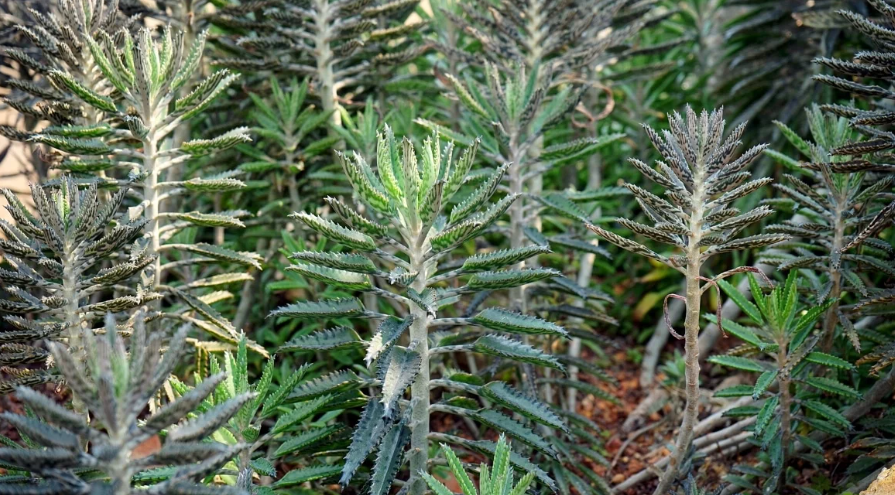
When most people picture a succulent, they imagine a compact, ground-hugging rosette or a neat, rounded cactus. While these forms are certainly common, the succulent world is far more architecturally diverse than this familiar image suggests. Among the most dramatic and structurally compelling of all succulents are those that develop long, elongated stems — reaching upward, cascading downward, or sprawling outward in ways that bring movement, height, and a sense of wild, natural energy to any garden or interior space.
Long-stemmed succulents serve a variety of ecological purposes in their native habitats. Upright, tall-stemmed species gain a competitive advantage by lifting their photosynthetic tissues above surrounding vegetation, accessing more direct sunlight in environments where ground-level competition is fierce. Trailing and cascading species, by contrast, use their long stems to colonize new ground, rooting at nodes wherever they make contact with soil. In both cases, the stem itself is a critical water-storage organ, thick and fleshy, filled with parenchyma cells that hold moisture through extended periods of drought.
The market for long-stemmed and trailing succulents has grown substantially in recent years, driven largely by the popularity of indoor plant styling and the rise of hanging planter and shelf display trends on social media. Species such as string of pearls and string of hearts have become genuine plant celebrities, with online searches for trailing succulents increasing by over 200 percent between 2018 and 2023. Garden designers and interior stylists alike have embraced long-stemmed succulents for their ability to add vertical interest, soften hard architectural lines, and bring an organic, flowing quality to both outdoor and indoor spaces.
Long-stemmed succulents span an extraordinary range of genera, growth habits, and geographic origins. From the towering, tree-like euphorbias of Madagascar to the gently cascading sedums of Mexico, and from the architectural columnar cacti of the American Southwest to the delicate trailing senecios of southern Africa, this group encompasses some of the most beautiful and structurally fascinating plants available to gardeners and collectors today. The following 28 plants represent the full breadth and beauty of this remarkable category.
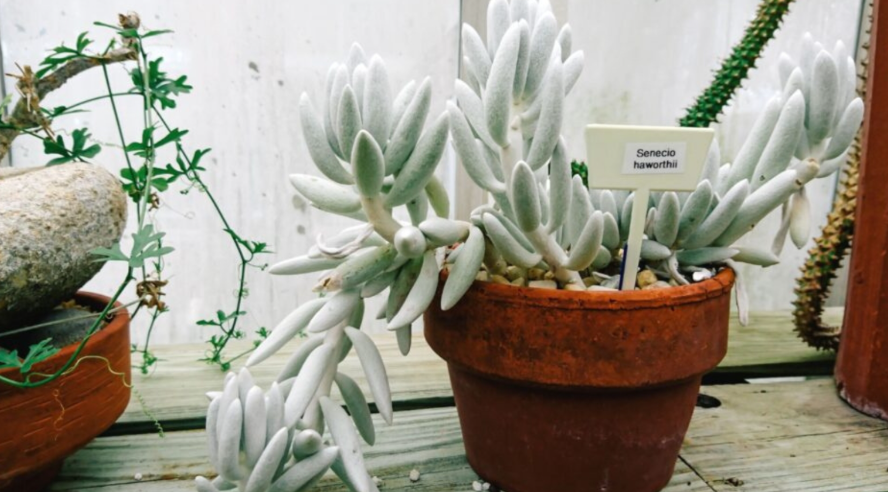
1. Euphorbia Ingens (Candelabra Tree)
Candelabra tree is one of the most imposing succulent plants on earth, a tree-like euphorbia from southern Africa capable of reaching 30 to 40 feet in height in its native savanna habitat. The thick, deeply ribbed, green stems branch repeatedly in a candelabra pattern, creating a sculptural silhouette that is instantly recognizable on the African landscape. In cultivation it grows more slowly, eventually becoming a dramatic specimen tree for large, frost-free gardens. Like all euphorbias, it produces a toxic, milky latex sap that requires careful handling.
2. Euphorbia Ammak (African Candelabra)
Euphorbia ammak is a magnificent columnar euphorbia from the Arabian Peninsula and the Horn of Africa, producing massive, upright, heavily ribbed stems that branch from the base to create towering columns reaching 20 to 30 feet. The pale gray-green stems are armed with paired spines along the ribs and have an almost architectural quality, resembling enormous organ pipes. In warm, frost-free gardens it makes an unparalleled statement specimen, and even young plants in containers have a commanding, sculptural presence that few other succulents can match.
Also Read: Succulents With Orange Flowers
3. Euphorbia Tirucalli (Pencil Cactus)
Pencil cactus, despite its common name, is not a cactus at all but a euphorbia from tropical Africa and India, producing masses of smooth, cylindrical, pencil-thin stems in a dense, intricately branched structure that can reach 20 feet outdoors. The stems are bright green in warm, shaded conditions but develop vivid orange, red, and pink tones in full sun and drought stress — a quality that has made the cultivar ‘Sticks on Fire’ one of the most popular ornamental succulents worldwide. The stems contain a highly caustic latex sap that can cause severe skin and eye irritation and must be handled with care.
4. Cereus Repandus (Peruvian Apple Cactus)
Peruvian apple cactus is a tall, columnar cactus from South America that can reach 30 feet or more at maturity, with thick, deeply ribbed, blue-green stems branching from the base in an upright, tree-like form. Large, white, night-blooming flowers appear in summer, followed by edible red fruits that give the plant its common name. It is one of the most widely cultivated tall columnar cacti in warm-climate landscaping, valued for its fast growth, drought tolerance, and dramatic vertical presence in gardens and urban streetscapes.
5. Pachycereus Pringlei (Mexican Giant Cardon)
Mexican giant cardon is the largest cactus species in the world by total mass, native to the Sonoran Desert of Baja California and northwestern Mexico. Mature plants can reach 60 feet in height with a trunk diameter of over 3 feet, and specimens over 300 years old have been recorded. The thick, ribbed, blue-green columns branch extensively with age, creating enormous, candelabra-like forms that dominate the desert landscape. It is a protected species in Mexico and a vital component of the Sonoran Desert ecosystem, providing nesting sites for dozens of bird species.
6. Stenocereus Thurberi (Organ Pipe Cactus)
Organ pipe cactus is a multi-stemmed columnar cactus from the Sonoran Desert of Arizona and Mexico, producing numerous upright stems from a central base that create the pipe-organ silhouette captured in its name. It can reach 20 feet in height and is the dominant plant of Organ Pipe Cactus National Monument in southern Arizona — one of the most biodiverse desert preserves in North America. The large, pale pink to white nocturnal flowers are pollinated by lesser long-nosed bats, and the sweet, edible fruits were an important food source for the Tohono O’odham people for centuries.
Also Read: Succulent Plants With Red Flowers
7. Senecio Rowleyanus (String of Pearls)
String of pearls is one of the most iconic and instantly recognizable trailing succulents in cultivation, producing long, thread-like stems bearing perfectly spherical, bright green leaves that look uncannily like a strand of beads. Native to the dry, rocky slopes of southwestern Africa, the spherical leaf shape minimizes surface area while maximizing water storage volume — a beautifully efficient evolutionary adaptation. String of pearls has become one of the most photographed houseplants in the world and is a fixture of hanging planter and shelf displays in contemporary interior design.
8. Senecio Herreianus (String of Watermelons)
String of watermelons is a close relative of string of pearls, producing similarly slender trailing stems but with oval to barrel-shaped leaves marked with translucent purple stripes that strongly resemble miniature watermelons. Native to Namibia, it shares the same trailing, cascading growth habit and the same preference for bright, indirect light and minimal watering. It is slightly less commonly available than string of pearls but is prized by collectors for its unusual, patterned leaves and performs equally well in hanging containers.
9. Senecio Radicans (String of Bananas)
String of bananas produces long, trailing stems bearing small, curved, crescent-shaped leaves that closely resemble tiny bunches of bananas. Native to South Africa, it is one of the fastest-growing of the trailing senecio species and adapts more readily to a wider range of light conditions than string of pearls, tolerating slightly lower light levels without losing its characteristic leaf shape. Small, white, cinnamon-scented flowers occasionally appear along the stems, adding a delicate, unexpected fragrance to an already charming plant.
10. Ceropegia Woodii (String of Hearts)
String of hearts is a delicate, trailing succulent from Zimbabwe and South Africa with wiry, purple-tinged stems bearing pairs of small, heart-shaped leaves in deep green marbled with silver. Along the stems, small, fleshy tubers develop that can be used for propagation — a fascinating adaptation for colonizing new ground in the plant’s rocky native habitat. String of hearts has become one of the best-selling succulent houseplants globally over the past decade, its romantic leaf shape and easy care requirements making it a perennial favorite among plant collectors of all experience levels.
11. Ceropegia Linearis (String of Needles)
String of needles is a trailing ceropegia with very long, thread-like, purple stems bearing pairs of narrow, needle-like leaves — a form quite different from the heart-shaped leaves of its famous relative. The slender stems can reach several feet in length, cascading gracefully from hanging pots or trailing along shelf edges. Small, pale pink to purple, lantern-shaped flowers with the characteristic ceropegia tube and fused petal tips appear along the stems in summer, adding an unusual ornamental dimension to an already intriguing plant.
12. Dischidia Ruscifolia (Million Hearts)
Million hearts is an epiphytic succulent vine from Southeast Asia and the Pacific, producing masses of tiny, heart-shaped, fleshy leaves along long, wiry, scrambling stems. In its native habitat it grows on tree bark in humid forests, deriving moisture from rainfall and humid air rather than soil. Small, white, star-shaped flowers are produced intermittently along the stems. In cultivation it is grown as a trailing or climbing houseplant and is particularly popular in terrariums and humid indoor garden setups where its cascading habit creates a curtain of tiny, overlapping leaves.
13. Aporocactus Flagelliformis (Rat Tail Cactus)
Rat tail cactus is a Mexican epiphytic cactus producing numerous long, pendant, cylindrical stems densely covered in fine, bristly spines. The stems can reach 3 to 6 feet in length, cascading dramatically from hanging baskets or over the edges of raised containers. In spring, vivid cerise to magenta tubular flowers appear along the length of the stems, creating a spectacular display against the spiny, trailing growth. It is one of the most popular hanging cactus specimens and has been in cultivation in European gardens since the 17th century.
14. Selenicereus Grandiflorus (Queen of the Night)
Queen of the night is a sprawling, climbing epiphytic cactus from the Caribbean and Central America, producing long, angled, spiny stems that can reach 10 feet or more, scrambling through supporting vegetation in their native habitat. The plant is grown almost exclusively for its flowers — enormous, intensely fragrant white blooms up to 12 inches across that open for a single night only and are gone by dawn. The fleeting nature of the bloom has made it a celebrated horticultural spectacle, with “queen of the night flowering parties” held by enthusiasts whenever a bloom is imminent.
Also Read: Succulents With White Flowers
15. Hylocereus Undatus (Dragon Fruit Cactus)
Dragon fruit cactus is a vigorous, climbing, three-winged cactus from Central America, producing long, sprawling stems that can reach 20 feet or more as they clamber over supporting structures with the help of aerial roots. It is grown commercially throughout tropical and subtropical regions worldwide for its spectacular, large dragon fruit — vivid pink-skinned fruits with white or red flesh that have become one of the most globally recognized exotic fruits. Global dragon fruit production has expanded significantly in recent years, with Vietnam, China, Thailand, and the Philippines among the leading producers.
16. Epiphyllum Oxypetalum (Orchid Cactus)
Orchid cactus is an epiphytic forest cactus from Central and South America with long, flattened, leaf-like stems that can reach several feet in length, arching gracefully outward from the base. The spectacular flowers — enormous, fragrant, white blooms up to 12 inches across — open for a single night in summer, earning the plant a devoted global following among collectors who grow it specifically for these fleeting blooms. In cultivation, the flattened stems are often grafted onto more vigorous rootstocks to improve flowering performance.
17. Aloe Vera
Aloe vera is the most commercially important succulent species in the world, cultivated on a massive scale across tropical and subtropical regions for the soothing gel contained within its thick, fleshy leaves. While individual leaves are relatively short, mature plants develop a clearly elongated, tall stem over time as the lower leaves die away and the growing point rises, eventually producing a visible trunk in old specimens. The global aloe vera industry is valued at over $600 million annually, with applications spanning cosmetics, pharmaceuticals, food and beverage, and traditional medicine across dozens of cultures.
18. Aloe Vera ‘Barbadensis Miller’ (True Aloe)
The cultivated form most widely grown commercially, this selection of aloe vera produces particularly large, gel-rich leaves on stems that elongate progressively with age. Mature plants develop a visible, short trunk as the lower leaves senesce and fall away, eventually becoming quite architectural in appearance. Tall, unbranched flower spikes bearing tubular, yellow to orange flowers are produced in summer on mature plants. In warm, frost-free climates it can grow outdoors year-round, developing into substantial, multi-headed clumps of considerable ornamental value.
19. Kalanchoe Beharensis (Velvet Leaf Kalanchoe)
Velvet leaf kalanchoe is one of the largest and most architecturally dramatic of all kalanchoe species, developing a clearly visible single stem over time as the lower leaves die away. The enormous, deeply lobed, triangular leaves are covered in dense, brown to silvery felt-like hairs, giving them a velvety texture and a warm, bronze tone that catches the light beautifully. In warm, frost-free conditions it can eventually reach 6 to 10 feet, developing a palm-like silhouette with a bare lower stem and a crown of large, dramatic leaves.
20. Aeonium Arboreum (Tree Aeonium)
Tree aeonium is a branching, shrubby succulent from the Canary Islands and the Mediterranean coast, developing clearly visible, woody stems over time that give mature plants a distinctly tree-like appearance. Each stem is topped with a flat, dinner-plate-sized rosette of glossy, bright green to burgundy leaves, and in late winter the stem tips carry tall, conical flower spikes of small, golden-yellow blooms. The dramatic, dark-leaved cultivar ‘Zwartkop’ (black rose) is one of the most widely grown and photographed succulents in the world, its near-black rosettes carried on tall, bare stems creating an extraordinarily theatrical effect.
21. Aeonium Undulatum (Giant Aeonium)
Giant aeonium is a tall-stemmed species from the Canary Islands, producing a single, unbranched stem that can reach 3 to 5 feet, topped with a single large rosette of mid-green, wavy-edged leaves. It is monocarpic — the rosette dies after producing its large, domed flower spike of yellow blooms — but produces offsets from the base that continue the colony. Its bold, sculptural form makes it a striking container specimen and a standout plant in Mediterranean and coastal garden schemes.
22. Portulacaria Afra (Elephant Bush)
Elephant bush develops into a sizeable, multi-stemmed shrub over time, with woody, reddish-brown stems that elongate steadily to create a shrubby structure reaching 6 to 8 feet outdoors in warm, frost-free climates. The small, round, jade-green leaves are carried in opposite pairs along the stems, creating a delicate, finely textured appearance despite the plant’s eventual size. It is widely used as a hedge, screening plant, and bonsai subject in warm gardens and is an important carbon-sequestering plant — studies have shown it captures carbon at a rate up to ten times that of other plants per unit area under optimal conditions.
23. Crassula Ovata (Jade Plant)
Jade plant is one of the most beloved and long-lived houseplants in the world, developing thick, woody, clearly visible stems over time that give mature specimens a genuine tree-like quality highly prized in bonsai cultivation. The thick, oval, glossy leaves are produced along the branching stems in opposite pairs, and in winter, mature plants produce clusters of small, star-shaped, pale pink to white flowers. Jade plants are remarkably long-lived — well-maintained specimens passed down through generations are known to be 50 to 100 years old, making them among the most enduring of all houseplants.
Also Read: Types of Poinsettia Flowers
24. Crassula Muscosa (Watch Chain Plant)
Watch chain plant is a fascinating South African succulent producing numerous upright to sprawling stems densely packed with tiny, scale-like leaves arranged in perfect four-ranked rows that completely encase the stem, creating a chain-like effect. The stems can reach 10 to 12 inches in length and branch repeatedly, eventually forming a dense, intricate tangle of miniature chain-like shoots. Small, inconspicuous, yellow-green flowers appear along the stems in spring, and the plant has a slightly mossy, resinous fragrance that many people find pleasant.
25. Selenicereus Chrysocardium (Fernleaf Cactus)
Fernleaf cactus is an extraordinary epiphytic cactus from the cloud forests of Chiapas, Mexico, producing enormously long, flat, deeply lobed stems that closely resemble giant fern fronds. Individual stems can reach 3 to 4 feet in length and 12 inches across, with deeply cut, wavy lobes that give the plant an unmistakably fern-like appearance. It is one of the most unusual-looking cacti in existence and is prized by collectors worldwide for its bizarre, beautiful form. Large, fragrant, white nocturnal flowers appear on mature plants in summer.
26. Euphorbia Trigona (African Milk Tree)
African milk tree is an upright, columnar euphorbia from Central Africa producing tall, three-winged stems with distinctive, small, oval leaves along the winged ridges and paired spines at the leaf nodes. It grows remarkably quickly for a succulent, adding a foot or more of height per year under good conditions, and can reach 6 to 9 feet indoors over several years. The cultivar ‘Royal Red’ produces stems flushed with deep burgundy to purple-red, making it one of the most ornamentally striking of all columnar succulents for indoor cultivation.
27. Selenicereus Validus (Climbing Cactus)
Selenicereus validus is a vigorous, climbing cactus from the Caribbean with long, ribbed, angled stems bearing small spines and aerial roots that allow the plant to scramble up trees, walls, and other supporting structures to considerable heights. Like other selenicereus species, it produces large, white, night-blooming flowers of extraordinary fragrance and beauty. In warm, frost-free gardens it can cover substantial wall areas with its scrambling stems, creating a dramatic, tropical effect.
28. Sedum Morganianum (Burro’s Tail)
Burro’s tail is one of the most popular and widely grown trailing succulents in cultivation, producing long, pendulous stems densely packed with overlapping, plump, blue-green leaves that give each stem a thick, rope-like or braid-like appearance. Native to Mexico and Honduras, the stems can reach 2 to 4 feet in length over several years, cascading beautifully from hanging baskets, high shelves, and wall-mounted containers. The leaves are extremely delicate and detach at the slightest touch — a trait that frustrates handling but aids natural propagation, as each fallen leaf can root to form a new plant.