Trees that grow well in Michigan benefit from a landscape unlike any other state in the country, since Michigan is the only state made up of two separate peninsulas almost entirely surrounded by the Great Lakes, a position that gives the state more than 3,200 miles of freshwater coastline, more than any other state except Alaska.
This extensive lake exposure creates a phenomenon known as the lake effect, in which the massive thermal mass of Lakes Michigan, Huron, Superior, and Erie moderates nearby temperatures enough to support a narrow but highly productive fruit belt along Michigan’s western shoreline, allowing tender fruit trees to thrive in a climate that would otherwise be far too harsh for consistent fruit production. Michigan’s forests remain remarkably extensive today, covering roughly 56 percent of the state’s total land area, a legacy shaped by the massive white pine logging boom of the late 1800s that once made Michigan the nation’s leading timber producer before overharvesting led to widespread forest depletion and eventual reforestation efforts.
The state also spans a considerable north-south climate gradient, from the boreal-influenced forests of the Upper Peninsula, home to jack pine barrens supporting the rare Kirtland’s warbler, down to the warmer hardwood forests of the southern Lower Peninsula, which support species more typically associated with states farther south. This list explores 50 trees, ranging from iconic northern conifers to hardwood forest natives and the fruit-bearing species that helped earn Michigan its reputation as a major agricultural producer, that grow well across the state’s distinctive Great Lakes landscape.
Eastern White Pine
The Eastern white pine, Michigan’s official state tree, once formed vast old-growth forests that fueled the state’s massive logging industry throughout the late 1800s, with historic accounts describing pre-logging specimens exceeding 200 feet in height. This tree typically reaches a mature height of 80 to 100 feet today and is easily identified by its soft, blue-green needles arranged in distinctive bundles of five.
Eastern white pine grows relatively quickly for a conifer, often exceeding 2 feet of height per year under favorable conditions, and remains one of the most commonly planted ornamental and timber conifers found throughout the state. This tree’s central role in Michigan’s economic and environmental history, from fueling the state’s 19th-century lumber boom to its eventual near-depletion and subsequent conservation, made it a fitting choice when the state legislature officially designated it Michigan’s state tree in 1955.
Red Pine
The red pine, sometimes called Norway pine despite being native to North America rather than Europe, is widely found throughout Michigan’s northern forests, typically reaching a mature height of 50 to 80 feet with distinctive reddish-orange, plated bark that becomes more pronounced as the tree matures. This tree favors the sandy, well-drained soils common throughout much of northern Michigan and has also been extensively planted across the state in reforestation efforts following the extensive logging of the late 1800s and early 1900s.
Red pine grows in relatively dense, uniform stands and produces long, straight trunks that have made it commercially valuable for utility poles and construction lumber throughout Michigan’s forest products industry. This tree’s needles, which grow in bundles of two and are notably longer and stiffer than those of Eastern white pine, provide a useful identification feature distinguishing the two species throughout Michigan’s mixed pine forests.
Jack Pine
The jack pine is a hardy, fire-adapted conifer found throughout Michigan’s sandy northern plains, typically reaching a mature height of 35 to 50 feet and playing a uniquely important ecological role as the primary nesting habitat for the endangered Kirtland’s warbler. This tree produces cones that often remain tightly sealed with resin for years, requiring the intense heat of wildfire to open and release seed onto the newly cleared, sunny ground the species depends on for successful regeneration.
Jack pine’s specific habitat requirements, including young stands of a particular height and density, made it central to one of the most successful endangered species recovery stories in American conservation history, as Michigan foresters learned to manage jack pine plantations specifically to support Kirtland’s warbler nesting habitat. This tree’s tolerance for Michigan’s poorest, sandiest soils allows it to thrive in conditions where few other tree species can successfully establish and grow.
Black Spruce
The black spruce grows throughout Michigan’s northern bogs and wetland areas, particularly common across the Upper Peninsula, typically reaching a mature height of 30 to 50 feet in the acidic, waterlogged soils it favors. This tree is notably slow growing, especially in the harshest bog conditions, where individual trees may take a century or more to reach modest size due to the poor nutrient availability found in Michigan’s peatland habitats.
Black spruce often forms distinctive, stunted stands in these bog environments, giving affected areas a somewhat otherworldly, sparse appearance compared to Michigan’s denser upland forests. This tree’s association with Michigan’s northern wetland ecosystems makes it an important indicator species for tracking the health and extent of the state’s remaining boreal bog habitat.
White Spruce
The white spruce is found throughout Michigan’s northern forests, typically reaching a mature height of 40 to 60 feet and tolerating the state’s cold winters exceptionally well. This tree produces dense, symmetrical growth that has made it a popular choice for both windbreak plantings and Christmas tree production throughout Michigan’s northern counties.
White spruce needles have a somewhat unpleasant odor when crushed, a trait that has earned the tree the informal nickname of skunk spruce in some parts of its Michigan range. This tree’s strong tolerance for wind and cold has made it a valuable species for windbreak plantings throughout Michigan’s more exposed agricultural areas, particularly across the state’s northern Lower Peninsula.
Balsam Fir
The balsam fir grows throughout Michigan’s northern forests, particularly common across the Upper Peninsula and northern Lower Peninsula, typically reaching a mature height of 40 to 60 feet. This tree is easily recognized by its symmetrical, pyramidal shape and pleasantly fragrant needles, traits that have made it one of the most popular Christmas tree species grown throughout the state’s northern tree farms.
Michigan remains one of the leading Christmas tree producing states in the country, and balsam fir represents one of several conifer species contributing significantly to this substantial seasonal agricultural industry. This tree’s strong needle retention, even after cutting, has made it a particularly valued choice among Michigan’s commercial Christmas tree growers, alongside other popular species like Fraser fir and Scotch pine.
Tamarack
The tamarack is one of the more unusual conifers found throughout Michigan’s northern bogs and wetlands, unusual among conifers for being deciduous, dropping its soft, needle-like foliage each fall after turning a striking golden yellow color. This tree typically reaches a mature height of 40 to 80 feet and thrives in the acidic, poorly drained peatland soils common throughout much of northern Michigan.
Tamarack’s brilliant fall color display, occurring notably later than most of Michigan’s broadleaf trees, creates a distinctive late-season golden glow across the state’s northern bog landscapes each October and November. This tree’s tolerance for standing water and nutrient-poor soils allows it to thrive in wetland conditions that would be lethal to most other conifer species found throughout Michigan’s forests.
Northern White Cedar
The northern white cedar, commonly called arborvitae, grows extensively throughout Michigan’s wetlands, swamps, and limestone-influenced forest areas, typically reaching a mature height of 40 to 50 feet. This tree is remarkably long-lived, with some specimens found on Michigan’s dolomite cliff faces along Lake Huron estimated to be more than 1,000 years old, among the oldest known trees in eastern North America.
Northern white cedar provides critical winter shelter and browse for white-tailed deer throughout Michigan, with dense cedar swamps serving as essential deer wintering habitat during the state’s harshest cold months. This tree’s aromatic, scale-like foliage and rot-resistant wood have also made it historically valuable for fence posts, shingles, and canoe construction throughout Michigan’s Indigenous and settler communities alike.
Quaking Aspen
The quaking aspen is one of the most widespread native trees found throughout Michigan, typically reaching a mature height of 40 to 60 feet and known for its distinctive white bark and leaves that flutter dramatically in even light wind. This tree often grows in large interconnected groves that share a single root system, with individual trunks technically functioning as a single genetically identical organism spanning considerable area throughout Michigan’s northern forests.
Quaking aspen is typically one of the first tree species to colonize areas following logging or fire, playing an important early successional role throughout much of Michigan’s managed forest land. This tree’s brilliant golden fall color, combined with its rapid growth and wide distribution, makes it one of the most recognizable and ecologically significant native trees found across the state.
Bigtooth Aspen
The bigtooth aspen grows throughout Michigan alongside its more common relative, the quaking aspen, typically reaching a mature height of 50 to 70 feet with larger, more coarsely toothed leaves that give the species its common name. This tree tends to favor slightly drier upland sites compared to quaking aspen and is somewhat less common overall throughout the state, though it remains a significant component of Michigan’s northern hardwood and mixed forest communities.
Bigtooth aspen grows relatively quickly and provides an important early food source for ruffed grouse and other wildlife, particularly through its buds and catkins during the late winter months when other food options remain scarce. This tree’s attractive yellow to orange fall color adds to Michigan’s celebrated autumn foliage displays throughout the northern and central parts of the state.
Paper Birch
The paper birch is one of Michigan’s most recognizable native trees, found throughout the state’s northern forests, typically reaching a mature height of 50 to 70 feet and easily identified by its striking white, papery bark that peels away in thin horizontal strips. This tree thrives in Michigan’s cooler climate zones, particularly throughout the Upper Peninsula and northern Lower Peninsula, where it commonly grows alongside aspen, balsam fir, and various spruce species.
Paper birch produces attractive golden-yellow fall color and small, wind-dispersed seeds contained within distinctive drooping catkins that provide food for numerous bird species throughout the winter months. This tree’s bark was historically used extensively by Indigenous communities throughout the Great Lakes region for canoe construction, given its natural water resistance and flexibility when properly harvested and prepared.
Yellow Birch
The yellow birch grows throughout Michigan’s cooler northern forests, typically reaching a mature height of 60 to 80 feet and easily recognized by its distinctive yellowish-bronze, curling bark. This tree often germinates on top of moss-covered rocks or fallen nurse logs, eventually sending roots down around the original growing surface as the tree matures over many decades.
Yellow birch is an important component of Michigan’s northern hardwood forests, typically growing alongside sugar maple, American beech, and eastern hemlock throughout the state’s more mature forest stands. This tree’s slow growth and long lifespan, sometimes exceeding 150 years, make it a valuable indicator of forest maturity throughout Michigan’s northern hardwood forest regions.
Eastern Hemlock
The Eastern hemlock is a slow-growing evergreen conifer found throughout Michigan’s cooler, moister forest areas, typically reaching a mature height of 60 to 70 feet and capable of living for more than 500 years under favorable old-growth conditions. This tree provides critical shade for Michigan’s coldwater streams, helping maintain the cool water temperatures needed to support native trout populations throughout the state’s northern watersheds.
Michigan has so far remained largely free of the hemlock woolly adelgid, an invasive insect that has devastated hemlock populations throughout much of the eastern United States, though state agencies continue monitoring efforts closely given the pest’s documented spread through neighboring states. This tree’s dense, shade-tolerant canopy makes it an important component of Michigan’s late-successional northern hardwood and mixed conifer forests.
Sugar Maple
The sugar maple is Michigan’s most abundant native tree species by volume, found throughout the state’s hardwood forests, typically reaching a mature height of 60 to 80 feet and producing some of the most vivid orange and red fall foliage found anywhere in the Great Lakes region. This tree is also central to Michigan’s substantial maple syrup industry, with the state ranking among the top five maple syrup producing states in the country, supporting hundreds of family-run sugarbush operations throughout the northern and central Lower Peninsula.
Sugar maple requires a specific combination of freezing nights and warmer days in late winter to produce the sap flow needed for syrup production, a pattern that occurs reliably across much of Michigan each February and March. This tree’s brilliant fall color display draws significant seasonal tourism to Michigan’s forests each October, particularly throughout the northern Lower Peninsula and Upper Peninsula regions.
Red Maple
The red maple is one of the most widely distributed native trees found throughout Michigan, typically reaching a mature height of 40 to 60 feet and producing some of the earliest spring color in the state, with small red flowers appearing on bare branches often as early as March.
This tree tolerates an unusually broad range of soil and moisture conditions, from swampy lowlands to drier upland forests, contributing to its presence in nearly every county across the state. Red maple displays vivid red fall foliage, one of the most reliable and widespread color displays found throughout Michigan’s autumn landscape. This tree’s remarkable adaptability has also made it one of the most commonly planted native trees in both Michigan’s forests and its urban and suburban landscapes.
Silver Maple
The silver maple is a fast-growing native tree commonly found along Michigan’s rivers, streams, and floodplains, typically reaching a mature height of 50 to 80 feet within just a few decades of establishment. This tree gets its common name from the silvery-white undersides of its leaves, which create a distinctive shimmering effect when the foliage moves in the wind across Michigan’s riverside landscapes.
Silver maple grows notably quickly, often exceeding 3 feet of height per year under favorable moisture conditions, though this rapid growth is associated with weaker wood more prone to storm damage compared to sugar maple. This tree’s tolerance for periodic flooding makes it a particularly important species along Michigan’s major waterways, including the Grand, Kalamazoo, and Saginaw river systems.
American Beech
The American beech is a slow-growing, long-lived native tree found throughout Michigan’s hardwood forests, typically reaching a mature height of 50 to 70 feet and capable of living for more than 300 years under favorable conditions. This tree is easily recognized by its smooth, light gray bark, which remains notably smooth even as the tree ages, unlike the furrowed bark typical of most other large hardwoods found in the state.
American beech produces nutritious beechnuts that serve as an important food source for black bears, wild turkey, and numerous other wildlife species throughout Michigan’s forests. This tree faces an emerging threat from beech leaf disease, first detected in the state in 2022, prompting increased monitoring efforts among Michigan’s forest health officials in recent years.
White Oak
The white oak is considered one of the most valuable native hardwood species found throughout Michigan’s southern and central hardwood forests, typically reaching a mature height of 60 to 100 feet and capable of living for more than 400 years. This tree produces relatively sweet acorns compared to many other oak species, an important food source for deer, turkey, and squirrels found throughout Michigan’s oak-hickory forest regions.
White oak grows notably slowly, often taking 50 years or more to reach significant size, but this slow growth produces exceptionally strong, durable wood that has long been prized for furniture and barrel making throughout the state’s hardwood industry. This tree’s rounded, spreading crown and light gray, scaly bark make it easily distinguishable from Michigan’s other common native oak species.
Northern Red Oak
The northern red oak is one of Michigan’s fastest-growing native oak species, typically reaching a mature height of 60 to 90 feet and found throughout the state’s hardwood forests from the southern counties up through much of the northern Lower Peninsula. This tree produces attractive dark red fall foliage and grows considerably faster than white oak, often reaching commercial timber size in significantly less time under good Michigan forest soil conditions.
Northern red oak is highly valued commercially, supporting a meaningful portion of the state’s hardwood forest products industry throughout Michigan’s oak-dominated forest regions. This tree’s relatively straight, tall trunk and strong, attractive wood grain have made it a particularly important species for furniture manufacturing throughout the state.
Bur Oak
The bur oak is found throughout Michigan’s southern Lower Peninsula, particularly associated with the state’s historic oak savanna landscape, easily identified by its thick, corky bark and enormous acorns capped with a distinctive shaggy, fringed cup. This tree typically reaches a mature height of 70 to 90 feet and is remarkably fire and drought tolerant, adaptations that allowed it to thrive for centuries in the open, sunny conditions of Michigan’s prairie-forest border before widespread agricultural conversion eliminated most of this habitat type.
Bur oak can live for more than 300 years, and scattered ancient specimens found today in Michigan cemeteries, parks, and remnant savannas offer a rare living connection to the state’s pre-settlement southern landscape. This tree’s exceptional drought tolerance and adaptability have also made it an increasingly popular choice for modern Michigan street tree and park plantings.
Black Oak
The black oak is found throughout Michigan’s drier upland forests, particularly common in the southern and central parts of the state, typically reaching a mature height of 50 to 80 feet. This tree is named for its notably dark, deeply furrowed bark, which contrasts with the lighter bark found on many other Michigan oak species.
Black oak produces acorns with a distinctively bitter taste due to higher tannin content, though they remain an important food source for wildlife despite this bitterness throughout Michigan’s oak-hickory forest communities. This tree’s strong tolerance for poor, sandy soils makes it a particularly important species throughout parts of southern and central Michigan where thin, well-drained soils limit many other tree species.
Shagbark Hickory
The shagbark hickory is found throughout Michigan’s southern and central hardwood forests, easily identified by its distinctive gray bark, which peels away from the trunk in long, curling strips, giving mature trees a notably shaggy, textured appearance. This tree typically reaches a mature height of 60 to 80 feet and produces sweet, edible nuts that were historically an important food source for both Indigenous communities and early Michigan settlers.
Shagbark hickory grows relatively slowly, often taking several decades to reach significant size, and can live for more than 300 years in undisturbed forest settings throughout the southern portion of the state. This tree’s extremely hard, dense wood has also been historically valued for tool handles and smoking wood, prized for the distinctive flavor it imparts to meats prepared over hickory smoke.
Black Walnut
The black walnut is a valuable native hardwood found throughout Michigan’s southern Lower Peninsula, typically reaching a mature height of 50 to 75 feet and prized for both its dark, richly grained wood and its large, edible nuts. This tree produces a natural chemical called juglone, released through its roots and fallen leaves, which can inhibit the growth of many other plant species growing nearby, an adaptation that reduces competition for resources.
Black walnut grows best in Michigan’s deep, fertile bottomland soils, particularly throughout the southern part of the state where growing seasons are long enough to support its full development. This tree’s wood remains among the most valuable hardwood timber species harvested in Michigan, commanding premium prices for furniture, veneer, and gunstock production.
Butternut
The butternut, sometimes called white walnut, is a native tree found throughout Michigan’s hardwood forests, typically reaching a mature height of 40 to 60 feet and producing oblong, oily nuts historically valued for both food and the yellow-brown dye that can be extracted from the tree’s husks. This tree has experienced severe population declines throughout Michigan due to butternut canker, a fungal disease that has affected the vast majority of the state’s mature butternut trees since being first identified in North America during the 1960s.
Butternut grows considerably faster than black walnut but has a notably shorter overall lifespan, even without disease pressure, typically living 75 to 100 years under average forest conditions. This tree’s ongoing struggle throughout Michigan has made surviving disease-resistant individuals an important focus for conservation and breeding programs aimed at preserving the species.
American Basswood
The American basswood, also called American linden, is a large native shade tree found throughout Michigan’s rich hardwood forests, typically reaching a mature height of 60 to 80 feet. This tree produces small, fragrant yellow-white flowers in early summer that attract enormous numbers of bees, making it one of the most valuable native trees for supporting Michigan’s pollinator populations.
American basswood often resprouts vigorously from its base after being cut or damaged, frequently forming multi-trunked clumps in forests that have experienced past disturbance throughout the state. This tree’s soft, light wood has been historically valued for carving and woodworking, prized for its fine, even grain and resistance to splitting.
American Elm
The American elm was once one of the most commonly planted street trees throughout Michigan, valued for its graceful, vase-shaped canopy and mature height that can reach 80 to 100 feet under favorable conditions. This tree suffered devastating losses throughout the state due to Dutch elm disease, which arrived in the United States in the late 1920s and eliminated the vast majority of Michigan’s mature street and forest elms over the following decades, dramatically changing the character of many of the state’s older neighborhoods.
Several disease-resistant American elm cultivars have been developed in recent decades, allowing this tree to make something of a comeback in newer Michigan plantings. This tree’s fast growth rate and excellent historical tolerance for urban conditions continue to make it a valuable option where disease-resistant varieties are specifically selected.
Black Cherry
The black cherry is one of Michigan’s most commercially valuable native hardwood species, found throughout the state’s hardwood forests, typically reaching a mature height of 50 to 80 feet. This tree produces small white flowers in spring, followed by dark purple-black fruit that provides an important food source for numerous bird species throughout Michigan’s forests.
Black cherry grows relatively quickly for a hardwood species, often reaching substantial size within 60 to 80 years under good forest conditions found throughout the state’s wooded regions. This tree’s rich, reddish-brown wood, which darkens attractively with age, has made Michigan-grown black cherry a valuable component of the state’s hardwood furniture and woodworking industries.
Black Ash
The black ash grows throughout Michigan’s wetlands and swamp forests, typically reaching a mature height of 40 to 50 feet and historically important to Indigenous basket-making traditions throughout the Great Lakes region, since its wood separates easily into thin, flexible splints when properly prepared. This tree favors the poorly drained, seasonally flooded soils found throughout much of Michigan’s northern and central wetland areas.
Black ash, like Michigan’s other native ash species, has been severely affected by the emerald ash borer, an invasive insect that has caused widespread mortality throughout the state’s ash populations since its initial detection near Detroit in 2002, marking the pest’s first documented occurrence in North America. This tree’s cultural and ecological significance throughout Michigan has made its ongoing decline a particularly notable loss for both Indigenous communities and the state’s wetland forest ecosystems.
White Ash
The white ash was historically valued throughout Michigan for its strong, flexible wood used extensively in tool handles, baseball bats, and furniture, though the species has faced severe population declines throughout the state in recent years. This tree typically reaches a mature height of 60 to 80 feet and produces attractive yellow to purple fall foliage when healthy, growing throughout Michigan’s upland and bottomland forests alike.
White ash has been devastated by the emerald ash borer throughout Michigan, the very state where this invasive insect was first identified in North America, with the pest having since spread to nearly every county across the state. This tree’s dramatic decline has prompted extensive research into resistant breeding programs and biological control methods aimed at preserving remaining Michigan ash populations.
Green Ash
The green ash was historically one of the most widely planted shade trees throughout Michigan’s urban areas, typically reaching a mature height of 40 to 60 feet with a broad, rounded canopy. This tree tolerated a wide range of soil conditions well, though its population has declined dramatically due to the emerald ash borer, the same invasive insect first detected near Detroit that has since devastated ash populations throughout North America.
Green ash populations throughout Michigan have suffered severe losses since the pest’s arrival in the early 2000s, with many municipalities removing dead and dying ash trees from streets and parks over the past two decades. This tree’s ongoing struggle throughout the state serves as a stark example of the broader forest health challenges posed by invasive insect species, particularly given Michigan’s role as the initial point of introduction for this destructive pest.
American Sycamore
The American sycamore is one of the largest native trees found in Michigan by trunk diameter, commonly growing along the state’s southern rivers and floodplains, typically reaching a mature height of 75 to 100 feet. This tree is easily identified by its mottled, peeling bark, which reveals patches of white, gray, and tan as older bark sheds away from the trunk and branches throughout the growing season.
American sycamore tolerates periodic flooding exceptionally well, making it one of the dominant large trees found along southern Michigan’s Grand and Huron river corridors. This tree’s massive trunk diameter, which can exceed 10 feet in old, undisturbed specimens, makes it one of the most visually impressive native trees found within the southern part of the state.
Eastern Cottonwood
The Eastern cottonwood is one of the fastest-growing native trees found in Michigan, commonly found along the state’s major rivers and floodplains, capable of reaching a mature height of 80 to 100 feet within just a few decades. This tree can grow more than 6 feet in height per year under favorable moisture conditions, making it one of the quickest native trees to reach substantial size anywhere in the state.
Eastern cottonwood produces enormous quantities of cottony, wind-dispersed seeds each spring, an adaptation that allows the species to rapidly colonize newly exposed sandbars and disturbed riverside soil throughout Michigan’s floodplain habitats. This tree’s massive size and rapid growth make it an important component of Michigan’s river corridor ecosystems throughout the southern and central parts of the state.
Eastern Hophornbeam
The Eastern hophornbeam, commonly called ironwood in Michigan, is a smaller native understory tree found throughout the state’s hardwood forests, typically reaching a mature height of 25 to 40 feet with distinctive shredded, flaky gray-brown bark. This tree produces papery, hop-like seed clusters that give the species its common name and provide a valuable food source for birds and small mammals throughout Michigan’s woodlands.
Eastern hophornbeam has exceptionally hard, dense wood, historically earning it the alternate common name ironwood among Michigan settlers who valued the timber for tool handles and other applications requiring durability. This tree’s tolerance for shade makes it a common component of the understory layer throughout Michigan’s mature hardwood forest communities.
American Hornbeam
The American hornbeam, sometimes called blue beech or musclewood, is a small native understory tree found throughout Michigan’s moist bottomland forests, typically reaching a mature height of 20 to 30 feet. This tree gets its common name musclewood from its smooth, gray bark, which develops a distinctive rippled, muscle-like texture as the tree matures.
American hornbeam favors the shaded, moist soils found along Michigan’s streams and in low-lying forest areas, thriving in conditions too wet or shady for many other native tree species. This tree’s exceptionally hard, dense wood and attractive orange to red fall color have made it an increasingly popular choice for native landscaping throughout Michigan’s woodland garden designs.
Serviceberry
The serviceberry is a versatile small native tree found throughout Michigan’s forest understory and edges, typically reaching a mature height of 15 to 25 feet with clusters of white flowers in early spring followed by small, sweet, blueberry-like fruit in early summer. This tree is often among the first native species to bloom each spring throughout the state, historically giving rise to its common name, since the flowering coincided with the return of circuit-riding preachers able to travel again after winter thaws.
Serviceberry fruit is highly attractive to birds and was historically an important food source gathered by Indigenous communities and early Michigan settlers. This tree also produces excellent orange to red fall color, adding a third season of visual interest beyond its spring flowers and summer fruit.
Eastern Redbud
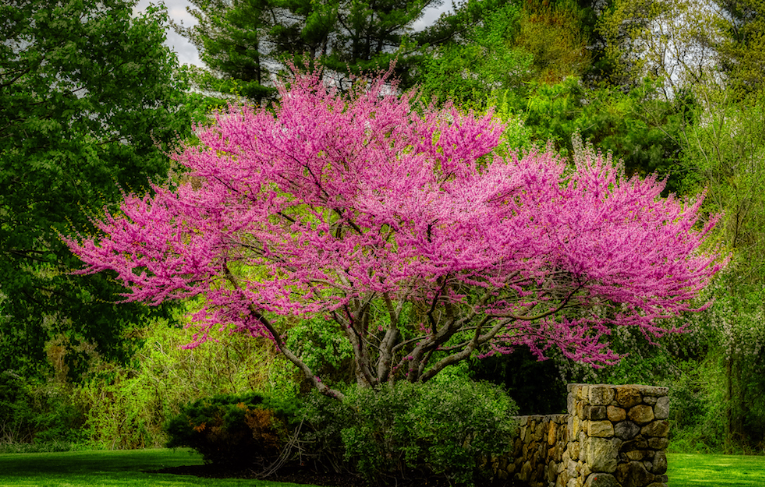
The Eastern redbud is a small native ornamental tree found throughout southern Michigan’s forest edges and understory, producing a striking display of magenta-pink flowers directly along its bare branches each spring before the leaves emerge. This tree typically reaches a mature height of 20 to 30 feet and is near the northern edge of its natural range within Michigan, generally becoming less reliably hardy toward the state’s central and northern counties.
Eastern redbud features attractive heart-shaped leaves that turn a pleasant yellow color each fall, adding a second season of visual interest beyond its notable spring bloom period. This tree’s relatively compact size and vivid early spring color have made it one of the most popular native ornamental trees planted throughout southern Michigan’s residential landscapes.
Flowering Dogwood
The flowering dogwood produces a spectacular display of white or pink bracts each spring, typically reaching a mature height of 15 to 30 feet, and grows naturally throughout southern Michigan’s forested regions near the northern edge of its overall range. This tree naturally grows as an understory species, thriving in the dappled shade found beneath larger canopy trees throughout southern Michigan’s oak-hickory woodlands.
Flowering dogwood becomes considerably less common toward Michigan’s northern counties, where colder winter temperatures limit its successful establishment and long-term survival. This tree’s bright red fall berries provide an important food source for migrating birds, and its attractive layered branching structure adds visual interest to the southern Michigan landscape throughout every season.
Black Locust
The black locust is a fast-growing tree found throughout much of Michigan, particularly common on disturbed sites and forest edges, typically reaching a mature height of 40 to 60 feet. This tree produces fragrant white flower clusters in late spring that provide an important early-season nectar source for bees throughout the state, supporting notable black locust honey production in some regions.
Black locust has a unique ability to fix atmospheric nitrogen through a symbiotic relationship with soil bacteria, allowing it to thrive in poor, nutrient-depleted soils where many other trees struggle to establish across Michigan’s disturbed and reclaimed land areas. This tree’s extremely dense, rot-resistant wood has made it historically valuable for fence posts and other applications requiring long-term ground contact durability throughout Michigan’s rural landscape.
Kentucky Coffeetree
The Kentucky coffeetree is found in scattered native populations throughout southern Michigan, and it is also increasingly planted as an urban street tree throughout the state, typically reaching a mature height of 50 to 70 feet. This tree tolerates urban stresses including drought, pollution, and road salt exposure with relative ease, making it well suited to Michigan’s challenging city growing environments, particularly in southeastern Michigan’s more urbanized areas.
Kentucky coffeetree features bold, coarse-textured compound leaves and large, leathery seed pods that were historically roasted as a coffee substitute by early Michigan settlers, giving the tree its common name. This tree’s strong branch structure and resistance to storm damage have made it an increasingly popular choice for street tree plantings throughout Detroit and other Michigan cities as ash tree populations continue their decline.
Tuliptree
The tuliptree, sometimes called yellow poplar, reaches near the northern edge of its natural range within southern Michigan, capable of reaching a mature height of 80 to 120 feet under favorable growing conditions. This tree produces distinctive tulip-shaped flowers in late spring, typically high in the canopy and easily overlooked despite their attractive yellow-green and orange coloration.
Tuliptree grows remarkably fast for a large hardwood, often exceeding 3 feet of height per year during its early decades of growth, making it one of the quickest native trees to reach substantial size where it occurs within the state. This tree’s tall, straight trunk and minimal lower branching have made it historically valuable for lumber production throughout the parts of southern Michigan where it grows naturally.
Sassafras
The sassafras is a distinctive native tree found throughout southern Michigan, easily recognized by its unusual leaves, which can appear in three different shapes, including oval, mitten-shaped, and three-lobed forms, sometimes all on the same branch. This tree typically reaches a mature height of 30 to 60 feet and produces small yellow flowers in early spring, followed by dark blue berries on red stems that provide an important food source for birds.
Sassafras roots and bark carry a distinctive spicy, root-beer-like fragrance, historically used to flavor traditional root beer and various other beverages before safety concerns limited commercial use of the tree’s oil. This tree’s brilliant orange, red, and yellow fall color, often displaying multiple shades simultaneously, makes it one of the most visually striking native trees found throughout southern Michigan’s forest edges.
Montmorency Tart Cherry
The Montmorency tart cherry has made Michigan the leading producer of tart cherries in the United States, with the state responsible for roughly 70 percent of the nation’s total tart cherry production, centered heavily around the Traverse City region, often called the Cherry Capital of the World. This tree typically reaches a mature height of 15 to 20 feet and benefits enormously from the lake effect climate along Michigan’s western shoreline, where nearby Lake Michigan moderates spring temperatures enough to protect vulnerable blossoms from damaging late frosts.
Montmorency cherry trees generally begin producing a meaningful fruit crop within 3 to 4 years of planting and can remain productive for 15 to 20 years under good orchard management. This tree’s economic and cultural significance to northern Michigan is celebrated each July during the National Cherry Festival, one of the state’s largest annual agricultural celebrations.
Sweet Cherry
The sweet cherry is grown throughout Michigan’s fruit belt region alongside its tart cherry relative, typically reaching a mature height of 20 to 35 feet and benefiting from the same favorable lake effect climate found along the state’s western Lake Michigan shoreline. This tree requires a slightly longer frost-free growing season than tart cherry to fully ripen its fruit, making Michigan’s most sheltered fruit belt microclimates particularly well suited to successful sweet cherry production.
Sweet cherry trees are somewhat more susceptible to certain diseases and pest pressures compared to tart cherry, requiring more intensive orchard management throughout the growing season. This tree contributes to Michigan’s overall standing as one of the nation’s most significant cherry-producing states, complementing the larger tart cherry industry with fresh-market sweet cherry production.
Apple Tree
The apple tree has an extensive agricultural history throughout Michigan, with the state consistently ranking among the top apple-producing states in the country, supported by the same favorable lake effect climate that benefits the state’s cherry industry. This tree typically reaches a mature height of 15 to 25 feet for standard varieties, though dwarf and semi-dwarf rootstocks have become increasingly popular for modern commercial orchards throughout the state.
Michigan’s apple industry benefits from the significant day-to-night temperature swings common throughout the state’s growing season, which help develop good fruit sugar content and coloration in many popular varieties. This tree’s long growing history in Michigan, combined with the state’s numerous fall harvest festivals and U-pick orchards, has made apple growing a deeply rooted part of Michigan’s agricultural identity and rural tourism economy.
Peach Tree
The peach tree is grown successfully throughout Michigan’s fruit belt region along the state’s western Lake Michigan shoreline, benefiting significantly from the lake effect climate that moderates otherwise harsh spring temperature swings. This tree typically reaches a mature height of 12 to 20 feet and requires the specific combination of adequate winter chill hours followed by a frost-free spring bloom period that Michigan’s fruit belt reliably provides in most years.
Peach trees are considerably more vulnerable to hard freezes than apple or tart cherry trees, since their early blossoms can be damaged or destroyed by a single significant cold snap at the wrong point in the growing season. This tree’s continued success throughout southwestern Michigan depends heavily on the moderating influence of nearby Lake Michigan, illustrating just how significant the Great Lakes’ presence is to the state’s overall fruit-growing capacity.
Autumn Blaze Maple
The Autumn Blaze maple is one of the most popular ornamental shade trees planted throughout Michigan’s urban and suburban landscapes, valued for its fast growth and reliably brilliant red-orange fall color, typically reaching a mature height of 40 to 50 feet. This hybrid maple variety was specifically developed to combine the strong points of its silver maple and red maple parentage, resulting in a tree with better structural strength and superior fall color performance compared to either parent species alone.
Autumn Blaze maple grows considerably faster than many other maple varieties, often adding 3 feet of height or more per year under good growing conditions throughout Michigan’s favorable climate. This tree’s strong tolerance for Michigan’s cold winters and adaptability to a range of soil types have made it an increasingly popular replacement choice as the state’s ash populations continue to decline from emerald ash borer damage.
Littleleaf Linden
The littleleaf linden is a popular ornamental shade tree widely planted throughout Michigan’s urban and suburban landscapes, typically reaching a mature height of 40 to 50 feet with a distinctive pyramidal to oval canopy shape. This tree produces small, fragrant yellow-white flowers in early summer that attract large numbers of bees, making it a valuable addition for supporting pollinator populations in developed areas throughout the state.
Littleleaf linden tolerates urban conditions well, including compacted soil and road salt exposure, making it a common choice for street tree plantings throughout many of Michigan’s cities and suburbs. This tree’s dense, uniform growth habit and strong tolerance for pruning have made it a popular formal shade tree choice throughout the state’s more developed landscapes, particularly across southeastern Michigan.
Honeylocust
The honeylocust is a hardy tree found throughout Michigan, typically reaching a mature height of 40 to 60 feet with an open, airy canopy that allows dappled light to reach the ground below. This tree tolerates a wide range of soil conditions, including Michigan’s compacted urban soils and road salt exposure, making it one of the most commonly planted street trees throughout the state’s cities.
Most landscape honeylocust trees planted today are thornless, seedless cultivars, avoiding the sharp thorns and messy seed pods found on the wild native form. This tree’s fine-textured, compound leaves produce light, dappled shade that allows grass and other plants to grow successfully beneath its canopy, a valuable trait in urban landscape settings throughout Michigan’s cities and suburbs.
Ginkgo
The ginkgo is a highly resilient ornamental shade tree widely planted throughout Michigan’s urban areas, typically reaching a mature height of 40 to 50 feet and valued for its unique, fan-shaped leaves that turn a brilliant, uniform gold each fall. This tree is highly tolerant of urban pollution, compacted soil, and road salt exposure, making it particularly well suited to street tree plantings throughout the state’s more developed cities, including Detroit and Grand Rapids.
Ginkgo grows relatively slowly compared to many other large shade trees, often taking 20 years or more to reach substantial landscape size, but rewards patience with a lifespan that can exceed several centuries. This tree is considered a living fossil, with a lineage tracing back more than 200 million years, making it one of the oldest tree species still commonly planted in Michigan’s cities today.
Colorado Blue Spruce
The Colorado blue spruce, though not native to Michigan, has become one of the most widely planted ornamental conifers throughout the state, valued for its striking blue-gray needle coloration and reaching a mature height of 50 to 75 feet in favorable landscape conditions. This tree tolerates Michigan’s cold winters exceptionally well, though it can be susceptible to certain fungal needle diseases that have become more prevalent throughout the state’s humid summer conditions in recent years.
Colorado blue spruce is commonly used throughout Michigan for windbreak plantings, privacy screening, and as a specimen tree in both residential and commercial landscapes statewide. This tree’s dense, symmetrical form and consistent year-round color have made it one of the most recognizable ornamental conifers found throughout Michigan’s urban and suburban landscapes despite its origin in the distant Rocky Mountains.