Edible palm fruits range from the familiar coconut and date to scaly, starchy and jelly-like fruits rarely seen outside the tropics. The palm family has about 2,600 species, but people regularly eat the fruit of only a few dozen. Those few are staple foods for hundreds of millions of people.
Most palm fruits share one basic design. A skin covers a layer of flesh, and the flesh surrounds a hard stone that holds the seed. In some palms people eat the flesh, and in others they eat the seed or the liquid inside it.
The flavors vary as much as the forms. Dates are almost pure sugar, peach palm fruit is as starchy as a potato, and açaí is rich in fat. Several must be cooked or soaked before they are safe or pleasant to eat.
Nearly all of these palms need tropical or desert heat, though one tolerates hard frost. The 10 fruits below are the most widely eaten, and each entry notes where the palm is grown.
1. Coconut
The coconut is the most widely used palm fruit in the world. It is large and oval, with a smooth outer skin. Beneath the skin is a thick, fibrous husk. Inside the husk is a hard brown shell. The shell is lined with firm white flesh. The hollow center holds a sweet, clear liquid.
Every edible part has its own use. Young green coconuts are opened for their water and soft, jelly-like flesh. Mature flesh is grated, pressed for milk or dried and pressed for oil. The flesh is high in fat and fiber. A palm can bear fruit for 60 years or more. Coconuts are grown on tropical coasts worldwide, mainly in Indonesia, the Philippines, India, Sri Lanka, Brazil and the Pacific islands.
2. Date
The date is one of the oldest cultivated fruits. It is oblong and 1 to 3 inches long. The skin is thin and ranges from golden to dark brown. The flesh is soft, sticky and very sweet. A single narrow seed runs through the center. Dates hang in clusters that can weigh 20 pounds or more.
The University of Florida notes that the date palm has been cultivated for its fruit for centuries. Ripe dates are more than half sugar by weight. They are eaten fresh, dried, stuffed or pressed into syrup. Dried dates keep for many months without refrigeration. The fruit needs long, hot, dry summers to ripen. Dates are grown in Egypt, Saudi Arabia, Iran, Iraq, Algeria, Tunisia and the deserts of California and Arizona.
3. Açaí
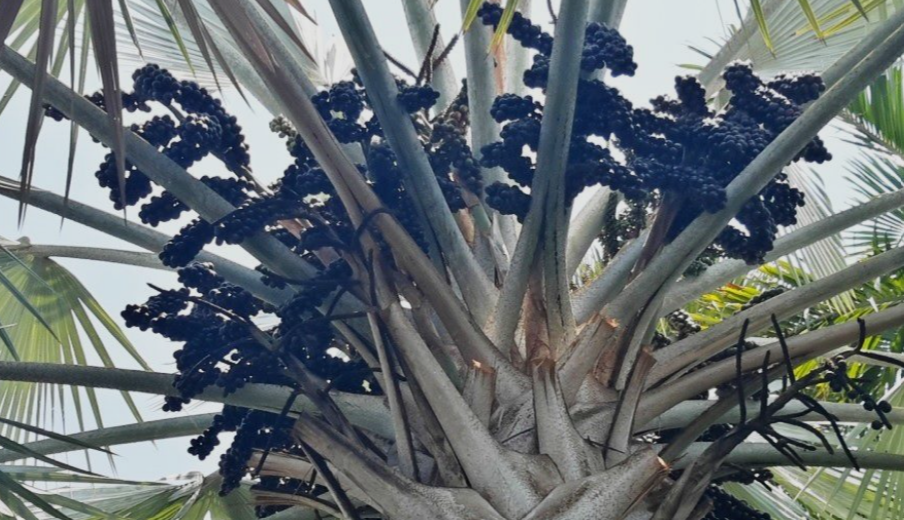
Açaí is a small, round, dark purple fruit. It is about the size of a large blueberry. It grows in hanging clusters of several hundred. Most of each fruit is a hard seed. Only a thin layer of purple pulp covers it. The fruit spoils within a day of picking.
The pulp is soaked and mashed into a thick, purple liquid. It tastes earthy, with a hint of chocolate and berry. It is unusually high in fat for a fruit. Along the lower Amazon it is eaten daily with fish and cassava. Elsewhere it is sold frozen and blended into bowls and drinks. Açaí is harvested in northern Brazil, especially the state of Pará, and in nearby parts of the Amazon basin.
4. Peach Palm Fruit
Peach palm fruit is a starchy fruit of tropical America. It is egg-shaped and about 2 inches long. The skin ripens to red, orange or yellow. The flesh is firm, dry and orange. Most fruits hold a single hard seed. Fruits with fine scars along the skin are considered the best.
Purdue University publishes a detailed account of this fruit, which is also called pejibaye. It is never eaten raw. It is boiled in salted water for an hour or more. The cooked flesh tastes like a blend of chestnut and squash. It is rich in starch, oil and vitamin A. Peach palm fruit is grown in Costa Rica, Panama, Colombia, Ecuador, Peru and Brazil.
5. Salak
Salak is known as snake fruit for its scaly skin. It is the size and shape of a fig. The skin is thin, brown and covered in shiny scales. It peels away easily from the tip. Inside are three pale, cream-colored lobes. The largest lobe holds a hard, brown seed.
The flesh is crisp and juicy, like an apple. The flavor is sweet and tart, with hints of pineapple and banana. Some varieties are dry and crumbly, and others are moist. A thin, papery skin on each lobe is usually rubbed off. The fruit is eaten fresh, pickled or cooked in syrup. Salak is grown in Indonesia, especially Java, Sumatra and Bali, and in Malaysia and Thailand.
6. Jelly Palm Fruit
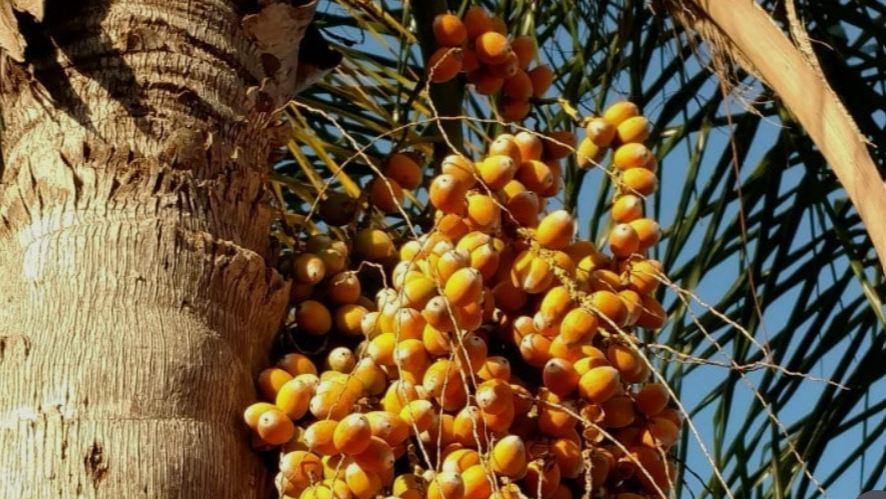
Jelly palm fruit comes from the pindo palm. It is round to oval and about an inch across. It ripens to yellow-orange. The fruits hang in large, heavy clusters. The flesh is juicy and somewhat fibrous. A hard seed sits at the center.
The University of Florida describes the fruits as juicy, edible and often used to make jams or jellies. The flavor is sweet and tart, like pineapple mixed with apricot. The fruit is high in pectin, so it sets easily. It can also be eaten fresh or made into wine. It ripens in summer. The palm is native to southern Brazil and Uruguay and is grown across the southeastern United States, California and southern Europe.
7. Aguaje
Aguaje is the fruit of the moriche palm. It is oval and about 2 inches long. Its skin is made of shiny, red-brown scales. Beneath the scales is a thin layer of bright orange flesh. A large seed fills most of the fruit. It grows in bunches that can hold hundreds of fruits.
The flesh is oily and slightly sour. It is one of the richest known plant sources of vitamin A. The fruit is soaked in warm water to soften the scales. It is eaten fresh with salt or made into drinks, ice pops and ice cream. In the Peruvian city of Iquitos it is sold on nearly every street. Aguaje is harvested in the swamp forests of Peru, Brazil, Venezuela, Colombia, Ecuador and Bolivia.
8. Ice Apple
Ice apple is the young fruit of the palmyra palm. The whole fruit is round and dark purple-black. It is about the size of a small coconut. Inside the fibrous husk are three seed pockets. Each holds a soft, translucent kernel. The kernel is filled with a little sweet water.
The kernels are scooped out and eaten fresh. The texture is like firm jelly. The flavor is mild and lightly sweet. It is sold by street vendors as a cooling snack in hot weather. The ripe fruit has orange pulp used in cakes and fritters. Ice apple is grown in India, Sri Lanka, Bangladesh, Myanmar, Thailand, Cambodia and Indonesia.
9. Doum Fruit
Doum fruit comes from the branching doum palm. It is oval and about 3 inches long. The skin is hard, glossy and orange-brown. Beneath it is a dry, fibrous, spongy rind. A large, very hard seed lies inside. The fruit takes many months to ripen.
The rind is the edible part. It tastes much like gingerbread. It is gnawed off the seed, ground into flour or steeped in water. The steeped drink is popular in Egypt. Doum fruit has been found in the tombs of ancient pharaohs. The palm grows along the Nile in Egypt and Sudan and across the Sahel, East Africa and the Arabian Peninsula.
10. Nipa Palm Fruit
Nipa palm fruit grows on a trunkless palm of tidal swamps. The fruits are packed into a round, woody cluster. The cluster is brown and about a foot across. Each segment is angular and fibrous. It holds a single seed. The seed is the part eaten.
Young seeds are soft, translucent and jelly-like. They are mildly sweet. They are eaten fresh or preserved in syrup. In Malaysia and Singapore they are a common topping for iced desserts. Mature seeds become hard and are no longer eaten. Nipa palms grow along muddy coasts from India and Sri Lanka through Southeast Asia to the Philippines and northern Australia.
Key Takeaways:
– Edible palm fruits come from several palm species: Popular examples include dates, coconuts, acai berries, palmyra fruits, and peach palm fruits, each with distinctive characteristics and culinary uses.
– Palm fruits vary in taste and texture: Depending on the species and maturity, edible fruits may taste sweet, mildly acidic, or nutty, with textures ranging from soft and juicy to firm and starchy.
– Dates and coconuts are widely consumed: Dates are valued for their natural sweetness, while coconuts provide edible flesh, refreshing water, and oil used in cooking and food processing.
– Some palm fruits require preparation before eating: Peach palm fruits, for example, are traditionally cooked before consumption, while other species have specific processing requirements to make their fruits suitable for eating.
– Edible palm fruits provide useful nutrients: Depending on the species, they can supply carbohydrates, dietary fiber, vitamins, minerals, and fats, making them valuable components of diets in many tropical regions.
– Not every palm fruit is safe to eat: Edibility varies considerably among palm species, so fruits should be positively identified before consumption. Some require processing, and ornamental palm fruits should not automatically be assumed to be edible.