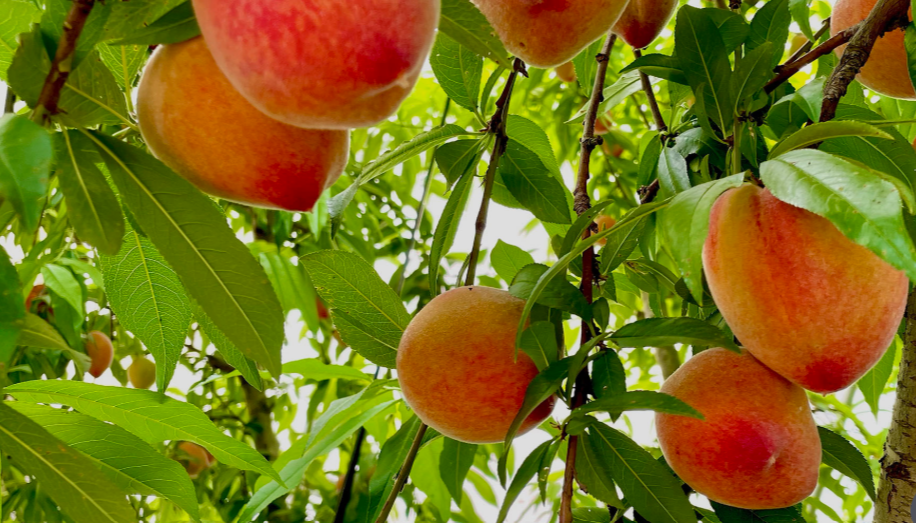
Peach season in Texas runs from mid-May through mid-August in most years, with the heaviest picking in June and July. The exact dates shift by region and by variety, so a stand in the Hill Country may open weeks before an orchard near the Red River. Knowing how the season unfolds makes it much easier to find fruit at its best.
Peaches are the leading deciduous fruit crop in the state, with an estimated 1 million trees planted. Only about half of those trees stand in commercial orchards, and the rest grow in backyards and small family plots. Most of the commercial crop is sold close to home, at roadside stands, farmers’ markets and Texas grocery stores.
When the Season Starts and Ends
The first Texas peaches ripen in early to mid-May. Springold and Bicentennial are usually the earliest varieties, and they are small, bright and juicy. Growers in the Hill Country typically open their stands around the middle of the month.
The season builds through June and peaks from late June into July, when the large freestone varieties come in. Picking tapers off in early to mid-August across central Texas. A few growers plant late varieties to keep fruit on their stands into late August and early September, and the last peaches of the year ripen in orchards along the Red River.
No single variety lasts long. Hill Country growers raise about 40 different varieties, and each one is picked for roughly 2 weeks. That steady succession is what keeps fresh fruit on the stands for 3 months.
Clingstone First, Freestone Later
The early weeks belong to clingstone peaches, whose flesh holds tightly to the pit. These are the peaches of May and early June, and varieties such as June Gold and Regal fall in this group. They are excellent for eating out of hand and for jam, though they take more work to slice.
Freestone peaches follow from late June into early August. Their flesh pulls cleanly away from the pit, which makes them the favorite for canning, freezing, cobblers and pies. Harvester, Majestic, Loring, Redglobe, Dixiland and Redskin are among the best-known freestones grown in the state.
Shoppers who want peaches for preserving should plan their trip for late June or July. Those who simply want the first taste of the season can go in May. Many stands post which variety they are picking, and it is worth asking if they do not.
Where Texas Peaches Grow
The Hill Country is the center of Texas peach growing. Gillespie County, which includes Fredericksburg and Stonewall, has produced about 40% of the state’s commercial crop. Roadside stands line Highway 290 between the two towns and Highway 87 south of Fredericksburg.
Commercial growing in the Hill Country dates to the 1930s, and several orchards are still run by the families that planted them. Extension specialists credit the area’s well-drained sandy soil, its mineral content and its elevation of about 1,700 feet for the quality of the fruit. The region’s reputation draws thousands of visitors every summer.
Northeast Texas ranks second in production. Orchards are scattered through East Texas and around Fairfield in Freestone County, where Texas A&M tests many of its new varieties. North Texas has its own peach country in Parker County, west of Fort Worth, and in the counties along the Red River.
Why Winter Decides the Summer Crop
A peach tree must spend a certain number of hours in the cold each winter before it will bloom and set fruit properly. These are called chill hours, and they are generally counted as hours below 45°F. Trees that miss their quota leaf out unevenly, bloom poorly and carry a light crop.
Hill Country orchards normally receive between 650 and 800 chill hours, and traditional records put the long-term figure near 830. East Texas tends to get more, with around 1,000 hours recorded at the research center in Overton in some recent winters. Many traditional peach varieties need 800 hours or more, which leaves little margin in a mild year.
The second danger is a late freeze. Peach trees bloom early, and a cold snap in March can destroy the flowers or the young fruit overnight. A late freeze in 2013 left most Hill Country growers with only about 5% of a normal commercial crop.
These two risks explain why the season varies so much from one year to the next. The 2026 Hill Country crop was light for the third year running, after a warm winter and a spring freeze that cut some orchards badly. Visitors should check with individual orchards before making a long drive.
How Texas A&M Is Extending the Season
Texas has a long history with the fruit. The 1910 census counted nearly 10 million peach trees in the state, a number that fell quickly as inexperienced growers learned how unreliable the crop could be. The University of North Texas preserves a state agriculture newsletter that traces this rise and fall.
Texas A&M University planted the first peach variety trial in the state in 1899 and began a breeding program in 1935. The program has since released about 40 stone fruit varieties suited to Texas and the southern United States. Its main goal has been peaches that crop reliably with less winter cold.
The newer varieties are sorted by chill requirement. Low-chill peaches need fewer than 250 hours, and medium-chill peaches need 350 to 650 hours. Texas A&M AgriLife notes that its releases range from about 150 hours, suitable as far south as the Rio Grande Valley, to about 600 hours for the northern part of the state.
In the warmest zones, these low-chill peaches can ripen in April and early May. That is several weeks ahead of the traditional Hill Country opening. As more growers plant them, the Texas season is slowly stretching at its front end.
Festivals and Peach Stands
Two festivals mark the height of the season. The Stonewall Peach JAMboree is held on the third weekend of June in Gillespie County and coincides with the start of the freestone harvest. The Parker County Peach Festival takes place in Weatherford in July and fills the town square with vendors.
Outside the festivals, most Texans buy their peaches straight from the orchard. Stands sell fruit by the basket, the peck and the half bushel, along with cobbler, ice cream, jam and preserves. Some orchards offer pick-your-own fields when the crop is large enough.
Choosing and Keeping Texas Peaches
Color is a better guide to ripeness than softness. A ripe peach has a deep yellow or golden background behind its red blush, with no trace of green near the stem. The red blush itself varies by variety and says little about ripeness.
A ripe peach also smells sweet and gives slightly when pressed near the stem. Firm peaches will soften in 2 or 3 days at room temperature if they are laid in a single layer. Once ripe, they keep for several more days in the refrigerator.
Peaches bought for freezing should be fully ripe freestones. They can be peeled, sliced and packed with a little sugar or lemon juice to hold their color. A half bushel put up in July will carry a household through the months when no Texas peaches are to be had.
Further References:
- Texas A&M University: Peach Breeding Program
- Texas A&M AgriLife Today: new peach varieties for Texas
- University of North Texas, Portal to Texas History: Texas Department of Agriculture newsletter, June 2022
- Farm Progress: Texas peach season underway
- Farm Progress: Texas peach yields and chill hours
- Texas Public Radio: 2026 Fredericksburg peach crop
- Visit Fredericksburg: 2026 Gillespie County peach season
- Visit Fredericksburg: Peach Season in the Texas Hill Country
- DailyTrib: Peach-perfect growing fields in the Highland Lakes
- Texas Monthly: Peach Dreams
- Fruit Growers News: Texas A&M releases low- and medium-chill peaches
- FreshPlaza: Texas peach harvest commencing May