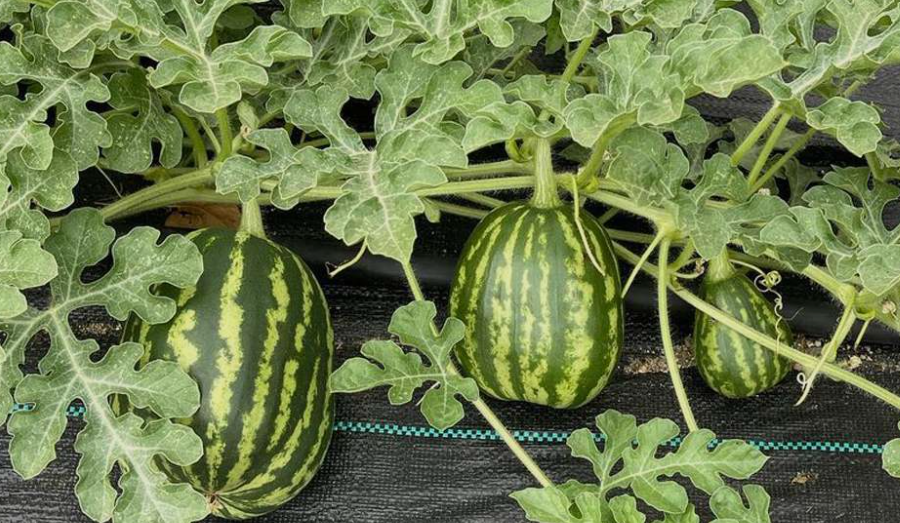
Types of watermelon number in the hundreds, yet almost every one traces back to a single desert fruit from northeast Africa. The plant was being farmed in the Nile Valley thousands of years ago, reached China by about the 10th century and arrived in the Americas with European colonists and enslaved Africans in the 1500s and 1600s. Today it is grown on every inhabited continent.
The scale of the crop is easy to underestimate. World production reached a record of about 104.9 million metric tons in 2023, and China alone grew roughly 60.8% of it. India and Turkey followed at a great distance, each with less than 4 million metric tons.
In the United States, farmers harvested 3.87 billion pounds of watermelon in 2025 from more than 100,000 acres. Georgia led with 813 million pounds, or 21.0% of the national crop, narrowly ahead of Florida at 798 million pounds. Penn State Extension notes that watermelon has long been the most available melon in the country, at between 11 and 17 pounds per person each year.
The fruit itself is about 92% water and close to 6% sugar, with a ripe melon weighing anywhere from 3 pounds to more than 300. Seedless melons now make up well over 80% of American shipments, up from 51% in 2003. That shift has pushed many older seeded varieties out of supermarkets and into seed catalogs and home gardens.
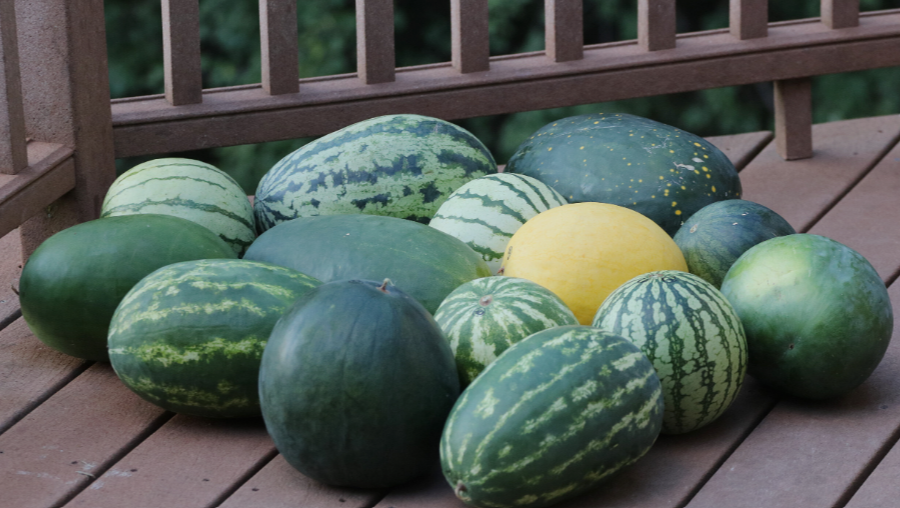
The 55 types below are arranged roughly in historical order, from wild African relatives to heirlooms, university-bred classics, modern hybrids and varieties from other countries. Each entry gives the origin of the melon, what it looks like and how it tastes. Weights and days to maturity are typical figures and vary with climate and soil.
1. Kordofan Melon
The Kordofan melon is a small, round melon with pale, whitish flesh that is mild instead of bitter. It grows in the Kordofan and Darfur regions of Sudan, where farmers still plant it and trade the seed locally. The rind is striped in light and dark green, much like a modern watermelon in miniature.
Washington University in St. Louis reported in 2021 that genetic work identified this melon as the closest known relative of the domesticated watermelon. The finding moved the fruit’s presumed homeland from southern Africa to the northeast of the continent. Breeders are now studying the Kordofan melon as a source of disease resistance.
2. Citron Melon
The citron melon is a hard, round melon with white or pale green flesh that is too firm and bland to eat raw. It comes from southern Africa, where wild forms grow in and around the Kalahari Desert. The flesh is rich in pectin, which makes it ideal for preserves, pickles and candied rind.
For about 90 years the citron was thought to be the ancestor of the sweet watermelon, a view the 2021 genetic study overturned. The plant has escaped from farms and grows wild in parts of the American South and Southwest. Ranchers have also used it as an emergency source of water and feed for cattle.
3. Egusi Melon
The egusi melon looks like a small, round watermelon on the outside, but its white flesh is dry and bitter. It originated in West Africa and is grown across Nigeria, Ghana and neighboring countries. The crop is raised for its large, flat seeds, which are rich in oil and protein.
The seeds are shelled, ground and cooked into egusi soup, one of the best-known dishes in West African cooking. Breeders have crossed egusi with sweet watermelon to move useful traits between them. The plant handles heat and drought better than most dessert melons.
4. Bradford
The Bradford is a long, dark green melon with faint ribs, weighing about 30 pounds. It was introduced around 1840 by Nathaniel Napoleon Bradford of Sumter County, South Carolina. By the 1850s it was famous across the South for its sweetness and for a rind tender enough to eat and pickle.
That soft rind was also its downfall, because the melons could not survive rail shipment. By 1925 the Bradford was grown only in South Carolina, and it was long believed lost. The family had kept the seed all along, and Nat Bradford brought the melon back to market in 2013.
5. Georgia Rattlesnake
The Georgia Rattlesnake is a long melon with light green rind crossed by dark, wavy stripes that resemble snakeskin. It is said to have been developed in Georgia in the 1830s. The flesh is rose-red and sweet, and mature fruits commonly reach 25 to 35 pounds.
It was one of the main shipping melons of the 19th-century South because of its tough rind. Gardeners in hot, humid states still grow it for its vigor and reliable size. The variety needs about 90 days of warm weather to mature.
6. Mountain Sweet Yellow
Mountain Sweet Yellow is a large, oblong melon with dark-striped rind and deep yellow flesh. It descends from Mountain Sweet, a leading market melon in New Jersey, New York and Philadelphia during the 1840s. The flesh is dense and very high in sugar, with black seeds.
Fruits weigh 20 to 35 pounds and ripen in about 95 to 100 days. It is one of the oldest yellow-fleshed varieties still sold in the United States. Seed savers revived it after it had nearly dropped out of commerce.
7. Kolb’s Gem
Kolb’s Gem is a nearly round melon with thick, dark green rind marked by lighter stripes. Reuben Kolb, a planter from Eufaula, Alabama, introduced it in the 1880s. It quickly became the leading shipping melon in the South, since its rind withstood long rail journeys.
Fruits commonly weighed 30 to 50 pounds, with bright red flesh. Kolb later became Alabama’s commissioner of agriculture and a candidate for governor. The variety is rare today but survives in heirloom seed collections.
8. Florida Favorite
Florida Favorite is an oblong melon with dark green rind and lighter stripes. W. M. Girardeau of Monticello, Florida, introduced it in 1887. It is thought to be a cross between Georgia Rattlesnake and an older variety called Pierson.
The melon was valued for ripening about 10 days ahead of other large varieties of its time. Its flesh is light crimson and very sweet, with pale seeds. Monticello went on to become a national center of watermelon seed production.
9. Cole’s Early
Cole’s Early is a medium-sized, slightly oval melon with green rind and dark stripes. It was introduced in 1892 by a seed house in Pella, Iowa. The variety was bred for northern gardens, where the growing season is too short for the big Southern melons.
It ripens in about 80 days and weighs 15 to 20 pounds. The rind is thin and brittle, so it was always a home garden melon. The flesh is bright pink-red and fine-grained.
10. Kleckley Sweet
Kleckley Sweet is a long, squared-off melon with glossy, dark green rind. W. A. Kleckley of Alabama developed it, and a Philadelphia seed company introduced it nationally in 1897. It is recorded as a selection from a cross of two older melons, Boss and Arkansas Traveler.
The flesh is deep scarlet and so tender that the melon was sold mainly at local markets. Fruits weigh 25 to 40 pounds and take about 85 days to ripen. Its genes passed into several important breeding lines of the 20th century.
11. Tom Watson
Tom Watson is a large, long melon with tough, dark green rind showing a faint network of veins. It originated in Georgia in the early 1900s and was named for Thomas E. Watson, a Georgia politician. Fruits often weigh 35 to 50 pounds.
The elastic rind made it one of the best shipping melons of its era. Its flesh is deep red and crisp, with brown seeds marked in white. For several decades it was among the most widely planted commercial varieties in the South.
12. Klondike
Klondike is a blocky, oblong melon grown in both solid green and striped forms. It rose to prominence in California in the early 1900s, though its exact beginnings are not well documented. The flesh is deep red and noted for a very high sugar content.
North Carolina State University lists Klondike among the foundational varieties of American watermelon breeding. A wilt-resistant selection called Klondike R-7 was introduced by the University of California at Davis in 1937 and stayed popular in the state for many years. Klondike is a parent of Crimson Sweet and Allsweet.
13. Chelsea
Chelsea is a round to oval melon with green rind and darker stripes, weighing 15 to 20 pounds. It comes from the town of Chelsea, Iowa, where it was grown in the early 1900s. Farmers there raised it on sandy river-bottom soil and hauled it to market by wagon.
The flesh is pink-red, very sweet and holds its quality well after picking. Seed preservationists in Iowa rescued the variety after it had almost disappeared. It ripens in about 90 days.
14. Stone Mountain
Stone Mountain is a large, nearly round melon with dark green rind and thick, sturdy walls. An Atlanta seed company introduced it in 1923 and named it after the granite mountain east of the city. Fruits typically weigh 30 to 40 pounds.
It became one of the leading commercial melons in the South during the 1930s and 1940s. The flesh is scarlet and sweet, with relatively few seeds. Disease pressure later reduced its acreage, and it is now a home garden heirloom.
15. Moon and Stars
Moon and Stars has dark green rind speckled with small yellow dots and one or more large yellow patches. A New York seed company introduced it in 1926. The leaves carry the same yellow spots, which makes the plants easy to identify.
The variety vanished from catalogs and was believed extinct until 1981, when seed was found with a farmer in Macon, Missouri. Fruits weigh 20 to 40 pounds and have sweet, pink-red flesh. Yellow-fleshed and long-fruited strains also exist.
16. Black Diamond
Black Diamond is a big, round melon with glossy rind so dark green that it looks almost black. It has been grown across Texas, Oklahoma and Arkansas since the mid-1900s, though the breeder is not clearly recorded. Fruits regularly reach 30 to 50 pounds and can go much higher.
The flesh is bright red and coarse-grained, with large dark seeds. A strain called Yellow Belly develops a bright yellow ground spot when ripe. The variety remains a roadside stand favorite in the southern Plains.
17. Hopi Yellow
Hopi Yellow is a round, medium-sized melon with pale green rind and crisp, yellow flesh. It has been grown for generations by the Hopi people on the mesas of northeastern Arizona. Watermelons reached the Southwest with the Spanish and spread quickly among Native farmers.
The Hopi plant it without irrigation, relying on deep sandy soil that holds winter moisture. Fruits weigh 10 to 20 pounds and are very sweet. The plants tolerate heat, wind and drought better than most commercial varieties.
18. Navajo Winter
Navajo Winter is a round melon with pale green or striped rind and pink to red flesh. It comes from the Navajo Nation in the Four Corners region of the Southwest. The rind is thick and hard, which allows the fruit to be stored for months.
Families traditionally kept the melons in cool cellars and ate them well into winter. Fruits weigh 15 to 20 pounds, and the flavor is mild and sweet. Like other desert-adapted melons, it grows well with little water.
19. Tohono O’odham Yellow-Meated
This is an oblong, green-striped melon with yellow to orange flesh. It was developed by the Tohono O’odham people of the Sonoran Desert in southern Arizona. The melon is planted to coincide with the summer monsoon rains.
Fruits can reach 30 pounds or more in good soil. The flesh is sweet and firm, with a high sugar content for a dry-land melon. A seed conservation group in Tucson has kept the variety available to growers.
20. Congo
Congo is a long, blocky melon with dark green rind and darker stripes. The federal vegetable breeding laboratory in Charleston, South Carolina, released it in 1949. It won an All-America Selections award in 1950.
Fruits weigh 30 to 40 pounds and have firm, deep red flesh. The variety was bred for resistance to anthracnose, a major fungal disease of the time. Its tough rind made it a dependable shipping melon.
21. Charleston Gray
Charleston Gray is a long melon with pale, gray-green rind that resists sunburn. Charles Fredric Andrus of the federal vegetable laboratory in Charleston, South Carolina, released it in 1954. It combined disease resistance, high yields and a rind strong enough for long-distance trucking.
Clemson University notes that Andrus began breeding for sweetness and disease resistance in 1938. Federal researchers say Charleston Gray is in the lineage of about 95% of the watermelons grown today. Fruits weigh 20 to 40 pounds and ripen in about 85 days.
22. New Hampshire Midget
New Hampshire Midget is a tiny, round melon weighing only 4 to 6 pounds. Breeders at the University of New Hampshire developed it, and it won an All-America Selections award in 1951. It was created for the short, cool summers of New England.
The fruit ripens in as little as 65 to 70 days, among the fastest of any watermelon. The rind is thin and dark-striped, and the flesh is red with black seeds. It helped establish the icebox class of small watermelons.
23. Sugar Baby
Sugar Baby is a round melon with very dark green rind, weighing 8 to 10 pounds. It was introduced in the mid-1950s by M. Hardin of Geary, Oklahoma. The flesh is deep red, fine-grained and notably sweet.
It became the standard icebox watermelon and is still one of the most widely sold garden varieties. The fruit ripens in 75 to 80 days and fits easily in a refrigerator. Bush forms have since been bred for small gardens.
24. Golden Midget
Golden Midget is a miniature melon that signals ripeness by turning its rind golden yellow. Elwyn Meader at the University of New Hampshire released it in 1959. The color change removes the guesswork from harvesting.
Fruits weigh about 3 pounds and have salmon-pink flesh. The variety matures in roughly 70 days, which suits it to northern gardens. Its leaves also yellow as the fruit ripens, which is normal for the variety.
25. Crimson Sweet
Crimson Sweet is a round to slightly oval melon with light green rind and bold, dark green stripes. Charles V. Hall of Kansas State University released it in 1963 after about 10 years of breeding. It became the most popular type of watermelon grown in the United States.
Fruits average about 25 pounds and have bright red flesh with small seeds. The variety resists both fusarium wilt and anthracnose. It remains widely grown in Africa and Asia as well as in American gardens.
26. Jubilee
Jubilee is a long melon with light green rind and distinct dark stripes. The University of Florida’s research center at Leesburg released it in 1963. Fruits commonly weigh 25 to 40 pounds.
The flesh is bright red, firm and sweet, with dark seeds. It became a leading commercial variety across the Southeast for decades. An improved strain, Jubilee II, added stronger wilt resistance.
27. Calhoun Gray
Calhoun Gray is a long, gray-green melon that closely resembles Charleston Gray. Louisiana State University released it in 1965 from its research station at Calhoun, Louisiana. Its main contribution was a very high level of resistance to fusarium wilt.
Fruits weigh 20 to 25 pounds and have red flesh. Plant pathologists still use the variety as a standard when testing new melons for wilt resistance. It is also grown in home gardens where the disease is a problem.
28. Sweet Princess
Sweet Princess is an oblong melon with pale green rind and a fine net of darker veins. North Carolina State University, which began breeding watermelon in 1953, released it in the 1960s. Fruits weigh 20 to 25 pounds.
The flesh is deep pink, sweet and crisp, with unusually small seeds. It resists anthracnose and fusarium wilt. The melon holds up well in the humid conditions of the Southeast.
29. Petite Sweet
Petite Sweet is a small, round melon with striped rind, weighing 6 to 10 pounds. Kansas State University released it in 1970 as part of the same breeding program that produced Crimson Sweet. It was designed as an icebox melon with the eating quality of a large one.
The flesh is bright red with a high sugar content. It carries the disease resistance of its larger relatives. The variety is uncommon today but is still offered by a few seed sellers.
30. Allsweet
Allsweet is a long melon with dark green rind and narrow, light green stripes. Kansas State University released it in 1973. Fruits weigh 25 to 30 pounds and have deep red, fine-textured flesh.
It gave its name to the Allsweet type, a market class that includes many later hybrids. The rind is tough, and the melon ships and stores well. It shares its parentage with Crimson Sweet.
31. Dixielee
Dixielee is a round melon with light green rind and narrow dark stripes. The University of Florida released it from its Leesburg center in 1979. Fruits weigh 20 to 30 pounds.
It is known for intensely red, very firm flesh that holds its texture after cutting. The variety resists fusarium wilt and anthracnose. It ripens in about 90 days.
32. AU-Producer
AU-Producer is a round, striped melon similar in appearance to Crimson Sweet. Auburn University in Alabama released it in 1985. It was bred to resist several diseases at once, including anthracnose, fusarium wilt and gummy stem blight.
Fruits weigh 20 to 25 pounds and have bright red, sweet flesh. The disease package made it useful to growers who wanted to spray less. It remains a sound choice for humid Southern gardens.
33. Mickylee
Mickylee is a round icebox melon with pale gray-green rind, weighing 7 to 10 pounds. The University of Florida released it in 1986. It was bred as a small melon that could handle Florida’s diseases and shipping distances.
The flesh is deep red and firm, with few seeds. Its tough rind gives it a longer shelf life than most small watermelons. Seed companies often include it as a pollinator in seedless fields.
34. Orangeglo
Orangeglo is a long melon with light green rind and jagged dark stripes. A family seed company in Poolville, Texas, introduced it in the 1960s. The flesh is bright orange, crisp and very sweet, with a flavor often described as tropical.
Fruits weigh 20 to 30 pounds and ripen in about 90 to 100 days. The seeds are cream-colored with dark tips. It is widely regarded as the best-tasting orange-fleshed watermelon.
35. Blacktail Mountain
Blacktail Mountain is a round, dark green melon weighing 6 to 12 pounds. Glenn Drowns bred it in northern Idaho in the 1970s, when he was still a teenager. He needed a melon that would ripen where summer nights are cold.
The fruit matures in 70 to 75 days and has deep scarlet, sweet flesh. It performs well in the North and also tolerates heat. The variety is named for a mountain near the breeder’s home.
36. Early Moonbeam
Early Moonbeam is a small, striped melon with bright yellow flesh. Alan Kapuler bred it in Corvallis, Oregon. It was selected to ripen in the cool, short summers of the Pacific Northwest.
Fruits weigh 5 to 8 pounds and mature in about 80 days. The flesh is sweet and crisp, with a thin rind. It is one of the few yellow watermelons that ripens reliably in maritime climates.
37. Strawberry
Strawberry is a long melon with dark green rind and darker stripes, weighing 15 to 25 pounds. It was selected from a Florida family heirloom in the 1980s. The flesh is a pink-red that resembles the color of ripe strawberries.
The texture is fine and nearly free of fiber, ripening close to the rind. It matures in about 85 days. Many seed savers rank it among the best-flavored heirloom melons.
38. Carolina Cross
Carolina Cross is the variety behind nearly every record-setting giant watermelon. It was developed in North Carolina from large melons long grown in Hope, Arkansas. The fruits are long and striped, and they often exceed 100 pounds.
The current world record is 350.5 pounds, set in 2013 by a grower in Sevierville, Tennessee. Giant melons need about 100 days, rich soil and heavy watering. The flesh is red and edible, though it is coarser than that of smaller melons.
39. Tri-X 313
Tri-X 313 was the first seedless watermelon to succeed commercially in the United States. It was developed by O. J. Eigsti in Goshen, Indiana, and released in 1962. The fruit is oval and striped, weighing 15 to 20 pounds.
The University of Arkansas explains that the method came from a scientist at Kyoto University in Japan, who described it in 1951. A plant with four sets of chromosomes is crossed with a normal one to give sterile seed with three sets. That seed costs 5 to 8 times as much as ordinary watermelon seed.
40. Yellow Baby
Yellow Baby is a round, striped icebox melon with bright yellow flesh. It was bred in Taiwan and won an All-America Selections award in 1975. Fruits weigh 8 to 10 pounds.
The flesh is crisp and sweet, with fewer and smaller seeds than most varieties of its day. The thin, hard rind helps it travel well. It matures in about 75 days.
41. Sangria
Sangria is a long hybrid melon with dark green rind and thin, light stripes. It was bred in the United States and introduced in the 1980s by a company that is now part of Syngenta. Fruits weigh 20 to 26 pounds.
It is prized for very dark red flesh and a high sugar content. For many years it was the standard seeded hybrid of the Allsweet type. Commercial growers still plant it for the seeded melon market.
42. PureHeart
PureHeart is a seedless mini melon weighing only 3 to 7 pounds. Syngenta introduced it in the United States in 2003. It was one of the first personal watermelons, sized for one or two people.
The rind is very thin, so a high share of the fruit is edible. The flesh is deep red, dense and sweet. Its success created a new category that now fills a large part of the supermarket melon display.
43. Harvest Moon
Harvest Moon is a seedless hybrid with the yellow-spotted rind of the old Moon and Stars. It was bred in the United States and won an All-America Selections award in 2013. It was the first seedless melon to carry that pattern.
Fruits weigh 18 to 20 pounds and have pink-red flesh. The plants are more compact and earlier than the heirloom. Like all seedless types, it needs a seeded variety planted nearby for pollination.
44. Densuke
Densuke is a round melon with glossy black rind and no stripes. It is grown only in and around the town of Toma on the island of Hokkaido in northern Japan. Only about 10,000 are harvested each year.
The flesh is bright red, crisp and sweeter than most watermelons. The melons are sold in gift boxes, and a single 17-pound fruit fetched about 6,100 dollars at auction in 2008. Most sell for a few hundred dollars.
45. Square Watermelon
The square watermelon is an ordinary melon grown inside a clear, box-shaped mold. The method was developed in Zentsuji, on the Japanese island of Shikoku, in the late 1970s. The idea was to make a melon that would fit neatly in a refrigerator and not roll.
Most are picked before they are ripe, so they are sold as ornaments and gifts. A single fruit can cost 100 dollars or more. Growers elsewhere have since produced heart-shaped and pyramid-shaped melons the same way.
46. Kodama
Kodama is the Japanese name for a class of very small watermelons weighing 2 to 6 pounds. The type was developed in Japan, where small households and small refrigerators created demand for it. The name means small ball.
The rind is thin and striped, and the flesh may be red or yellow. Kodama melons are very sweet and ripen early. They influenced the breeding of personal-sized melons in other countries.
47. Japanese Cream Fleshed Suika
This is a round, green-striped melon with pale cream flesh. It is an heirloom from Japan, and suika is the Japanese word for watermelon. Fruits weigh 6 to 12 pounds.
The flesh is crisp, mild and refreshing, with a lighter sweetness than red types. It matures in about 85 days. The unusual color makes it popular with market growers who sell mixed melon displays.
48. Ali Baba
Ali Baba is an oblong melon with light green rind that resists sunburn. It is an heirloom from Iraq and reached American gardeners through an Iraqi seed collector. Fruits weigh 12 to 30 pounds.
The flesh is red, very sweet and crisp. The hard rind allows the fruit to ship and store well. It thrives in extreme heat and has become one of the most praised heirlooms in American seed catalogs.
49. Malali
Malali is a small to medium melon with light green rind and darker stripes. It comes from Israel, where it is well suited to hot, dry summers. Fruits weigh about 10 pounds.
The flesh is deep pink and sweet. The variety is also grown for its seeds, which are roasted and salted as a snack. It matures in roughly 90 days.
50. Astrakhan
The Astrakhan watermelon is a round, striped melon with bright red flesh. It comes from the Astrakhan region of southern Russia, near the mouth of the Volga River. The area has been the country’s watermelon center for centuries.
Fruits weigh 15 to 20 pounds and have a thick rind that travels well. The melons reach Russian markets in August. The city of Astrakhan holds a watermelon festival each summer.
51. Ogonyok
Ogonyok is a small, round melon with thin rind of very dark green. It was bred in Ukraine during the Soviet period, and its name means little flame. Fruits weigh 4 to 6 pounds.
The flesh is orange-red, sweet and grainy. It ripens in 70 to 80 days, which made it popular in the shorter summers of central Russia. It remains one of the most common garden watermelons in Eastern Europe.
52. Kholodok
Kholodok is a large, oval melon with dark green rind and faint stripes. It was bred in southern Russia, and its name means coolness. Fruits weigh 10 to 15 pounds.
It is a late variety with a thick rind that allows it to be stored for 2 to 3 months. Families in Russia traditionally keep it for the New Year table. The flesh is pink-red and sweet.
53. Sweet Siberian
Sweet Siberian is an oblong melon with green rind and apricot-orange flesh. It came from Russia and was offered in the United States around 1900. Fruits weigh 8 to 10 pounds.
The flesh is juicy and very sweet. It ripens in about 80 days and performs well in cool northern gardens. Seed preservationists reintroduced it after it had dropped out of commerce.
54. Cream of Saskatchewan
Cream of Saskatchewan is a round, striped melon with creamy white flesh. Russian immigrants brought it to the Canadian province of Saskatchewan in the early 1900s. Fruits weigh 8 to 10 pounds.
The rind is so thin and brittle that a ripe melon can split when touched with a knife. For that reason it has never been shipped and is strictly a garden melon. It ripens in about 80 days and is very sweet.
55. Hawkesbury
Hawkesbury is a long melon with gray-green rind and fine, darker veins. It was developed in New South Wales, Australia, in the 1930s. It was among the first varieties bred for resistance to fusarium wilt.
Fruits weigh 25 to 30 pounds and have pink-red, sweet flesh. It is counted among the foundational varieties behind later American and Australian melons. The variety is still sold to home gardeners in Australia.
Key Takeaways:
- Watermelons come in many varieties that differ in size, shape, rind pattern, flesh color, sweetness, and seed characteristics.
- Common types include large picnic watermelons, smaller personal-size varieties, seedless watermelons, and compact icebox types.
- Watermelon flesh is usually red or pink, but some varieties produce yellow, orange, cream, or even unusual-colored flesh.
- Seedless watermelons are popular for fresh eating, while seeded varieties are still valued for their flavor, productivity, and traditional characteristics.
- Different watermelon varieties have different maturity periods, making some better suited to short growing seasons and others to long, warm seasons.
- Choosing the right variety depends on available garden space, climate, intended use, fruit size preferences, and whether you want seeded or seedless fruit.
Further References
- Penn State Extension: Watermelon Production in the United States
- Washington University in St. Louis: origin of domesticated watermelons
- NC State University: History, Important Varieties
- Clemson University: The Watermelon Journey
- University of Arkansas: Seedless Watermelon
- USDA Economic Research Service: 2025 watermelon production
- FreshPlaza: world watermelon production record
- Agricultural Marketing Resource Center: Watermelon
- Clemson World: Discovering a Family Heirloom
- Iowa State University Library: Charles V. Hall Papers
- USDA: Charleston Gray watermelon