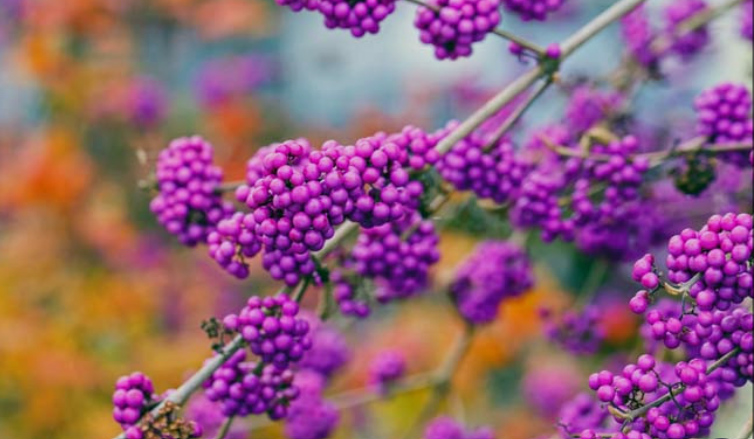
Fruits that are purple on the inside are far scarcer than fruits that are purple on the outside. Concord grapes, plums, eggplants and passion fruit all wear purple skin over flesh that is green, yellow or white. Even the blueberry, the fruit most people would name first, is pale green once you bite it in half.
The fruits that do carry the color all the way through owe it to anthocyanins. These pigments shift between red, purple and blue depending on acidity, and in most fruits the plant deposits them only in the skin. In a small number of species they fill the pulp and the juice as well.
There is a simple test for a purple interior, and it is the stain. A fruit that leaves your fingers, your tongue and your cutting board violet is purple inside, while one that rinses clean is purple only at the surface. That staining power is the reason many of the fruits below were once used as dyes and inks.
Most of the 24 fruits that follow are berries, since small fruits pack pigment more densely than large ones. The list also includes a cherry, a peach, an orange, a wine grape and a tomato bred to be purple to the core. Each entry explains how deep the color runs, what the fruit tastes like and where it grows in North America.
1. Blackberry
The blackberry is glossy black on the outside and deep purple-red within, and its juice stains almost anything it touches. Each berry is a cluster of tiny juice-filled segments, each holding one seed. Unlike a raspberry, the blackberry keeps its soft white core when picked, which is the easiest way to tell the two apart.
Oregon is the leading producer in the United States, and wild blackberries grow along roadsides and fence lines across much of the country. A ripe berry is dull black, plump and pulls free with no effort. Berries that are still shiny and firm are usually sour.
2. Marionberry
The marionberry is a blackberry variety with longer, more conical fruit and a darker purple interior than most. Its flavor is more complex than that of a standard blackberry, with both sweetness and a sharp, earthy tartness. Oregon bakers treat it as the standard berry for pies, jams and syrups.
Oregon State University lists it among the blackberry cultivars grown in the state. It was released in 1956 through a federal breeding program working with Oregon’s agricultural experiment station, and it was named for Marion County, where it was tested. More than 90% of the world’s acreage is in Oregon, and the great majority of the crop is frozen or processed because the fruit is too soft to ship fresh.
3. Boysenberry
The boysenberry is a large, soft berry with deep maroon skin and reddish-purple pulp. It is a cross involving blackberry, raspberry and loganberry, and it tastes like all three at once. The berries are juicy to the point of fragility and begin to leak within a day or two of picking.
Rudolph Boysen bred the berry in California in the 1920s, and farmer Walter Knott made it famous in the 1930s at his roadside stand in Buena Park. That stand grew into Knott’s Berry Farm. Most boysenberries today are grown in Oregon and California for preserves, pies and juice.
4. Black Raspberry
The black raspberry is smaller and firmer than a blackberry, with a hollow center where it separates from the plant. The flesh and juice are an intense dark purple, deeper than that of any red raspberry. The flavor is rich and less tart, with a slightly wine-like finish.
The plant is native to eastern North America and is often called blackcap. Oregon grows most of the commercial crop in the United States. The pigment is so concentrated that the juice has long been used as a natural food coloring.
5. Mulberry
The black mulberry looks like an elongated blackberry and is purple-black through and through. The fruit is sweet and mild, with a soft texture and a short green stem that stays attached. Its juice stains hands, clothes and sidewalks, which is why many homeowners plant fruitless types.
Mulberries grow on trees, not canes, and a mature tree can reach 30 to 50 feet. The red mulberry is native to the eastern United States, while black and white mulberries were brought from Asia. The fruit ripens over several weeks in late spring and early summer and is usually gathered by shaking the branches over a sheet.
6. Elderberry
Elderberries are tiny, round berries borne in wide, drooping clusters, and both the skin and the juice are a dark purple that is almost black. They taste tart and earthy, with little sweetness of their own. The berries are used almost entirely for syrups, jellies, wine and pie.
Oregon State University advises that all elderberries be cooked before they are eaten, because the raw fruit contains toxic compounds. Freezing or drying alone does not make them safe. The American elderberry grows wild across the eastern and central states and is farmed on a small scale in the Midwest.
7. Bilberry
The bilberry is the European cousin of the blueberry, and the difference shows as soon as one is crushed. A cultivated blueberry has pale green flesh, while a bilberry is dark purple-red all the way through. The berries are smaller and softer, with a sharper, more intense flavor.
Bilberries grow wild on moors and in forests across northern Europe, where they are picked by hand in late summer. They are borne singly or in pairs instead of in clusters, which makes them slow to harvest. In the United States they are sold mostly frozen, dried or as juice.
8. Huckleberry
The western huckleberry is a small, round berry that ranges from red to purple-black, with flesh and juice of a deep purple. The taste is stronger and more tart than a blueberry’s. Each berry holds a few seeds that are larger and a little crunchier.
Huckleberries grow wild on mountain slopes in Idaho, Montana, Washington and Oregon. The shrubs have resisted nearly every attempt at farming, so the crop is still picked in the wild. Idaho named the huckleberry its official state fruit in 2000.
9. Haskap
The haskap, also sold as honeyberry, is an elongated blue berry with a dusty bloom on the skin. Inside, the flesh is a dark purple-red that melts into juice with almost no noticeable seeds. The flavor falls between blueberry and raspberry, with a tart edge.
Utah State University describes the plant as a long-lived and extremely hardy shrub native to northern Eurasia and Canada, with more vitamin C than blueberries. It is a type of honeysuckle and one of the first fruits to ripen in spring. Two compatible varieties must be planted together for the bushes to set fruit.
10. Saskatoon Berry
The saskatoon berry looks like a blueberry but belongs to the apple family, and its flesh is purple from skin to center. The taste is sweet and nutty, with an almond note that comes from the soft seeds. It is also known as serviceberry or juneberry in the United States.
The shrub is native to the northern Great Plains and the Canadian prairies. Indigenous peoples dried the berries and pounded them with meat and fat to make pemmican. The Canadian city of Saskatoon takes its name from the berry.
11. Aronia Berry
The aronia berry, or black chokeberry, is a pea-sized black fruit with dark purple-red flesh. It is strongly astringent and dries the mouth when eaten raw, which explains the older name. Sweetened and cooked, it makes dark, rich juice, jam and wine.
The shrub is native to eastern North America and is planted as both an ornamental and a crop. Growers in Iowa and neighboring states have established commercial plantings. The berries are among the most pigment-rich of any temperate fruit.
12. Salal Berry
Salal berries are dark blue-black, slightly hairy and filled with purple pulp and many tiny seeds. The flavor is mildly sweet and a little mealy, somewhere between a blueberry and a black currant. They hang in rows along one side of a reddish stem.
Salal is an evergreen shrub that carpets the forest floor along the Pacific coast from California to Alaska. The berries were a staple for coastal Native peoples, who dried them into cakes for winter. The leathery leaves are also harvested and sold to florists across the country.
13. Garden Huckleberry
The garden huckleberry is a member of the nightshade family, unrelated to true huckleberries, with round black fruit the size of a large pea. The pulp turns deep purple as the fruit matures and produces an inky purple juice when cooked. The raw berries are bland and slightly bitter, so they are always sweetened.
The plant is grown as an annual from seed, much like a tomato. The berries must be fully ripe, soft and dull black before use, because green and unripe fruit is toxic. Cooked with sugar and lemon, they make a pie filling that looks very much like blueberry.
14. Açaí
The açaí berry is a round, purple-black palm fruit about the size of a grape. Only a thin layer of purple pulp surrounds a large seed, which makes up most of the fruit. That pulp has an earthy flavor often compared to unsweetened chocolate and berries.
The palms grow in the floodplain forests of the Amazon basin, mainly in Brazil. The fruit spoils within about a day of harvest, so it reaches the United States only as frozen pulp, juice or powder. It is most familiar blended into thick smoothie bowls.
15. Maqui Berry
The maqui berry is a small, round, purple-black fruit with pulp and juice of the same intense color. It tastes tart and mildly sweet, similar to a blackberry or elderberry. The pigment is strong enough that the berry has been used to color wine.
The shrub grows wild in the cool forests of southern Chile and Argentina. The Mapuche people have gathered the fruit for centuries. In the United States it is sold as freeze-dried powder and juice, since the fresh berries are not imported.
16. Java Plum
The Java plum, also called jambolan, is an olive-shaped fruit with shiny purple-black skin. The flesh varies from white to deep purple by tree, and the purple-fleshed types are considered the best. It is juicy and sweet-tart with a drying, astringent finish, and it turns the tongue purple.
The tree is native to South and Southeast Asia and was planted widely in Florida and Hawaii. It has since spread on its own and is treated as an invasive species in both states. The fruit is eaten fresh with a pinch of salt or made into juice, jelly and vinegar.
17. Star Apple
The purple star apple is a round, smooth fruit the size of a small orange, with skin of dull purple. The flesh is purple near the rind and fades to white at the center, where the seed cells form a star when the fruit is cut crosswise. The pulp is soft, sweet and jelly-like.
The University of Florida records that the tree was introduced to Florida around 1887 and that south Florida has a small commercial industry. The purple-skinned variety grown there is called Haitian Star, and the fruit is harvested from February to May. The rind and skin contain a sticky latex, so the flesh is scooped out with a spoon.
18. Bing Cherry
The Bing cherry is a large, heart-shaped sweet cherry with mahogany skin and firm, dark purple-red flesh. Its juice is nearly as dark as the skin and stains fingers readily. The flavor is rich and sweet, with just enough acidity to keep it lively.
Orchardist Seth Lewelling developed the variety in Milwaukie, Oregon, in 1875 and named it after his foreman, Ah Bing. Washington is now the leading sweet cherry state, followed by California and Oregon. The season is short, running from late May in California to July in the Northwest.
19. Indian Blood Peach
The Indian Blood peach is an old heirloom with fuzzy, dusky red skin and flesh streaked in crimson and purple. Some fruits are so dark inside that they resemble a cooked beet. The flavor is tart and intense, quite unlike a mild supermarket peach.
The variety has been grown in the American South since colonial times. It is a clingstone, meaning the flesh holds tightly to the pit. The fruit ripens late, in August and September, and is prized for canning, pickling and preserves.
20. Moro Blood Orange
The Moro is the darkest of the blood oranges, with flesh that ranges from deep burgundy to a purple that is almost black. Its rind often shows a red blush, but the true color is only visible when the fruit is cut. The taste is tart and bold, with a distinct raspberry note.
The variety originated in Sicily and is the most common blood orange grown in California. The pigment develops only when warm days are followed by cold nights. The fruit is in season from December through March.
21. Alicante Bouschet Grape
Alicante Bouschet is one of the few grapes with colored flesh. Nearly all red and purple grapes have clear pulp and get their color from the skins, but this one yields red-purple juice the moment it is crushed. Winemakers use it to deepen the color of paler wines.
French breeder Henri Bouschet created the variety in 1866. It was planted heavily in California during Prohibition, because its thick skins survived rail shipment to home winemakers in the East. It is still grown in California’s Central Valley, mostly for blending.
22. Purple Tomato
The Purple Tomato is a cherry-type tomato that is purple through the skin, flesh and gel. It was developed by Norfolk Plant Sciences, which added two genes from the snapdragon flower so that the fruit produces anthocyanins throughout. It tastes much like any other cherry tomato, with a slightly earthy note.
The United States Department of Agriculture cleared the plant for cultivation in 2022, and seeds went on sale to home gardeners in 2024. It differs from older purple-skinned varieties such as Indigo Rose, which are red inside. The pigment develops whether or not the fruit is exposed to sunlight.
23. Purple Tomatillo
The purple tomatillo grows inside a papery husk like the green type, but its skin ripens to a deep violet. The color extends partway into the flesh, which is purple near the skin and paler toward the center. It is sweeter and fruitier than a green tomatillo, with less of the sharp tartness.
The color deepens where sunlight reaches the fruit, so berries that split their husks early are the darkest. The plants are grown the same way as green tomatillos and need a second plant nearby for pollination. Purple tomatillos make a violet-tinted salsa and can also be eaten raw.
24. Kalamata Olive
The Kalamata is an almond-shaped olive with dark purple skin and purple-brown flesh. It is left to ripen on the tree, unlike green olives, which are picked early. The taste is fruity and rich, with a soft, meaty texture.
The olive is named for the city of Kalamata in southern Greece. It is cured in brine, often with red wine vinegar, which helps hold the color. Nearly all Kalamata olives sold in the United States are imported from Greece.
Key Takeaways:
- Purple-fleshed fruits include tropical fruits, berries, grapes, figs, plums, and several specialty varieties.
- Examples include purple dragon fruit, mangosteen, passion fruit, purple grapes, and certain varieties of figs and plums.
- Their flesh can range from light lavender and violet to deep purple, burgundy, or nearly black.
- Anthocyanins are responsible for much of the purple coloration found in many fruits, although the intensity varies between varieties.
- Purple-fleshed fruits can have different textures, including juicy, creamy, soft, crisp, and jelly-like interiors.
- Their flavors range from sweet and mild to tart, acidic, floral, and strongly tropical.
- For accurate identification, consider the fruit’s skin color, shape, seeds, texture, and ripeness in addition to its purple flesh.