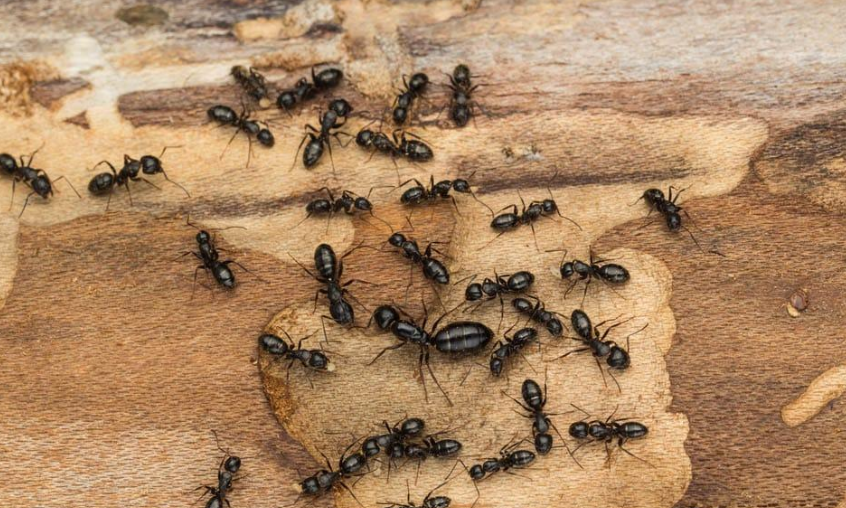
Wood-boring insects are a group of insects that live, feed, or reproduce inside wood. They include beetles, termites, and certain ants, all of which have developed the ability to break down or tunnel through wooden material. These insects are commonly found in forests, where they play a natural role in decomposing dead trees, but they can also become pests when they infest wooden structures or furniture.
One of the most noticeable signs of wood-boring insects is the damage they leave behind. They create tunnels and galleries inside wood as they feed or make space for their larvae. Over time, this can weaken the structure of the wood, causing it to become brittle or hollow. In homes, this type of damage can affect furniture, flooring, and even building supports if left untreated.
Many wood-boring insects spend a large part of their life cycle hidden inside wood. Eggs are often laid in cracks or on the surface, and once the larvae hatch, they burrow inside and begin feeding. This hidden lifestyle makes them difficult to detect early, as the damage is often occurring out of sight.
Despite their reputation as pests, these insects play an important ecological role. In natural environments, they help break down dead and decaying wood, returning nutrients to the soil and supporting forest ecosystems. Without them, fallen trees and plant material would take much longer to decompose.
Managing wood-boring insects involves prevention and early detection. Keeping wood dry, treating it with protective finishes, and regularly inspecting structures can reduce the risk of infestation.
Types of wood boring beetles
Emerald Ash Borer (Agrilus planipennis)
Originally from Asia, the Emerald Ash Borer has become the most destructive invasive forest insect in North American history — responsible for the death of hundreds of millions of ash trees across the eastern United States and Canada since its accidental introduction in the early 1990s.
Its metallic green adult beetles are strikingly beautiful, but it is the pale, S-shaped larvae tunneling through the cambium layer beneath the bark that deliver the fatal damage — cutting off the tree’s supply of water and nutrients with lethal efficiency. No native North American ash tree has demonstrated meaningful resistance to it.
Asian Longhorned Beetle (Anoplophora glabripennis)
One of the most feared invasive wood-boring insects in the world, the Asian Longhorned Beetle threatens the broadleaved forests of North America and Europe with a voracious appetite for maple, birch, willow, elm, and dozens of other hardwood species.
Its dramatic appearance — jet black body splashed with white spots and extraordinarily long, banded antennae that can exceed the length of its own body — makes it one of the most visually striking of all wood-boring beetles. Larvae tunnel deep into the heartwood of healthy trees, causing structural damage that eventually kills even large, established specimens.
Mountain Pine Beetle (Dendroctonus ponderosae)
The Mountain Pine Beetle is the architect of the largest forest insect outbreak in North American recorded history — having killed tens of millions of hectares of pine forest across western Canada and the United States in an outbreak that peaked in the early 2000s and was dramatically accelerated by climate change-driven warming that allowed beetle populations to survive at higher elevations and more northerly latitudes than ever before.
Adult beetles carry blue-stain fungi into the trees they attack, and it is the combination of larval tunneling and fungal infection that kills even large, healthy pines within weeks of a mass attack.
Southern Pine Beetle (Dendroctonus frontalis)
The most economically destructive forest insect in the southeastern United States, the Southern Pine Beetle attacks living pine trees in mass aggregations — using pheromone signals to coordinate attacks of hundreds or thousands of beetles overwhelming a tree’s natural resin defenses simultaneously.
Its distinctive S-shaped larval galleries winding beneath the bark of killed trees are instantly recognizable to foresters in the region. Climate change has expanded its range northward into the pine forests of New Jersey and Long Island, where it was previously too cold for the species to establish permanent populations.
European Spruce Bark Beetle (Ips typographus)
The European Spruce Bark Beetle is the most economically significant forest pest in Europe — responsible for killing spruce trees across millions of hectares of Central European forest, particularly in the wake of droughts and wind-throw events that weaken trees and reduce their ability to produce the defensive resin flows that repel beetle attacks under normal conditions.
Its name comes from the characteristic gallery patterns it engraves beneath the bark — a central maternal gallery flanked by radiating larval galleries that create a pattern resembling printed text. Climate-driven drought stress across European forests has caused outbreak populations to reach historically unprecedented levels in recent decades.
Bark Beetle (Scolytinae — various species)
The bark beetles — a vast subfamily containing over six thousand species distributed across every forested continent — are collectively the most ecologically important group of wood-boring insects on Earth. Most species attack only dead, dying, or severely stressed trees and perform the essential ecological function of initiating the decomposition of dead wood and the recycling of forest nutrients.
A minority of species — including the Mountain Pine Beetle and European Spruce Bark Beetle — are capable of attacking and killing healthy trees under outbreak conditions. Their intricate gallery systems beneath the bark are among the most precise and elaborate structures produced by any insect.
Longhorn Beetle (Cerambycidae — various species)
The Longhorn Beetles — named for the extraordinary antennae that in many species exceed the length of the body itself — comprise a family of over thirty-five thousand species distributed worldwide, making them one of the largest beetle families on Earth. Their larvae bore through the wood of an enormous variety of tree species, and the family as a whole represents one of the primary agents of wood decomposition in forests globally. Many species are highly host-specific, targeting only a single genus or family of trees.
Their adult beetles are often among the most beautiful of all insects — large, boldly patterned, and equipped with those remarkable antennae that have made them favorites of insect collectors across centuries.
Jewel Beetle (Buprestidae — various species)
The Jewel Beetles — named for the iridescent, gem-like colors of many species’ adults, whose metallic green, blue, red, and copper elytra have been used in decorative jewelry and textiles across Asia for thousands of years — are a family of wood-boring beetles whose larvae are flattened, legless borers that tunnel through the cambium and wood of a very wide range of tree species.
The family contains over fifteen thousand species and includes the notorious Emerald Ash Borer among its membership. Their larvae produce characteristically serpentine galleries that wind through the wood in distinctive patterns, and the damage they cause ranges from minor aesthetic blemishing to complete tree mortality depending on species and infestation intensity.
Carpenter Ant (Camponotus spp.)
Unlike most wood-boring insects whose larvae eat wood, Carpenter Ants excavate it — tunneling through soft, moist, often already-decaying wood to create the galleries and chambers of their elaborate nest systems without actually consuming the material they remove.
They prefer wood that has been softened by moisture and fungal decay, and their presence in structural timber is often a secondary symptom of an underlying moisture problem rather than the primary cause of damage. Their smooth, clean-cut galleries — free of the frass and sawdust that accumulate in the tunnels of wood-eating species — are the diagnostic sign of their activity. They are significant pests of wooden structures in North America, Europe, and Asia.
Carpenter Bee (Xylocopa spp.)
The large, robust Carpenter Bees — their females equipped with powerful mandibles capable of chewing through sound, dry wood with remarkable speed — excavate perfectly circular nesting tunnels in unpainted or weathered timber, fence posts, deck rails, and the structural timbers of wooden buildings.
Unlike Carpenter Ants they work alone rather than colonially, with each female excavating her own gallery system in which she provisions individual brood cells with pollen and nectar before sealing them off and leaving the larvae to develop. Their perfectly round entry holes — approximately thirteen millimeters in diameter — are immediately diagnostic. The damage they cause is primarily cosmetic and structural weakening develops only after years of repeated use of the same timber by successive generations.
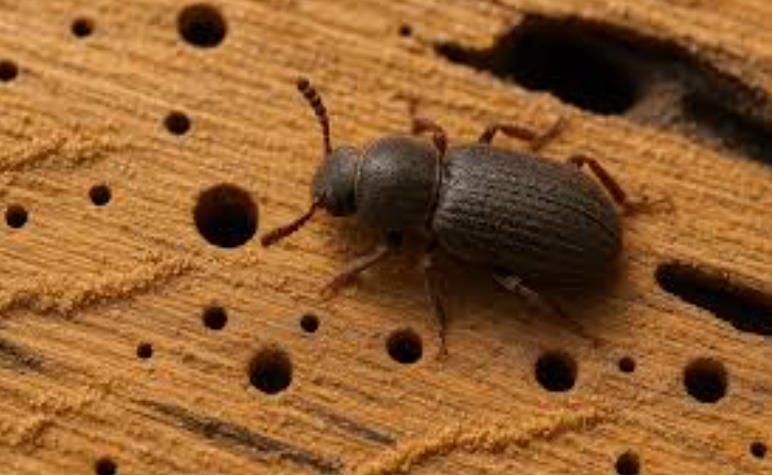
Common Furniture Beetle (Anobium punctatum)
The Common Furniture Beetle — whose larvae are the infamous woodworm responsible for the distinctive small round exit holes and powdery frass that signal active infestation in antique furniture, old floorboards, and structural roof timbers throughout Europe — is perhaps the most familiar wood-boring insect to the average homeowner.
Its larvae spend two to five years tunneling through the sapwood of seasoned hardwoods and softwoods before pupating and emerging as small, brown adult beetles through the characteristic two-millimeter exit holes that announce their presence. Historically responsible for enormous losses of antique furniture and architectural timber, it has declined in many modern buildings due to the replacement of old, unfinished timber with treated modern materials.
Deathwatch Beetle (Xestobium rufovillosum)
The Deathwatch Beetle earned its haunting name from the tapping sound — produced by the adult beetles banging their heads against the walls of their galleries as a mating signal — that was audible in the silence of rooms where the dying were being watched over through the night.
Its larvae bore through the heartwood of large, old hardwood timbers — particularly oak — and require the wood to have been partially softened by fungal decay before they can establish successfully. As a result it is most commonly found in the ancient oak timbers of historic buildings, medieval churches, and stately homes, where it has sometimes caused catastrophic structural damage over centuries of undetected activity in roof structures and floor beams.
Wood Wasp (Urocerus gigas)
The Giant Wood Wasp — or Horntail — is a large, dramatic-looking insect whose formidable ovipositor, extending from the female’s abdomen like a fearsome sting, is actually a precision drilling tool used to inject eggs deep into the wood of coniferous trees. Despite its alarming appearance the ovipositor cannot sting — it is purely for egg-laying.
Larvae bore through softwood timber for two to three years before pupating, and the species is a significant pest of freshly felled conifer timber in sawmills and timber yards, sometimes emerging dramatically from the wood of newly constructed buildings or freshly made furniture long after the timber was processed and installed.
Sirex Wood Wasp (Sirex noctilio)
The Sirex Wood Wasp is one of the world’s most damaging invasive forest insects — native to Europe and Asia but accidentally introduced to the Southern Hemisphere, where it has caused catastrophic losses in the pine plantations of Australia, New Zealand, South Africa, and South America.
Females inject a toxic mucus alongside their eggs that disrupts the tree’s water transport, and they introduce a symbiotic fungus that further kills the wood and provides food for developing larvae. In its native range natural parasitoids keep its populations in check, but in introduced regions — where these natural enemies are absent — it has the capacity to kill entire pine plantations.
Pinhole Borer (Platypodinae — various species)
The Pinhole Borers — sometimes called ambrosia beetles — are a group of bark beetles whose most distinctive characteristic is their farming of ambrosia fungi within their gallery systems. Rather than eating wood directly, they cultivate fungal gardens in their tunnels and feed on the fungal growth — a sophisticated agricultural relationship that has evolved independently multiple times across the wood-boring beetle families.
The perfectly circular entry holes they produce — as precisely made as if drilled by a machine — give the group its common name, and the blue-gray staining of the surrounding wood caused by their fungal associates is a characteristic diagnostic sign of infestation in freshly felled timber.
Bronze Birch Borer (Agrilus anxius)
A close North American relative of the Emerald Ash Borer and member of the same devastatingly destructive Agrilus genus, the Bronze Birch Borer is a significant pest of birch trees across North America — attacking stressed, drought-weakened, or ornamentally planted birches that lack the vigor of wild forest trees to resist infestation.
Its metallic bronze adult beetles lay eggs in bark crevices, and the hatching larvae tunnel through the cambium layer in the characteristic serpentine galleries of the Agrilus genus, cutting off water and nutrient transport and killing branches from the top of the tree downward in a progressive dieback that is one of the most diagnostic symptoms of its presence.
Old House Borer (Hylotrupes bajulus)
The Old House Borer — despite its name — is actually most damaging in relatively new timber, with larvae preferring the resin-rich sapwood of recently dried softwoods rather than old, seasoned structural timber. Its larvae can spend between three and eleven years boring through structural timber before emerging — an extraordinarily variable development period that means infestations in buildings can go undetected for a decade or more.
It is one of the most significant structural timber pests in Europe and has been introduced to North America, Australia, and South Africa through infested timber trade. The rasping sound of its larvae chewing through wood is sometimes audible in heavily infested structures on quiet nights.
Poplar Borer (Saperda calcarata)
One of North America’s largest and most visually impressive native longhorn beetles, the Poplar Borer produces adults of striking appearance — their gray bodies marked with bold yellow spots and their antennae banded in black and white — that emerge from large exit holes in the trunks of poplar and willow trees.
Its larvae bore through the heartwood of living trees, creating large oval galleries that structurally weaken trunks and major limbs, making infested trees susceptible to wind breakage. It is a significant pest of poplar plantations grown for timber, pulp, and bioenergy production across the northern United States and Canada, and its infestations are sometimes visible from a distance through the characteristic yellowish frass that accumulates around the entry holes.
Locust Borer (Megacyllene robiniae)
The Locust Borer is a striking North American longhorn beetle whose adults are boldly patterned in vivid yellow and black — a wasp-mimicking coloration that provides protection from predators despite the beetle’s complete harmlessness. It is entirely host-specific — attacking only Black Locust trees — in whose trunks and major branches larvae bore extensive gallery systems that can structurally compromise entire trees when infestations are severe.
Adult beetles are goldenrod specialists, feeding on pollen from late-summer goldenrod flowers before laying eggs in the bark of nearby Black Locust trees — the same trees whose flowers the species depends upon for its early-season nourishment each spring.
Cedar Bark Beetle (Phloeosinus spp.)
The Cedar Bark Beetles are a group of small but ecologically significant Scolytine beetles that attack cedar, cypress, juniper, and related conifers — boring through bark to create egg galleries in the inner bark and outer sapwood. Like many bark beetles they preferentially attack stressed or recently felled trees and play an important ecological role in the decomposition of dead coniferous wood in forest ecosystems.
In ornamental and urban settings they can cause significant damage to weakened landscape cedars and junipers, particularly during drought periods when trees lack the resin pressure necessary to repel initial attacks. Their characteristic gallery patterns — a central maternal gallery with lateral larval tunnels — are diagnostic features carved in the wood of killed trees.
Ambrosia Beetle (Xylosandrus and related genera)
The ambrosia beetles — a diverse, polyphyletic group of bark and wood-boring beetles united by their shared practice of cultivating ambrosia fungus as their primary food source — include numerous species of significant importance to both natural forest ecosystems and commercial forestry and horticulture.
Several Asian species introduced to North America — particularly Xylosandrus crassiusculus, the granulate ambrosia beetle — have become serious pests of a very wide range of hardwood and softwood trees in nurseries and orchards. Their entry holes — surrounded by characteristic toothpick-like extrusions of compacted frass that project from the bark surface — are among the most diagnostic signs of infestation in affected trees.
Banded Elm Bark Beetle (Scolytus multistriatus)
The Banded Elm Bark Beetle — a small but historically catastrophic species — became notorious as the primary vector of Dutch elm disease, the fungal pathogen Ophiostoma novo-ulmi that devastated the elm populations of North America and Europe through the twentieth century.
Adult beetles carry fungal spores from infected trees to healthy ones in the feeding wounds they make in bark and young twigs, transmitting what is essentially a vascular wilt disease that blocks the elm’s water-conducting vessels and kills the tree rapidly. The loss of elms from the landscapes of Britain, continental Europe, and North America represents one of the most dramatic ecological changes caused by an insect-vectored tree disease in recorded history.
Red Turpentine Beetle (Dendroctonus valens)
The largest bark beetle in North America, the Red Turpentine Beetle is native to the pine forests of the continent and under natural conditions attacks only weakened, dying, or recently felled pines.
However, following its accidental introduction to China in the 1980s through infested timber imports, it became one of the most devastating invasive forest pests ever recorded in Asia — killing millions of mature pine trees across northern China in an outbreak that demonstrated with extraordinary clarity how a species held in ecological balance in its native range by natural enemies, host resistance, and evolved coexistence can become catastrophically destructive when transplanted to a region where none of these limiting factors exist.
Woodboring Weevil (Euophryum confine)
The Woodboring Weevil is a small, elongated weevil whose larvae bore through severely decayed, moisture-damaged timber in buildings — typically attacking wood that has already been substantially softened by wet rot fungal decay, making it a secondary rather than primary structural pest.
Its presence in a building is invariably a sign of an underlying moisture problem — persistent dampness, inadequate ventilation, or a failure of waterproofing — rather than an independent infestation of sound timber. Originally from New Zealand, it has been widely introduced to Europe and other temperate regions through timber trade and is now naturalized across the British Isles, where it is commonly found in the damaged timbers of damp cellars, crawl spaces, and poorly ventilated subfloor voids.
Raspberry Crown Borer (Pennisetia marginata)
The Raspberry Crown Borer is a clearwing moth — its transparent, wasp-patterned wings and yellow-banded abdomen giving it a remarkable wasp mimicry that protects the adults from predation — whose larvae bore into the crowns and roots of raspberry, blackberry, and related Rubus canes over a two-year development cycle. Infested canes wilt and die from the crown upward, and heavily infested plantings can lose entire stools to larval boring at the soil level.
It is one of the most significant insect pests of commercial and garden raspberry production across North America, and its complete two-year life cycle makes it particularly difficult to control, as larvae at different stages of development are present in affected plants throughout the growing season.