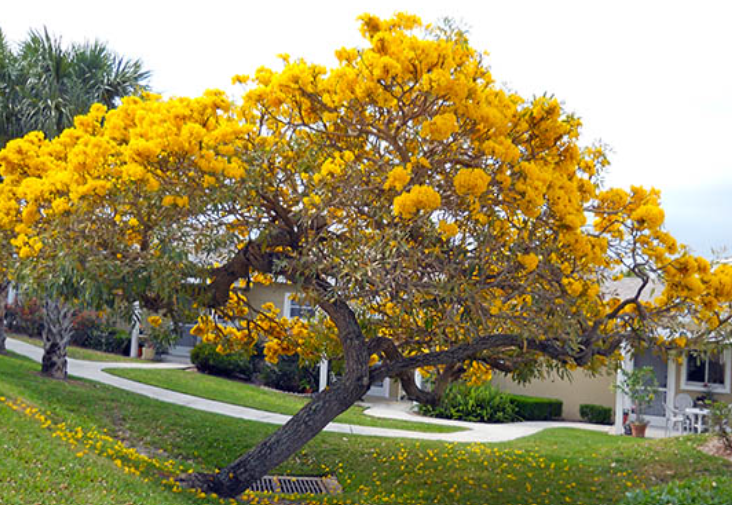
Among the most spectacular flowering trees of the American tropics, Tabebuia and its closely related genera produce trumpet-shaped flowers in dazzling shades of pink, yellow, purple, and white — often erupting across entirely leafless branches in breathtaking seasonal displays that can be seen from great distances.
Note that modern taxonomy has reclassified many species formerly placed in Tabebuia into the related genera Handroanthus and Roseodendron, though all remain commonly known as Tabebuia trees in horticulture and everyday use. They are native to Central and South America but are widely planted in warm regions around the world for their beauty. These trees belong to the same plant family as jacarandas and are especially valued for their seasonal bursts of color.
Many species bloom during the dry season, often when the tree has shed most or all of its leaves. This makes the flowers stand out even more, covering the branches in vivid shades of yellow, pink, white, or purple.
Tabebuia trees are generally medium-sized and have a spreading canopy that provides light shade. Their bark is often rough, and their leaves are usually divided into several leaflets. Despite their delicate-looking flowers, these trees are quite hardy and can tolerate periods of drought once established.
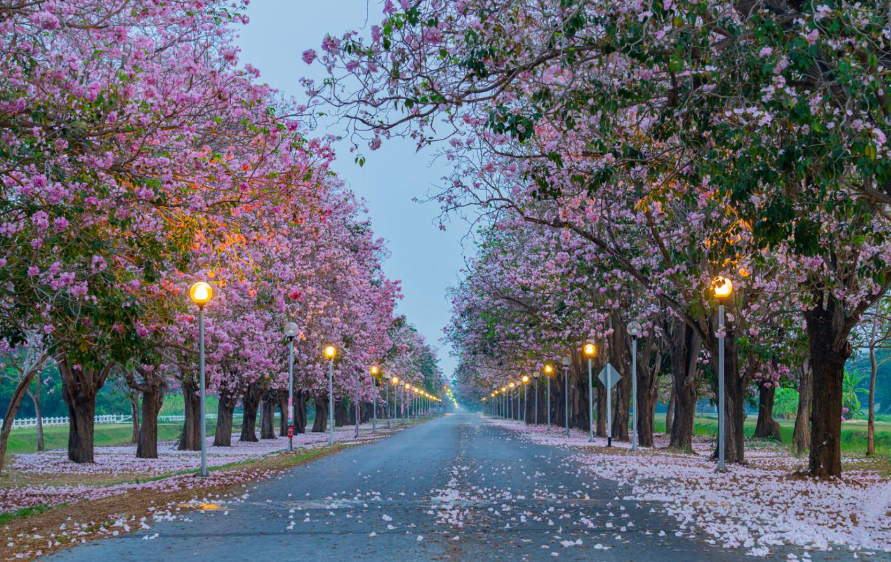
These trees are commonly used in landscaping, especially along streets, parks, and gardens. Their colorful blooms make them popular ornamental choices in tropical and subtropical climates. In some regions, they are planted in rows to create stunning avenues of seasonal color.
The wood of certain species is strong and resistant to decay, making it useful for construction and outdoor applications. In traditional medicine, parts of the tree have been used for various remedies, although such uses should be approached with caution.
Species of Tabebuia Trees
Pink Trumpet Tree (Tabebuia rosea)
One of the most widely planted and instantly recognizable of all tropical flowering trees, the Pink Trumpet Tree explodes into enormous clusters of soft pink to lavender-pink blooms on bare branches during the dry season — a display so spectacular that entire avenues appear to be on fire with color.
Native to Mexico, Central America, and northern South America, it is widely planted as a street and ornamental tree across tropical Asia, Africa, and Florida. It grows rapidly to considerable size and is one of the most important timber trees in Central America.
Pink Ipê (Handroanthus impetiginosus)
Formerly known as Tabebuia impetiginosa, the Pink Ipê is the national tree of Brazil and one of the most beloved flowering trees in South America, producing vivid magenta-pink trumpet flowers on completely bare branches before the new leaves emerge. It grows across a vast range from northern Mexico to Argentina in seasonally dry tropical forests and cerrado woodland.
Its timber — known simply as Ipê — is extraordinarily dense and durable, among the hardest woods in the world, valued for decking, flooring, and heavy construction.
Golden Trumpet Tree (Handroanthus chrysotrichus)
Formerly Tabebuia chrysotricha, this Brazilian species is one of the most popular yellow-flowered Tabebuia trees in cultivation worldwide, producing masses of rich golden-yellow trumpet flowers with faint brown striping in the throat on bare branches in late winter and spring.
It is a medium-sized tree well suited to street planting in subtropical and tropical climates, and its annual flowering display — which can blanket the entire crown in gold — is one of the most visually dramatic events in the tropical horticultural calendar. It is widely planted across Florida, California, South Africa, and Australia.
Yellow Ipê (Handroanthus serratifolius)
Known as Ipê Amarelo in Brazil, this tall, majestic tree of the Amazon and Atlantic Forest produces brilliant yellow flowers and is one of the most commercially important hardwood timber trees in South America. Its wood is so dense and decay-resistant that it is used for the construction of boardwalks, bridges, and marine structures that must withstand constant weathering.
When in full flower, a mature specimen in full bloom is an unforgettable sight — its crown transformed into a solid mass of golden yellow visible from considerable distances across the landscape.
Silver Trumpet Tree (Tabebuia aurea)
The Silver Trumpet Tree of the South American cerrado and dry chaco woodland is named for the silvery sheen of its leaves — covered in fine silvery or golden scales that catch the light — as much as for its bright yellow trumpet flowers.
It is one of the most drought-tolerant members of the group, naturally inhabiting seasonally inundated savannas and dry woodlands where it endures alternating flood and drought. Its striking upright form, silver foliage, and masses of yellow flowers have made it a popular ornamental in dry tropical landscapes across the world.
Pink Poui (Tabebuia pallida)
The Pink Poui is the national flower of the Turks and Caicos Islands and a beloved ornamental tree throughout the Caribbean, where its soft pink to pale lavender flowers decorate roadsides and gardens across the islands.
It is a smaller, more compact tree than Tabebuia rosea and tends to flower more repeatedly through the year rather than in a single dramatic flush, making it a reliable and consistent source of color in tropical gardens. It is widely naturalized across the Caribbean and is one of the most culturally significant flowering trees of the region.
Cuban Pink Trumpet Tree (Tabebuia heterophylla)
Native to the Caribbean islands — Cuba, Hispaniola, Puerto Rico, and the Lesser Antilles — the Cuban Pink Trumpet Tree is a variable species that produces flowers ranging from nearly white through pale pink to deep rose depending on the individual tree and local conditions.
It is a hardy, drought-tolerant species well adapted to the thin, rocky soils of Caribbean limestone landscapes, and it is one of the most widely planted flowering trees throughout the region. In Puerto Rico it is known as the Roble Blanco and holds considerable cultural significance as a landscape and street tree.
Roble de Sabana (Tabebuia roseo-alba)
Also called the White Trumpet Tree, Tabebuia roseo-alba produces pure white or faintly pink-tinged trumpet flowers with a yellow throat that glow luminously against the bare branches in the dry season.
Native to the cerrado and dry forests of central Brazil, Paraguay, and Argentina, it is a medium-sized tree with an elegant, open crown that makes it particularly attractive as a garden specimen. Its white flowers age to pink as they mature, giving flowering trees a bicolored appearance that is especially beautiful in early morning light.
Purple Trumpet Tree (Handroanthus heptaphyllus)
Closely related to H. impetiginosus and sometimes confused with it, the Purple Trumpet Tree of Paraguay, Brazil, and Argentina produces deep pink to purple-pink flowers in spectacular pre-leaf displays that color entire forest edges and roadsides in the dry season.
It is the national tree of Paraguay, where it is known as the Lapacho Negro, and its timber shares the extraordinary density and durability of other Ipê species. It is one of the most important trees in the culture and ecology of the southern South American cone, providing nectar for a wide range of pollinators including bees, hummingbirds, and bats.
White Ipê (Handroanthus albus)
The White Ipê of southern Brazil and Argentina stands apart from its colorful relatives with its striking pure white flowers produced in profuse clusters on bare branches during the dry winter season.
It is a medium to large tree of subtropical gallery forests and rocky hillside woodlands in Rio Grande do Sul, Santa Catarina, and adjacent Argentina, where its winter flowering makes it one of the few trees providing significant nectar resources during the coldest months. Its white-flowered display against a winter sky is considered one of the most beautiful natural spectacles of southern Brazil’s Atlantic Forest region.
Red Trumpet Tree (Tabebuia haemantha)
One of the few genuinely red-flowered members of the group, the Red Trumpet Tree is native to the Caribbean — particularly Puerto Rico and the Virgin Islands — where its deep red to brick-red flowers make it immediately distinctive from the pink and yellow species that dominate the genus.
It is a smaller tree than many of its relatives, well adapted to coastal and limestone habitats, and its relatively rare red coloration has made it a sought-after specimen in tropical horticulture. It flowers on bare branches in the dry season and the vivid red blooms are particularly attractive to hummingbirds which are its primary pollinators.
Cortez Amarillo (Tabebuia ochracea / Handroanthus ochraceus)
The Cortez Amarillo is one of Central America’s most celebrated dry season spectacles — a medium-sized tree of tropical dry forest that briefly transforms roadsides and hillsides in Costa Rica, Nicaragua, and Guatemala into rivers of golden yellow for just a few days each year before the leaves return and the flowers vanish.
Its flowering is so brief and so spectacular that people travel specifically to witness it, and its timing — so precise that it has been used as a phenological calendar marker by rural communities — makes it one of the most ecologically fascinating flowering trees of the Mesoamerican dry forest.
Ipê Roxo (Handroanthus avellanedae)
Often grouped with or confused with H. impetiginosus, the Ipê Roxo is a large, impressive tree of the Atlantic Forest and cerrado of Brazil and adjacent countries that produces deep purple-pink flowers of extraordinary intensity — some of the deepest, most saturated flower colors of any tree in South America.
It is a major component of the spectacular spring flowering displays that transform Brazil’s cerrado landscape in August and September, when dozens of species flower simultaneously in an explosion of color that has been compared to a pointillist painting seen from the air. Its timber is equally valuable and shares the legendary hardness of all Ipê species.
Geiger Tree relative / Roble Amarillo (Tabebuia bibracteolata)
This yellow-flowered Tabebuia of the Caribbean and Central American Pacific coast is a smaller, more shrubby species found in coastal dry forests and scrubland, often flowering repeatedly through the year rather than in a single dry-season flush. Its compact size and repeat-flowering habit make it particularly useful in tropical landscape design where a smaller, manageable flowering tree is preferred.
It is found from Panama through Costa Rica’s Guanacaste province and into Nicaragua in seasonally dry coastal habitats where its yellow flowers provide important nectar resources for dry season pollinators.
Dwarf Tabebuia (Tabebuia nodosa)
The Dwarf Tabebuia of the Gran Chaco — the vast dry woodland covering parts of Paraguay, Argentina, Bolivia, and Brazil — is a small, gnarled, and slow-growing species adapted to one of South America’s harshest environments. It produces pale pink to white flowers and is notable for flowering even under extreme drought stress — a trait that reflects the remarkable environmental resilience of the Tabebuia group as a whole.
Its small size, thorny branches, and dense, twisting growth form make it a distinctive presence in the thorny woodland communities of the Chaco, where it provides important habitat and food resources for the specialized wildlife of that challenging ecosystem.