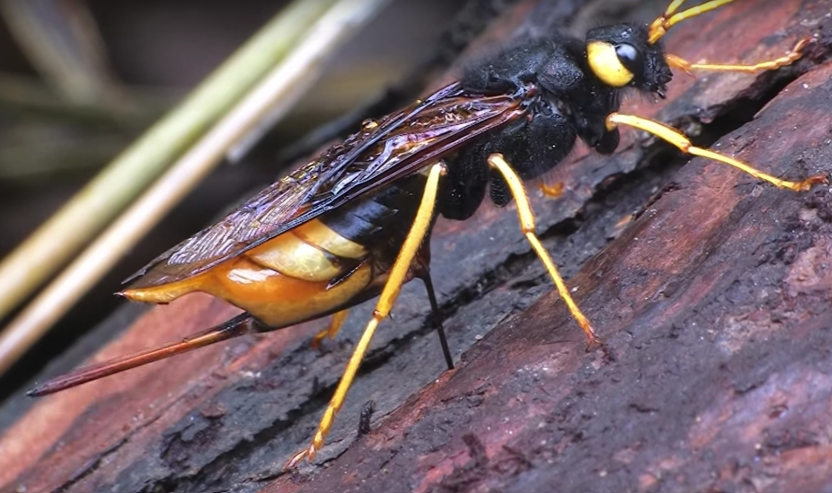
Some hornets and hornet-like wasps are closely associated with wood, either by nesting inside it or using it as a primary resource. These insects are often found in forests, parks, or areas with old trees, logs, or wooden structures. Wood provides both shelter and building material, making it an ideal environment for certain species.
Many true hornets prefer to build their nests in hollow trees or wooden cavities. Instead of digging into solid wood, they take advantage of natural openings such as cracks, knots, or spaces left by decay. Inside these सुरक्षित spots, they construct layered, paper-like nests that are protected from weather and predators.
Hornets also rely on wood to create their nests. Workers chew weathered wood fibers and mix them with saliva to form a pulp, which dries into a paper-like material. This is how they build the familiar layered structures, even when the nest is hidden within a wooden space.
There are also wood-associated wasps, sometimes confused with hornets, that interact with wood in a different way. Some species lay their eggs inside wood, especially in dead or dying trees. Their larvae develop by feeding on wood or the organisms living within it, such as fungi, rather than hunting other insects.
These wood-dwelling insects play a role in natural recycling. By breaking down decaying wood or using it for nesting, they contribute to the gradual decomposition process. This helps return nutrients to the soil and supports the growth of new plants.
Although they may occasionally nest near human structures like wooden fences or attics, they are not usually destructive in the way termites are. Most hornets that live in or around wood are simply using it as a convenient shelter.
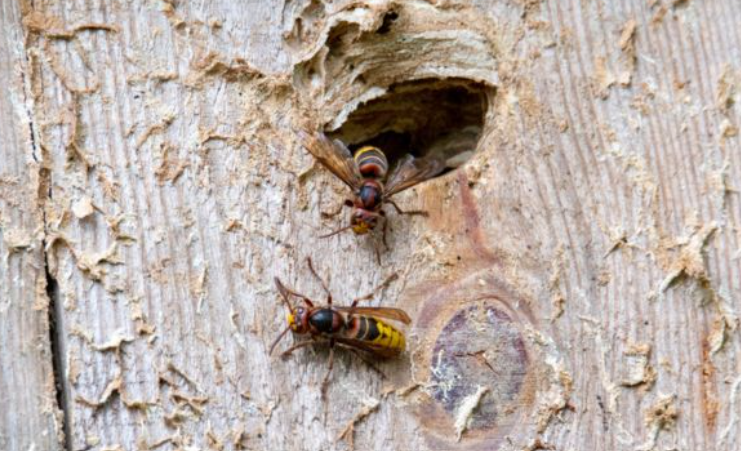
Hornets and Hornet-like Wasps
European Hornet (Vespa crabro)
The European Hornet is the quintessential wood-dwelling hornet, showing a strong preference for nesting inside hollow trees, rotten logs, and wooden wall cavities. Workers chew weathered wood fiber and mix it with saliva to produce a coarse, layered paper material used to construct their large, enclosed nest.
A single colony can cause considerable damage to wooden structures over the course of a season as workers continuously harvest wood fiber from fence posts, deck railings, and wooden siding.
Bald-Faced Hornet (Dolichovespula maculata)
While the Bald-Faced Hornet typically suspends its distinctive gray paper nest from tree branches and building eaves, it frequently anchors nests inside the hollow cavities of large, dead trees.
Workers harvest wood fiber from decaying logs and unpainted timber, converting it into the multi-layered paper envelope that surrounds and insulates their nest. The interior of a hollow tree provides structural support and weather protection that allows colonies to grow to exceptional sizes by late summer.
German Yellowjacket (Vespula germanica)
The German Yellowjacket is a highly opportunistic nester that readily establishes colonies inside wall voids, attics, and the hollow spaces within wooden structures.
It chews through soft or rotting wood to expand existing cavities, and its nests built inside timber walls can grow to enormous proportions — sometimes containing hundreds of thousands of cells — before being detected by homeowners. Its tendency to nest within the fabric of buildings makes it one of the most structurally intrusive stinging insects in the world.
Asian Giant Hornet (Vespa mandarinia)
Although the Asian Giant Hornet most commonly nests underground, it also establishes colonies inside the hollow bases and root cavities of large, mature trees in the forested landscapes of East and Southeast Asia. Workers chew and harvest wood fiber from surrounding trees and stumps to construct internal nest structures.
The sheer size of an Asian Giant Hornet colony, combined with the species’ extreme aggression in nest defense, makes encounters with a tree-dwelling colony particularly dangerous.
Yellow-Legged Hornet (Vespa velutina)
The Yellow-Legged Hornet, native to Southeast Asia and now invasive in Europe, builds its primary nest — a large, teardrop-shaped paper structure — high in the canopies of trees, constructed almost entirely from chewed wood fiber and bark.
It has a strong preference for tall deciduous trees and frequently builds secondary, smaller nests at lower heights early in the season before relocating to a larger elevated nest. The paper envelope is made from finely chewed wood and is distinctively smooth compared to the rougher nests of other Vespa species.
Oriental Hornet (Vespa orientalis)
While the Oriental Hornet is primarily known as a ground nester, it also nests inside hollow tree trunks and the wooden cavities of old buildings across its range in Southern Europe and the Middle East.
When nesting in wood, it chews the interior surfaces to widen the available space and lines the cavity with paper comb structures built from chewed wood pulp. Its ability to exploit both underground and above-ground wooden cavities makes it one of the most adaptable nesters in the Vespa genus.
Greater Banded Hornet (Vespa tropica)
The Greater Banded Hornet of South and Southeast Asia frequently constructs nests within hollow sections of standing dead trees and bamboo stems, using chewed wood fiber to build its internal comb structures. It is a cavity-dependent nester that relies on the structural protection offered by surrounding wood to insulate and shield its colony from temperature fluctuations and predators.
Nests inside bamboo and thin-walled woody stems are particularly compact and densely organized compared to exposed aerial nests of the same species.
Hornet Moth (Sesia apiformis)
The Hornet Moth is not a hornet at all but a clearwing moth whose remarkable mimicry of the European Hornet — in color, shape, and even buzzing flight — makes it one of the most convincing insect mimics in Europe. Its larvae bore directly into the wood of poplar and willow trees, spending two to three years tunneling through the heartwood before pupating just beneath the bark.
Emerging adults chew their way out through the bark, leaving characteristic exit holes. Its entire larval existence is spent living and feeding within the wood of its host tree.
Median Wasp (Dolichovespula media)
The Median Wasp, common across Europe, builds its paper nest preferentially inside the hollow cavities of old trees and occasionally within the timber framing of rural outbuildings and garden sheds. It harvests wood fiber from dry, weathered timber surfaces, producing a coarser paper than some other species.
Its nests are smaller than those of true hornets but are defended with considerable aggression. The woody cavity provides a sheltered microclimate that helps the colony maintain stable temperatures essential for brood development.
Aerial Yellowjacket (Dolichovespula arenaria)
The Aerial Yellowjacket frequently selects the hollow interiors of dead standing trees as nesting sites, building its enclosed paper nest within the protected woody cavity. Like all paper-nest builders, it harvests wood fiber from nearby sources — preferring gray, weathered, and unpainted wood — and chews it into a fine pulp.
Nests inside tree cavities can go undetected for an entire season, as the entrance hole is typically small and inconspicuous. Workers are highly defensive and will pour out of the nest entrance in large numbers if the tree is struck or disturbed.
Saxon Wasp (Dolichovespula saxonica)
The Saxon Wasp is a woodland species that frequently nests inside hollow trees and stumps in the deciduous forests of Europe and temperate Asia. It builds a fully enclosed paper nest from chewed wood fiber, with a single entrance hole at the base.
Its nests are relatively small and tidy compared to those of larger Vespula species, and are considered less of a structural nuisance. The Saxon Wasp is an important woodland predator of caterpillars and other herbivorous insects that damage forest trees.
Carpenter Wasp / Horntail (Urocerus gigas)
The Giant Horntail, often called a Carpenter Wasp or Wood Wasp, is frequently mistaken for a hornet due to its large size and bold yellow and black coloration. Females use their formidable ovipositor — which resembles a stinger — to bore directly into the wood of pine and other conifer trees, depositing eggs deep within the timber alongside a wood-rotting fungus that the larvae require for digestion.
The larvae spend several years tunneling through and consuming the wood before emerging as adults, making this species one of the most dedicated wood-dwellers of any hornet-like insect.
Black Hornet / Aerial Blackjacket (Dolichovespula norwegica)
The Norwegian Wasp, sometimes called the Black Hornet in parts of its range, is a woodland-associated species that builds small paper nests inside the hollow sections of trees or suspended from interior woody surfaces in forest environments.
It is found across northern Europe and Asia and prefers cool, forested habitats. Its nest paper is notably dark in color — produced from the weathered, moisture-darkened wood fiber it preferentially harvests — giving its nest a distinctive gray-brown appearance compared to the paler nests of other species.
Red Wasp (Polistes carolina)
The Red Wasp of the southeastern United States frequently establishes its open-comb paper nests inside hollow logs, beneath loose tree bark, and within the wooden cavities of old barns and outbuildings.
It does not build an outer paper envelope like true hornets, instead constructing a single open comb that hangs directly from a woody surface by a paper stalk. It is highly protective of its nest and can be aggressive when the wooden structure it has chosen as home is disturbed during renovation or yard maintenance.
Yellowjacket (Vespula squamosa)
The Southern Yellowjacket is a wood-cavity nester that frequently exploits the hollow interiors of fallen logs, tree stumps, and rotting fence posts as nest sites. Workers chew surrounding wood fiber directly from the walls of the cavity to produce nest paper and simultaneously expand the available nesting space.
In warmer parts of its range, perennial colonies that survive winter inside well-insulated wooden cavities can grow to staggering proportions — with documented nests inside old tree stumps containing multiple queens and millions of workers built up over several successive seasons.