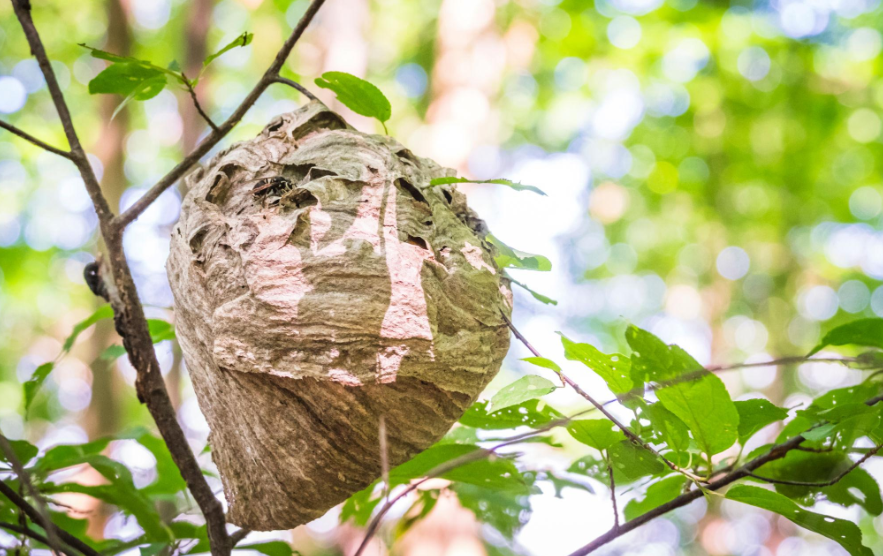
Hornets are large, social wasps known for their strong bodies, loud buzzing, and organized colonies. They belong to a group of insects that live and work together, usually building nests and defending them as a team. Compared to common wasps, hornets tend to be bigger and more noticeable, often with bold patterns of black, yellow, or brown.
A hornet colony is centered around a single queen whose main job is to lay eggs. Worker hornets, which are all female, handle most of the daily tasks such as building the nest, gathering food, and protecting the colony. Male hornets appear later in the season and are mainly involved in reproduction rather than labor.
Hornets build their nests using a paper-like material made from chewed wood mixed with saliva. These nests are often found hanging from trees, tucked under roof edges, or hidden in shrubs. The structure can grow quite large over time, with multiple layers and chambers inside to house developing larvae.
In terms of diet, hornets are both hunters and scavengers. They feed on other insects, making them useful for controlling pest populations, but they are also attracted to sugary foods like fruit and nectar. This combination of feeding habits helps them survive in a variety of environments.
Hornets are known for their defensive behavior, especially when their nest is disturbed. They can sting multiple times, and their stings are often more painful than those of smaller wasps. While they generally avoid humans, they can become aggressive if they feel threatened, so it’s best to keep a safe distance from their nests.
Different Types of Hornets
European Hornet (Vespa crabro)
The European Hornet is the only true hornet species native to Europe and the largest eusocial wasp found there. It has a distinctive reddish-brown and yellow coloring and can grow up to 35mm in length.
Unlike many of its relatives, it is somewhat tolerant of human presence and is known to be active at night, attracted to light sources. It builds large paper nests in hollow trees, wall cavities, and attics.
Asian Giant Hornet (Vespa mandarinia)
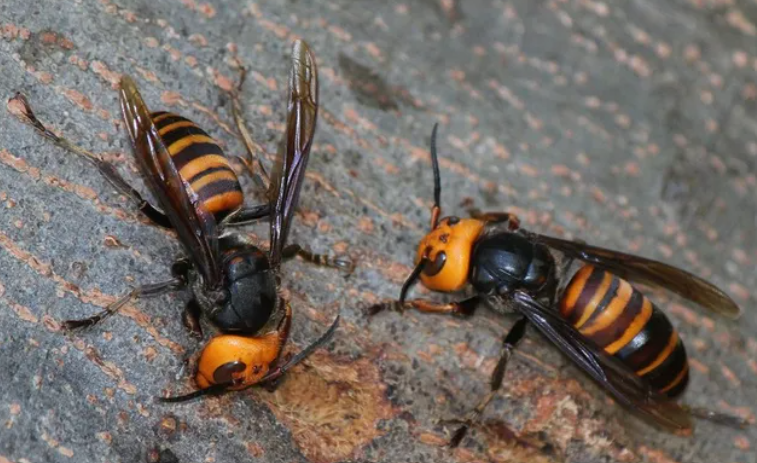
Infamous as the world’s largest hornet, the Asian Giant Hornet — colloquially known as the “murder hornet” — can reach up to 50mm in length with a wingspan of about 75mm.
Native to the forests of East and Southeast Asia, it is a highly aggressive predator of honeybee colonies, capable of decimating an entire hive within hours using its powerful mandibles. Its venom is potent enough to cause serious harm to humans, and multiple stings can be fatal.
Yellow Hornet (Vespa simillima)
The Yellow Hornet is a medium-sized species native to East Asia, particularly Japan and parts of China. It is predominantly yellow with some brown markings, making it relatively easy to identify.
It tends to build aerial nests in trees and shrubs and is less aggressive than many of its Vespa relatives when undisturbed. It plays an important ecological role as both a predator of insects and a scavenger of protein-rich food sources.
Black-Tailed Hornet (Vespa ducalis)
Found across a wide range spanning from India through Southeast Asia to Japan, the Black-Tailed Hornet is a large and visually striking species characterized by its dark abdomen with a contrasting yellow tip.
It is a solitary hunter that primarily preys on other wasps and hornets, including members of its own genus. Despite its fearsome appearance, it tends to avoid confrontation with humans unless its nest is threatened.
Lesser Banded Hornet (Vespa affinis)
The Lesser Banded Hornet is a widespread species found across South and Southeast Asia, including India, Sri Lanka, and the Philippines. It is recognizable by its mostly dark body with a single bright orange or yellow band across its abdomen. It is known to be one of the more aggressive hornet species and will readily defend its nest. Its colonies can be quite large, and it often builds nests in exposed locations such as tree branches and building eaves.
Greater Banded Hornet (Vespa tropica)
One of the most commonly encountered hornets in South and Southeast Asia, the Greater Banded Hornet is known for its bold yellow banding on a dark brown body.
It is particularly notable for its predatory behavior toward other social wasps, often raiding their nests to harvest larvae as a protein source. It typically builds small to medium-sized paper nests and is considered moderately aggressive, posing a risk to those who disturb its colony.
Oriental Hornet (Vespa orientalis)
The Oriental Hornet is a fascinating species found across Southern Europe, the Middle East, Central Asia, and parts of Africa. What makes it scientifically remarkable is its ability to convert sunlight into electricity using a pigment called xanthopterin found in its yellow body segments — making it the only known animal with this capability.
It is also unique in that it becomes most active during midday rather than morning or evening, correlated with peak solar radiation.
Philippine Hornet (Vespa philippinensis)
Endemic to the Philippine archipelago, the Philippine Hornet is a large and robust species that thrives in the diverse forest ecosystems of the islands. It builds substantial paper nests, usually in elevated positions in trees or on cliffs, and is known for vigorous colony defense.
Due to habitat loss and deforestation in the Philippines, its populations face increasing pressure, making it a species of growing conservation interest in the region.
Bald-Faced Hornet (Dolichovespula maculata)
Despite its name, the Bald-Faced Hornet is technically a yellowjacket wasp rather than a true hornet, though it is commonly referred to as one. Native to North America, it is easily identified by its striking black body with white facial markings.
It builds large, distinctive gray paper nests, often hanging from tree branches or building overhangs. It is notably aggressive in defense of its colony and can sting repeatedly, making nest removal a task best left to professionals.
Dybowski’s Hornet (Vespa dybowskii)
Dybowski’s Hornet is a parasitic species found in parts of Russia, China, Korea, and Japan. It is unusual in that it lacks a true worker caste — instead, the queen invades the nests of other Vespa species, kills or drives out the resident queen, and uses the host colony’s workers to raise her own offspring.
This cleptoparasitic lifestyle makes it a fascinating subject of study in social insect behavior and evolutionary biology.
Chinese Hornet (Vespa bicolor)
The Chinese Hornet, also known as the Two-colored Hornet, is native to China and parts of Southeast Asia. It is characterized by a mostly black body with a sharp yellow or orange posterior section.
It tends to build smaller nests than other Vespa species, often in sheltered spots such as rock crevices or dense vegetation. Though not as large as the Asian Giant Hornet, it is still capable of delivering a painful sting and can be defensive around its nest.
Indian Hornet (Vespa crabroniformis)
Found across the Indian subcontinent, the Indian Hornet is a large, robust species that closely resembles the European Hornet in coloration, displaying rich reddish-brown and yellow tones.
It inhabits a range of environments from forested hillsides to agricultural areas and gardens. It is an important predator of a variety of insects, helping to regulate pest populations. Its nests are typically constructed inside tree cavities or underground burrows.
Japanese Hornet (Vespa xanthoptera)
The Japanese Hornet is a medium-to-large species endemic to the Japanese archipelago. It is distinguished by its vibrant orange-yellow coloration on the head and abdomen, with brownish wings. It is a capable predator and often competes aggressively with other Vespa species for territory and food resources.
Native Japanese honeybees have evolved a remarkable defense against this predator — they surround attacking hornets and vibrate their wing muscles to generate lethal heat.
Collar-Waisted Hornet (Vespa velutina)
More widely known as the Asian Predatory Wasp or Yellow-Legged Hornet, Vespa velutina is native to Southeast Asia but has become an invasive species in Europe, particularly France, Spain, and the UK.
It is an aggressive predator of honeybees and poses a significant threat to both wild and managed bee populations. It is smaller than the European Hornet and is recognizable by its dark body, yellow-tipped legs, and the orange band on its abdomen.
Budden’s Hornet (Vespa budd)
Budden’s Hornet is a lesser-known species found in parts of South and Southeast Asia. It shares many behavioral characteristics with its Vespa relatives, including colonial nesting and aggressive colony defense.
It is a predatory species that feeds on a range of arthropods and is known to scavenge protein from carrion and food waste. Though not as extensively studied as larger species in the genus, it contributes meaningfully to its local ecosystem as a top insect predator.
Magnificent Hornet (Vespa magnifica)
The Magnificent Hornet, found in parts of China and Southeast Asia, is one of the most visually stunning members of the Vespa genus. Its coloration is bold and striking, with deep reddish-orange hues set against dark contrasting bands.
It tends to inhabit mountainous forested regions at higher elevations. Though data on this species is relatively limited compared to more widely studied hornets, it is known to construct paper nests and maintain colonies with a typical hornet social structure.
Aerial Yellowjacket (Dolichovespula arenaria)
A species common across North America, the Aerial Yellowjacket is often grouped with hornets due to its aerial nesting habits and paper nest construction. It builds rounded, enclosed paper nests hanging from branches or building structures, similar in style to the Bald-Faced Hornet’s nests.
Colonies can contain several hundred workers. While it can be aggressive when disturbed, it generally forages peacefully and contributes to pest control and pollination in its local environment.
Cicada Killer Wasp (Sphecius speciosus)
While technically a solitary wasp rather than a true hornet, the Cicada Killer is frequently called a “hornet” by North Americans due to its enormous size — it is one of the largest wasps on the continent. Females hunt and paralyze cicadas, dragging them into underground burrows to serve as food for their larvae. Despite their intimidating appearance, males cannot sting and females rarely do unless handled directly. They are harmless to humans and beneficial to ecosystems by helping regulate cicada populations.
Saxon Wasp (Dolichovespula saxonica)
The Saxon Wasp is a social wasp native to Europe and parts of Asia, commonly associated with hornets due to its similar appearance and nesting habits. It builds small to medium aerial paper nests, often in sheltered spots in trees or building eaves.
It is smaller and less aggressive than true hornets but will defend its nest if disturbed. It is an important predator of agricultural pest insects, making it a beneficial, if sometimes misunderstood, presence in gardens and farmland.
Red Wasp (Polistes carolina)
Found predominantly in the southeastern United States, the Red Wasp is a paper wasp species often called a “hornet” colloquially. It is notable for its uniformly reddish-brown coloration, which makes it easy to distinguish from yellow and black species.
It builds open, umbrella-shaped paper nests typically attached to building eaves, fences, and tree branches. It is aggressive when its nest is disturbed and can deliver multiple painful stings, making it one of the more formidable wasp species encountered in suburban settings.
Banded Hornet (Vespa fasciata)
The Banded Hornet is found across East Asia, including China, Japan, and Korea. As its name suggests, it is characterized by clearly defined alternating bands of color on its abdomen — typically yellow and dark brown or black.
It is a medium-to-large hornet that builds paper nests in trees or concealed in structural cavities. It is an active and effective predator of other insects and is known to forage over considerable distances from its nest in search of food.
Giant Hornet (Vespa soror)
Vespa soror is a large hornet species closely related to the Asian Giant Hornet, found in parts of South and Southeast Asia, including Vietnam and India. It rivals Vespa mandarinia in size and is similarly feared for its potent venom and powerful mandibles.
Like its giant relative, it is known to attack honeybee colonies and can pose a genuine threat to humans who disturb its nests. Its population dynamics and full ecological range remain an area of active research.
Hornet Mimic Hoverfly (Volucella zonaria)
While not a true hornet, the Hornet Mimic Hoverfly deserves mention due to its extraordinarily convincing mimicry of the European Hornet. Found across Europe and parts of Asia, this hoverfly has evolved coloration and body shape that closely resembles a hornet’s, providing protection from predators through Batesian mimicry.
It is entirely harmless, lacking a stinger, and is actually a beneficial pollinator. It often lays its eggs inside wasp and hornet nests, where its larvae develop safely among the colony’s young.
Australian Hornet (Abispa ephippium)
The Australian Hornet is not a true hornet but a large potter wasp native to Australia. It is widely called a hornet due to its size, bold coloration — typically reddish-brown and yellow — and the alarm it causes in people who encounter it.
Unlike social hornets, it is a solitary species. Females construct small mud nests, which they provision with paralyzed caterpillars as food for their larvae. Despite its imposing appearance, it is not particularly aggressive toward humans and rarely stings unless handled.
Rusty Spider Wasp (Cryptocheilus bicolor)
Another Australian species commonly mistaken for a hornet, the Rusty Spider Wasp is a large, striking solitary wasp with an orange-red body and dark wings. It hunts and paralyzes large spiders — including huntsman and wolf spiders — to provision its underground burrows where eggs are laid.
Its dramatic appearance and size make it one of the more commonly misidentified “hornets” in Australia. Though it possesses a potent sting capable of causing significant pain, it is rarely aggressive toward humans.
Median Wasp (Dolichovespula media)
The Median Wasp is a social species native to Europe that has expanded its range significantly in recent decades, becoming more common in the United Kingdom. It builds teardrop-shaped aerial paper nests, often in garden shrubs and hedgerows.
It is sometimes mistaken for a hornet due to its relatively large size compared to common yellowjackets. Colonies are typically smaller than those of true hornets, but the species can be defensive around its nest, making accidental encounters potentially painful.
Thread-Waisted Hornet (Vespa analis)
Vespa analis, the Thread-Waisted Hornet, is found across East and Southeast Asia and is notable for its distinctly narrow petiole — the waist-like constriction between the thorax and abdomen — which gives the species its common name.
It is a moderately large hornet that nests in trees and occasionally in man-made structures. Like most hornets, it is a predatory species that hunts a wide variety of insects to feed its larvae, while adult hornets primarily subsist on carbohydrate-rich plant sugars and nectar.
Vespa vivax
Vespa vivax is a hornet species found in parts of South and Southeast Asia, including Nepal, India, and China. It is a medium-sized hornet with coloration similar to several other Vespa species — a combination of yellow, brown, and black markings.
Like its relatives, it builds paper nests and maintains a colony structure organized around a single queen. Though less studied than more prominent species in the genus, it is recognized as a distinct species and occupies an important predatory niche in its native mountain and forest habitats.