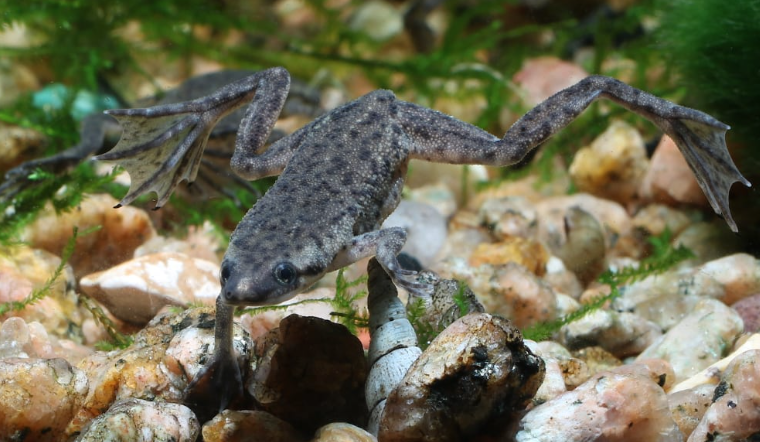
African Dwarf Frogs (Genus: Hymenochirus)
African dwarf frogs are small aquatic amphibians that belong to the frog family Pipidae, a group known for fully aquatic species. They are part of the genus Hymenochirus and are closely related to larger aquatic frogs. Unlike many frogs, they lack tongues and teeth, relying instead on suction feeding to capture food. Their classification places them among frogs that are highly adapted to life underwater.
These frogs are native to parts of Central and West Africa, where they live in slow-moving rivers, ponds, and flooded areas. They prefer calm, warm waters with plenty of vegetation and hiding places. In the wild, they often stay near the bottom or among plants, blending into their surroundings for safety.
African dwarf frogs are known for their small size, usually growing to about 4–6 cm (1.5–2.5 inches). They have smooth skin, webbed feet, and slightly flattened bodies that help them swim easily. Their eyes are positioned on the sides of their heads, giving them a wide field of vision while they remain mostly submerged.
In terms of behavior, these frogs are peaceful and social, often doing well in groups. They are active swimmers but also spend time resting on plants or tank decorations. Because they breathe air, they frequently swim to the surface for quick breaths before returning to the bottom.
Their diet consists mainly of small, protein-rich foods such as worms, insect larvae, and tiny aquatic creatures. In captivity, they are commonly fed sinking pellets, frozen foods, or live prey. They are slow eaters, so they may need extra attention during feeding time to ensure they get enough food.
African dwarf frogs are popular in aquariums due to their calm nature and interesting habits. They require clean, warm water and a well-maintained tank to stay healthy. With proper care, they can live for several years and provide a unique glimpse into the life of fully aquatic amphibians.
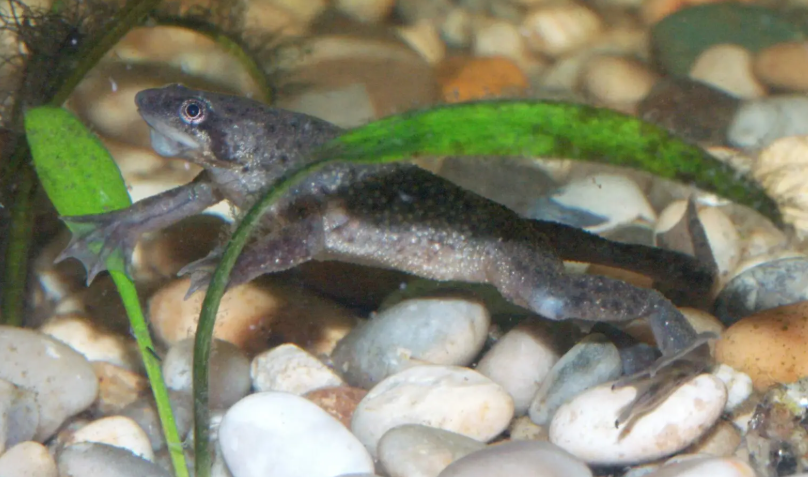
Species of African Dwarf Frog
Boettger’s African Dwarf Frog (Hymenochirus boettgeri)
By far the most familiar of the four species, Hymenochirus boettgeri is the frog sold in virtually every pet shop worldwide under the name “African Dwarf Frog” — often without any species-level identification at all. Native to the slow-moving streams, forest pools, and flooded lowlands of Nigeria, Cameroon, Gabon, the Democratic Republic of Congo, and the Central African Republic, it inhabits warm, vegetation-rich water with soft, leaf-littered substrates.
In the wild it is a microcarnivore, hunting small invertebrates, worms, and organic detritus using both vision and its lateral line to locate prey in murky water. It reaches approximately three to four centimeters in length, with females consistently larger and more robust than males. Males can be identified by a small, pale gland visible just behind each front armpit — a post-axillary subdermal gland whose function remains incompletely understood but is thought to play a role in courtship signaling.
During amplexus, the male grasps the female around the waist in inguinal embrace — a position lower on the body than most frogs — and the pair performs a remarkable underwater ballet, spinning slowly together before the female releases eggs into the water column. In captivity it thrives in community aquariums of ten gallons or more, is peaceful toward fish that cannot fit it in their mouths, and adapts readily to frozen bloodworms, brine shrimp, and specialist pellet diets. With good care it lives five to eight years, occasionally longer.
Western Dwarf Clawed Frog (Hymenochirus curtipes)
The least frequently encountered of the four species in the aquarium hobby, Hymenochirus curtipes is found in the forested pools, swamps, and slow river backwaters of West and Central Africa, with its range centered on the Democratic Republic of Congo and extending into neighboring regions.
It is the smallest of the four Hymenochirus species, rarely exceeding two and a half to three centimeters in length, and it is noticeably shyer and more retiring than H. boettgeri — spending more time sheltering among aquatic plant stems and submerged leaf litter than actively foraging in open water. Its coloration tends toward darker browns and grays with faint mottling, providing excellent camouflage against the dark substrate of the forest floor pools it inhabits.
It was for many years confused with H. boettgeri in both the scientific literature and the pet trade, and specimens sold as the commoner species occasionally turn out on closer examination to be curtipes. In captivity it benefits from densely planted aquariums with subdued lighting, hiding spaces among driftwood and broad-leaved plants, and live or frozen small invertebrates. It is less forgiving of poor water quality than its hardier relative and rewards the keeper who provides stable, well-filtered, warm water with a retiring but captivating presence.
Boulenger’s African Dwarf Frog (Hymenochirus boulengeri)
Named in honor of the prolific Belgian-British herpetologist George Albert Boulenger, Hymenochirus boulengeri is endemic to the Congo Basin — one of the most biodiverse and least scientifically explored freshwater systems on Earth. It inhabits the slow, vegetation-choked pools, forest stream margins, and seasonally flooded forest floors of the central Congo region, where the water is warm, soft, and heavily stained with tannins from decaying leaf matter.
It is the least studied of the four species in terms of ecology and behavior, and relatively little is known about its specific dietary preferences, breeding biology, or population status in the wild — though habitat loss in the Congo Basin represents an ongoing concern for all forest-floor aquatic species in the region. Morphologically it closely resembles its congeners but tends toward slightly more robust proportions and a somewhat flatter dorsal profile.
In the aquarium hobby it is genuinely rare, occasionally appearing in specialist collections and amphibian-focused breeding programs but essentially absent from mainstream pet trade supply chains. Dedicated hobbyists who have kept it describe behavior broadly similar to H. boettgeri but with a greater preference for cover and slower, more deliberate foraging movement — spending long periods hovering motionless in the water column before making sudden, precise strikes at prey.
Feae’s African Dwarf Frog (Hymenochirus feae)
The most geographically restricted of the four species, Hymenochirus feae is known from the forests of Gabon and southern Cameroon, where it inhabits the kind of warm, slow, heavily vegetated lowland pools and forest floor puddles that characterize the equatorial Atlantic coast of Central Africa. It was named after the Italian naturalist and explorer Leonardo Fea, who collected specimens in West Africa during the late nineteenth century.
Like H. boulengeri, it is very poorly represented in scientific literature, and much of what is assumed about its biology is extrapolated from more thoroughly studied congeners rather than direct field observation. Its external morphology conforms closely to the Hymenochirus body plan — small, flattened, with clawed hind feet, no visible external eardrums, no tongue, and the characteristic star-shaped sensory filaments on the fingertips that all four species use to detect movement in the water around them.
In captivity it is exceptionally rare, known primarily from a small number of specialist European collections and virtually unknown in the North American hobby. Its care requirements are presumed to broadly mirror those of the genus as a whole — warm, clean, well-filtered water, live or frozen small invertebrates, and a heavily planted tank that replicates the dense, low-light environment of its forest pool habitat.