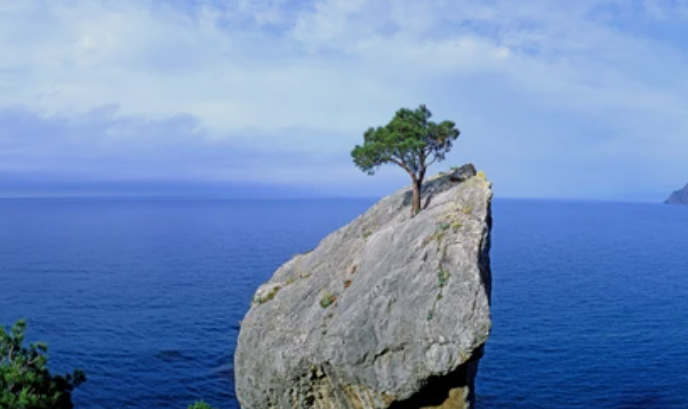
Lithophytes are specialized trees and plants that grow directly on rock surfaces or in crevices, adapting to harsh conditions to obtain nutrients and water. These resilient trees, such as Pines and Eastern White Cedars, often survive in nutrient-poor environments by developing extensive root systems that break down rock, sometimes outliving forest counterparts.
These trees anchor themselves directly onto rock surfaces or in tiny cracks where soil is minimal. Their roots often penetrate fissures in the rock to access water and essential minerals, making them highly resilient and uniquely adapted to challenging landscapes.
A key feature of lithophytic trees is their adapted root system. Unlike typical trees, their roots can cling tightly to rocky surfaces and even extract nutrients from tiny amounts of organic matter that accumulate in crevices. Some species also develop shallow, spreading roots to catch rainwater and dew, maximizing hydration in dry environments.
Lithophytic trees are commonly found in mountainous regions, cliff faces, and rocky outcrops. They are often exposed to extreme sunlight, wind, and temperature fluctuations, yet they thrive where other plants cannot. Their ability to survive in such tough conditions makes them ideal for creating unique rock gardens or naturalistic landscapes.
These trees are often slow-growing and hardy, which contributes to their longevity. Many lithophytes are also drought-tolerant and resistant to pests and diseases, making them low-maintenance options for gardeners and landscapers looking to add greenery to rocky or challenging sites.

Trees That Grow On Rocks
Indian Laurel Fig
Indian laurel fig is a classic lithophyte, often growing directly on rocks or cliff faces. Its roots penetrate small crevices to anchor the tree and absorb nutrients from minimal soil. Hardy and drought-tolerant, it can develop dramatic aerial roots that cling to rocky surfaces.
Buddhist Pine
Buddhist pine thrives on rocky slopes and outcrops. Its roots adapt to shallow substrates, anchoring securely in cracks and feeding from limited organic matter. This slow-growing tree is often used in bonsai and rock garden designs.
Sago Palm
The sago palm grows well on rocky substrates with minimal soil. Its thick, fibrous roots spread across rock surfaces to extract moisture and nutrients. Drought-tolerant, it adds a striking, prehistoric appearance to rocky landscapes.
Common Juniper
Common juniper is well-suited to rocky hillsides and cliff edges where soil is thin or absent. Its deep, spreading roots find moisture in crevices, allowing the tree to survive harsh, exposed conditions. Its evergreen foliage adds greenery to rugged environments.
Rubber Fig
Rubber fig can grow directly on rocks in tropical and subtropical regions. Its strong roots penetrate crevices to anchor the tree while absorbing water and nutrients. Over time, these trees create dramatic landscapes as they cling to cliffs and boulders.
Dragon Tree
Dragon tree is a lithophytic species that naturally grows on rocky outcrops, especially in volcanic areas. Its roots are adapted to shallow, rocky soils, absorbing moisture from cracks and limited organic material. The tree is slow-growing, with a thick trunk and umbrella-like canopy.
Eastern White Cedar
Eastern white cedar is a hardy tree commonly found on rocky, harsh environments such as the Niagara Escarpment. It has a remarkable ability to grow in shallow soils and cracks between rocks, where few other trees can survive. This slow-growing tree can live for over 1,900 years, making it one of the longest-living trees in North America. Its dense, conical form and evergreen foliage make it resilient against harsh winds and cold conditions.
Pine Trees
Many pine species thrive on mountain rocks and cliff edges, where soil is minimal and water is limited. Their deep, penetrating roots allow them to anchor in crevices and reach underground moisture. Pines are drought-tolerant and adaptable, often forming picturesque stands on rocky slopes. Species such as the Scots pine and Pinyon pine are classic examples of lithophytic pines.
Pohutukawa (New Zealand Christmas Tree)
The Pohutukawa is famous for its ability to grow directly on volcanic lava rocks and rugged coastal cliffs in New Zealand. Its roots spread across rocks and into small crevices, allowing it to survive extreme wind, salt spray, and minimal soil. Known for its bright red flowers in summer, the Pohutukawa adds vibrant color to otherwise barren rocky landscapes.
Boswellia sacra
Boswellia sacra, the frankincense tree, naturally grows on the edges of rocky cliffs in arid regions of the Arabian Peninsula and the Horn of Africa. Its roots penetrate narrow rock fissures to access water and nutrients. This tree is slow-growing and highly drought-tolerant, producing aromatic resin prized for centuries.