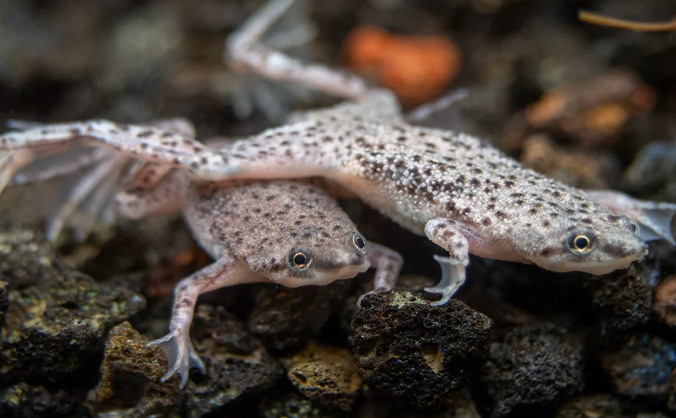
Swimming frogs kept in aquariums are usually fully aquatic species that spend their entire lives in water. These frogs are popular with aquarium enthusiasts because they are active, interesting to watch, and relatively easy to care for. Common examples include small, social frogs that glide through the water using smooth, graceful movements rather than hopping like land frogs. Their behavior makes them well-suited for life in a tank.
These frogs are excellent swimmers thanks to their webbed feet and streamlined bodies. They use gentle kicking motions to move through the water and often come up to the surface to breathe air. Because of this, aquariums should always have easy access to the surface and should not be too deep or crowded. They also enjoy having plants, hiding spots, and open swimming areas to feel secure and active.
Feeding aquarium frogs is usually simple, as they eat small, protein-rich foods like bloodworms, brine shrimp, and specially prepared pellets. They are not aggressive hunters, so food should be easy to find and sink slowly in the water. In community tanks, care must be taken to ensure they get enough to eat, as faster fish can outcompete them during feeding time.
Water quality is very important for these frogs. Clean, filtered water with stable temperature conditions helps keep them healthy. Sudden changes in temperature or poor water conditions can stress them and lead to illness. Regular tank maintenance, including partial water changes, is essential to create a safe and comfortable environment.
Underwater Frogs For Aquarium
African Dwarf Frog (Hymenochirus boettgeri)
The undisputed king of the aquarium frog world, the African Dwarf Frog is the most widely kept aquatic frog on the planet and for very good reason. Fully aquatic throughout its adult life, it thrives in a standard community aquarium, is peaceful toward fish of similar size, and remains small enough — barely three centimeters — to be comfortable in tanks as modest as ten gallons.
It surfaces periodically to gulp air, a charming behavior that becomes predictable and endearing over time. It accepts frozen bloodworms, brine shrimp, and specialist frog pellets, and its gentle, bumbling hunting style — arms outstretched, feeling through the water for food — is endlessly entertaining to watch.
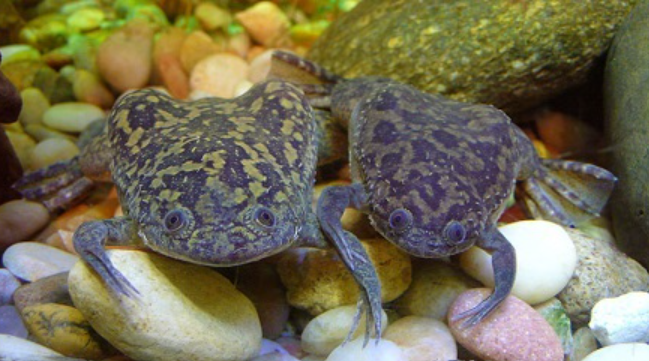
African Clawed Frog (Xenopus laevis)
A far more robust and demanding animal than its dwarf cousin, the African Clawed Frog is a fully aquatic powerhouse that requires a species-only or carefully selected tank due to its habit of consuming anything it can fit in its considerable mouth. It is tongueless, using its clawed forefeet to stuff food into its mouth with rapid, shoveling motions.
It is hardy, long-lived — up to 15 years in captivity — and deeply fascinating to observe, hovering motionless in the midwater column with a stillness that suggests deep meditation. A 20-gallon tank per individual is the minimum, with secure lids essential as it will escape given any opportunity.
Western Dwarf Clawed Frog (Hymenochirus curtipes)
Closely related to H. boettgeri and nearly identical in care requirements, the Western Dwarf Clawed Frog is a fully aquatic species from the forested pools of Central Africa that has entered the aquarium trade in smaller numbers than its eastern relative.
It is marginally smaller and somewhat shyer, benefiting from densely planted tanks with plenty of hiding places among broad-leaved aquatic plants. Like all dwarf clawed frogs, it uses a lateral line system to detect water movements and locate food in low-visibility conditions, making it an effective hunter even in dimly lit tanks filled with dense vegetation.
Albino African Clawed Frog (Xenopus laevis — albino morph)
The albino form of the African Clawed Frog is a captive-bred variety that has been selectively bred in laboratories and the pet trade for decades. Its ghostly white skin and vivid pink eyes make it a striking centerpiece animal for a species-dedicated aquarium.
Care requirements are identical to the wild-type — a large, securely lidded tank, meaty food items, and no tankmates small enough to be eaten. The albino morph is arguably even more compelling to watch than the wild type, its pale form drifting through the water column with an otherworldly, translucent quality that few aquarium animals can match.
Tropical Clawed Frog (Xenopus tropicalis)
Smaller and faster than Xenopus laevis, the Tropical Clawed Frog is a West African species that has become important in laboratory research but has also found a niche in the specialist aquarium hobby. It requires warmer water than its southern relative — 24 to 28 degrees Celsius — and is more active and skittish, darting around the tank with sudden bursts of speed.
Like all Xenopus frogs, it is fully aquatic, tongueless, and clawed, and it is a voracious feeder that will attempt to consume anything of appropriate size. It is best kept in a species-only setup with hiding places and subdued lighting.
Surinam Toad (Pipa pipa)
For the truly dedicated specialist, the Surinam Toad is perhaps the most extraordinary aquarium frog in existence. Its flat, leaf-like body, upward-facing eyes, and star-shaped sensory fingertips are unlike anything else in the hobby. It is a fully aquatic ambush predator that lies motionless on the substrate for hours, vacuuming up fish, worms, and invertebrates with a rapid suction strike.
The holy grail of keeping Surinam Toads is witnessing the breeding process — the sight of froglets erupting from pockets in the female’s back is one of the most remarkable events any aquarium keeper can witness. It requires a large, warm, dimly lit tank with soft substrate and feeder fish or large invertebrates.
Dwarf Surinam Toad (Pipa parva)
A much smaller and more manageable relative of Pipa pipa, the Dwarf Surinam Toad from Venezuela and Colombia is an excellent choice for the specialist aquarist who wants the extraordinary Pipa body plan without the tank size demands of its giant cousin. It reaches only four to five centimeters in length, making it suitable for a 20 to 30-gallon species tank.
It shares the same extraordinary sensory fingertips, the same ambush hunting strategy, and the same remarkable reproductive biology — females of this species also carry eggs embedded in the dorsal skin — though the clutch size is considerably smaller than that of Pipa pipa.
Budgett’s Frog (Lepidobatrachus laevis)
The Budgett’s Frog is a grotesque, wide-mouthed, semi-aquatic predator from the wetlands of Argentina and Bolivia that has developed a devoted following in the specialist amphibian hobby. It spends most of its time floating at the water’s surface or resting on the bottom of a shallow aquatic setup, its enormous mouth forming the most prominent feature of its entire body.
It is aggressive, bitey, and completely unapologetic about both traits, screaming and snapping when disturbed. A shallow aquarium — water depth roughly equal to the frog’s body length — with a land area for access to air is ideal. It accepts large earthworms, feeder fish, and appropriately sized insects with great enthusiasm.
Ornate Horned Frog (Ceratophrys ornata)
The Pac-Man Frog is primarily a terrestrial and semi-fossorial animal, but it thrives in a shallow aquatic setup — sometimes called a “paludarium” arrangement — where water depth does not exceed its chin when sitting on the bottom. In such a setup it reveals its essentially aquatic hunting strategy — sitting motionless and half-submerged, engulfing worms, feeder fish, and large invertebrates that wander within range of its enormous mouth.
A single specimen in a 20-gallon shallow tank with a gentle filter is a highly rewarding display animal, its round, colorful body and bottomless patience making it one of the most characterful frogs in the hobby.
Fantasy Horned Frog (Ceratophrys cranwelli × ornata hybrid)
A captive-bred hybrid between Cranwell’s Horned Frog and the Ornate Horned Frog, the Fantasy Horned Frog is widely available in the pet trade and combines the robustness of C. cranwelli with the striking coloration of C. ornata. It comes in a staggering array of captive-bred color morphs — albino, piebald, green, brown, and various patterned forms — that have been developed by specialist breeders.
It thrives in the same shallow aquatic or paludarium setup as its parent species and is often considered the most forgiving of all horned frogs for beginners, tolerating a wider range of temperatures and water conditions than pure species.
American Bullfrog (Lithobates catesbeianus)
For aquarists with the space and appetite for a truly large, bold, and characterful animal, the American Bullfrog is a magnificent specimen frog. In a large aquarium — 75 gallons or more — with a substantial water area and a land platform, it becomes surprisingly interactive, learning to associate its keeper with food and approaching the glass at feeding time with undisguised interest.
It is a consummate predator and will eat virtually anything offered, from large earthworms to feeder fish to prepared carnivore diets. It is important to note that in many jurisdictions outside North America it is a regulated species due to its invasive potential, and escape-proofing is essential.
Green Frog (Lithobates clamitans)
A smaller, more manageable alternative to the Bullfrog, the Green Frog of eastern North America is a semi-aquatic species that does extremely well in a large paludarium with a generous water section and emergent platform. It is a bold, curious, and highly visual frog that quickly becomes accustomed to its keeper, and its bright green coloration with bold dorsolateral ridges makes it one of the most attractive of the native North American aquarium frogs.
Males produce a single, banjo-string-like “gunk” call that is one of the most distinctive sounds of eastern North American wetlands. It accepts a wide variety of live and moving prey items.
Paradox Frog (Pseudis paradoxa)
The Paradox Frog is a highly aquatic South American species that spends its adult life floating among dense aquatic vegetation in warm, slow-moving water — a lifestyle it replicates well in a planted aquarium. Its most famous feature — the fact that its tadpoles are vastly larger than the adults — makes it one of the most talked-about frogs in the hobby, though few keepers have successfully bred it in captivity.
It is a mid-sized frog of around five to seven centimeters, and it is best kept in a heavily planted 40-gallon or larger aquarium with floating plants under which it can shelter and rest, emerging to hunt at the surface.
White’s Tree Frog (Litoria caerulea)
Though primarily arboreal, White’s Tree Frog is an enthusiastic and capable swimmer that does well in a large paludarium with a substantial water section, vertical climbing space, and dense cover. It is one of the most endearing and handleable frogs in the hobby — fat, placid, and seemingly unbothered by most of the indignities of captive life.
In a paludarium it will regularly descend to bathe in the water section, and its large, sticky toe pads allow it to cling to the glass walls just above the waterline with characteristic nonchalance. It accepts crickets, earthworms, and occasional waxworms with great enthusiasm.
Vietnamese Mossy Frog (Theloderma corticale)
A prized specialist animal, the Vietnamese Mossy Frog thrives in a tall, humid paludarium with a water section and vertical moss-covered surfaces to climb. Its extraordinary camouflage — it is virtually indistinguishable from actual moss — means that a well-planted paludarium display becomes a game of spot-the-frog for visitors, with the frog invariably winning.
It breeds in water-filled cavities and will utilize cork tubes or artificial caves above the waterline for this purpose. It requires cool temperatures — ideally 18 to 24 degrees Celsius — making it more suitable for cooler climates or air-conditioned rooms. It feeds on appropriately sized crickets and other invertebrates.
Tomato Frog (Dyscophus antongilii)
The blazing orange Tomato Frog of Madagascar is a semi-aquatic species that does well in a shallow paludarium with a small water section and a generous land area of moist substrate. While it is not a strong swimmer and does not require deep water, it will soak regularly in its water area and benefits greatly from the humidity a water section provides.
It is a stocky, attractive, and robust frog that is relatively straightforward to keep, accepting a varied diet of crickets, earthworms, and other appropriately sized invertebrates. Its vivid coloration makes it one of the most visually striking frogs available in the hobby, and captive-bred specimens are now widely available.
Amazon Milk Frog (Trachycephalus resinifictrix)
The Amazon Milk Frog is a large, bold tree frog from the Amazonian canopy that does exceptionally well in a tall, humid paludarium with a water section for soaking and breeding. Its striking black-and-white banded juvenile coloration gradually transforms into the muted grey-brown and white pattern of the adult — both phases are attractive in their own way.
In captivity it will frequently use a water section for breeding, depositing eggs on the walls or surfaces just above the waterline. It is a hardy, forgiving species that tolerates a range of temperatures and humidity levels, making it a good choice for aquarists transitioning into the paludarium hobby.
Red-Eyed Tree Frog (Agalychnis callidryas)
The iconic Red-Eyed Tree Frog is a highly sought-after paludarium species whose stunning coloration — vivid green body, scarlet eyes, blue flanks, and orange feet — makes it one of the most visually spectacular frogs available in the hobby. It requires a tall, warm, very humid paludarium with broad-leaved plants overhanging a water section, as it lays eggs on leaves above water in the wild.
It is not a strong swimmer but will descend to the water section and benefits from its presence for humidity and hydration. Captive-bred specimens are available from specialist breeders and are considerably more robust than wild-caught animals.
Glass Frog (Hyalinobatrachium sp.)
Glass Frogs are specialist-only animals that require very specific conditions — a tall, very humid paludarium with fast-moving, well-oxygenated water flowing over smooth surfaces that replicate a forest stream environment. Their extraordinary transparent undersides, through which internal organs are clearly visible, make them among the most visually fascinating frogs in the hobby, and a well-maintained glass frog paludarium is genuinely one of the most beautiful displays in the aquarium world.
They are delicate, sensitive to water quality, and require live prey — primarily small crickets and fruit flies — making them a challenging but deeply rewarding species for the committed specialist.
Australian Green Tree Frog (Litoria caerulea — Queensland form)
The Queensland form of the Green Tree Frog is a particularly large and robust expression of this popular species, with individuals sometimes exceeding eleven centimeters. In a large paludarium it is an impressive display animal — its size, vivid green coloration, and calm temperament combine to make it one of the most visitor-friendly frogs in any collection.
It basks under artificial lighting with apparent pleasure, descends to bathe in the water section regularly, and is one of the few frogs that seems genuinely comfortable with careful handling. Its skin secretions have been extensively studied for antibacterial and antiviral compounds with potential medical applications.
Lake Titicaca Water Frog (Telmatobius culeus)
Listed here not as a recommendation for casual hobbyists — it is critically endangered and tightly regulated — but as a testament to what dedicated specialist aquarists and conservation breeding programs have achieved, the Titicaca Water Frog represents the pinnacle of aquatic frog keeping.
Maintained in a handful of specialist collections and zoo programs, it requires cold, highly oxygenated, pristine water replicating the high-altitude Andean lake conditions of its native habitat, with powerful filtration and temperatures rarely exceeding 15 degrees Celsius.
Its extraordinary baggy, wrinkled skin — evolved to maximize oxygen absorption through cutaneous respiration — makes it one of the most biologically remarkable animals any aquarist could ever house, a living reminder of how strange and wonderful the world of aquatic frogs truly is.