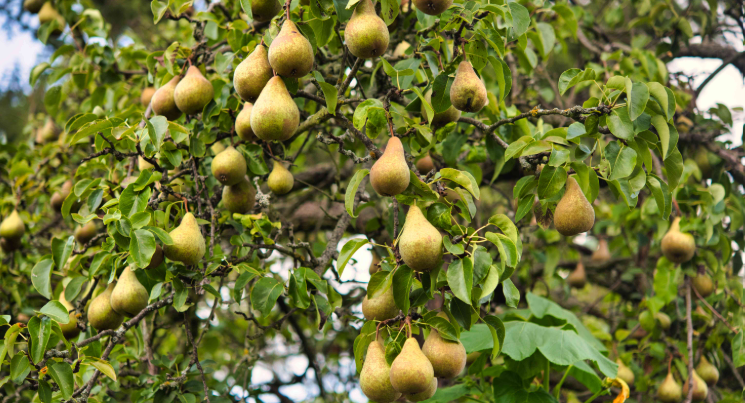
Pears are popular fruit trees known for their sweet, juicy fruits and graceful appearance. Most cultivated pears come from the species Pyrus communis (European pear) and Pyrus pyrifolia (Asian pear). Pear trees belong to the rose family, the same plant family that includes apples, cherries, and plums. They are widely grown in temperate regions and are valued both for fresh eating and for use in cooking, baking, and preserving.
Pear trees are deciduous, meaning they shed their leaves in autumn and grow new foliage in spring. In early spring, pear trees produce clusters of small white blossoms that cover the branches before the leaves fully develop. These blossoms are not only attractive but also essential for fruit production because they must be pollinated to form pears.
Like many fruit trees, most pear varieties require cross-pollination. This means pollen from one pear variety must fertilize the flowers of another compatible variety in order to produce fruit. Pollinating insects, especially bees, transfer pollen between trees while visiting the blossoms. When two different pear varieties bloom at the same time, fruit production is usually more reliable.
However, some pear trees are considered partially or fully self-fertile. Self-pollinating pear varieties are capable of producing fruit with their own pollen, meaning a single tree can still produce a harvest. These trees are particularly useful for small gardens or home landscapes where planting multiple trees may not be practical.
Even though self-fertile pear trees can bear fruit on their own, yields are often improved when another pear tree grows nearby. Cross-pollination typically increases the number and size of fruits because more flowers are successfully fertilized. For this reason, many gardeners still choose to plant more than one pear variety when space allows.
In addition to fruit production, pear trees are also appreciated for their ornamental value. Their spring blossoms, lush green summer leaves, and attractive fall colors make them appealing landscape trees.
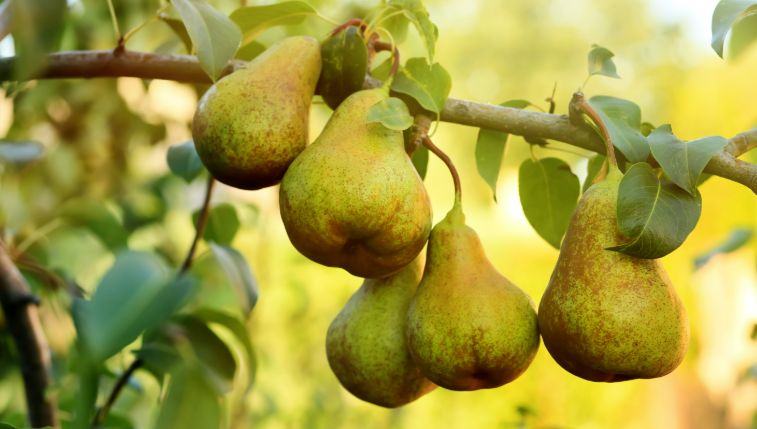
Self pollinating Pear Trees
Seckel
Seckel is among the most reliably self-fertile pear varieties, producing small sweet russeted pears without requiring another tree. This sugar pear ripens in September, features exceptional sweetness and spicy flavor, and produces consistent crops when planted alone. Seckel tolerates cold climates, bears fruit within 3-5 years, and provides excellent dessert quality despite small fruit size making it ideal for small spaces.
Kieffer
Kieffer is a partially self-fertile hybrid pear that produces adequate crops alone though yields improve significantly with cross-pollination. This late-season pear ripens in October, features hard texture best suited for canning and preserving, and demonstrates exceptional disease resistance. Kieffer tolerates heat and humidity better than European pears, produces reliably without requiring pollinators, and provides abundant fruit for processing.
Bartlett (Williams)
Bartlett is partially self-pollinating and produces reasonable crops alone though fruit set improves dramatically with cross-pollination. This classic pear ripens in August to September, features buttery texture and sweet flavor, and remains the standard for canning. Bartlett begins bearing young within 3-5 years, produces adequately as a single tree, and provides outstanding fresh eating and canning quality.
Anjou
Anjou shows partial self-fertility and can produce moderate crops without cross-pollination though yields improve with pollinators. This late-season pear ripens in October, stores exceptionally well through winter, and maintains smooth buttery texture for months. Anjou tolerates various climates, produces reasonable fruit set alone, and provides excellent storage pears for winter consumption.
Comice
Comice demonstrates limited self-fertility and produces some fruit alone though cross-pollination significantly improves yields and quality. This premium pear ripens in late September to October, features exceptional buttery texture and sweet flavor, and is considered among the finest dessert pears. Comice requires careful management, produces smaller crops without pollinators, but offers supreme eating quality worth growing as single specimen.
Summercrisp
Summercrisp is a hybrid Asian-European pear with good self-fertility that produces reliable crops without requiring another variety. This early-season pear ripens in August, features crisp texture similar to Asian pears, and demonstrates excellent fire blight resistance. Summercrisp tolerates cold climates, produces well without cross-pollination, and provides early-season crisp pears with disease resistance.
Moonglow
Moonglow shows partial self-fertility and produces moderate crops alone while also serving as excellent pollinator for other varieties. This mid-season pear ripens in late August to September, features soft buttery texture, and demonstrates good fire blight resistance. Moonglow bears fruit young, produces reasonably without requiring pollinators, and provides dual value as both fruiting tree and pollinator.
Harrow Sweet
Harrow Sweet demonstrates good self-fertility for a European pear, producing reliable crops without requiring cross-pollination. This mid-season variety ripens in September, features smooth buttery texture and sweet flavor, and shows excellent fire blight resistance. Harrow Sweet tolerates cold climates, produces consistently as a single tree, and combines productivity with disease resistance for low-maintenance growing.
Warren
Warren shows partial self-fertility and can produce adequate crops alone though yields improve with cross-pollination. This late-season pear ripens in October, features exceptional buttery texture and complex flavor, and stores well for several months. Warren produces reasonable fruit set without pollinators, develops outstanding flavor, and offers premium eating quality worth growing as single specimen.
Maxine
Maxine is an Asian pear variety with good self-fertility that produces crisp juicy fruit without requiring another tree. This mid-season Asian pear ripens in August to September, features apple-like crisp texture, and produces consistently without cross-pollination. Maxine tolerates heat better than European pears, bears fruit reliably alone, and provides crisp refreshing pears eaten fresh like apples.
Shinseiki
Shinseiki is a popular Asian pear with partial self-fertility that produces reasonable crops without requiring pollinators. This early-season variety ripens in August, features crisp juicy texture and mild sweet flavor, and produces consistently in warm climates. Shinseiki demonstrates good self-pollination, bears fruit young within 3-4 years, and provides abundant crisp pears for fresh eating.
Orcas
Orcas shows good self-fertility for a European pear and produces reliable crops without requiring another variety. This mid-season pear ripens in September, features smooth buttery texture, and demonstrates excellent disease resistance including fire blight. Orcas tolerates Pacific Northwest maritime climates, produces well without cross-pollination, and provides consistent yields with minimal pest and disease issues.