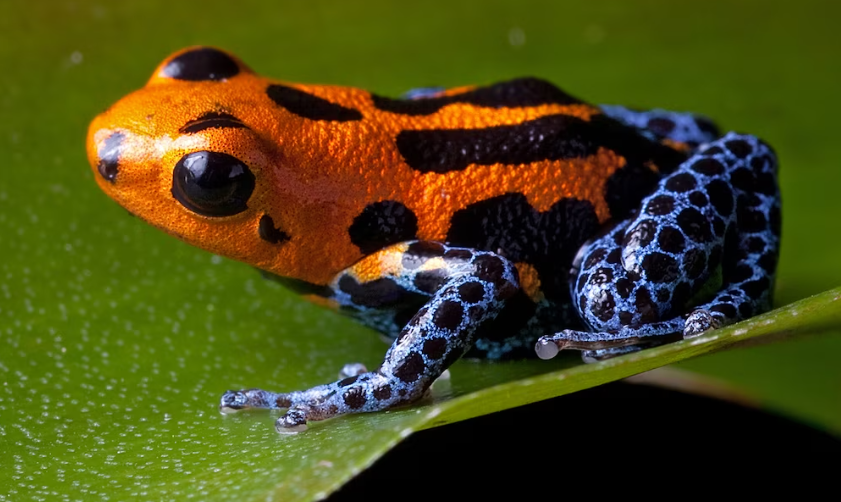
Poisonous frogs, often called poison dart frogs, are small amphibians best known for the toxic substances they produce through their skin. Most of them belong to a group found in Central and South American rainforests. Their toxins serve as a powerful defense against predators, making them some of the most well-protected frogs in the wild despite their small size.
One of their most striking features is their bright coloration. These frogs often display vivid shades of blue, yellow, red, or orange, sometimes with bold patterns. This is a warning signal to predators, letting them know the frog is toxic and should not be eaten. The brighter the colors, the stronger the warning tends to be.
The toxicity of these frogs comes from their diet in the wild, which includes ants, mites, and other tiny insects that contain natural chemicals. The frogs store and concentrate these toxins in their bodies. Interestingly, when kept in captivity and fed a different diet, many poison frogs lose their toxicity over time.
Despite their dangerous reputation, poison frogs are not aggressive and do not attack humans. Their toxins are only harmful if ingested or if they enter the body through cuts or sensitive areas. In their natural habitat, they spend most of their time on the forest floor or low vegetation, searching for food and caring for their young.
Common Types of Poisonous Frogs
Golden Poison Dart Frog (Phyllobates terribilis)
The most toxic vertebrate on Earth, the Golden Poison Dart Frog inhabits a tiny patch of humid rainforest on Colombia’s Pacific coast and carries enough batrachotoxin in its skin to kill ten adult humans. Unlike most poison dart frogs whose toxins require ingestion to be dangerous, Phyllobates terribilis can poison through skin contact alone — handling one with bare hands is genuinely life-threatening.
Its uniform golden-yellow coloration — sometimes orange or pale green depending on the population — is among the most unambiguous warning signals in the natural world. The Emberá people of Colombia have used its secretions on blowgun darts for generations, carefully wiping dart tips across the frog’s back to transfer the toxin. In captivity, without the wild diet of toxic beetles and ants from which it derives its poison, it gradually becomes harmless over several generations.
Strawberry Poison Dart Frog (Oophaga pumilio)
Few frogs in the world display the color variation of the Strawberry Poison Dart Frog, which comes in over thirty distinct morphs across its Central American range — from the classic red body with blue legs of the Bocas del Toro archipelago to all-yellow, white-spotted, green, and even completely blue forms in isolated populations.
Each morph is essentially its own isolated population, separated by geography and non-interbreeding. Its toxins — primarily pumiliotoxins and allopumiliotoxins derived from its diet of tiny mites and ants — cause muscle dysfunction and cardiovascular disruption in predators. The species is also a dedicated mother, carrying individual tadpoles to separate water-filled bromeliads and returning repeatedly to feed each one with unfertilized trophic eggs until it metamorphoses.
Blue Poison Dart Frog (Dendrobates azureus)
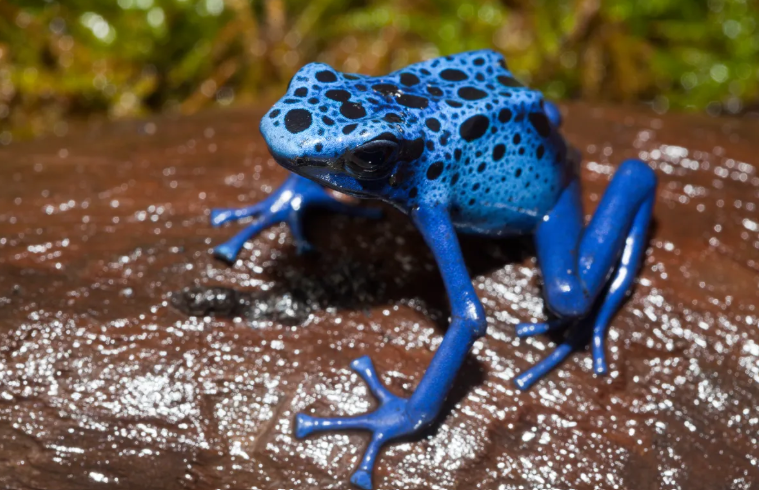
Endemic to a small, isolated patch of savanna forest in southern Suriname, the Blue Poison Dart Frog is one of the most recognizable amphibians alive — its cobalt blue body spotted with irregular black markings has made it an icon of amphibian conservation imagery worldwide. Its restricted range, estimated at just a few hundred square kilometers, makes it vulnerable to any habitat disturbance.
It carries dendrobatid alkaloids derived from its diet of small arthropods, particularly mites and ants, and is toxic enough to deter virtually all natural predators. In the hobby it is widely captive-bred and, like all captive dart frogs raised on a commercial diet, is entirely non-toxic. Males are devoted fathers, guarding eggs and carrying tadpoles on their backs to carefully chosen water sources.
Dyeing Poison Dart Frog (Dendrobates tinctorius)
One of the largest and most variable of the Dendrobates dart frogs, Dendrobates tinctorius ranges across the Guiana Shield of northeastern South America — Suriname, Guyana, French Guiana, and northern Brazil — and comes in a dazzling array of color morphs including the famous “azureus-like” blue forms, yellow-and-black “Patricia” morphs, white-and-black “Bakhuis” morphs, and many others.
The name “dyeing” refers to a legend — likely apocryphal — that indigenous peoples rubbed the frog on young parrots to cause their feathers to grow back in unusual colors. Its skin alkaloids are potent enough to cause serious toxicity in predators, and it is a popular and widely captive-bred species in the dart frog hobby due to its bold behavior and striking appearance.
Green-and-Black Poison Dart Frog (Dendrobates auratus)
Ranging from Nicaragua through Panama and into northwestern Colombia, the Green-and-Black Poison Dart Frog is one of the most widespread and recognizable of all dart frogs. Its name is somewhat misleading — while many individuals display classic emerald green and black patterning, others show turquoise, sky blue, mint, or even brown tones with black markings, varying considerably across its range. It was introduced to the Hawaiian island of Oahu in the 1930s and has established a small wild population there.
Its alkaloid toxins — primarily pumiliotoxins — are potent enough to cause significant physiological effects in predators, though it is considerably less toxic than the most dangerous South American species. It is widely kept in captivity and adapts well to life in a bioactive terrarium with live plants.
Phantasmal Poison Frog (Epipedobates tricolor)
This small Ecuadorian frog from the western slopes of the Andes made medical history when researchers discovered that its skin contains epibatidine — a chlorine-containing alkaloid with pain-relieving properties approximately 200 times more potent than morphine. Epibatidine acts on nicotinic acetylcholine receptors rather than opioid receptors, making it of extraordinary pharmaceutical interest as a potential non-addictive painkiller.
Unfortunately its direct therapeutic use is impossible due to severe toxicity, but it has inspired years of research into synthetic analogs. The frog itself is boldly patterned with red or maroon stripes on a dark background and inhabits the humid forest streams and rocky outcrops of western Ecuador, where it is threatened by habitat loss.
Splendid Poison Frog (Oophaga speciosa)
Found only in a small region of western Panama, the Splendid Poison Frog is one of the rarest and most beautiful dart frogs in the world — and one of the most critically endangered. Its intense red, orange, or yellow body contrasted with black markings makes it a visually stunning animal, but its restricted range and severe habitat loss from deforestation have pushed it to the brink of extinction.
It carries potent skin alkaloids and displays the same devoted maternal behavior as its relative Oophaga pumilio, transporting tadpoles to individual bromeliad pools and feeding them with trophic eggs. Conservation breeding programs in Panama and abroad represent the primary hope for the species’ survival.
Golfodulcean Poison Frog (Phyllobates vittatus)
Found only in the Golfo Dulce region of southwestern Costa Rica, this strikingly patterned frog displays bold orange or yellow stripes running the length of its dark body — a warning coloration that signals its membership in the genus Phyllobates, the most toxic of all dart frog genera.
While considerably less toxic than Phyllobates terribilis, it carries batrachotoxins that are still potent enough to cause serious harm, and it is the second most toxic species in its genus. It inhabits the leaf litter of humid lowland rainforest and is endemic to a very restricted coastal area, making it vulnerable to the ongoing deforestation of the Osa Peninsula and surrounding regions.
Kokoe Poison Dart Frog (Phyllobates aurotaenia)
One of the three species traditionally used by the Emberá and Noanamá peoples of Colombia for dart poisoning, Phyllobates aurotaenia carries batrachotoxins in quantities that rank it among the most toxic frogs in the world — surpassed in its genus only by P. terribilis. Its slender body displays vivid yellow or orange stripes against a jet-black background, a warning pattern so effective that it is mimicked by non-toxic species in its range.
It inhabits the humid lowland rainforests of Pacific Colombia and adjacent Panama, foraging in the leaf litter for small invertebrates. Its toxins are acquired through its diet and cannot be produced by the frog independently — a dietary dependency that makes it a valuable model for studying the evolution of chemical defense.
Mimic Poison Frog (Ranitomeya imitator)
The Mimic Poison Frog of the Peruvian Amazon is one of the most scientifically celebrated frogs in the world for its extraordinary ability to mimic the warning coloration of other, more toxic dart frog species in its range. Across different parts of its range it adopts different color patterns — striped in areas where the striped Ranitomeya variabilis is the dominant model, banded where banded species dominate, and spotted elsewhere.
This geographic color variation has made it a key study subject for understanding Müllerian and Batesian mimicry, speciation, and the evolution of coloration. Despite its mimicry of highly toxic species, it carries only moderate levels of alkaloids in its own skin and is considered less toxic than its models.
Lovely Poison Frog (Phyllobates lugubris)
Found in the Caribbean lowlands of Costa Rica and Panama, the Lovely Poison Frog is the least toxic member of the dangerous Phyllobates genus — but “least toxic” is a relative term that still places it well ahead of most other frogs in terms of chemical defense. Its body is jet black with vivid green, yellow, or orange stripes running from snout to groin, a bold aposematic pattern that is unmistakably a warning.
It inhabits leaf litter on the forest floor of humid lowland rainforest and is a dedicated parent, with males carrying tadpoles to suitable water sources on their backs. Despite its toxicity, it has become relatively popular among specialist dart frog hobbyists who appreciate the dramatic contrast of its coloration.
Harlequin Poison Frog (Oophaga histrionica)
Endemic to the extraordinarily biodiverse Chocó region of western Colombia, the Harlequin Poison Frog is one of the most polymorphic vertebrates on Earth — populations just a few kilometers apart can display completely different color patterns, ranging from white-on-black to red-on-black to orange-spotted to entirely different arrangements of the same colors.
This exceptional intraspecific variation has made it one of the most intensively studied frogs in evolutionary biology, as researchers attempt to understand how and why such dramatic visual diversity arose and is maintained within a single species. Its skin alkaloids are potent, and the frog’s reliance on its highly specific Chocó forest habitat makes it vulnerable to the rapid deforestation devastating that region.
Granular Poison Frog (Oophaga granulifera)
Found along the Pacific coast of Costa Rica and extreme northwestern Panama, the Granular Poison Frog takes its name from the prominently granular texture of its skin, which gives it a rougher appearance than many of its smoother-skinned relatives. It displays vivid red or orange on its upper surfaces contrasting with blue or green on its legs — a color combination that varies across its relatively small range.
Like other Oophaga species, females invest heavily in parental care, providing unfertilized nutritive eggs to developing tadpoles in individual bromeliad tanks. It inhabits humid lowland forest and is threatened by the rapid loss of Pacific coastal forest in Costa Rica, one of the most deforested landscapes in Central America.
Splash-Back Poison Frog (Ranitomeya variabilis)
Named for the variable color pattern concentrated on its back and head, the Splash-Back Poison Frog ranges across the Amazon Basin of Peru and Brazil and exhibits geographic color variation that makes it one of the more complex species in its genus to identify. Some populations display vivid green and black striping, others show yellow and black, and still others exhibit nearly solid green or blue-green tones.
It serves as a model species mimicked by the Mimic Poison Frog across parts of its range. Its alkaloid profile is moderate, and it is a popular terrarium animal among dart frog enthusiasts due to its relatively small size, bold behavior, and willingness to breed in captivity.
Bumblebee Poison Frog (Dendrobates leucomelas)
Named for its bold yellow-and-black banded pattern — reminiscent of the warning coloration of a bumblebee — this Venezuelan species is one of the most widely recognized and commonly kept dart frogs in the hobby worldwide. It ranges across Venezuela, Guyana, and extreme northern Brazil, inhabiting both rainforest and drier seasonal forest — a broader habitat tolerance than many of its relatives.
It is a bold, active, and vocal species, with males producing a distinctive chirping call throughout the day. In captivity it is hardy, breeds readily, and tolerates a slightly wider range of temperatures and humidity than more specialist dart frog species, making it an excellent starting point for hobbyists entering the world of poison dart frogs.
Zimmermann’s Poison Frog (Ranitomeya amazonica)
Found in the Peruvian and Brazilian Amazon, Zimmermann’s Poison Frog is a small but brilliantly colored species displaying a vivid orange or red head and upper back contrasting sharply with a dark, spotted or reticulated body. It was for many years considered a subspecies of Ranitomeya ventrimaculata before being elevated to full species status.
Like other Ranitomeya frogs it is a biparental species, with both males and females participating in tadpole transport and provisioning — an unusual level of paternal investment for a frog. Males defend territories vigorously and produce persistent, high-pitched calls from elevated perches in the forest understory.
Reticulated Poison Frog (Ranitomeya ventrimaculata)
Widespread across the western Amazon Basin in Peru, Ecuador, and Brazil, the Reticulated Poison Frog is named for the fine reticulated — net-like — black patterning on its vivid red, orange, or yellow body. It is one of the smaller Ranitomeya species, rarely exceeding fifteen millimeters in length, but its intense coloration more than compensates for its diminutive size.
It inhabits the lower strata of primary rainforest, foraging among leaf litter and low vegetation for tiny mites and other micro-arthropods. In captivity it is delicate and demanding, requiring very high humidity, stable warm temperatures, and a steady supply of appropriately tiny prey items such as springtails and micro fruit flies.
18. Three-Striped Poison Frog (Ameerega trivittata)
One of the larger members of the family Dendrobatidae, the Three-Striped Poison Frog of the western Amazon Basin reaches up to four centimeters — considerably larger than most of its more famous relatives — and displays bold yellow or cream stripes running along each side of its dark brown or black body. Unlike the brightly colored Dendrobates and Oophaga species, its more subdued coloration reflects its somewhat lower toxicity, though it still carries sufficient alkaloids to deter most predators. It is a terrestrial species of the forest floor, moving through leaf litter with a distinctive deliberate walk rather than the rapid hops of less toxic frogs. It is occasionally kept in captivity but is less popular in the hobby than more vividly colored species.
Anthony’s Poison Arrow Frog (Epipedobates anthonyi)
A close relative of the medically important Epipedobates tricolor, Anthony’s Poison Arrow Frog of southwestern Ecuador and adjacent Peru carries similar alkaloid compounds that have attracted significant pharmaceutical research attention. It displays bold red or maroon striping on a dark body — a vivid warning coloration shared with its famous relative.
It inhabits humid forests and scrubland on the western slopes of the Andes, an ecosystem under severe pressure from agricultural expansion. Its skin secretions contain pumiliotoxins and other alkaloids, and the genus Epipedobates as a whole has become one of the most important in biomedical research due to the novel chemical structures found in its members’ skin.
Sky-Blue Poison Frog (Hyloxalus azureiventris)
Found in the cloud forests of northern Peru, the Sky-Blue Poison Frog is named for the vivid turquoise-blue coloration of its undersides — a flash of unexpected color visible when the frog moves and visible as a warning when it adopts a defensive posture.
Its dorsal surface is dark brown or olive, providing camouflage when at rest, while the bright ventral coloration serves as a secondary warning signal revealed only to predators that have already made initial contact. It belongs to the genus Hyloxalus, members of which were formerly placed in Colostethus and represent a diverse group of mostly cryptically colored, moderately toxic dendrobatid frogs found across the Andes.
Splendid Poison Frog relative / Crowned Poison Frog (Oophaga speciosa-related / Dendrobates coronatus)
The range of toxic Oophaga and Dendrobates frogs across Panama includes several species of restricted range and vivid coloration that serve as important indicators of forest health in one of the world’s most biodiverse isthmian regions.
These frogs display the full range of aposematic strategy — from brilliant solid colors to complex multicolored patterns — and carry alkaloid cocktails whose precise composition reflects the micro-arthropod communities available in their specific forest patches. Their sensitivity to forest disturbance makes them among the first species to disappear when habitat is degraded, earning them a role as biological sentinels of ecosystem integrity in Panamanian conservation monitoring programs.
Dyeing Frog relative / Lehmann’s Poison Frog (Oophaga lehmanni)
Found only in a tiny fragment of forest in the Valle del Cauca department of Colombia, Lehmann’s Poison Frog is one of the rarest and most critically endangered dart frogs in the world. Its dramatic coloration — bold red or orange banding on a jet-black body — is among the most striking of any Oophaga species, and its extreme rarity has made it a target for illegal collection for the exotic pet trade, which has historically been a significant threat to its already tiny population.
It is named in honor of the Colombian ornithologist Federico Carlos Lehmann. Conservation assessments suggest its wild population may number only in the hundreds of individuals, making every surviving patch of its Andean forest habitat critically important.
Super Blue Poison Dart Frog (Dendrobates truncatus)
Native to Colombia’s Caribbean coast and adjacent lowland forests, Dendrobates truncatus is a smaller, more lightly built dart frog than many of its well-known relatives, displaying yellow, white, or pale blue stripes or spots on a dark body in a pattern that varies across its range.
Though less frequently discussed in popular accounts than the more glamorous Amazonian species, it is a fully equipped chemical defender, carrying dendrobatid alkaloids that render it unpalatable to virtually all natural predators. It inhabits primary and secondary lowland forest and is vulnerable to the extensive deforestation affecting Colombia’s Caribbean coastal regions, which have lost the majority of their original forest cover.
Dyeing Frog relative / Amazonian Poison Frog (Ranitomeya uakarii)
Named after the bald uakari monkey whose territory overlaps its range in the Peruvian Amazon, Ranitomeya uakarii is a vivid, red-headed poison frog of the dense Amazonian lowlands. Its brilliant crimson or orange head and neck contrast with a dark reticulated body in a pattern that makes it unmistakable and unmistakably dangerous to experienced predators in its range.
It inhabits primary forest and is associated with specific palm species whose leaf axils collect water suitable for tadpole deposition. Like other biparental Ranitomeya species, both parents participate in tadpole care, with the male typically responsible for transport and the female for nutritive egg provisioning.
Little Devil Poison Frog (Oophaga sylvatica)
Found in the Chocó lowlands of Ecuador and adjacent Colombia, the Little Devil Poison Frog is a small but intensely colored species displaying vivid red, orange, or yellow on its dorsal surfaces contrasting with dark or pale undersides depending on the population. It was for years considered a variant of Oophaga pumilio until genetic analysis confirmed its status as a distinct species.
It inhabits the leaf litter and low vegetation of humid lowland rainforest in one of the most biodiverse — and most threatened — ecosystems in the western hemisphere. Its skin alkaloids include pumiliotoxins and histrionicotoxins derived from its highly specific diet of mites and ants in the Chocó forest floor community.
Deceptive Poison Frog (Allobates femoralis)
Unlike the brilliantly colored dart frogs that dominate popular imagination, the Deceptive Poison Frog of the Amazon Basin is a cryptically colored, brownish frog with subtle pale stripes that blends into leaf litter rather than advertising itself boldly. It belongs to a group of dendrobatid frogs that were long assumed to be non-toxic due to their cryptic coloration, but research has revealed that it does carry alkaloids — at lower concentrations than the most vividly colored species.
Its “deceptive” name refers both to its misleading cryptic appearance and to the behavioral complexity it displays — males hold elaborate territories and engage in extended vocal and physical contests that have been studied as a model for understanding resource competition in anurans.
Malagasy Poison Frog (Mantella aurantiaca)
The Golden Mantella of Madagascar is not a dendrobatid dart frog at all — it belongs to the entirely separate family Mantellidae — but it has arrived at strikingly similar coloration and toxicity through convergent evolution, representing one of the most remarkable examples of evolutionary parallel development in the vertebrate world.
Its blazing orange body carries pumiliotoxins and other alkaloids derived from its diet of tiny forest-floor invertebrates in the central Malagasy rainforest. Like the South American dart frogs it so closely resembles, it is diurnal, boldly colored, and chemically defended. Critically endangered due to the catastrophic deforestation of Madagascar’s central highlands, it has become a flagship species for Malagasy amphibian conservation.