Oak trees (Quercus spp.) are among the most ecologically valuable trees on Earth, supporting thousands of species of insects, birds, and mammals. Gardening beneath them, however, requires careful plant selection. Oak canopies create dense summer shade, and their surface roots compete aggressively for water and nutrients.
Many oaks, particularly in California and the American West, are highly sensitive to summer irrigation near their root zones — a condition known as oak root fungus (Armillaria) susceptibility. The most successful plants under oaks are drought-tolerant, shade-adapted, and preferably native to oak woodland ecosystems.
Key Tips for Planting Under Oak Trees: Always choose drought-tolerant, shade-adapted plants, especially in summer-dry climates where oaks are particularly sensitive to irrigation near their root zones. Never install irrigation systems within the drip line of native oaks in summer-dry regions — this is one of the leading causes of oak decline and death from Armillaria root fungus.
Plant in autumn rather than spring to give new plants the winter rains to establish before summer drought. Avoid deep digging near surface oak roots — plant shallowly and carefully. Use native plants wherever possible — they are the most naturally adapted to co-existing with oaks and provide the greatest wildlife value. Mulch lightly with wood chip or shredded leaf litter to conserve soil moisture and moderate temperature without smothering surface roots.
Plants That Grow Well Under Oak Trees
Wild Ginger (Asarum canadense / Asarum caudatum)
One of the most reliable and beautiful native ground covers for the shaded, dry conditions beneath oak trees. Its large, soft, kidney-shaped leaves form a dense, spreading carpet that completely suppresses weeds.
Hidden beneath the leaves in spring are small, brownish-purple, jug-shaped flowers pollinated by ground-crawling insects. Eastern wild ginger (A. canadense) and western wild ginger (A. caudatum) both thrive in the acidic, root-competitive, dry-shaded soil typical under oak canopies.
Sword Fern (Polystichum munitum)
A magnificent, evergreen fern forming large, vase-shaped rosettes of long, glossy, dark green fronds that grow naturally beneath oaks in Pacific Coast forests. It is superbly adapted to dry shade, root competition, and acidic soil — exactly the conditions beneath a mature oak.
In eastern and midland gardens, Christmas fern (Polystichum acrostichoides) performs the same role with equal grace. Both are virtually maintenance-free, extremely long-lived, and among the most dependable ferns for oak woodland gardens.
Wood Fern (Dryopteris spp.)
The wood ferns — including autumn fern (Dryopteris erythrosora), male fern (D. filix-mas), and marginal wood fern (D. marginalis) — are outstanding performers in the dry, shaded conditions under oak trees. Their arching, elegantly divided fronds bring lush texture to bare woodland floors. Many species are semi-evergreen to fully evergreen, providing year-round coverage. Once established, wood ferns are highly drought-tolerant and spread slowly to create naturalistic colonies beneath the oak canopy.
Epimedium (Epimedium spp.)
Universally regarded as the finest ground cover for dry shade in the world, epimedium is an exceptional companion for oak trees. Its heart-shaped, often bronze-tinted leaflets emerge beautifully in spring, become tough and weed-smothering through summer, and remain semi-evergreen through winter.
Delicate, spider-like flowers in yellow, white, pink, lavender, or orange appear in spring. Once established beneath an oak, epimedium forms impenetrable mats requiring almost no irrigation, fertilization, or care.
Hellebore (Helleborus spp.)
Hellebores are among the most beautiful and trouble-free shade perennials for planting under oak trees. Their leathery, evergreen, deeply divided leaves remain attractive year-round and suppress weeds effectively.
Nodding, cup-shaped flowers in white, cream, pink, plum, burgundy, and near-black appear in late winter and early spring — among the earliest flowers of the year. They self-seed prolifically once established, gradually colonizing the ground beneath the oak with minimal intervention and no supplemental irrigation.
Trillium (Trillium spp.)
Native woodland wildflowers of exquisite beauty, trilliums are naturally at home beneath oak trees across eastern North America. Their distinctive three-petaled flowers in white, pink, red, or maroon rise above a perfect whorl of three broad leaves in early spring.
White trillium (T. grandiflorum), red trillium (T. erectum), and toadshade (T. sessile) are all classic oak woodland companions. They are slow to establish but extremely long-lived, returning reliably each spring for decades.
Solomon’s Seal (Polygonatum biflorum)
An elegant, arching native woodland perennial perfectly suited to the dry shade under oak trees. Its graceful, horizontally arching stems carry alternating, broadly oval, parallel-veined leaves and rows of pendant, creamy-white bell flowers hanging below the stem in spring.
Blue-black berries follow in autumn. It spreads steadily by underground rhizomes to create sweeping, naturalistic drifts on the oak woodland floor. It tolerates dry shade and root competition with remarkable ease and requires no supplemental care once established.
Wild Blue Phlox (Phlox divaricata)
A charming native woodland perennial producing clouds of fragrant, soft blue to lavender flowers in mid-spring above spreading, semi-evergreen mats of small oval leaves.
It thrives in the partially shaded, moderately dry, humus-rich conditions beneath deciduous oaks, where filtered light reaches the woodland floor in early spring before leaf-out. It spreads gently by stolons and self-seeds to naturalize attractively beneath oak canopies and is highly attractive to butterflies and early-season pollinators.
Foamflower (Tiarella cordifolia)
A delightful native North American woodland perennial producing frothy spikes of tiny white to pale pink flowers in spring above attractive, maple-like, semi-evergreen, lobed leaves.
It tolerates the dry, shaded, acidic conditions beneath oak trees and spreads by stolons to form a weed-suppressing mat. Many modern cultivars offer striking leaf patterning with dark burgundy markings along the veins. It naturalizes beautifully in oak woodland gardens, self-seeding to create gradually expanding colonies.
Coral Bells (Heuchera spp.)
Grown primarily for their spectacular foliage — in shades of burgundy, caramel, silver, bronze, lime, and near-black — coral bells are outstanding perennials for the partially shaded conditions beneath oak trees. Airy wands of tiny white, pink, or red flowers rise above mounded foliage in summer, attracting hummingbirds.
Many species are native to oak woodland and chaparral habitats in North America. Modern cultivars have been extensively selected for improved drought and shade tolerance beneath oak canopies.
Bleeding Heart (Lamprocapnos spectabilis)
A beloved spring perennial producing arching stems of heart-shaped, pendulous pink and white flowers above soft, deeply divided blue-green foliage. It thrives in the cool, shaded conditions beneath deciduous oaks, emerging in spring when filtered light still reaches the woodland floor.
It tolerates dry shade and acidic soil well, though it appreciates some moisture during spring. Fringed bleeding heart (Dicentra eximia) is a superior native alternative that blooms repeatedly and tolerates drier conditions beneath oak trees.
Wild Columbine (Aquilegia canadensis)
Eastern red columbine is a graceful, self-seeding native wildflower that naturalizes beautifully beneath oak trees. Its distinctive nodding flowers with red spurs and yellow petals are irresistible to hummingbirds and long-tongued bees. Delicate, blue-green, compound foliage is attractive before and after bloom.
It tolerates dry shade, acidic soil, and root competition and perpetuates itself freely through self-seeding, creating naturalistic colonies on the oak woodland floor with absolutely minimal intervention.
Hosta (Hosta spp.)
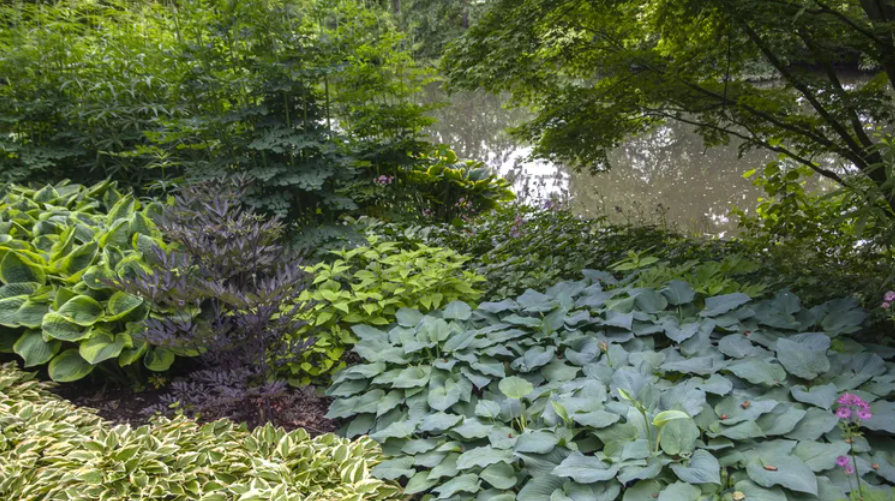
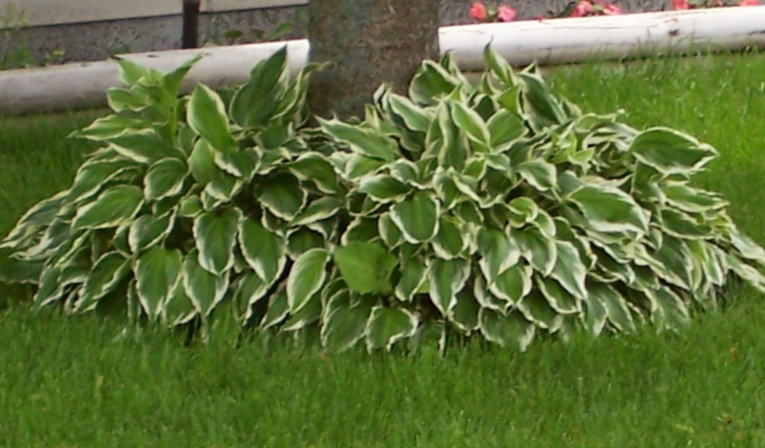
Among the most popular and versatile shade perennials in temperate gardens, hostas are outstanding performers beneath oak trees. Their bold, architecturally striking leaves in shades of blue-green, gold, chartreuse, and white-variegated make them dominant foliage plants in shaded spaces.
They tolerate dry shade and root competition better than many perennials and return reliably each year, forming increasingly impressive, weed-suppressing clumps. Blue-leaved cultivars such as ‘Halcyon’ and ‘Blue Angel’ are particularly well-adapted to dry shade.
Lungwort (Pulmonaria spp.)
One of the earliest-blooming and most attractive perennials for dry shade, lungwort produces clusters of funnel-shaped flowers that open pink and age to vivid blue in early spring. Its large, semi-evergreen leaves are heavily spotted or splashed with silver, providing striking year-round foliage interest.
It tolerates the dry, shaded, root-competitive conditions beneath oak trees and forms steadily spreading, weed-suppressing clumps. ‘Raspberry Splash’ and ‘Trevi Fountain’ are outstanding cultivars for dry oak woodland conditions.
Creeping Phlox (Phlox stolonifera)
A native woodland ground cover that produces a carpet of vivid violet, pink, or white flowers in mid-spring above spreading mats of semi-evergreen foliage. Unlike sun-loving moss phlox, creeping phlox is specifically a woodland species adapted to the partially shaded, moderately dry conditions beneath deciduous oaks.
It spreads by stolons to form a weed-suppressing ground cover and is particularly effective at the lighter, outer edges of the oak canopy where dappled spring light filters through before leaf-out.
Lily of the Valley (Convallaria majalis)
One of the toughest and most fragrant ground covers for dry shade, lily of the valley spreads aggressively by underground rhizomes beneath oak trees to form a dense, weed-suppressing carpet.
Its paired, broad, lance-shaped leaves emerge in spring, followed by arching stems of tiny, perfectly bell-shaped, intensely fragrant white flowers. Once established it is virtually unstoppable, tolerating the driest, most root-competitive conditions beneath mature oak canopies where few other plants survive.
Ajuga (Ajuga reptans)
A fast-spreading, mat-forming ground cover that excels in the challenging dry shade beneath oak trees. Its rosettes of bronzed, burgundy, or dark green leaves spread rapidly by stolons to carpet large areas quickly, and short spikes of vivid blue flowers appear in spring.
Ajuga tolerates dry, acidic, root-competitive, deeply shaded conditions with remarkable resilience. It is one of the fastest and most effective weed-suppressing ground covers for the bare soil beneath dense, mature oak canopies.
Pachysandra (Pachysandra terminalis / Pachysandra procumbens)
Japanese spurge (P. terminalis) is one of the most widely planted evergreen ground covers for dry shade, forming a dense, uniform, 6-inch carpet beneath oaks.
Allegheny spurge (P. procumbens), the native North American species, is even better adapted to conditions beneath eastern oaks, with beautifully mottled, semi-evergreen leaves and fragrant white spring flowers.
Both tolerate dry, acidic, root-competitive conditions beneath oaks exceptionally well and require virtually no maintenance once established.
Vinca (Vinca minor)
Lesser periwinkle is a vigorous, trailing, evergreen ground cover that smothers the ground beneath oak trees with a dense mat of small, glossy, dark green leaves.
Cheerful violet-blue, white, or burgundy pinwheel flowers appear in spring and sporadically through summer. It tolerates deep shade, dry soil, and root competition with great resilience, spreading steadily by trailing stems that root at the nodes. It is one of the most dependable evergreen ground covers for the densest dry shade beneath mature oaks.
Mahonia (Mahonia aquifolium / Mahonia repens)
Oregon grape (M. aquifolium) and creeping mahonia (M. repens) are bold, architectural, evergreen shrubs that thrive in the dry, acidic shade beneath oak trees — habitats that closely replicate their native Pacific Northwest coniferous and oak woodland environments. Glossy, spiny, holly-like pinnate leaves turn bronze-purple in winter.
Fragrant yellow flowers in early spring are followed by clusters of blue-black berries beloved by birds. Creeping mahonia is particularly effective as a low, spreading ground cover.
Rhododendron and Azalea (Rhododendron spp.)
Classic companions for oak trees across the temperate world, rhododendrons and azaleas share the acidic, humus-rich, partially shaded soil preferences that mature oaks help create. Their spectacular spring flower displays — in every color from white through pink, red, orange, and purple — are unmatched among shade-tolerant shrubs.
Native azaleas such as flame azalea (R. calendulaceum) and pinxterbloom (R. periclymenoides) are particularly well-adapted to the dry shade conditions beneath eastern oak woodlands.
Mountain Laurel (Kalmia latifolia)
A magnificent native North American evergreen shrub that grows naturally in the understory of oak and mixed deciduous woodland. Its glossy, lance-shaped dark green leaves are attractive year-round, and its intricate, cup-shaped flowers in white, pink, and rose with crimson markings are among the most beautiful of any native shrub.
It thrives in the dry, acidic, shaded conditions beneath oak trees, forming large, billowing masses of evergreen foliage and spectacular spring bloom.
Native Azalea (Rhododendron canescens / Rhododendron arborescens)
Piedmont azalea (R. canescens) and sweet azalea (R. arborescens) are deciduous native shrubs that grow naturally beneath oak woodland canopies across the eastern United States. They produce exquisitely fragrant flowers — pink and white respectively — in spring before or with the new leaves.
Their naturally open, multi-stemmed habit is perfectly suited to the dappled light beneath oaks. They tolerate dry, acidic soil and are outstanding choices for naturalistic oak woodland garden designs.
Oakleaf Hydrangea (Hydrangea quercifolia)
A spectacular native shrub named for its large, deeply lobed leaves that closely resemble those of red oak. It grows naturally in the understory of oak woodland in the southeastern United States and is superbly adapted to the conditions beneath oak trees.
Enormous, conical, white flower heads that age through cream to parchment-pink to russet-brown provide interest from midsummer through winter. Exfoliating cinnamon-brown bark and vivid burgundy-red fall foliage add further seasonal interest.
Wild Hydrangea (Hydrangea arborescens)
A tough, adaptable native shrub of eastern American woodlands and rocky slopes, growing naturally in oak woodland understory. Its large, rounded, creamy-white flower heads — including the popular cultivar ‘Annabelle’ — are produced abundantly even in dry, shaded conditions.
It is significantly more drought-tolerant than exotic hydrangeas and handles the root competition beneath oaks with ease. It dies back to the ground in cold winters and returns vigorously each spring, flowering on new wood.
Virginia Bluebells (Mertensia virginica)
A breathtaking native spring ephemeral that naturalizes magnificently beneath deciduous oak trees. Large, soft, blue-green leaves emerge in early spring, followed by clusters of pendulous, trumpet-shaped flowers that open pink and mature to vivid sky-blue — one of the most beautiful color combinations in the native wildflower palette.
By early summer all the foliage dies back completely, leaving the ground bare to be covered by later-emerging companions such as hostas or ferns.
Jack-in-the-Pulpit (Arisaema triphyllum)
A fascinating and distinctive native woodland wildflower of eastern oak woodlands, producing its unique hooded spathe — the “pulpit” — surrounding a club-shaped spadix — the “Jack” — in spring. Large, three-part compound leaves emerge alongside the flower. By late summer, clusters of brilliant red berries replace the flower.
It thrives in the moist to moderately dry, acidic, shaded conditions beneath oak trees and self-seeds to form naturalistic colonies over time in undisturbed woodland gardens.
Bloodroot (Sanguinaria canadensis)
One of the earliest and most beautiful native spring wildflowers, bloodroot produces solitary, pristine white flowers with golden stamens that emerge wrapped in a single lobed leaf in early spring — sometimes pushing through snow.
The flowers are short-lived but breathtakingly pure. Named for the orange-red sap in its rhizome, it spreads slowly to form colonies beneath oaks. The double-flowered form ‘Multiplex’ holds its blooms longer. It requires moist to moderately dry, humus-rich, acidic woodland soil.
Dutchman’s Breeches (Dicentra cucullaria)
A delightful spring ephemeral of eastern deciduous woodland, producing arching stems of unique white flowers with yellow tips that resemble tiny pairs of pantaloons hung upside down.
Its finely divided, blue-green, ferny foliage is attractive alongside the flowers before dying back by early summer. It grows naturally beneath oak trees in eastern North America and self-seeds to create charming, naturalistic colonies. It thrives in the cool, moist to moderately dry, acidic conditions beneath oaks in spring.
Mayapple (Podophyllum peltatum)
A dramatic and distinctive native woodland perennial that spreads by underground rhizomes to create large, sweeping colonies of umbrella-like, deeply lobed, bright green leaves beneath oak trees.
Single, waxy-white, nodding flowers appear at the fork of twin-leaved plants in spring, followed by a small, lemon-yellow, edible fruit in summer. Mayapple tolerates dry shade, root competition, and acidic soil extremely well and is one of the most effective large-leaved ground covers for naturalizing beneath mature oaks.
Native Ginger (Hexastylis arifolia)
Little brown jugs or heartleaf ginger is an evergreen native ground cover of southeastern oak woodlands, forming spreading mats of beautifully marbled, arrow-shaped, dark green leaves. Unlike the deciduous wild ginger (Asarum canadense), it retains its attractive foliage year-round.
Small, brownish-purple, jug-shaped flowers hide beneath the leaves close to the ground. It is superbly adapted to the dry, acidic, deeply shaded conditions beneath southeastern oaks and spreads slowly to form colonies.
Green-and-Gold (Chrysogonum virginianum)
A cheerful, low-growing native perennial ground cover producing a profusion of bright golden-yellow, star-shaped flowers above spreading mats of semi-evergreen, toothed, oval leaves.
It blooms abundantly in spring and sporadically through summer and fall in the shaded, acidic conditions beneath oak trees. It tolerates dry shade and root competition well, spreading by stolons to form a weed-suppressing mat. It is an excellent native alternative to introduced flowering ground covers for the oak woodland garden.
Wild Stonecrop (Sedum ternatum)
The only stonecrop native to the eastern United States woodlands, wild stonecrop thrives in the rocky, shaded, dry conditions beneath oaks. It forms low, spreading mats of succulent, bright green, rounded leaves with star-shaped white flowers in spring.
Unlike most sedums, it is adapted to shade rather than full sun, making it a uniquely useful native succulent for the oak woodland garden. It colonizes rocky outcrops, root-covered ground, and the difficult soil at the base of large oaks.
Pennsylvania Sedge (Carex pensylvanica)
One of the finest native lawn alternatives and ground covers for dry shade beneath oak trees, Pennsylvania sedge forms a soft, fine-textured, arching carpet of narrow, dark green leaves just 6–8 inches tall.
It grows naturally as the dominant ground cover in eastern oak woodland and is superbly adapted to dry, acidic, root-competitive conditions beneath oak canopies. Once established it requires no mowing, no irrigation, and no fertilization — a truly maintenance-free, ecologically appropriate ground cover for the oak woodland garden.
Inland Sea Oats (Chasmanthium latifolium)
A graceful native ornamental grass of eastern woodland understory, producing broad, bamboo-like leaves and distinctive, flattened, oat-like seed heads that dangle from arching stems and rattle softly in the breeze.
It grows naturally beneath oaks and tolerates dry to moist shade with equal ease. The seed heads dry to a warm bronze-tan through autumn and winter, providing months of ornamental interest. It self-seeds prolifically and can naturalize extensively beneath oak trees over time.
Wild Bergamot (Monarda fistulosa)
A native prairie and woodland-edge perennial that performs well in the dappled shade at the margins of oak canopies. Its ragged, lavender-pink flowers in summer are irresistible to bees, butterflies, and hummingbirds.
Strongly aromatic foliage is deer-resistant. It tolerates dry, well-drained, moderately poor soils — conditions found at the sunny edges of oak tree canopies. It spreads by rhizomes and self-seeds, naturalizing attractively in semi-shaded woodland garden settings.
Wild Geranium (Geranium maculatum)
A beloved native woodland perennial producing a long season of soft, rose-purple, five-petaled flowers in spring and early summer above deeply lobed, attractively veined foliage.
It grows naturally in the understory of eastern oak woodlands and is superbly adapted to dry, acidic, shaded conditions beneath oaks. It spreads steadily by rhizomes and self-seeds to create naturalistic drifts on the woodland floor. The foliage turns attractive shades of red and orange in autumn before dying back.
Spiderwort (Tradescantia virginiana)
A tough, adaptable native perennial producing clusters of three-petaled, violet-blue, pink, or white flowers above strap-like, arching foliage from late spring through summer.
It tolerates the partial shade, dry soil, and root competition beneath oak trees and spreads steadily to form large, weed-suppressing clumps. Each individual flower lasts only a single day but is replaced by a continuous succession of new blooms over many weeks. It naturalizes easily and requires no care once established in the oak woodland garden.
Goldenrod (Solidago caesia / Solidago flexicaulis)
While most goldenrods demand full sun, bluestem goldenrod (S. caesia) and zigzag goldenrod (S. flexicaulis) are exceptional shade-tolerant native species adapted to oak woodland understory.
Their arching stems carry small clusters of bright yellow flowers in late summer and autumn — a vital late-season nectar source for migrating monarchs and native bees. They tolerate dry, acidic soil beneath oaks and spread by rhizomes and self-seeding to create naturalistic colonies on the woodland floor.
Wild Blue Indigo (Baptisia australis)
A magnificent native perennial of oak woodland edges and open woodlands, producing tall spikes of deep violet-blue, pea-shaped flowers in late spring above blue-green, clover-like foliage.
It fixes atmospheric nitrogen through root bacteria, gradually improving the poor, dry soils typical beneath oak trees. It is extremely long-lived, deeply taprooted, and highly drought-tolerant once established. Inflated, charcoal-black seed pods rattle dramatically on the plant through autumn and winter, providing additional ornamental interest.
Shooting Star (Dodecatheon meadia)
A breathtaking native spring wildflower that grows naturally in oak savannas and open woodland across central and eastern North America. Its distinctive flowers — with reflexed, swept-back petals in white or rose-pink surrounding a pointed yellow beak — are unmistakable.
Rosettes of broad, pale green leaves emerge in early spring, followed quickly by tall stems of nodding flowers. By early summer the plant goes completely dormant. It thrives in the dry, moderately shaded, acidic conditions beneath oak trees.
Oak Fern (Gymnocarpium dryopteris)
Appropriately named for its natural habitat, oak fern grows in the woodland understory beneath oaks across the Northern Hemisphere. It produces delicate, triangular, three-divided fronds on slender, wiry black stems that spread by slender rhizomes to form airy, bright green colonies on the woodland floor.
It prefers slightly moist to dry, acidic, humus-rich soil in the shade of oaks and conifers. Its light, delicate texture provides a beautiful contrast to bolder-leaved companions such as hostas.
Alumroot (Heuchera americana)
The native species from which many modern coral bells cultivars have been developed, alumroot grows naturally in the rocky, shaded understory of eastern oak woodlands.
Its mounded rosettes of lobed, veined, attractively mottled leaves are evergreen to semi-evergreen, and airy wands of tiny greenish-white flowers rise above the foliage in late spring. It is highly tolerant of dry shade, rocky soil, and root competition — conditions closely matching its natural oak woodland habitat.
Wild Stonecrop (Hylotelephium telephium / Autumn Joy Sedum)
Tall sedums including Autumn Joy perform surprisingly well at the dripline and sunny margins of oak canopies, thriving in the dry, poor, well-drained conditions the tree’s root competition creates.
Their succulent, blue-green foliage and large, flat-topped flowerheads — aging from pink through copper-red to russet-brown — provide interest from midsummer through winter. They are exceptionally drought-tolerant and require no supplemental irrigation once established at the margins of oak trees.
Indian Pink (Spigelia marilandica)
A stunning but underused native woodland wildflower producing upright clusters of brilliantly bicolored, tubular flowers — scarlet on the outside, vivid yellow inside — in late spring and early summer.
It grows naturally in the moist to dry shade of southeastern oak woodlands and is one of the most spectacular native perennials for the shaded garden. Hummingbirds are powerfully attracted to its vivid flowers. It tolerates the dry, acidic conditions beneath oak trees and spreads slowly into well-behaved clumps.
Partridgeberry (Mitchella repens)
A charming, diminutive, trailing evergreen native ground cover that spreads slowly across the woodland floor beneath oaks. Its tiny, paired, glossy, dark green leaves with distinctive white veining form a delicate, prostrate mat just 2 inches tall.
Paired, white, fragrant tubular flowers appear in spring, followed by persistent bright red berries that remain through winter — beloved by partridges, wild turkeys, and other ground-feeding birds. It thrives in the acidic, dry to moist, deeply shaded conditions beneath mature oaks.
Fringed Bleeding Heart (Dicentra eximia)
A superior native alternative to the Asian bleeding heart, fringed bleeding heart is a clump-forming perennial with finely cut, ferny, blue-green foliage that remains attractive throughout the entire growing season — unlike the Asian species, which goes dormant in summer.
It produces heart-shaped, rosy-pink flowers repeatedly from spring through autumn. It tolerates dry shade, root competition, and acidic soil extremely well and self-seeds gently to create naturalistic colonies beneath oak trees without becoming invasive.
Creeping Jenny (Lysimachia nummularia)
A fast-spreading, trailing, mat-forming ground cover with small, rounded, chartreuse to bright green leaves that create a vivid, low carpet beneath oak trees. It tolerates shade and moderately dry conditions well and spreads rapidly by creeping stems that root at each node to cover large areas of bare ground.
The golden-leaved cultivar ‘Aurea’ is particularly effective at brightening dark, shaded spaces beneath mature oaks. Small, cup-shaped yellow flowers appear in summer above the trailing mats.
Eastern Redbud (Cercis canadensis)
A small, graceful native understory tree that grows naturally beneath oak woodland canopies across eastern North America. Its most spectacular feature is its breathtaking early spring flower display — clusters of vivid rose-pink, pea-like flowers that emerge directly from bare branches and even the trunk before the leaves appear.
Heart-shaped leaves emerge purplish-red in spring and mature to glossy mid-green. It is perfectly scaled for planting beneath large oaks, tolerating dry shade and acidic soil with great adaptability.
Native Wild Ginger California (Asarum caudatum)
Western wild ginger is one of the finest native ground covers for dry shade beneath California and Pacific Northwest oak species, including blue oak (Quercus douglasii) and Oregon white oak (Quercus garryana).
Its large, heart-shaped, glossy, dark green leaves form a dense, spreading, evergreen carpet that suppresses weeds and stabilizes soil on slopes beneath oaks. Unusual, brownish-purple, long-tailed flowers hide beneath the foliage in spring. It is fully adapted to the summer-dry conditions essential for oak health in western gardens.