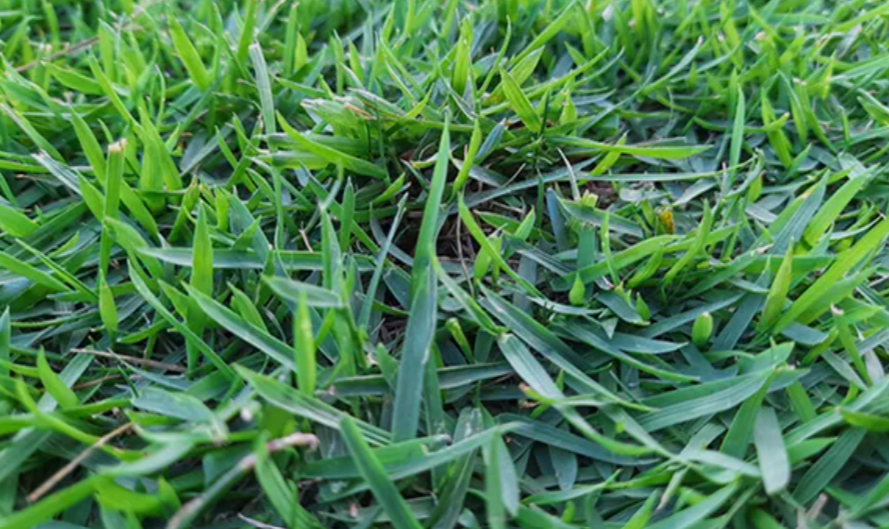
Grasses that spread by runners expand across the ground using above-ground stems that grow outward from the main plant. These runners root at points where they touch the soil, producing new shoots that quickly fill open areas. This growth habit allows lawns to spread visibly and establish coverage in a relatively short time.
This spreading method helps lawns recover rapidly from wear and damage. When sections are thinned by foot traffic or environmental stress, nearby runners can extend into those spaces and restore density. As a result, the lawn maintains a continuous and uniform appearance.
Runner-spreading grasses are especially effective at suppressing weeds. By covering the soil surface quickly, they reduce the light and space available for unwanted plants to grow. The dense network of runners forms a living mat that protects the soil and limits weed establishment.
However, this fast horizontal growth can be aggressive. Runners may extend beyond lawn boundaries and move into flower beds or paved areas if left unchecked. Regular attention helps keep growth contained and directed where it is wanted.
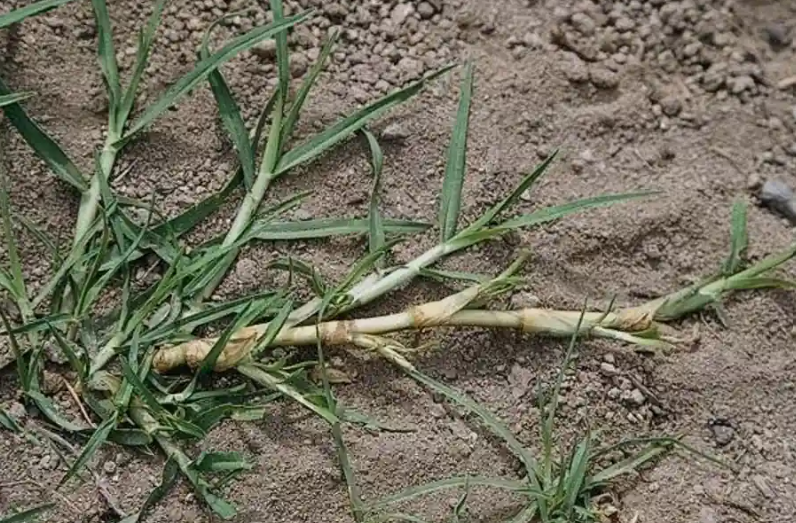
Grasses That Spread by Runners
Bermudagrass
Bermudagrass is renowned for its aggressive spreading through both stolons and rhizomes, with the aboveground runners being particularly visible and fast-growing. The stolons can extend several feet in a single growing season, rooting at nodes to produce new plants and quickly filling in bare spots.
This vigorous spreading makes bermudagrass ideal for high-traffic areas like sports fields and playgrounds, though the same characteristic requires regular edging to prevent it from invading flower beds and sidewalks.
St. Augustine Grass
St. Augustine grass spreads exclusively through thick, fleshy stolons that grow along the soil surface and root at nodes to establish new plants. These broad, flat runners are easily visible and can extend rapidly during the growing season, creating dense turf coverage in warm, humid climates.
The stolon-based spreading allows St. Augustine to recover from damage and fill in thin areas, though establishment can be slow initially until the runner network becomes well-developed.
Centipede Grass
Centipede grass spreads slowly through stolons that creep along the ground, producing a dense, low-growing turf over time. The stolons are less aggressive than those of bermudagrass or St. Augustine, giving centipede grass a more controlled spreading pattern that requires less maintenance.
This measured spreading habit makes centipede grass easier to keep within lawn boundaries while still providing the self-repair benefits of a stolon-forming grass in southern lawns.
Creeping Bentgrass
Creeping bentgrass produces numerous fine stolons that spread aggressively across the soil surface, creating an extremely dense, mat-like turf. The runners root frequently at nodes, forming such a tight network that the grass can tolerate being mowed at extremely low heights on golf course putting greens.
This intensive stolon production requires regular management to prevent thatch buildup, but it creates the smooth, uniform surface that makes creeping bentgrass the gold standard for premium golf turf.
Buffalo Grass
Buffalo grass is a native North American warm-season grass that spreads through stolons to form a fine-textured, low-growing turf adapted to dry prairie conditions. The stolons extend slowly but steadily, creating a dense groundcover that requires minimal water and maintenance once established.
Female buffalo grass plants produce more vigorous stolons than male plants, and this spreading ability allows buffalo grass to fill in over time while remaining one of the most drought-tolerant lawn grasses available.
Carpet Grass
Carpet grass spreads through flat, creeping stolons that grow along the ground and root at nodes, forming a dense mat in moist, acidic soils of the Deep South. The stolons are similar to St. Augustine grass but thinner, and they spread aggressively in wet conditions where other grasses struggle.
This stolon-based spreading allows carpet grass to thrive in poorly drained areas and along pond edges, though it produces a coarse-textured lawn that requires frequent mowing during peak growth.
Colonial Bentgrass
Colonial bentgrass spreads through stolons that are less aggressive than those of creeping bentgrass but still create a fine-textured, dense turf. The runners extend moderately across the soil surface, allowing colonial bentgrass to fill in gradually and form uniform coverage.
This grass is commonly used on golf course fairways and fine lawns in cool, humid climates where its stolon-based spreading creates attractive turf without requiring the intensive maintenance that creeping bentgrass demands.
Seashore Paspalum
Seashore paspalum spreads vigorously through thick stolons that allow it to tolerate salt water and thrive in coastal environments where most grasses fail. The runners grow rapidly during warm weather, creating dense turf that can be irrigated with brackish or even ocean water.
This stolon-based spreading makes seashore paspalum valuable for coastal golf courses and lawns, where it quickly recovers from salt spray damage and fills in areas affected by foot traffic or environmental stress.
Korean Lawngrass (Zoysia japonica)
Korean lawngrass, a type of zoysia, spreads through both stolons and rhizomes, with the aboveground runners being particularly prominent during active growth. The stolons extend across the soil surface and root at nodes, complementing the underground rhizome network to create exceptionally dense turf.
This dual spreading mechanism allows Korean lawngrass to fill in bare spots from both above and below ground, though establishment takes time as the runner network develops.
Kikuyu Grass
Kikuyu grass is an extremely aggressive warm-season grass that spreads through vigorous stolons capable of growing several inches per day during optimal conditions. The thick, fleshy runners root strongly at nodes and can climb over obstacles, making kikuyu grass both excellent for erosion control and potentially invasive in cultivated landscapes.
This rapid stolon-based spreading allows kikuyu grass to outcompete most other species and recover instantly from damage, though it requires frequent mowing and aggressive edging to keep it contained within desired boundaries.