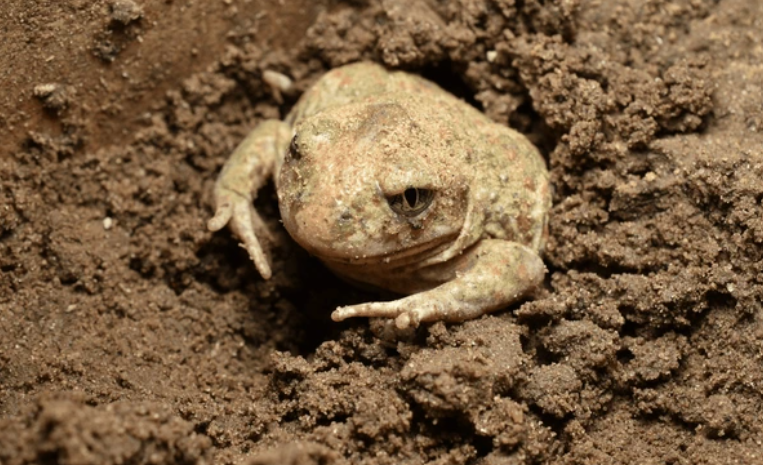
Some frogs have adapted to life underground, spending most of their time burrowed beneath the soil. These burrowing frogs have strong, muscular legs and thick, rounded bodies that help them dig efficiently. Unlike many other frogs, they rarely come to the surface, only emerging during rainy seasons or to find mates. Their lifestyle helps them avoid predators and extreme weather, making underground living a successful survival strategy.
These frogs often have smooth or slightly rough skin that helps them move through soil without injury. Their eyes may be smaller or positioned differently compared to surface-dwelling frogs since they rely less on sight and more on touch and vibration. Their digging ability allows them to create tunnels that provide safety, moisture, and stable temperatures, which are crucial in hot or dry environments.
Burrowing frogs usually remain inactive for long periods, especially during dry seasons. Some species can enter a state similar to hibernation, slowing their metabolism and storing water in their bodies to survive until the rains return. This dormancy is an important adaptation that allows them to endure harsh conditions that would be fatal to other frogs.
Reproduction for underground frogs is often timed with rainfall. When heavy rains arrive, they emerge to breed, laying eggs in temporary pools or damp soil. Some species even carry their eggs or young in specialized pouches or on their backs to ensure they remain protected. These adaptations ensure the survival of their next generation despite spending most of their lives hidden underground.
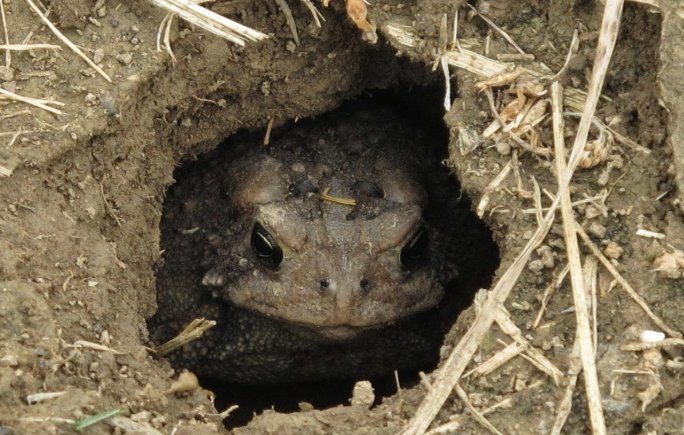
Frogs that Burrow or Live Underground
Purple Frog (Nasikabatrachus sahyadrensis)
One of the most extraordinary burrowing frogs on Earth, the Purple Frog of India’s Western Ghats spends approximately eleven months of every year sealed deep underground, feeding on termites through its specialized, fluted tongue. Discovered by science only in 2003, it represents an ancient lineage that diverged from its closest relatives — the Sooglossid frogs of the Seychelles — over 100 million years ago when India was still a drifting landmass.
It surfaces for only two weeks each monsoon season to breed in fast-flowing streams, then disappears underground again almost immediately. Its bloated, purple-gray body with a tiny pointed snout looks less like a frog and more like something that never intended to be seen.
Turtle Frog (Myobatrachus gouldii)
Western Australia’s Turtle Frog is one of the most committed subterranean frogs alive, spending nearly its entire life underground in the deep sandy soils of the southwestern scrublands. Unlike virtually every other burrowing frog in the world, it digs headfirst rather than backwards, using its powerful, muscular forelimbs like a pair of shovels to push directly into the earth.
It follows termite tunnels deep into the soil, feeding on colonies it encounters along the way, and can burrow to depths exceeding one meter. It has dispensed with the tadpole stage entirely — eggs laid underground hatch directly as fully formed froglets, completing their entire life cycle without ever touching open water.
Mexican Burrowing Toad (Rhinophrynus dorsalis)
The sole surviving member of a lineage over 60 million years old, the Mexican Burrowing Toad is a living fossil of the amphibian world. Its barrel-shaped body, tiny pointed head, and powerful hind legs equipped with hardened metatarsal tubercles make it a formidable underground excavator, capable of vanishing into soft soil with remarkable speed.
It spends the dry season sealed in underground chambers, emerging explosively after heavy rains to breed in temporary pools — gatherings so sudden and chaotic that they are often called explosive breeding events. Underground, it feeds on ant and termite colonies, using its highly specialized, projectile-capable tongue to extract insects from narrow tunnels.
Desert Spadefoot Toad (Scaphiopus couchii)
Couch’s Spadefoot Toad of the North American deserts is the undisputed champion of underground endurance among North American amphibians, capable of remaining buried for up to eleven months of the year in a state of reduced metabolism called estivation. It digs backwards into the soil using a sharp, sickle-shaped keratin spade on each hind foot, sealing itself in a moisture-retaining cocoon made of multiple shed skin layers.
When summer monsoon rains finally penetrate the soil, the toad emerges, breeds in temporary desert pools that may last only days, and feeds voraciously before disappearing underground again — completing an entire active life cycle in a matter of weeks.
Eastern Spadefoot Toad (Scaphiopus holbrookii)
Found across the eastern United States, the Eastern Spadefoot spends the vast majority of its life underground, emerging primarily on warm, rainy nights to feed and breed. Like its western relatives, it uses a hardened spade on each hind foot to dig backwards into loose or sandy soil, where it can remain dormant for months.
It is so secretive that many people living in areas where it is common have never seen one, despite populations existing beneath their feet. Its breeding aggregations are explosive and brief — triggered by heavy rain and thunder — with males producing a distinctive, hoarse wail that sounds more like a crow than a frog.
African Bullfrog (Pyxicephalus adspersus)
The massive African Bullfrog, one of the largest frogs on the continent, spends up to ten months of the year underground in a sealed cocoon of shed skin layers that prevents water loss during the long dry season. It digs into the soil using powerful hind legs and tooth-like projections on its lower jaw called odontoids, which also serve as weapons — the African Bullfrog is famously aggressive and will bite anything that threatens it, including human hands, with bone-crushing force.
When the seasonal rains arrive, it erupts from the ground, breeds explosively in flooded pans, and the male becomes one of the most ferocious parents in the frog world, guarding tadpoles and even attacking animals as large as jackals that venture too close.
Water-Holding Frog (Cyclorana platycephala)
Australia’s Water-Holding Frog has developed one of the most extraordinary underground survival strategies of any animal on Earth. Before burying itself, it absorbs a massive volume of water into its bladder and body tissues, then surrounds itself in multiple layers of shed skin that form a nearly impermeable cocoon.
In this sealed underground chamber, it can survive for years — not months — between rainfalls, slowly drawing on its stored water reserves. Indigenous Australians have long known of this ability and traditionally dug up the frogs and gently squeezed them to obtain drinking water during droughts, a survival technique passed down through generations.
Plains Spadefoot (Spea bombifrons)
The Plains Spadefoot of the North American Great Plains is built for a world of extremes — hot summers, freezing winters, and erratic rainfall — and it meets all these challenges by spending most of its time underground. Its single wedge-shaped spade on each hind foot is used to shuffle backwards into the earth with surprising speed, sometimes disappearing in under a minute when threatened or when conditions deteriorate.
Its tadpoles have evolved a remarkable dietary flexibility, capable of switching between a plant-based diet and a carnivorous diet of fairy shrimp and even other tadpoles depending on food availability, allowing them to complete metamorphosis before temporary pools evaporate.
Giant Burrowing Frog (Heleioporus australiacus)
One of the largest frogs in southeastern Australia, the Giant Burrowing Frog is a powerful excavator that constructs deep burrows in sandy or loamy soil near streams and swamps. Unlike many burrowing frogs that only go underground to wait out dry periods, this species uses its burrows year-round as retreats, hunting at night from the burrow entrance and retreating underground at dawn.
Males construct breeding burrows near water and call from within them — a muffled, resonant “oo-oo-oo” that seems to emanate from the earth itself. Eggs are laid in a foam nest inside the burrow, where they develop until rains flood the chamber and wash the tadpoles out into streams.
Ornate Burrowing Frog (Platyplectrum ornatum)
Widespread across inland and northern Australia, the Ornate Burrowing Frog is a compact, spotted species that uses hardened tubercles on its hind feet to excavate burrows in clay and sandy soils. It is a master of timing — emerging after heavy rains with extraordinary precision, breeding explosively in temporary floodwaters that may persist for only a few days, and retreating underground before the ground has fully dried.
So efficient is its burrowing ability that it can completely disappear into cracked clay soil within minutes. Its striking pattern of brown, cream, and orange markings makes it one of the more visually attractive of Australia’s many burrowing frogs.
Horned Land Frog (Melanophryniscus stelzneri)
This small Argentine frog from the dry Chaco and grassland regions burrows into loose soil to escape the heat and desiccation of its harsh environment. It uses its hind limbs to shuffle backwards into the earth, where it can remain for weeks during dry spells.
What makes it particularly notable is its aposematic coloration — its underside blazes with vivid red, orange, and yellow patches that it displays in a defensive posture called the unken reflex, arching its back and lifting its brightly colored limbs to warn predators of its toxic skin secretions. Underground, it is invisible; above ground, it is unmistakably dangerous.
Cruziohyla frogs / Sandhill Frog (Arenophryne rotunda)
Western Australia’s Sandhill Frog is one of the most specialized burrowing frogs in the world, found only in the coastal sand dunes of the Shark Bay region. Perfectly adapted to a life in loose, shifting sand, it moves through the dunes by swimming through the sand rather than digging in the conventional sense, using rapid lateral undulations of its body to submerge itself in seconds.
It never enters open water, completing its entire life cycle — including reproduction — underground in moist sand. Eggs hatch directly as froglets, and the entire population exists in a narrow strip of coastal dunes, making it one of the most geographically restricted amphibians in Australia.