The United Kingdom is not particularly rich in frog diversity — its cool, temperate climate and island geography limit the number of species that have naturally colonized or successfully established themselves. However, the frogs and toad-like amphibians that do call Britain home are fascinating, well-studied, and deeply woven into the cultural and ecological fabric of the British countryside. Including native species, introduced populations, and the Channel Islands, the UK’s complete picture of frog life looks like this.
Frogs that Live in the UK
Common Frog (Rana temporaria)
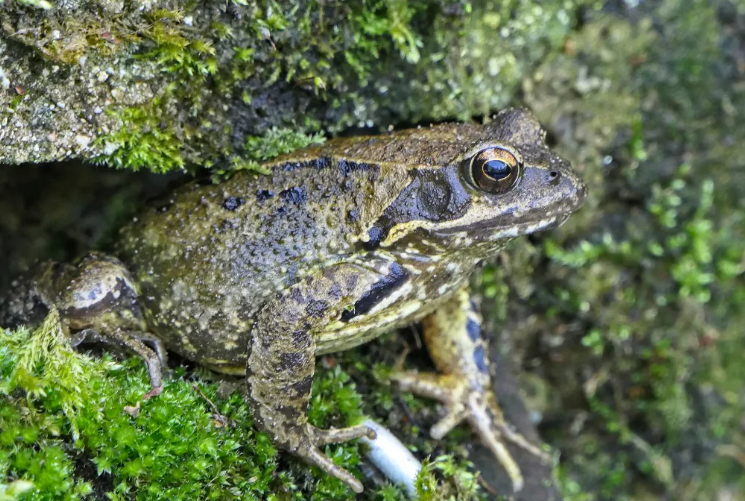
The Common Frog is Britain’s most familiar and beloved amphibian — the frog of garden ponds, village greens, and primary school nature tables across the entire country. Found from the Shetland Islands to Cornwall and throughout Ireland, it is one of the most widespread amphibians in Europe.
Its coloring is enormously variable — ranging from yellow-brown to olive to reddish-brown — always with a distinctive dark mask through the eye and darker mottled blotches across the back. It is often the first sign of spring in British gardens, emerging from winter dormancy to breed in ponds from late January in the south to April in the Scottish Highlands, producing the familiar floating masses of frogspawn that generations of British children have scooped into jam jars.
It is equally at home in urban garden ponds, upland moorland pools, and lowland agricultural ditches, making it one of the most ecologically flexible amphibians in the temperate world.
Common Toad (Bufo bufo)
Though technically a toad rather than a frog, the Common Toad is so embedded in British amphibian culture and ecology that no account of UK frogs would be complete without it.
It is the second most widespread amphibian in Britain — stockier, wartier, and more terrestrial than the Common Frog — and it is famous for its remarkable annual migrations, during which thousands of individuals cross roads to return to their ancestral breeding ponds, inspiring dedicated volunteer “toad patrol” groups across the country who carry them safely across busy roads each spring.
Its skin secretions — produced from prominent parotoid glands behind each eye — are mildly toxic and deeply unpleasant to any predator that attempts to swallow one, and it will puff itself up, tilt toward a threat, and stand its ground rather than fleeing as readily as a frog would.
Natterjack Toad (Epidalea calamita)
Britain’s rarest native amphibian, the Natterjack Toad is a protected species found only in scattered coastal dune systems and inland heathlands in England, Scotland, and Ireland — habitats so specialized and so reduced by development that the species now exists in fewer than sixty known sites across the country.
It is immediately distinguished from the Common Toad by a bold yellow stripe running down the center of its back and by its habit of running rather than hopping — it scurries across open sand with a distinctive mouse-like gait that makes it instantly recognizable.
Its call is the loudest of any British amphibian — a harsh, carrying churr produced by males in breeding choruses that can be heard up to a kilometer away on still spring nights.
Pool Frog (Pelophylax lessonae)
The Pool Frog has one of the most complicated conservation stories of any British amphibian. Long dismissed as a non-native introduction, genetic and historical research eventually confirmed that a small population in East Anglia represented a genuine native British lineage — the northernmost natural population of the species in the world — that had been present since before the last ice age.
This native population went extinct in the 1990s due to habitat loss, but a successful reintroduction program using Pool Frogs from Sweden — the genetically closest surviving relatives of the original British population — has re-established the species at carefully managed nature reserves in Norfolk.
It is a green, vocal, and highly aquatic frog, spending more of its life in water than the Common Frog and producing a loud, duck-like quacking call from its breeding ponds.
Marsh Frog (Pelophylax ridibundus)
The largest frog in Europe, the Marsh Frog was introduced to Britain in 1935 when a small number of individuals were released into a garden pond in Romney Marsh in Kent — and from that modest beginning it has spread extensively across the wetlands of southeast England, particularly in Kent, East Sussex, and the Thames Estuary region.
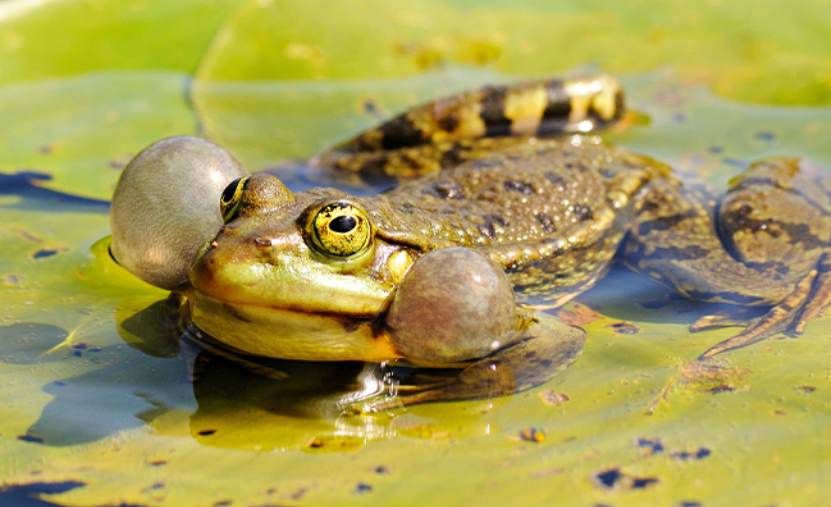
It is a bold, conspicuous, and extremely vocal species — breeding choruses of hundreds of individuals produce a deafening cacophony of laughing, rattling calls audible from considerable distances across the marshes. It is more aggressive and less shy than the Common Frog, often sitting in the open on floating vegetation and diving into water with a loud splash when disturbed.
Edible Frog (Pelophylax esculentus)
The Edible Frog — the frog most commonly consumed in French cuisine — exists in Britain as a naturally occurring hybrid between the Pool Frog and the Marsh Frog, and it has established itself in parts of southeast England alongside its parent species. Its reproductive biology is unusual and complex — it requires the presence of one of its parent species to reproduce successfully, as it eliminates the genetic contribution of one parent during egg formation.
It is found in ponds, ditches, and wetlands in East Anglia and parts of southeast England, where it calls from emergent vegetation with a characteristic croaking that blends with the calls of the Marsh Frog in mixed-species colonies.
European Tree Frog (Hyla arborea)
The European Tree Frog does not occur naturally on the British mainland but is native to the island of Jersey in the Channel Islands — Britain’s only truly arboreal frog species. It is a stunning little animal, barely four centimeters long, with vivid lime-green coloration, large adhesive toe pads, and a bold dark stripe running from the nostril through the eye and along each flank.
Jersey’s population is one of the most northwesterly in Europe and is considered nationally important, inhabiting the island’s remaining areas of traditional bocage countryside — a mosaic of small fields, hedgerows, and farm ponds that is rapidly disappearing. The male’s call — a loud, rapid series of “arp” notes — fills Jersey’s countryside on warm spring nights and is one of the most evocative sounds of the island’s rural landscape.