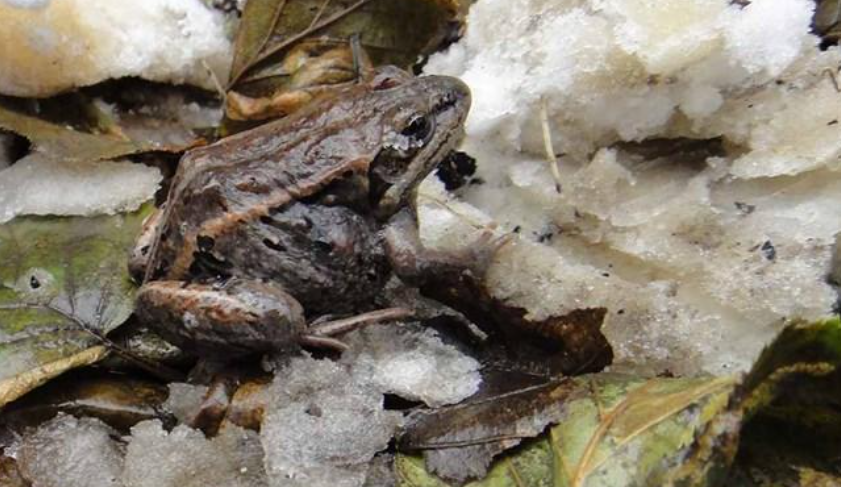
Frogs that can freeze solid and come back to life are among the most remarkable survivors in the animal world. These species, mostly found in cold regions, have evolved a way to endure freezing temperatures that would normally be fatal to other animals. Instead of avoiding winter, they face it head-on by entering a frozen state.
When temperatures drop, these frogs stop moving and their bodies begin to freeze. Ice forms first on the outside and gradually spreads inward. Their hearts stop beating, breathing halts, and brain activity nearly disappears. To an outside observer, the frog appears completely lifeless.
What keeps them from dying is a special biological response. As freezing begins, the frog’s liver produces large amounts of glucose, which acts like a natural antifreeze. This sugar floods the cells and helps protect vital structures from damage caused by ice crystals.
At the same time, water is drawn out of the cells into spaces where ice can form more safely. By controlling where ice develops, the frog prevents sharp crystals from rupturing delicate cell membranes. This careful balance allows tissues and organs to remain intact during the frozen period.
These frogs can remain frozen for weeks or even months, depending on how long winter lasts. When temperatures rise again, the ice slowly melts, and the frog’s body begins to restart. Its heart starts beating, breathing resumes, and it gradually regains movement.
This ability is not just fascinating—it also interests scientists studying medicine and preservation. Understanding how these frogs survive freezing could help improve techniques for preserving organs, tissues, and even cells for medical use in the future.
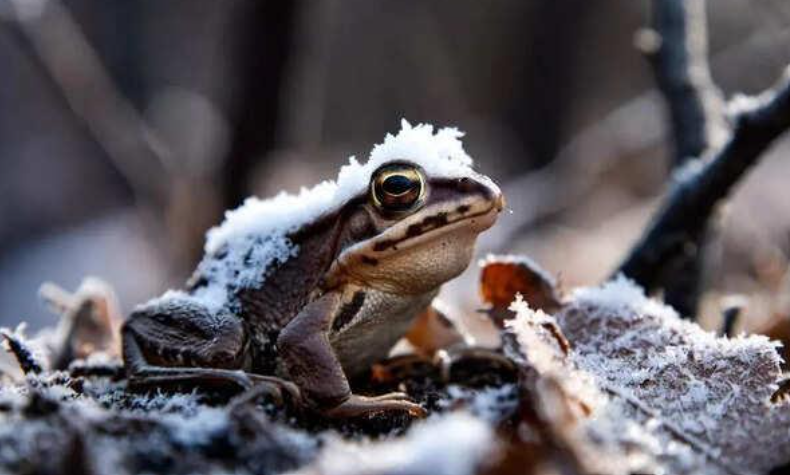
Frogs That Can Survive Freezing Temperatures
Wood Frog (Lithobates sylvaticus)
The wood frog is the most famous freeze-tolerant amphibian. Found in northern forests, it can survive with up to 65% of its body water frozen. Its heart stops, breathing ceases, and it appears lifeless. When temperatures rise, it thaws and resumes normal activity. Special chemicals like glucose act as natural antifreeze, protecting its cells from damage.
Alaska Wood Frog
A population of wood frogs living in Alaska has taken freeze survival to extremes. These frogs can endure even lower temperatures than their southern relatives. Their bodies produce higher concentrations of cryoprotectants, allowing them to survive long, brutal winters where they remain frozen for months.
Spring Peeper (Pseudacris crucifer)
This tiny, high-pitched chorus frog of eastern North America is a surprisingly robust freezer. It can tolerate having roughly 40–50% of its body fluids turned to ice. Like the wood frog, it uses glucose as a cryoprotectant, and its small body size actually helps it thaw quickly when temperatures rise.
Gray Tree Frog (Hyla versicolor)
The Gray Tree Frog spends winter hiding under loose bark or leaf litter, where it endures hard freezes with ease. It uses glycerol — an alcohol-based antifreeze — in addition to glucose to shield its cells, making it one of the more chemically sophisticated freeze-tolerant species in North America.
Moor Frog (Rana arvalis)
Found across Europe and Siberia, the Moor Frog can tolerate partial freezing of its body tissues during harsh winters. It accumulates urea as a cryoprotectant — a strategy distinct from the glucose-heavy approach of North American species — giving it a unique biochemical method for surviving icy conditions. Males are also known for turning bright blue during breeding season, a striking contrast to their winter survival strategy.
Siberian Wood Frog (Rana amurensis)
One of the most freeze-tolerant frogs on Earth, this Siberian species can survive temperatures as low as –6°C (21°F) with significant portions of its body frozen. It inhabits some of the coldest regions of Russia and East Asia, and its exceptional cold hardiness has made it a subject of scientific interest for cryobiology research.
Chorus frogs
Closely related to the spring peeper, they’re known for their loud, musical calls that signal the arrival of spring. During winter, they survive by hiding under leaves or shallow soil, where they can tolerate partial freezing. Their bodies produce natural sugars that protect vital cells from ice damage, allowing them to thaw and quickly become active again when temperatures rise.
Common Frog (Rana temporaria)
Europe’s most widespread frog demonstrates partial freeze tolerance, able to survive mild freezing events by entering a state of suspended animation. While not as extreme as the Wood Frog, it can endure ice formation in its lymph and body cavity fluids, using urea accumulation to reduce the freezing point of its cells.
Striped Chorus Frog (Pseudacris feriarum)
A close relative of the Western Chorus Frog found in the southeastern United States, this species exhibits freeze tolerance well-suited to the unpredictable cold snaps of its range. It shelters in shallow ground cover and can survive brief but intense freezing events, bouncing back to activity remarkably quickly once warmth returns.
Alberta Wood Frog (Lithobates sylvaticus — northern population)
Technically the same species as the common Wood Frog, the far-northern Alberta population represents such an extreme expression of freeze tolerance that researchers often study it separately. These frogs survive Arctic winters lasting up to eight months, enduring repeated freeze-thaw cycles with hearts that literally stop beating for weeks at a time before resuming perfectly normal function come spring.
Mountain Chorus Frog (Pseudacris brachyphona)
Native to the Appalachian Mountains, this small frog endures the harsh freeze-thaw cycles characteristic of high-elevation winters. Researchers have documented its ability to survive partial freezing, using cryoprotective sugars to shield delicate internal tissues from ice crystal damage.
Boreal Chorus Frog (Pseudacris maculata)
A cold-climate specialist of Canada and the northern U.S., the Boreal Chorus Frog is one of the first frogs to call in spring — often while snow is still on the ground. Its freeze tolerance allows it to thaw and refreeze multiple times across a single winter season without lasting harm.
Cope’s Gray Tree Frog (Hyla chrysoscelis)
Nearly identical in appearance to Hyla versicolor but diploid rather than tetraploid, Cope’s Gray Tree Frog shares the same impressive freeze-tolerance strategy. It accumulates glycerol in its tissues before winter, allowing it to survive sub-zero temperatures beneath forest debris without any permanent cellular damage.
Western Chorus Frog (Pseudacris triseriata)
Widespread across the central and eastern United States, this small frog overwinters in shallow soil or leaf litter and endures significant freezing. Studies have shown it can survive ice formation in its extracellular fluids, relying on glucose mobilization to protect cells during prolonged cold snaps.
Northern Cricket Frog
The northern cricket frog is a small, agile amphibian commonly found in parts of North America, especially across the eastern and central United States, where it lives along sunny shorelines of ponds, lakes, and slow-moving streams. It is known for its sharp, clicking call and its quick, zigzag jumps to escape predators.
It gets its name from its sharp, clicking call that sounds like two pebbles being tapped together. Although it prefers to avoid deep freezing by staying near water or sheltered spots, it can tolerate brief exposure to cold temperatures and recover quickly when conditions improve, helping it survive in regions with mild winters.