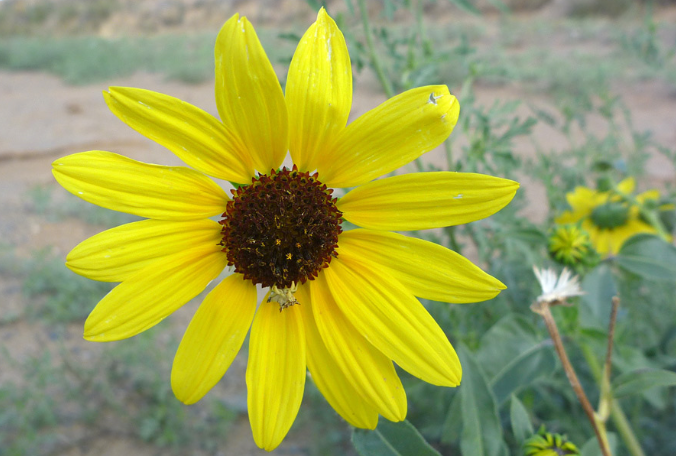
The Fibonacci sequence — 1, 2, 3, 5, 8, 13, 21, 34 — is the mathematical backbone of plant growth, governing the spiral arrangements of seeds, leaves, and scales across the plant kingdom. As a result, thirteen petals — or more precisely, thirteen ray florets in the composite flowers of the daisy family — occur with far greater natural consistency and frequency than seven, nine, or ten ever could.
The important caveat is that most reliably thirteen-petaled flowers belong to the Asteraceae family, where what appear to be petals are technically individual ray florets surrounding a central disc of tiny true flowers — a structural distinction that is botanically significant but visually irrelevant to anyone simply counting petals on a flower.
Flowers With Thirteen Petals
Ragwort (Jacobaea vulgaris)
The most reliably and consistently thirteen-rayed wildflower in the European flora, Common Ragwort produces bright yellow flower heads whose ray florets number thirteen with a consistency that has made it a standard textbook example of Fibonacci numbers in nature.
Found across roadsides, meadows, and disturbed ground throughout Europe and naturalized worldwide, it is simultaneously one of the most botanically interesting and ecologically important wildflowers — its flowers supporting over thirty specialist invertebrate species — and one of the most controversial, being toxic to horses and livestock. Its thirteen rays are as reliable as a clock.
Corn Marigold (Glebionis segetum)
The vivid golden-yellow Corn Marigold — once a common arable weed of European grain fields before herbicides reduced it to a rarity — produces flower heads whose ray florets most commonly number thirteen, though the count can vary between twelve and sixteen depending on growing conditions.
Its intense, saturated yellow is among the purest and most vivid in the wildflower palette, and the thirteen rays surrounding the deeper golden disc create one of the most geometrically satisfying simple flower heads in the European flora. It is now deliberately sown in conservation field margins as a heritage wildflower of considerable beauty and ecological value.
Black-Eyed Susan (Rudbeckia hirta)
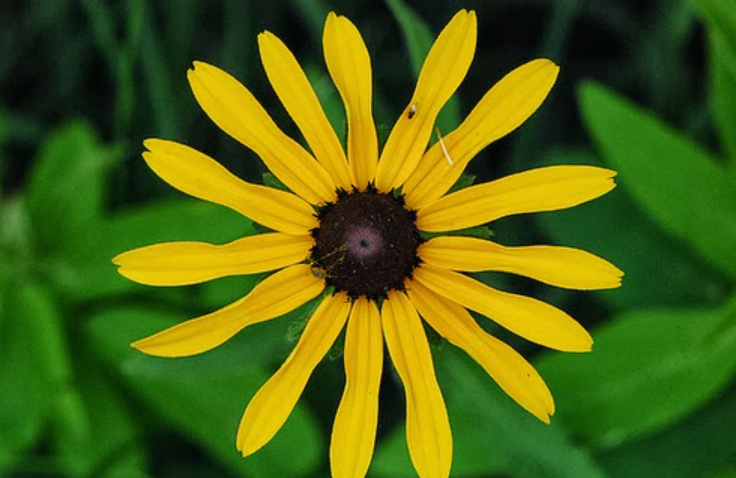
One of North America’s most beloved wildflowers and garden plants, the Black-Eyed Susan produces warm golden-yellow ray florets surrounding a dramatically prominent dark brown-black central disc — and thirteen is among the most frequently occurring ray counts in wild populations, sitting comfortably within the species’ natural range of eight to twenty-one.
The thirteen-rayed form has a particularly balanced, open appearance — generous enough to feel substantial but not so crowded that the individual rays lose their definition. Its cheerful, sun-facing flowers have made it a symbol of the North American prairie and one of the most widely grown native wildflowers in cultivation.
Cineraria (Pericallis × hybrida)
The florist’s Cineraria — a widely grown cool-season pot plant producing dense heads of daisy-like flowers in vivid blue, purple, pink, red, and white — most commonly produces thirteen ray florets per flower head in standard cultivated forms, making it one of the more reliably thirteen-rayed flowers available in the commercial trade.
Its ray florets are broad and overlapping compared to the narrow rays of many wild daisies, giving thirteen-rayed flower heads a full, almost circular appearance of great visual richness. The vivid blue and purple Cineraria varieties represent some of the most intense cool colors available in the winter and spring flowering plant trade.
Fleabane (Erigeron speciosus)
The showy garden Fleabane produces flower heads with a very high number of extremely narrow ray florets — often between fifty and one hundred — but several of the simpler wild Erigeron species produce flower heads in the thirteen-to-twenty-one Fibonacci range, with thirteen occurring in the simplest wild forms.
More significantly, Erigeron annuus — Annual Fleabane — produces flower heads whose ray count frequently falls at or near thirteen in typical wild specimens. The narrow, slightly drooping rays in white or pale pink give fleabane flowers a more informal, meadow-like quality than the more formal daisy composites.
Sow Thistle (Sonchus oleraceus)
The Common Sow Thistle — regarded by most gardeners as an unremarkable weed but botanically a fascinating member of the daisy family — produces pale yellow flower heads whose ray florets frequently number around thirteen in typical specimens. Unlike the Asteraceae flowers above, Sow Thistle flower heads consist entirely of ray florets — there are no central disc florets at all — making every apparent petal a complete flower in its own right.
This ligulate structure means that a thirteen-rayed Sow Thistle flower head contains thirteen individual complete flowers, each one a yellow strap of fused petals with its own reproductive structures — a remarkable concentration of botanical complexity in a flower most people walk past without a second glance.
Hawkweed (Hieracium spp.)
The Hawkweeds — a vast and botanically complex group of hundreds of species found across the temperate northern hemisphere — produce flower heads consisting entirely of ray florets like the Sow Thistle, and many species produce flower heads with ray counts in the Fibonacci range including thirteen.
Hieracium pilosella — Mouse-Ear Hawkweed — produces pale lemon-yellow flower heads whose ray count frequently approaches thirteen in typical specimens. The Hawkweeds’ extraordinary species diversity — they reproduce largely by apomixis, producing seeds without fertilization — means they represent one of the most botanically complex genera in the European flora, hiding extraordinary genetic diversity behind a superficially uniform daisy-like appearance.
Chicory (Cichorium intybus)
Wild Chicory — its vivid sky-blue flower heads one of the most intensely colored sights of European roadsides in midsummer — produces heads consisting entirely of ray florets like the Sow Thistle and Hawkweeds, and the ray count in typical flower heads frequently falls in the range of twelve to sixteen, with thirteen appearing as a common count in many populations.
The extraordinary blue of wild Chicory — a color almost unique in the European roadside flora — combined with the geometric arrangement of its ray florets makes it one of the most visually distinctive of all the apparent thirteen-petaled flowers, its color intensifying in the morning and fading toward white in the heat of the afternoon sun.
Pot Marigold (Calendula officinalis)
The familiar Pot Marigold produces flower heads with ray floret counts that vary considerably with breeding — single-flowered varieties most commonly produce between twelve and twenty ray florets, with thirteen appearing regularly in standard open-pollinated garden forms.
The single-flowered strains of Calendula — producing one outer ring of broad orange or yellow ray florets around a prominent central disc — are the forms most likely to produce thirteen rays, and the thirteen-rayed flower heads have a particularly open, classical daisy form that the over-bred double varieties — with their packed, overlapping layers of ray florets — entirely obscure. The simple thirteen-rayed Calendula is considerably more beautiful than its showier doubled descendants.
Tickseed (Coreopsis spp.)
Several Coreopsis species — particularly the native North American prairie species used extensively in naturalistic and wildlife garden planting — produce flower heads whose ray floret count falls in the eight-to-thirteen Fibonacci range, with thirteen occurring in certain species and individuals.
Coreopsis tinctoria — Plains Coreopsis — produces particularly variable ray counts across its wide prairie range, and thirteen-rayed flower heads occur naturally in wild populations. The bright yellow ray florets with their dark red basal markings surrounding the dark central disc create one of the most graphically bold color combinations in the North American wildflower palette.
Elecampane (Inula helenium)
The giant Elecampane — a magnificent medicinal and ornamental plant reaching two meters or more in rich garden soil — produces large, shaggy yellow flower heads with numerous very narrow ray florets whose count in individual flower heads frequently falls near Fibonacci numbers including thirteen in the smaller-headed species of the genus.
Inula species as a whole display the characteristic Fibonacci tendency in their ray floret counts, and the large-flowered ornamental species grown in gardens — their golden, slightly disheveled heads swaying on tall stems in late summer — include individuals whose ray count falls at thirteen in the simplest expressions of the genus’s considerable floral diversity.
Arnica (Arnica montana)
The mountain Arnica of European alpine and subalpine meadows — one of the most important medicinal plants of alpine herbal tradition and the source of the widely used topical anti-inflammatory preparation — produces bright orange-yellow flower heads whose ray floret count most commonly falls between twelve and fifteen, with thirteen appearing regularly as the most Fibonacci-consistent count in typical wild high-altitude specimens.
Growing in the acidic, nutrient-poor soils of mountain meadows from the Pyrenees to the Carpathians, Arnica’s vivid orange flower heads against the short alpine turf represent one of the most beautiful expressions of Fibonacci petal arrangement in the European mountain flora — a wildflower of genuine medical importance and botanical elegance combined.
Why Thirteen Matters Botanically
Thirteen’s appearance in these flowers is not coincidence or approximation — it is the direct expression of the Fibonacci spiral growth pattern that governs how plants add new organs during development. The same mathematical principle that produces thirteen spirals in one direction and eight in the other in a sunflower seed head, and thirteen scales in one direction on a pine cone, produces thirteen ray florets in the composite flowers of the daisy family.
It is the most direct visual evidence available to any flower observer that living things grow according to mathematical principles as precise and as elegant as anything in human architecture — and all it requires to see it is the willingness to stop, look at a daisy, and count.