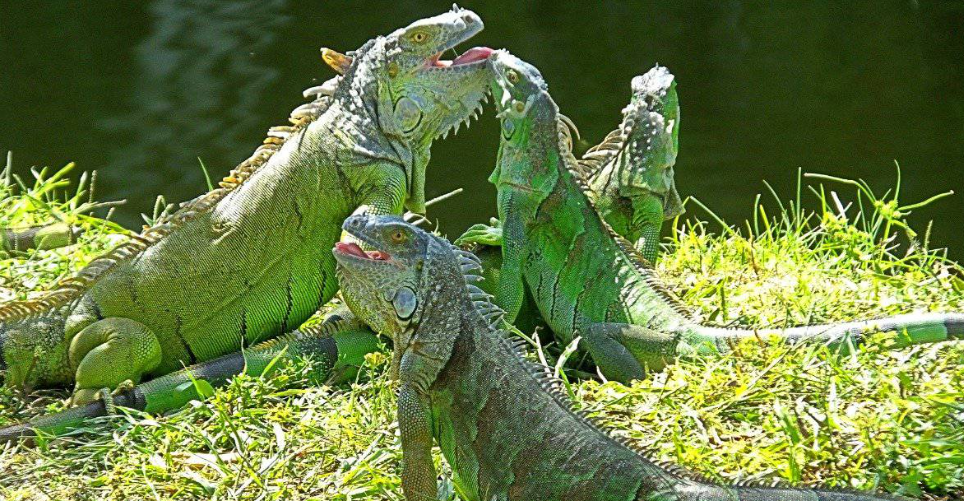
Florida has become one of the most notable examples of reptile invasion in the United States, with iguanas emerging as a particularly visible and ecologically significant concern. These large lizards, native to Central and South America as well as some Caribbean islands, have established thriving feral populations across the state over the past several decades.
Their presence is largely attributed to the exotic pet trade, through which individuals either escaped or were deliberately released by owners who could no longer care for them. What began as isolated sightings has since grown into a widespread ecological and economic challenge that state wildlife managers continue to grapple with today.
Geographic Distribution
Geographic Distribution
Green iguanas are most abundant in MiamiDade, Broward, Palm Beach, Monroe Counties, and the Florida Keys, where permanent breeding populations thrive due to warm temperatures, abundant vegetation, and water access. On the East Coast, stable populations extend north to Brevard County, including cities like Melbourne, Cocoa Beach, and Titusville.
On the West Coast, populations reach Manatee and Pinellas Counties, including Sarasota and St. Petersburg, though these are less dense due to cooler Gulf temperatures. Sightings have also been reported as far north as Alachua, Highlands, Hillsborough, Indian River, and St. Lucie Counties, but sustained breeding populations are limited to areas south of Lake Okeechobee where winters remain mild enough for year-round survival.
Habitat Preferences
Iguanas in Florida demonstrate remarkable adaptability when it comes to habitat selection. They tend to favor areas near water, including canal banks, shorelines, and retention ponds, as access to water supports both thermoregulation and escape from predators. Urban and suburban environments suit them particularly well, offering abundant food sources in the form of ornamental plants, garden vegetation, and fruit trees.
They are frequently observed basking on seawalls, rooftops, sidewalks, and docks, taking advantage of heat-absorbing surfaces. Despite their preference for human-modified landscapes, they also occupy more natural settings such as mangroves, hammocks, and scrublands when conditions are favorable.
Types of Iguanas
- Green Iguana (Iguana iguana) — The most widespread and recognizable species in Florida, adults can grow up to five feet in length and are distinguished by their bright green to grayish coloration. They are the primary species of concern for wildlife managers.
- Black Spiny-Tailed Iguana (Ctenosaura similis) — Native to Central America, this species is established in parts of South Florida and is considered one of the fastest-running lizards in the world. It tends to be more terrestrial than the green iguana.
- Mexican Spiny-Tailed Iguana (Ctenosaura pectinata) — Present in smaller numbers, this species has been recorded in isolated pockets of South Florida and shares many behavioral traits with its black spiny-tailed relative.
- Rhino Iguana (Cyclura cornuta) — Occasionally reported in Florida, though it has not established a large feral population. Sightings are generally linked to escaped or released pets.
Range Expansion
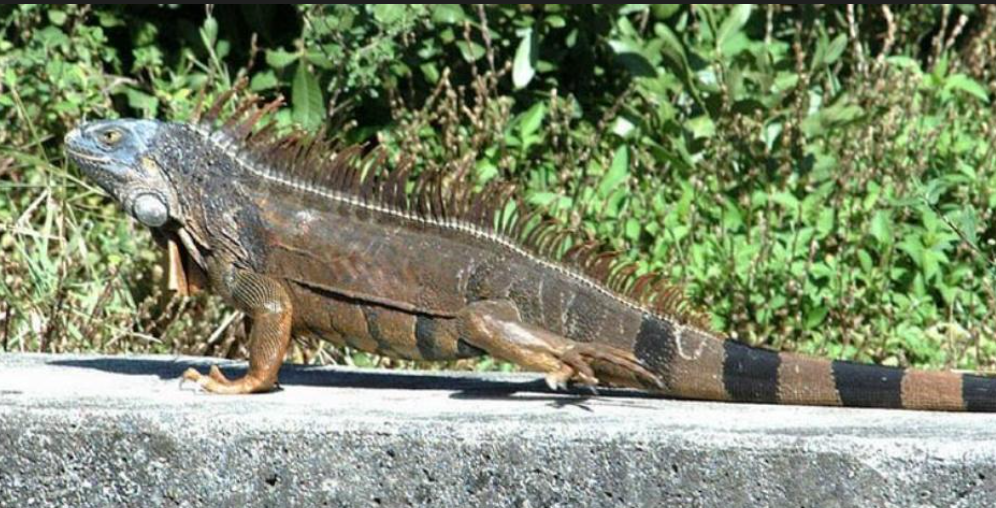
The range of iguanas within Florida has expanded considerably over time, driven by a combination of population growth, climate suitability, and a lack of natural predators. Cold snap events — such as the well-publicized instances of iguanas falling from trees during Florida cold fronts — temporarily reduce population numbers, but surviving individuals quickly rebound when temperatures return to normal.
Human activity has also contributed to range expansion, as individuals are sometimes transported to new areas unintentionally through landscaping equipment, vehicles, or deliberate relocation. Coastal development has paradoxically created ideal iguana habitat in many areas by producing the warm, food-rich, and water-adjacent environments these animals prefer.
Management Considerations
Managing iguana populations in Florida is a complex and ongoing challenge for state and local authorities. The Florida Fish and Wildlife Conservation Commission (FWC) has classified green iguanas as an invasive species and actively encourages their humane removal. Property owners are legally permitted to kill green iguanas on their own land without a license, though the methods used must be humane.
Trapping programs, public education campaigns, and coordinated removal efforts in public spaces have all been employed as management tools. Despite these efforts, fully eradicating established iguana populations is considered infeasible given their reproductive capacity and geographic spread. Instead, management strategies tend to focus on population control and minimizing the ecological and infrastructural damage — including burrowing that destabilizes seawalls and canal banks — that large iguana populations can cause.
Other Facts About Iguanas in Florida
- Iguanas found in Florida are not native; they originate mainly from Central and South America.
- The most common species is the green iguana, though a few other species also exist in smaller numbers.
- They were introduced through the pet trade, with many escaping or being released into the wild.
- Iguanas thrive in warm, tropical climates, making South Florida an ideal habitat.
- They are excellent climbers and are often seen in trees, especially near water.
- Iguanas are also strong swimmers and can stay underwater for extended periods.
- They are mostly herbivorous, feeding on leaves, flowers, and fruits.
- Adult iguanas can grow quite large, often reaching over 1.5 meters (5 feet) in length including the tail.
- They are cold-blooded, so their activity depends heavily on temperature and sunlight.
- During cold snaps, iguanas can become immobile and fall from trees, a phenomenon sometimes seen in Florida winters.
- Iguanas dig burrows in soil, which can damage sidewalks, seawalls, and landscaping.
- They reproduce quickly, with females laying dozens of eggs in a single nesting season.
- Iguanas are considered an invasive species in Florida because they harm native ecosystems and property.
- They have few natural predators in Florida, which helps their populations grow rapidly.
- Local authorities sometimes encourage humane population control measures to manage their spread.