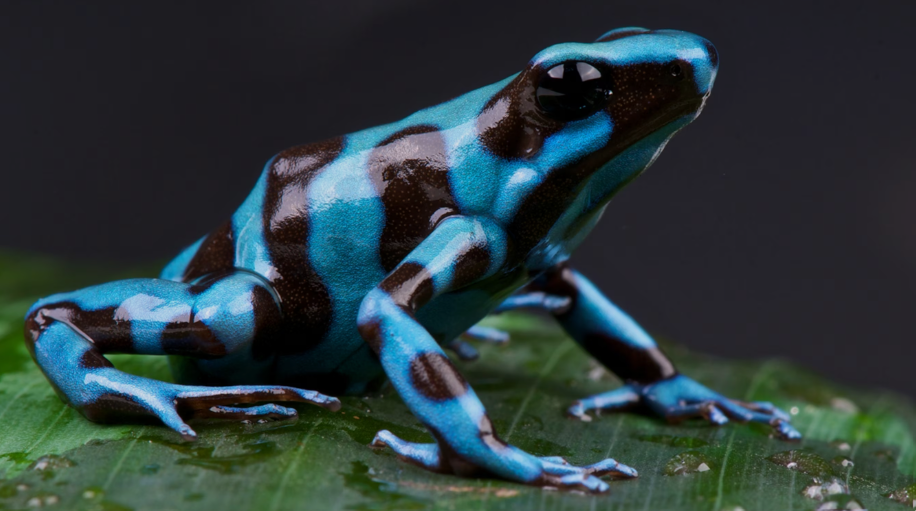
Poison dart frogs are small, colorful amphibians that live in the warm, humid rainforests of Central and South America. They are famous for their bright colors, such as blue, yellow, red, and green, which help them stand out in their environment. These colors act as a warning to predators that the frogs are poisonous. This type of warning coloration is called aposematism, a survival strategy used by many poisonous animals.
In the wild, their poison comes from their natural diet, which includes ants, termites, mites, and other small insects. Scientists believe chemicals from these prey items are stored and modified in the frogs’ bodies, making them poisonous. Interestingly, poison dart frogs raised in captivity without this natural diet usually lose most or all of their toxicity.
Poison dart frogs are active during the daytime, unlike many other frogs that are mostly nocturnal. They spend their time hopping along the forest floor or climbing low plants in search of food. Their sticky toe pads help them grip leaves and branches easily. Because they depend on moist environments to keep their skin healthy, they thrive in humid rainforests with plenty of rainfall and dense vegetation.
Reproduction in poison dart frogs is unusually complex compared to many other amphibians. After eggs are laid in moist locations, one of the parents—often the male—guards them carefully. When the eggs hatch, a parent may carry the tadpoles on its back to small pools of water found in plants or tree holes. Some species even feed their developing young with unfertilized eggs, showing a high level of parental care rarely seen in frogs.
These frogs play an important role in rainforest ecosystems. By controlling insect populations, they help maintain ecological balance. At the same time, they serve as prey for a few specialized predators that have adapted to tolerate their toxins. Because they are sensitive to environmental changes, poison dart frogs are also considered indicators of ecosystem health; declines in their populations can signal problems such as habitat destruction or pollution.
Poison Dart Frog
Dyeing Poison Dart Frog (Dendrobates tinctorius)
The dyeing poison dart frog is one of the largest poison dart frog species, reaching up to 2 inches in length with a robust, stocky build. These frogs display remarkable color variation depending on their geographic location, with patterns including bright blue legs with yellow or white stripes, solid blue bodies, or black bodies with yellow or white bands.
Found in the rainforests of Suriname, French Guiana, and northern Brazil, they inhabit the forest floor among leaf litter and fallen logs. The common name “dyeing” comes from a legend that indigenous peoples would rub the frog on green parrot feathers to make them turn yellow or red, though this practice is not well-documented.
Strawberry Poison Dart Frog (Oophaga pumilio)
The strawberry poison dart frog is a small species measuring only 0.75-1 inch in length with a distinctive bright red or orange body paired with blue or black legs. Despite the common name, this species displays incredible color polymorphism, with populations varying from red, orange, yellow, green, to blue, and some even appearing entirely black.
Native to Central America including Costa Rica, Panama, and Nicaragua, they inhabit lowland rainforests and prefer areas near streams and water sources. Strawberry poison frogs are notable for their complex parental care, with mothers returning to feed tadpoles unfertilized eggs in water-filled bromeliads.
Blue Poison Dart Frog (Dendrobates tinctorius azureus)
The blue poison dart frog, now considered a color morph of Dendrobates tinctorius, is famous for its brilliant sapphire blue coloration with black spots scattered across its body. These medium-sized frogs reach 1.5-2 inches in length and have a stocky, muscular build with slightly webbed toes.
Endemic to a very limited range in southern Suriname near the Sipaliwini savanna, they inhabit islands of rainforest surrounded by savanna grassland. The vivid blue coloration serves as a warning to predators about their toxic skin secretions, and in captivity, they lose much of their toxicity as it derives from their wild diet of mites and other arthropods.
Golden Poison Dart Frog (Phyllobates terribilis)
The golden poison dart frog is considered the most toxic of all poison dart frogs and one of the most poisonous animals on Earth. These frogs are relatively large for the family, reaching 1.5-2 inches, with bright yellow, orange, or pale green coloration covering their entire body uniformly.
Found only in a small rainforest region on the Pacific coast of Colombia, they inhabit the forest floor in areas with high rainfall and humidity. A single frog contains enough batrachotoxin poison to kill 10-20 humans, and indigenous Emberá people of Colombia historically used their toxins to poison blow darts for hunting, giving the entire frog family its common name.
Green and Black Poison Dart Frog (Dendrobates auratus)
The green and black poison dart frog displays striking patterns of metallic green or blue-green with black spots, bands, or reticulations covering its body. These frogs measure 1-1.5 inches in length with a slender build and long limbs adapted for climbing and jumping.
Native to Central America from Nicaragua to Colombia, with introduced populations in Hawaii, they inhabit lowland rainforests and are often found near streams and in agricultural areas. Color patterns vary significantly between populations, with some showing predominantly black with green spots while others display green with black markings, and their bold coloration warns predators of their toxic alkaloid-laden skin.
Harlequin Poison Dart Frog (Oophaga histrionica)
The harlequuin poison dart frog displays one of the most variable color patterns of any poison frog, with combinations including orange, red, yellow, and black in complex spotted or striped patterns. These small frogs measure only 0.75-1.5 inches and have a relatively slender build compared to Dendrobates species.
Found in the rainforests of western Colombia along the Pacific coast, they inhabit humid lowland and foothill forests with abundant rainfall. Each population has distinct color patterns, leading to remarkable diversity within the species, and like other Oophaga species, females exhibit extensive parental care by feeding their tadpoles unfertilized eggs in bromeliad pools.
Lehmann’s Poison Dart Frog (Oophaga lehmanni)
Lehmann’s poison dart frog is a critically endangered species displaying brilliant red or orange bodies with distinctive black, brown, or dark red markings. These small frogs reach only 0.5-0.75 inches in length, making them among the smallest poison dart frogs.
Endemic to a tiny area in the cloud forests of southwestern Colombia at elevations of 3,000-5,000 feet, their limited range makes them extremely vulnerable to habitat loss. The bold coloration varies between populations, with some individuals showing more extensive dark markings than others, and their rarity in the wild has made them highly sought after by collectors, further threatening their survival.
Mimic Poison Dart Frog (Ranitomeya imitator)
The mimic poison dart frog earns its name by evolving different color patterns to mimic other toxic frog species in its range, an example of Müllerian mimicry. These small frogs measure 0.5-0.75 inches with color patterns varying dramatically by location, including striped morphs mimicking Ranitomeya fantastica and banded morphs mimicking Ranitomeya variabilis.
Found in the rainforests of northern Peru, particularly in the San Martín region, they inhabit lowland and montane forests. Different populations have evolved distinct color patterns matching the predominant toxic frog species in their specific area, providing mutual protection through shared warning coloration.
Splash-Backed Poison Dart Frog (Adelphobates galactonotus)
The splash-backed poison dart frog is characterized by its bright orange, yellow, or red “splash” pattern covering the back, contrasting with black legs and sides. These medium-sized frogs reach 1-1.5 inches with a robust build and strong limbs.
Endemic to a small area in southeastern Brazil, they inhabit the Atlantic rainforest, one of the most threatened ecosystems in the world. The distinctive dorsal coloration varies between populations, with some showing more extensive colored areas than others, and like many poison frogs, they lose their toxicity in captivity when not fed their natural diet of toxic arthropods.
Bumblebee Poison Dart Frog (Dendrobates leucomelas)
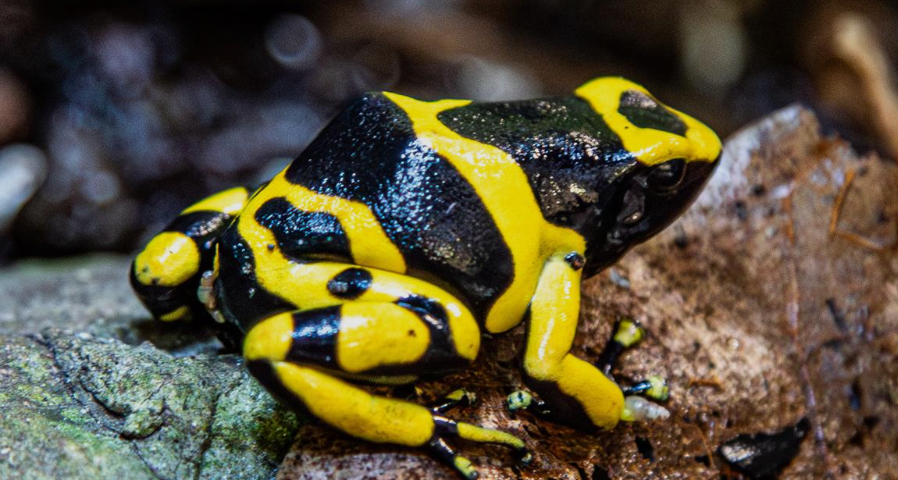
The bumblebee poison dart frog displays distinctive yellow and black banding reminiscent of a bumblebee, with broad yellow bands alternating with black stripes. These medium to large poison frogs reach 1.25-1.5 inches with a stocky, muscular build.
Found in northern South America including Venezuela, Brazil, Guyana, and Colombia, they inhabit upland rainforests and are often found on or near rocks and elevated surfaces. The high-contrast pattern serves as an effective warning to predators, and they’re popular in captivity due to their bold appearance, relatively large size, and active daytime behavior that makes them entertaining display animals.
Three-Striped Poison Dart Frog (Ameerega trivittata)
The three-striped poison dart frog displays three distinctive light-colored stripes running down its dark brown or bronze body from head to rear. These slender frogs measure 1-1.5 inches with a more streamlined build than many poison dart frogs.
Found widely across the Amazon basin including Peru, Ecuador, Brazil, and Bolivia, they inhabit lowland rainforests and are more terrestrial than many species. Despite being called poison dart frogs, this species is less toxic than many relatives and was not traditionally used by indigenous peoples for poisoning darts, and the striped pattern provides effective camouflage among leaf litter when the frog is stationary.
Lovely Poison Dart Frog (Phyllobates lugubris)
The lovely poison dart frog, despite its charming name, displays relatively subdued coloration compared to many poison frogs, typically showing black or dark brown with green, yellow, or orange markings. These small to medium frogs measure 0.75-1 inch with a slender build and long limbs.
Found in Central America from Nicaragua through Costa Rica to Panama, they inhabit lowland rainforests and are commonly found near streams and in areas with dense vegetation. The species shows considerable color variation across its range, with some populations displaying more extensive bright coloration while others are predominantly dark, and while toxic, they’re less poisonous than Phyllobates terribilis.
Granular Poison Dart Frog (Oophaga granulifera)
The granular poison dart frog displays bright red, orange, or green coloration with a distinctively granular skin texture that gives the species its name. These small frogs measure 0.75-1 inch and have a compact, rounded body shape. Endemic to Costa Rica and western Panama, they inhabit lowland and foothill rainforests along the Caribbean slope.
The granular skin texture distinguishes them from smooth-skinned relatives, and like other Oophaga species, they exhibit complex parental care with females transporting tadpoles to water-filled bromeliads and returning to feed them unfertilized eggs over the course of several weeks.
Zimmermann’s Poison Dart Frog (Ranitomeya variabilis)
Zimmermann’s poison dart frog displays highly variable coloration ranging from red, orange, yellow, to green with black spots, bands, or reticulations. These small frogs measure 0.5-0.75 inches with a slender build and long limbs relative to body size.
Found in the rainforests of Peru, particularly in the Loreto and San Martín regions, they inhabit lowland and montane forests where they’re often found in the canopy rather than on the forest floor.
The extreme color variability across populations initially led taxonomists to describe several separate species, but genetic analysis revealed they belong to a single highly polymorphic species with different populations evolving distinct color patterns in isolation.
Kokoe Poison Dart Frog (Phyllobates aurotaenia)
The kokoe poison dart frog displays distinctive green or yellow-green coloration with dark markings, typically showing two dark dorsolateral stripes running the length of the body. These medium-sized frogs reach 1-1.5 inches with a moderately robust build. Found in the Pacific lowlands of Colombia, they inhabit humid rainforests and are often found near streams and water sources.
Like other Phyllobates species, they’re highly toxic, and indigenous Emberá people historically used their skin secretions to poison blow darts, though they’re less toxic than the closely related golden poison frog. The species name “aurotaenia” refers to the golden stripes some populations display.