Birds that live in the Everglades are shaped by a landscape dominated by shallow water, sawgrass marshes, mangroves, and slow-moving rivers. This vast wetland provides feeding grounds rich in fish, insects, crustaceans, and amphibians. Many species here have evolved long legs for wading and specialized beaks for catching prey in murky water.
Seasonal water levels play a major role in their lives. During the dry season, shrinking water concentrates food, making it easier for birds to hunt and feed. In contrast, the wet season spreads prey over larger areas, requiring greater movement and adaptability. These natural cycles strongly influence breeding patterns and migration timing.
Nesting strategies vary widely across the Everglades. Some birds build nests high in trees or shrubs to avoid flooding and predators, while others nest in dense vegetation over water for protection. Large nesting colonies are common, where many individuals gather in the same area, increasing safety through numbers.
Feeding behaviors are diverse and often highly specialized. Some birds patiently stand still, waiting to strike at passing prey, while others actively stir the water with their feet or sweep their beaks side to side to detect movement. A few species even use cooperative hunting techniques to improve success.
The Everglades also serves as an important stopover or wintering ground for migratory species. Birds traveling long distances rely on its resources to rest and refuel. This makes the region not only a permanent home for many but also a critical link in larger ecological networks that span continents.
Famous Birds of the Everglades
Roseate Spoonbill (Platalea ajaja)
The Roseate Spoonbill is the Everglades’ most visually spectacular bird — its shocking flamingo-pink plumage and spatula-shaped bill making it immediately unmistakable as it sweeps its bill side to side through shallow water to catch fish and crustaceans.
Once hunted almost to extinction for its feathers, it has recovered significantly and is now one of the most celebrated sights in the Everglades ecosystem.
Wood Stork (Mycteria americana)
The only stork native to North America, the Wood Stork is a large, prehistoric-looking wading bird whose bald, scaly gray head and massive decurved bill give it a distinctly ancient appearance entirely appropriate for the primordial landscape of the Everglades.
It feeds by touch rather than sight — sweeping its open bill through water and snapping it shut with extraordinary speed when prey is detected — and its breeding success is so tightly linked to water levels that it has become one of the primary indicators of Everglades ecosystem health.
Great Blue Heron (Ardea herodias)
The largest heron in North America, the Great Blue Heron is a commanding presence in the Everglades — standing over a meter tall on spindly legs at the water’s edge, its blue-gray plumage, black eye stripe, and heavy yellow bill making it one of the most recognizable birds in the ecosystem.
It hunts with extraordinary patience, standing motionless for minutes before striking with explosive speed at fish, frogs, snakes, and even small mammals that venture within range.
Great Egret (Ardea alba)
The Great Egret’s pure white plumage, black legs, and yellow bill made it the primary target of the nineteenth-century plume hunting trade that decimated Everglades wading bird populations — and its recovery became the founding cause of the American conservation movement, leading directly to the establishment of the Audubon Society.
Today it is one of the most abundant and visible wading birds in the Everglades, its brilliant white form a constant presence at the edges of ponds, prairies, and mangrove channels throughout the ecosystem.
Snowy Egret (Egretta thula)
The Snowy Egret is distinguished from its larger white relatives by its black bill, black legs, and vivid yellow feet — the yellow feet earning it the folk name golden slippers and making it immediately identifiable in the field.
It is a more active and animated feeder than the patient Great Egret — shuffling its feet in the water to disturb prey, chasing fish with animated pursuit, and sometimes hovering briefly above the water before dropping to strike. Its delicate breeding plumes were the most coveted of all the Everglades wading birds by nineteenth-century plume hunters.
Tricolored Heron (Egretta tricolor)
The Tricolored Heron — formerly called the Louisiana Heron — is one of the most active and energetic of the Everglades wading birds, its blue-gray, purple, and white plumage and white belly stripe making it one of the most distinctively patterned herons in North America.
It feeds with considerable animation — running, leaping, and spreading its wings to create shade that reduces surface glare and draws fish into the shadow — behaviors that give it an almost comical energy compared to the stately stillness of the Great Blue Heron.
Little Blue Heron (Egretta caerulea)
The Little Blue Heron undergoes one of the most dramatic plumage changes of any Everglades bird — juveniles are entirely white and are frequently mistaken for Snowy Egrets, before molting through a distinctive piebald white-and-blue transitional plumage into the deep slate-blue and maroon-headed adult coloration.
This white juvenile plumage is thought to allow young birds to join feeding flocks of white egrets more easily. The adult’s deep, moody coloration makes it one of the most handsomely plumaged of all the Everglades wading birds.
Green Heron (Butorides virescens)
The Green Heron is one of the few tool-using birds in the world — it has been documented placing small objects including feathers, insects, and pieces of bread on the water surface as lures to attract fish within striking range.
This sophisticated behavior, combined with its compact size, cryptic green and chestnut plumage, and habit of hunching motionless on low branches overhanging water, makes it one of the most interesting and frequently overlooked birds in the Everglades ecosystem.
Black-crowned Night Heron (Nycticorax nycticorax)
The Black-crowned Night Heron is the most widespread heron in the world and a common Everglades resident — its stocky, short-necked silhouette and distinctive black cap and back contrasting with pale gray wings and white underparts making it immediately recognizable.
As its name suggests it is primarily nocturnal, roosting in dense vegetation during the day and emerging at dusk to hunt fish and invertebrates through the night. Its loud, barking “kwok” call — given in flight — is one of the characteristic sounds of the Everglades night.
Yellow-crowned Night Heron (Nyctanassa violacea)
The Yellow-crowned Night Heron is a specialist crustacean hunter of the Everglades mangrove and coastal marsh zones — its heavy, powerful bill specifically adapted for crushing the shells of fiddler crabs and crayfish that make up the bulk of its diet.
Its elegant gray plumage, bold black and white head pattern, and creamy yellow crown give it a more refined appearance than its black-crowned relative, and its preference for mangrove-fringed tidal creeks and coastal habitats gives it a more restricted distribution within the Everglades ecosystem.
Reddish Egret (Egretta rufescens)
The Reddish Egret is the rarest of the Everglades herons and one of the most entertaining to watch — its feeding style involving wild, lurching, spinning, wing-spreading dances across the shallows that look almost choreographed but are in fact a highly effective fish-herding strategy.
It comes in two color morphs — a dark morph with rusty head and neck and slate-gray body, and a white morph resembling a white egret — and both forms perform the same extraordinary feeding ballet in the shallow coastal flats they prefer.
American Flamingo (Phoenicopterus ruber)
The American Flamingo has a complex history in the Everglades — long considered only a visitor from Caribbean populations, recent research has established that wild flamingos were indeed native to Florida and were hunted to local extinction in the nineteenth century.
Small but growing numbers of genuinely wild flamingos have been recolonizing Florida Bay and the southern Everglades in recent years, representing one of the most exciting potential wildlife recoveries in North American ornithology. Their vivid pink coloration and distinctive down-bent bills make them unmistakable.
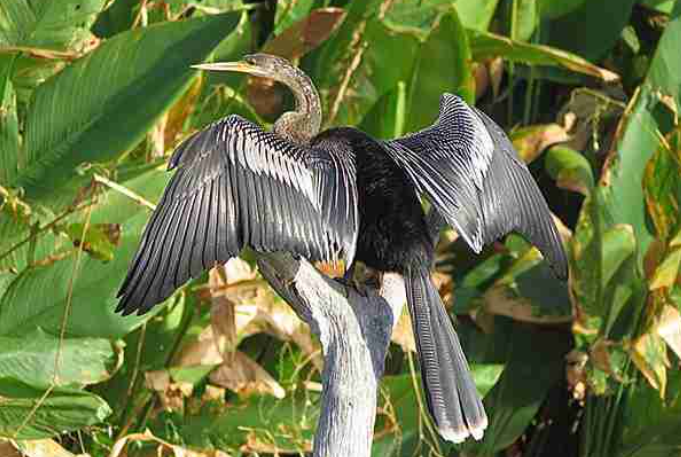
Anhinga (Anhinga anhinga)
The Anhinga — sometimes called the Snakebird for the sinuous, serpentine appearance of its long neck when swimming — is one of the most characteristic birds of the Everglades, found on virtually every pond, canal, and cypress swamp in the ecosystem.
Unlike ducks and cormorants, it lacks waterproofing oils in its feathers and becomes waterlogged when diving — a trait that aids underwater swimming but requires it to spread its wings in the sun to dry after each dive, a behavior that produces one of the Everglades’ most iconic images.
Double-crested Cormorant (Nannopterum auritum)
The Double-crested Cormorant is a large, fish-eating waterbird found throughout the Everglades on open water, canals, and coastal bays — its black plumage, orange throat pouch, and habit of perching with wings spread making it somewhat similar in silhouette to the Anhinga but stockier and with a distinctive hooked bill.
It is a powerful diver, pursuing fish to considerable depths, and large roosting colonies produce the strong ammonia odor of concentrated guano that is detectable from considerable distances.
Brown Pelican (Pelecanus occidentalis)
The Brown Pelican is the smallest of the world’s pelicans but one of its most dramatic fishers — plunge-diving from heights of up to ten meters, folding its wings and hitting the water with explosive force to capture fish in its enormous expandable throat pouch.
It is a common sight along the Everglades’ coastal margins, Florida Bay, and the Ten Thousand Islands — flying in low, graceful lines just above the wave tops or roosting in dense colonies on coastal mangrove islands. Its recovery from near-extinction due to DDT poisoning is one of American conservation’s great success stories.
White Ibis (Eudocimus albus)
The White Ibis is one of the most abundant wading birds in the Everglades and one of its most socially gregarious — feeding in large flocks that probe the marsh soil and shallow water with their long, curved bills for crayfish, crabs, and aquatic invertebrates, and roosting and nesting in enormous colonies of thousands of birds that create spectacular aerial displays at dawn and dusk.
Its brilliant white plumage, vivid red-orange curved bill, and red facial skin make it one of the most colorful of all Everglades wading birds despite its predominantly white coloration.
Glossy Ibis (Plegadis falcinellus)
At first glance the Glossy Ibis appears entirely dark — a slim, curved-billed wading bird of deep, uniform darkness moving through marsh vegetation. Close examination reveals an extraordinary iridescence — deep chestnut, bronze, green, and purple sheens that shift and shimmer in sunlight, making it one of the most subtly beautiful of all Everglades birds.
It is the most widespread ibis in the world — found on every continent except Antarctica and Australia — and feeds in freshwater marshes and flooded agricultural fields alongside the more abundant White Ibis.
Limpkin (Aramus guarauna)
The Limpkin is a unique bird — the sole member of its family, occupying an evolutionary position between cranes and rails — found in the Everglades’ freshwater marshes and cypress swamps where it specializes almost exclusively in feeding on apple snails.
Its loud, wailing, banshee-like call — one of the most haunting sounds of the Everglades night — carries extraordinary distances across the marsh. Its spotted brown plumage, drooping bill tip, and distinctive limping gait when walking combine to create an utterly distinctive and unforgettable bird.
Sandhill Crane (Antigone canadensis)
The Florida Sandhill Crane is a non-migratory subspecies resident year-round in the Everglades’ surrounding grasslands and wet prairies — a tall, gray, red-capped crane whose loud, resonant, rattling call carries across open landscapes for considerable distances.
Mated pairs perform elaborate dancing displays — bowing, jumping, and calling in synchronized duets — that strengthen pair bonds maintained for life. Florida Sandhill Cranes are increasingly common in suburban and agricultural areas adjacent to the Everglades, where they have adapted to human-modified landscapes with remarkable ease.
Whooping Crane (Grus americana)
The Whooping Crane is North America’s tallest bird and one of its most endangered — reduced to fewer than twenty wild individuals in the 1940s before intensive conservation programs began a slow recovery that continues today.
While not historically a common Everglades bird, reintroduction efforts have included Florida as a target area for establishing non-migratory populations, and occasional individuals are encountered in the Everglades ecosystem. Its pure white plumage, red crown, and extraordinary height make it unmistakable and its presence anywhere in Florida remains a significant conservation event.
Osprey (Pandion haliaetus)
The Osprey is one of the Everglades’ most successful fish-hunting raptors — its specialized reversible outer toe, barbed foot pads, and oily, water-resistant plumage making it uniquely adapted for plunging feet-first into water to seize fish.
Its large, untidy stick nests on channel markers, utility poles, and dead trees are a familiar sight throughout the Everglades waterways, and its dramatic hunting dives — sometimes fully submerging before emerging with a fish clasped in both talons — are among the most exciting wildlife spectacles the ecosystem offers.
Bald Eagle (Haliaeetus leucocephalus)
The national bird of the United States is a year-round resident of the Everglades and Florida Bay — one of the highest breeding densities of Bald Eagles in the eastern United States is found in the Everglades ecosystem, where the abundance of fish and waterfowl provides exceptional hunting opportunities.
Its white head and tail, yellow bill, and enormous wingspan of over two meters make it unmistakable, and its habit of stealing fish from Ospreys — a behavior called kleptoparasitism — is frequently observed over the Everglades’ open water.
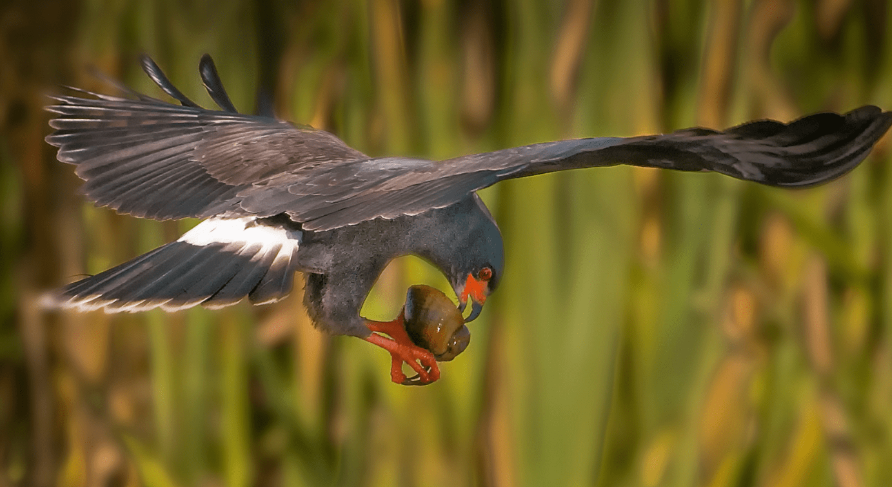
Snail Kite (Rostrhamus sociabilis)
The Snail Kite is one of the most habitat-specialized raptors in North America — its entire diet consisting almost exclusively of Florida apple snails, for which its dramatically hooked bill is specifically adapted to extract from the shell without breaking it.
The entire North American population — a federally endangered subspecies — depends on the freshwater marshes of the Everglades and associated wetlands, and the species’ fate is inextricably linked to the health of the Everglades ecosystem and the abundance of its single prey species.
Swallow-tailed Kite (Elanoides forficatus)
The Swallow-tailed Kite is arguably the most beautiful raptor in North America — its crisp black and white plumage, long, deeply forked tail, and effortless, acrobatic flight combining to create an aerial presence of extraordinary elegance.
It arrives in the Everglades each spring from South American wintering grounds to breed — hawking large insects and small vertebrates from the air with spectacular maneuverability, drinking by skimming water surfaces in flight, and bathing in rain showers without ever landing. Its departure in late summer is one of the Everglades’ most poignant seasonal events.
Mississippi Kite (Ictinia mississippiensis)
The Mississippi Kite passes through the Everglades during migration — its slate-gray plumage, pale head, and long, pointed wings creating a falcon-like silhouette as it hawks large insects in the air above forest edges and open country.
A highly social species during migration, it sometimes moves through southern Florida in large flocks of dozens or hundreds of individuals, catching dragonflies and other large insects in flight and eating them on the wing. Small numbers nest in adjacent areas of southern Florida, making it both a migrant and a local breeding species in the broader region.
Red-shouldered Hawk (Buteo lineatus)
The Red-shouldered Hawk is the characteristic woodland hawk of the Everglades’ cypress swamps and hardwood hammocks — its loud, repeated “kee-ahh” call one of the most familiar sounds of these forested wetland habitats.
Its distinctive barred rusty-orange breast, checkered wings, and boldly banded tail make it one of the most attractive of the Buteo hawks, and it is a versatile predator of frogs, snakes, lizards, and small mammals in the wet forest habitats it prefers. It often perches quietly on low branches within the forest interior, scanning the ground below.
Short-tailed Hawk (Buteo brachyurus)
The Short-tailed Hawk is one of Florida’s most sought-after raptors — a small, compact buteo found almost exclusively in Florida among North American populations, where it inhabits the cypress swamps and forest edges of the Everglades and surrounding areas.
It comes in two color morphs — a dark morph of uniform dark brown and a striking white-breasted light morph — and it hunts primarily by soaring high above the forest canopy and diving on small birds flushed from the vegetation below. Its restricted Florida range and relative scarcity make it a prize sighting for visiting birdwatchers.
Great Horned Owl (Bubo virginianus)
The Great Horned Owl is the apex nocturnal predator of the Everglades — its powerful talons exerting crushing force sufficient to kill prey considerably larger than itself, including Ospreys, other owls, and large wading birds roosting at night.
Its deep, resonant hooting — one of the most evocative sounds of the North American night — echoes across the Everglades’ cypress swamps and pine flatwoods from dusk onward, and it begins nesting in January — the earliest of any Everglades bird — often using the abandoned stick nests of hawks and herons.
Barred Owl (Strix varia)
The Barred Owl’s loud, distinctive call — traditionally transcribed as “who cooks for you, who cooks for you-all” — is one of the most familiar sounds of the Everglades’ cypress swamps and hardwood hammocks.
It is the most commonly heard owl in the ecosystem, calling freely during the day as well as at night and sometimes engaging in extraordinary vocal duets between mated pairs that build into a cacophony of hooting, barking, and caterwauling. It hunts frogs, crayfish, fish, and small mammals along the edges of swamps and marshes.
Burrowing Owl (Athene cunicularia)
The Burrowing Owl is a small, ground-dwelling owl of open, short-grass habitats — found in the dry prairies and disturbed areas adjacent to the Everglades rather than in the wetlands themselves.
It nests in underground burrows — either self-excavated or appropriated from ground squirrels and other burrowing animals — and stands at the burrow entrance during the day with a characteristic upright, alert posture.
Its long legs, flat facial disc, and bright yellow eyes give it an endearing, wide-eyed expression, and its habit of bobbing up and down when alarmed is one of the most charming behavioral quirks of any Everglades bird.
Purple Gallinule (Porphyrio martinica)
The Purple Gallinule is one of the most extravagantly colored birds in North America — its iridescent blue-purple plumage, vivid red and yellow bill, pale blue frontal shield, and yellow legs combining in a color combination of almost tropical excess that seems barely believable in a temperate bird.
It walks across floating lily pads and aquatic vegetation on its enormous yellow feet with delicate precision, and its habit of clambering through marsh vegetation and climbing reeds and cattails gives it a more arboreal quality than most rail relatives. It is a common and spectacular Everglades resident.
Common Gallinule (Gallinula galeata)
The Common Gallinule — formerly called the Common Moorhen — is a dark, chicken-like waterbird found throughout the Everglades’ freshwater marshes and pond margins, its red frontal shield and bill tipped with yellow making it immediately distinctive from ducks and coots.
It nods its head with each swimming stroke in a characteristic pumping motion and is highly vocal — producing a wide range of clucking, cackling, and shrieking calls from within dense marsh vegetation. It builds floating nests of aquatic vegetation and is an attentive parent, with older siblings from previous broods sometimes helping to raise younger chicks.
American Coot (Fulica americana)
The American Coot is the most abundant and visible waterbird on the Everglades’ open water — occurring in flocks of hundreds or even thousands on large ponds and water management areas during winter.
Its entirely dark gray plumage, white bill and frontal shield, and lobed — rather than webbed — feet distinguish it from ducks, and its quarrelsome, aggressive interactions with other coots and waterbirds provide constant entertainment for observers. Despite looking ungainly on land, it is an accomplished diver and a remarkably aggressive territorial defender during breeding season.
Sora (Porzana carolina)
The Sora is the most abundant rail in North America and a common but secretive winter visitor to the Everglades’ freshwater marshes — its distinctive descending whinny call betraying its presence in dense cattail and sawgrass vegetation where the bird itself is almost impossible to see.
Like all rails it has a laterally compressed body — “thin as a rail” — allowing it to move through dense marsh stems that would trap most other birds. It feeds on seeds and invertebrates in the marsh shallows and is far more often heard than seen.
Clapper Rail (Rallus crepitans)
The Clapper Rail is the characteristic rail of the Everglades’ coastal salt marshes and mangrove-fringed tidal creeks — its loud, clattering, machine-gun call that gives it its name echoing across the tidal marsh at dawn and dusk.
Like the Sora it is far more often heard than seen, its cryptic brown streaked plumage and secretive habits keeping it hidden within the dense marsh vegetation through which it moves with silent, effortless ease. It feeds on fiddler crabs and other tidal invertebrates at the margins of salt marsh channels.
King Rail (Rallus elegans)
The King Rail is the largest North American rail — a freshwater specialist found in the Everglades’ sawgrass prairies and freshwater marshes that is closely related to the Clapper Rail and hybridizes with it where their habitats meet.
Its rich, warm rufous breast and boldly striped brown upperparts make it considerably more attractively patterned than the duller Clapper Rail, and its loud, grunting calls — a series of deep, evenly spaced notes — are one of the characteristic sounds of Everglades freshwater marsh at dawn. Its populations have declined significantly as freshwater marsh habitats have been reduced.
Killdeer (Charadrius vociferus)
The Killdeer is the most familiar and widespread shorebird in the Everglades ecosystem — found on mudflats, short grass areas, roadsides, and parking lots throughout the region, its loud “kill-deer” call and double breast bands making it immediately recognizable.
It is famous for its broken-wing display — dragging one wing along the ground while calling piteously to lead predators away from its nest or chicks — one of the most convincing and frequently observed distraction displays of any North American bird. It nests directly on the ground in open habitats throughout the Everglades region.
Black-necked Stilt (Himantopus mexicanus)
The Black-necked Stilt’s extraordinary legs — rose-pink, pencil-thin, and disproportionately long even by wading bird standards — carry its bold black and white body through the shallow water of Everglades impoundments and flooded fields with an elegance that is genuinely striking.
It is one of the most aggressively defensive of all Everglades birds at the nest — dive-bombing intruders of any size, including humans, with loud, persistent yapping calls that continue until the threat retreats. Its long legs allow it to wade in deeper water than most other small shorebirds.
American Avocet (Recurvirostra americana)
The American Avocet is a stunning shorebird — its rusty-orange head and neck, black and white body, and elegantly upturned bill combining in one of the most distinctive and beautiful silhouettes of any North American wading bird.
It feeds by sweeping its upturned bill side to side through shallow water in the same scything motion used by the Roseate Spoonbill, straining small invertebrates from the water. A winter visitor to the Everglades rather than a breeding resident, it occurs on flooded impoundments and coastal shallows in the colder months.
Willet (Tringa semipalmata)
The Willet is a large, stocky shorebird of the Everglades’ coastal beaches, tidal flats, and mangrove margins — appearing completely dull gray-brown at rest but revealing spectacular bold black and white wing patterns in the moment of takeoff, a flash of unexpected contrast that is one of the most dramatic moments in Everglades shorebird watching.
Its loud, repetitive “will-will-willet” call carries across tidal flats and coastal areas throughout the year, and the Florida breeding subspecies is resident year-round in the Everglades coastal zone.
Roseate Tern (Sterna dougallii)
The Roseate Tern is one of the rarest and most elegant seabirds of the Everglades’ coastal zone — its extremely long tail streamers, pale gray and white plumage, and delicate proportions giving it a more refined appearance than the more common terns of Florida Bay.
It nests in small colonies on coastal islands and sandy beaches and feeds by plunge-diving for small fish in the shallow coastal waters. Its declining population — the result of historical feather hunting, habitat loss, and predation at nest sites — makes every Everglades sighting a significant one.
Laughing Gull (Leucophaeus atricilla)
The Laughing Gull is the most abundant gull of the Everglades’ coastal zone — its loud, laughing call one of the defining sounds of Florida Bay and the Ten Thousand Islands mangrove coast.
Its black hood in breeding plumage, dark gray back, and white underparts make it one of the most attractively patterned of North American gulls, and its habit of following fishing boats and stealing food from Brown Pelicans as they emerge from their plunge dives gives it a reputation for opportunistic boldness entirely consistent with its raucous personality.
Royal Tern (Thalasseus maximus)
The Royal Tern is the largest tern regularly found in the Everglades ecosystem — a powerful, orange-billed seabird of coastal waters, Florida Bay, and the Ten Thousand Islands that plunge-dives for fish with forceful, direct dives quite different from the more graceful hovering of smaller tern species.
Its shaggy black cap worn in breeding season and its very large orange bill make it immediately identifiable, and it nests in dense, noisy colonies on coastal sandy beaches where its raucous calling creates an extraordinary wall of sound during the breeding season.
Magnificent Frigatebird (Fregata magnificens)
The Magnificent Frigatebird is one of the most aerially accomplished birds in the world — spending almost its entire life on the wing, never landing on water, and obtaining all its food by stealing it from other seabirds in spectacular aerial chases.
Its enormous wingspan — over two meters — relative to its light body gives it an effortless, almost raptor-like mastery of the air, and the male’s brilliant red throat sac inflated during breeding displays is one of nature’s most dramatic sexual ornaments. It is a common sight soaring over Florida Bay and the Everglades coast.
Mangrove Cuckoo (Coccyzus minor)
The Mangrove Cuckoo is one of the most sought-after and least-seen birds in the Everglades ecosystem — a secretive, skulking species of dense mangrove and tropical hardwood hammock that is far more often heard than seen.
Its distinctive, slow, guttural “gawp gawp gawp” call is heard throughout the mangrove coast from spring through summer, but the bird itself — buffy below with a black mask and long, white-spotted tail — remains hidden within the dense foliage with frustrating consistency. It is a specialty species that draws dedicated birdwatchers to the Everglades specifically to add it to their life lists.
Smooth-billed Ani (Crotophaga ani)
The Smooth-billed Ani is a bizarre, all-black cuckoo relative found in the agricultural and scrub areas surrounding the Everglades — its enormous, laterally compressed, parrot-like bill, loose-jointed flight, and habit of living in cooperative groups that share incubation and chick-rearing duties giving it a completely unique character among South Florida birds.
Multiple females lay eggs in the same communal nest, and all group members take turns incubating and brooding. Its population in Florida has declined significantly in recent decades, making it a species of growing conservation concern.
Red-bellied Woodpecker (Melanerpes carolinus)
The Red-bellied Woodpecker is the most common and conspicuous woodpecker of the Everglades’ pine flatwoods and hardwood hammocks — its loud, rolling “churr” call and bright red cap making it one of the most familiar birds in South Florida’s wooded habitats.
Despite its name the red on its belly is usually invisible in the field — the vivid red of the crown and nape are far more obvious features. It is an omnivorous forager — excavating insects from bark, storing food in bark crevices, and consuming fruit and nectar with equal enthusiasm.
Pileated Woodpecker (Dryocopus pileatus)
The Pileated Woodpecker is the largest woodpecker in North America — a crow-sized, dramatically patterned black and white bird with a vivid red crest that excavates large, rectangular holes in dead and dying trees in search of carpenter ant colonies.
Its loud, prehistoric-sounding calls echo through the Everglades’ cypress swamps and hardwood hammocks like the calls of a bird from a different era, and the large rectangular cavities it excavates are subsequently used as nest sites by a wide range of other cavity-nesting species including Wood Ducks, owls, and small mammals.
Carolina Wren (Thryothorus ludovicianus)
The Carolina Wren is a tiny, energetic ball of warm brown energy — its loud, ringing “tea-kettle, tea-kettle, tea-kettle” song one of the most powerful and persistently repeated of any small bird in the Everglades’ shrubby habitats and hardwood hammock margins.
Its upturned tail, bold white eyebrow stripe, and habit of exploring every crevice and dense tangle with insatiable curiosity make it one of the most characterful small birds in the ecosystem. Despite its small size it is one of the loudest birds for its size in North America.
Painted Bunting (Passerina ciris)
The male Painted Bunting is arguably the most colorful bird in North America — its combination of vivid blue head, brilliant red underparts, and lime-green back creating a color scheme so intense it looks almost artificially painted, exactly as its name suggests.
It winters in South Florida and the Everglades region in significant numbers — feeding on seeds in brushy areas, forest edges, and suburban gardens — before returning to its southeastern breeding grounds in spring. Female Painted Buntings are a beautiful lime-green — cryptic but distinctive among North American sparrows.