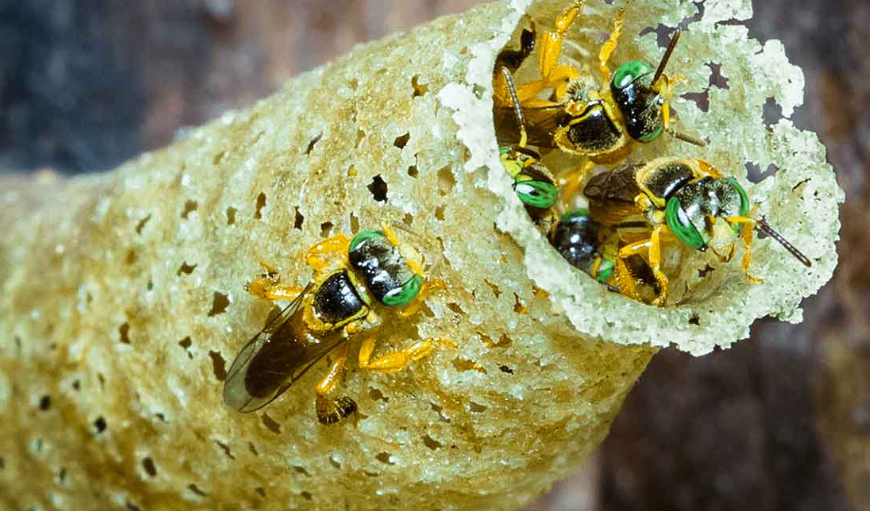
Some bees closely resemble wasps in appearance, which can make them difficult to distinguish at first glance. They often share similar body shapes, color patterns, and markings such as black and yellow stripes. Because of these similarities, people sometimes mistake them for wasps, especially when they are seen flying quickly around flowers or garden plants.
This resemblance is often considered a natural form of protection. Predators that avoid wasps because of their sting may also stay away from insects that look similar. By having colors and patterns that mimic wasps, these bees gain an advantage that helps reduce the chances of being attacked by birds or other predators.
Although they may look similar to wasps, their behavior is usually quite different. Many of these bees spend most of their time visiting flowers to collect nectar and pollen rather than hunting other insects. They are typically more focused on pollination activities and are often seen moving gently from flower to flower.
Their bodies may also have subtle differences that separate them from wasps. In many cases, they appear slightly fuzzier because of the fine hairs that help them gather pollen. These hairs are important for pollination, allowing pollen grains to cling to their bodies as they move between plants.
Bees that Look Like Wasps
Nomada Bees (Cuckoo Bees)
Nomada bees are perhaps the most convincing wasp mimics in the bee world. They are cleptoparasites, meaning they lay their eggs in the nests of other bees. Because they do not collect pollen to feed their young, they have lost the dense “fuzzy” hair associated with most bees. They typically feature bright red, yellow, and black bands and have a slender, cylindrical abdomen that makes them nearly indistinguishable from common wasps to the untrained eye.
Yellow-faced Bees (Hylaeus)
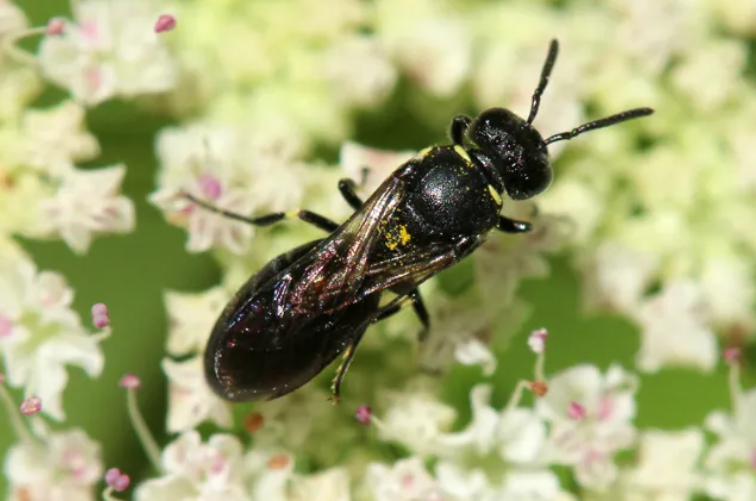
These bees are small, slender, and almost entirely hairless, giving them a very “waspish” appearance. They are mostly black but feature distinct yellow or white markings on their faces and legs, resembling small sphecid wasps. Unlike most bees, they carry pollen internally in a crop rather than on external hairs, which contributes to their sleek, smooth-bodied look that often causes gardeners to mistake them for tiny predatory wasps.
European Wool Carder Bees (Anthidium manicatum)
The Wool Carder bee is often mistaken for a yellow jacket because of the bright yellow spots and stripes along the sides of its abdomen. They are quite robust and can be aggressive defenders of their floral territories. Males, in particular, will hover and “dart” at other insects to drive them away, a behavioral trait that, combined with their striking yellow-and-black coloration, leads many people to assume they are a type of hornet or wasp.
Blood Bees (Sphecodes)
Blood bees get their name from their bright, blood-red abdomens, which often contrast sharply with their black heads and thoraxes. This coloration is very similar to many species of spider wasps. Like Nomada bees, Blood bees are parasites that do not collect pollen, so they lack the hairy “pollen baskets” on their legs. Their smooth, shiny bodies and erratic flight patterns near the ground make them look very much like hunting wasps searching for prey.
Triepeolus Bees (Cuckoo Bees)
These bees are known for their striking, high-contrast black and white patterns that look like intricate “war paint.” They are relatively large and have a very thick, armor-like exoskeleton that lacks the typical bee fuzziness. Their geometric markings and sturdy body shape often lead people to classify them as some sort of exotic wasp. They are parasites of long-horned bees and can often be seen patrolling the ground near their hosts’ nests.
Sharp-tailed Bees (Coelioxys)
The most defining feature of this bee is its sharply pointed, cone-shaped abdomen, which looks remarkably like a long stinger. They are hairless parasites of leafcutter bees. Their sleek, black bodies and the aggressive-looking point at the end of their abdomen give them a very intimidating, wasp-like silhouette. Despite their appearance, that “point” is actually a specialized tool used by the female to pierce the leaf-lined walls of a host’s nest.
Epeolus Bees (Variegated Cuckoo Bees)
Epeolus bees are closely related to Triepeolus and share the same “wasp-mimic” strategy. They are usually smaller and feature short, felt-like patches of white or yellow hair that form distinct patterns on a dark background. Because they are parasitic and do not forage for pollen for their young, they have a smooth, hard-bodied appearance that is far more characteristic of a wasp than a typical honey bee or bumble bee.
Stelis Bees (Dark Cuckoo Bees)
Stelis bees are small, dark-colored bees that are often mistaken for small black wasps. They are parasites of resin bees and mason bees. They lack the specialized pollen-collecting hairs on their abdomens, resulting in a smooth, shiny look. Many species have small yellow or white spots on the sides of their abdomens, further mimicking the appearance of certain small predatory wasps that inhabit the same environments.
Melecta Bees (Digger Cuckoo Bees)
These bees are often large and have a somewhat “scary” appearance. They frequently have black bodies with white or grey spots on the sides of their abdomens, resembling certain species of digger wasps. They are parasites of Anthophora bees and are often seen hovering around clay banks and vertical soil walls. Their lack of a thick coat of hair and their specialized body shape make them look like hunters rather than pollinators.
Small Carpenter Bees (Ceratina)
Small Carpenter bees are often tiny and have a metallic blue or green sheen, but their body shape is very long and cylindrical. They are relatively hairless compared to other bees, and their slender profile is very similar to that of many small solitary wasps. While they are industrious pollinators that nest in the pithy stems of plants, their shiny, smooth exterior frequently leads to them being misidentified as small, harmless wasps.
Holcopasites Bees
These are very small, colorful bees that are often reddish-brown or black with white spots. They have a distinct “sculptured” look to their exoskeleton, which is a common trait among many parasitic wasps. They target the nests of small ground-nesting bees. Because they are so tiny and move with a quick, jerky flight, they are almost always mistaken for some variety of minute wasp rather than a member of the bee family.
Masked Bees (Hylaeinae)
A sub-group of the yellow-faced bees, these insects are almost exclusively black with small, bright “masks” of yellow or white. Their bodies are very thin, and they fly with a rapid, direct motion that is very wasp-like. Since they carry their pollen internally, they have no need for the fuzzy “bee” look, allowing them to perfectly mimic the sleek, dangerous appearance of small predatory wasps to avoid being eaten by birds.