Botanical Classification
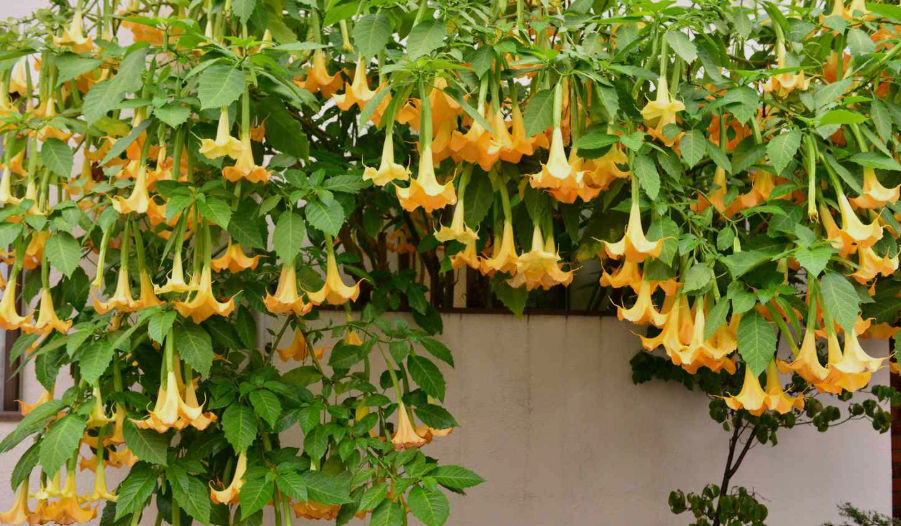
Angel’s trumpet belongs to the genus Brugmansia, which is part of the family Solanaceae, commonly known as the nightshade family. Its scientific name is Brugmansia, and it includes several species such as B. suaveolens, B. aurea, and B. arborea.
The genus is closely related to Datura, another group of trumpet-shaped flowering plants, but Brugmansia species are woody shrubs or small trees, unlike herbaceous Datura.
Description / Characteristics
Angel’s trumpet is a large, woody shrub or small tree, typically reaching 2–6 meters (6–20 feet) in height, with a broad, spreading crown. The leaves are large, ovate to lance-shaped, and sometimes slightly hairy along the veins. Its most striking feature is the pendulous, trumpet-shaped flowers, which can measure 20–50 centimeters (8–20 inches) in length.
The flowers bloom in colors ranging from white and cream to yellow, pink, and peach, often emitting a strong, sweet fragrance in the evening to attract nocturnal pollinators like moths. Flowering typically occurs from late spring through fall in warm climates.
Distribution & Habitat
Brugmansia species are native to tropical regions of South America, particularly the Andes of Peru, Colombia, and Ecuador. They naturally grow in forest edges, along riverbanks, and in well-drained soils at low to mid elevations.
Due to their striking flowers and fragrance, Angel’s trumpets have been widely introduced and cultivated in tropical and subtropical regions worldwide, including parts of United States (Florida, southern California, Hawaii), Australia, and Southeast Asia. They are commonly grown as ornamental plants in gardens, large containers, and public landscapes.
Conservation
Angel’s trumpet (Brugmansia spp.) is not currently listed as threatened in cultivation, but wild populations in the Andes have been affected by habitat loss due to deforestation and land conversion.
Conservation efforts focus on preserving native genetic diversity and protecting remaining wild populations, while cultivated plants worldwide help maintain the species’ ornamental presence. Because the plant is widely grown in gardens and landscapes, its survival is secure outside its native range.
Uses
Angel’s trumpet is primarily valued for ornamental purposes due to its large, pendulous, trumpet-shaped flowers and intoxicating fragrance. It is commonly planted in gardens, patios, and parks, often as a focal point or specimen plant.
The flowers are especially notable for their nighttime fragrance, which attracts pollinators such as moths. Historically, some indigenous South American communities used Brugmansia in traditional medicine and shamanic rituals, but the plant is highly toxic, so such uses require extreme caution.
Varieties and Cultivars
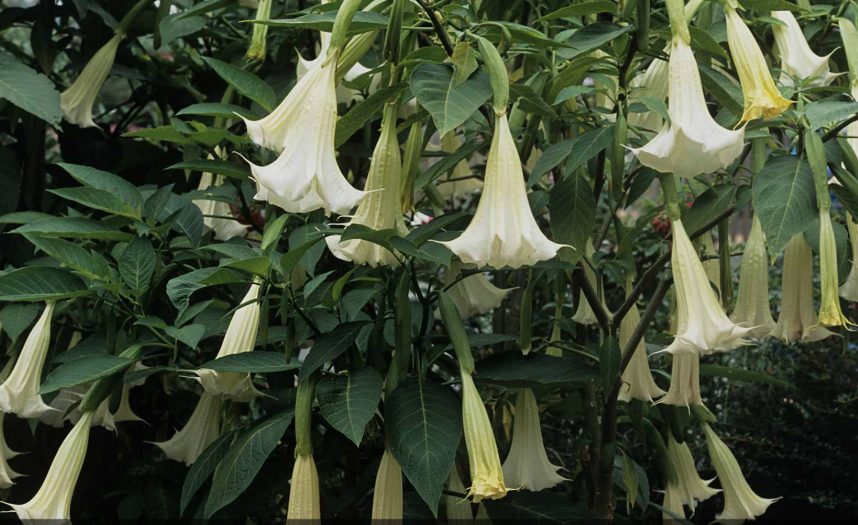
Several species and cultivars of Angel’s trumpet are grown for ornamental appeal:
- Brugmansia suaveolens – Known for large, fragrant white to cream flowers and prolific blooming.
- Brugmansia aurea – Features yellow flowers with strong fragrance, often used as a garden specimen.
- Brugmansia arborea – A smaller, shrubbier species with white flowers and more compact growth.
- Brugmansia ‘Charles Grimaldi’ – Hybrid cultivar prized for very large, fragrant, creamy-white flowers.
- Brugmansia ‘Angels Gold’ – Hybrid with bright yellow blooms, offering a tropical garden accent.
Growth Rate
Angel’s trumpet (Brugmansia spp.) has a moderate to fast growth rate. In warm climates, young plants can grow 30–60 centimeters (1–2 feet) per year, quickly developing into large shrubs or small trees. Under optimal conditions with full sun, fertile soil, and regular watering, mature specimens can reach 4–6 meters (13–20 feet) in height within 5–10 years.
Regular pruning encourages bushier growth and more prolific flowering, while also keeping the plant manageable in garden spaces.
USDA Zones
Angel’s trumpet thrives in USDA Hardiness Zones 9–11, corresponding to tropical and subtropical regions with minimal frost. In cooler zones, it is often grown as a container plant that can be moved indoors during winter or treated as an annual.
The tree prefers full sun to partial shade, fertile, well-drained soil, and consistent moisture to support vigorous growth and abundant flowering.
Problems
Despite its ornamental appeal, Angel’s trumpet can face several issues:
- Toxicity: All parts of the plant, especially seeds and flowers, are highly toxic if ingested by humans or animals. Handling the plant carefully is essential.
- Pests: Aphids, spider mites, whiteflies, and caterpillars can infest leaves and flowers.
- Fungal diseases: Root rot, powdery mildew, and leaf spot may occur in poorly drained soils or overly humid conditions.
- Environmental stress: Frost, cold temperatures, or prolonged drought can damage growth and reduce flowering.
- Structural issues: Large branches may require pruning to prevent breakage, particularly in windy locations.
How to grow and care for Angel’s Trumpet (Brugmansia spp.)
- Sunlight – Plant Angel’s trumpet in full sun to partial shade. Full sun promotes the largest, most abundant flowers, but the tree can tolerate light shade in very hot climates.
- Soil Requirements – Use well-drained, fertile soil rich in organic matter. Avoid heavy clay or waterlogged areas, as soggy soil can lead to root rot. Slightly acidic to neutral soil (pH 6.0–7.0) is ideal.
- Watering – Water regularly to keep the soil consistently moist, especially during hot, dry periods. Mulching around the base helps retain soil moisture and keeps roots cool.
- Fertilization – Feed every 4–6 weeks during the growing season with a balanced, water-soluble fertilizer or one high in phosphorus to encourage flowering. Slow-release fertilizers can also be used for container-grown plants.
- Pruning and Deadheading – Prune lightly after flowering to maintain shape, encourage bushier growth, and stimulate more blooms. Remove dead or weak branches to improve airflow and reduce disease risk.
- Pest and Disease Management – Monitor for aphids, spider mites, whiteflies, and caterpillars. Treat infestations with insecticidal soap or neem oil. Ensure good drainage and air circulation to prevent fungal diseases such as root rot, leaf spot, or powdery mildew.