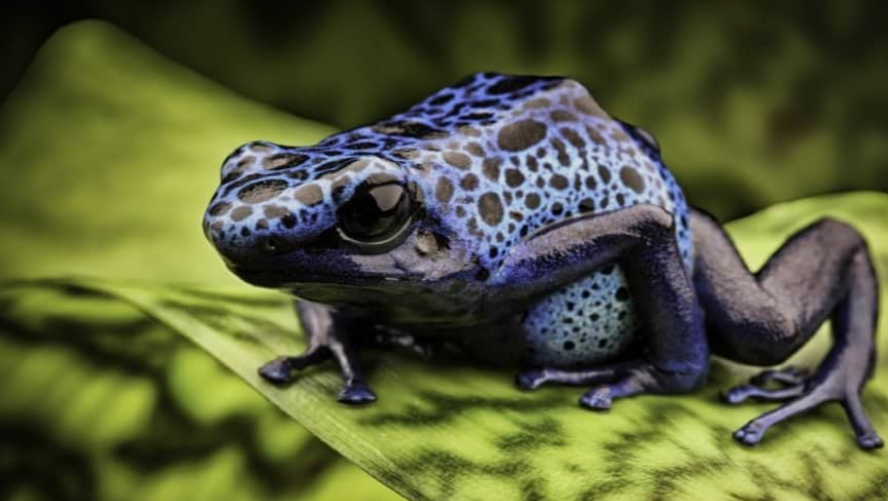
Poisonous frog species carry their defenses in their skin, where glands release toxins that sicken or kill animals that try to eat them. A poisonous animal harms through touch or taste, while a venomous one injects its toxin. Almost all toxic frogs are poisonous, and only two known species are truly venomous.
The best-known group is the poison frog family of Central and South America, which has more than 300 members. They range from harmless to deadly, and a single golden poison frog holds enough toxin to kill about 10 people. Their bright colors act as a warning that predators learn to avoid.
Most of these frogs do not make their own poison. Stanford University biologist Lauren O’Connell explains that they get their toxins from the ants and mites they eat on the rainforest floor. Frogs raised in captivity on other food never become toxic.
Toxic skin has also evolved separately in frogs in Madagascar, Australia, Brazil and North America. The 28 species below include members of all these groups, and each entry notes where the frog lives.
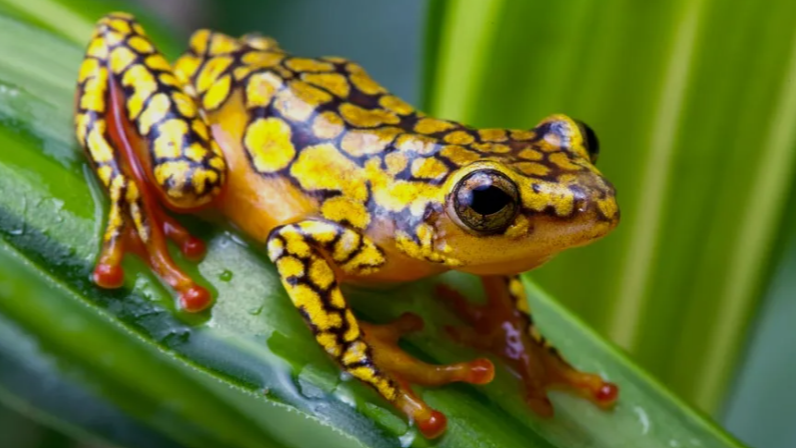
1. Golden Poison Frog
The golden poison frog is considered the most poisonous frog on Earth. It grows to about 2 inches long, which is large for its family. Its skin is a single bright color, usually yellow, orange or pale mint green. Its skin holds as much as 2 milligrams of a nerve toxin. That is enough to kill at least 10 people. The toxin stops nerves from sending signals and paralyzes the muscles.
The University of Michigan’s Animal Diversity Web describes the frog’s skin as saturated with this poison. The Emberá people of Colombia rubbed their blowgun darts across its back for hunting. Scientists think the toxin comes from small beetles in its diet. Captive-bred frogs have no detectable poison. The species is endangered because its forest is being cleared. It lives only in a small area of lowland rainforest on the Pacific coast of Colombia, in the Cauca region.
2. Black-Legged Poison Frog
The black-legged poison frog is the second most toxic member of its group. It is slightly smaller and slimmer than the golden poison frog. Its body is yellow or orange. Its legs are dark, often blackish with a blue or green tint. It carries the same type of nerve toxin as its larger relative. The amount per frog is much lower.
It is one of only three frogs documented as a source of dart poison. Hunters in western Colombia warmed the frogs over a fire to make them sweat toxin. The poison remained active on a dart for a long time. A person can be seriously poisoned if the toxin enters a cut. The species is threatened by logging and mining. It lives in the Chocó rainforest of western Colombia, mainly in the San Juan River basin.
3. Kokoe Poison Frog
The Kokoe poison frog is the smallest of the three dart-poison frogs. It is about an inch and a quarter long. Its body is black. Two gold, orange or green stripes run down its back. Its legs are speckled with blue or green. Its call is a loud, birdlike trill.
Its skin holds the same nerve toxin as the golden poison frog, in smaller amounts. It was the frog first used by Indigenous hunters for blowgun darts. A dart was drawn across the frog’s back to coat it. The poison can cause numbness, fever and paralysis if it enters the blood. The frog spends its life on the forest floor. It lives in the wet lowland forests of the Pacific coast of Colombia.
4. Lovely Poison Frog
The lovely poison frog is a small, striped relative of the golden poison frog. It reaches about an inch in length. Its body is black. Two yellow, orange or turquoise stripes run along its back. Its belly is marbled with blue or white. It is active by day in leaf litter near streams.
It is the least toxic member of its group. Its skin holds only traces of the nerve toxin found in its deadly relatives. That is still enough to deter most predators. Males carry the tadpoles on their backs to water. It is fairly common within its range. It lives in the Caribbean lowland forests of Nicaragua, Costa Rica and Panama.
5. Dyeing Poison Frog
The dyeing poison frog is one of the largest poison frogs. It can reach 2 inches or more. Its colors vary greatly from place to place. Most are black with yellow or white bands and blue legs. No two populations look quite alike. It moves boldly across the forest floor in daylight.
Its skin toxins cause pain, cramping and stiffness. They discourage snakes and birds from eating it. Its name comes from a legend that its skin was used to change the color of parrot feathers. It lives among boulders and fallen logs near streams. Males guard the eggs and carry the tadpoles. It lives in the rainforests of Guyana, Suriname, French Guiana and northern Brazil.
6. Blue Poison Dart Frog
The blue poison dart frog is one of the most recognizable frogs in the world. Its skin is a brilliant sky blue. Its legs are darker blue. Its back and head are scattered with black spots. The spot pattern differs on every frog. It grows to about an inch and three-quarters.
Scientists now regard it as a color form of the dyeing poison frog. Its skin carries the same kind of toxins. They can cause swelling, nausea and muscle paralysis in a predator. It was not known to science until the 1960s. It lives in small patches of forest surrounded by grassland. It is found only in the Sipaliwini savanna of southern Suriname and the adjoining part of Brazil.
7. Green and Black Poison Frog
The green and black poison frog is boldly patterned. Its skin is black with bands and blotches of mint green. Some populations are blue, yellow or bronze. It grows to about an inch and a half. It is less shy than many of its relatives. It climbs well and often shelters in tree holes.
Studies found that ants made up about 73% of its diet. A single frog’s stomach can hold hundreds of ants and mites. That diet is the source of its skin toxins. Its poison is moderate and rarely dangerous to people. It was released in Hawaii in the 1930s to control mosquitoes. It lives from Nicaragua through Costa Rica and Panama to northwestern Colombia, and on the island of Oahu.
8. Strawberry Poison Frog
The strawberry poison frog is tiny, at under an inch long. The typical form is bright red with blue legs. That form is nicknamed the blue jeans frog. On the islands of Panama it comes in at least 15 other colors. They include green, yellow, orange, blue and white. Each island has its own form.
The University of Michigan’s Animal Diversity Web covers the species in detail. Its skin toxins come from the mites and ants it eats. Mothers carry each tadpole to its own pool of water in a plant. They return to feed it unfertilized eggs. Those eggs also pass toxins to the young. It lives in the lowland forests of Nicaragua, Costa Rica and Panama.
9. Yellow-Banded Poison Frog
The yellow-banded poison frog is often called the bumblebee poison frog. Its skin is bright yellow with broad black bands and spots. It grows to about an inch and a half. It is one of the largest of its group. Males give a loud, trilling call. It is active even in fairly dry weather.
Its warning colors are among the boldest of any frog. Its skin toxins cause intense pain and cramping in predators. It takes shelter under rocks and logs in the dry season. Males guard the eggs and carry the tadpoles to water. It is common in the pet trade, where it is harmless. It lives in Venezuela, Guyana, northern Brazil and eastern Colombia.
10. Granular Poison Frog
The granular poison frog is named for its rough, grainy skin. Its back is bright red or orange. Its legs and belly are green or blue-green. Some populations are entirely green or yellow. It is less than an inch long. It is active by day on the forest floor.
It is closely related to the strawberry poison frog. It carries similar skin toxins. Mothers feed their tadpoles with unfertilized eggs. The young are raised in the water held by leaves. Its small range makes it vulnerable to forest loss. It lives on the Pacific slope of Costa Rica and nearby western Panama.
11. Harlequin Poison Frog
The harlequin poison frog is strikingly variable. Its skin is black or dark brown. It is marked with spots or blotches of orange, yellow, red or white. Nearly every valley has its own pattern. It grows to about an inch and a half. Males call from low perches in the forest.
Its skin holds a group of toxins first discovered in this species. They interfere with the signals between nerves and muscles. Chemists have studied them closely for medical research. Mothers feed their tadpoles unfertilized eggs. Collection for the pet trade has harmed wild populations. It lives in the rainforests of western Colombia.
12. Lehmann’s Poison Frog
Lehmann’s poison frog is one of the rarest poison frogs. Its skin is smooth and glossy. It is black with two broad bands of red, orange or yellow. Its legs are banded in the same way. It grows to about an inch and a half. It lives in humid forest on the lower slopes of the Andes.
It carries potent skin toxins like its close relatives. Its beauty has made it a target for illegal collectors. It is listed as critically endangered. It breeds slowly, with mothers raising only a few young at a time. Each tadpole is fed with unfertilized eggs. It lives in a small area of western Colombia, in the Valle del Cauca region.
13. Little-Devil Poison Frog
The little-devil poison frog takes its name from its Spanish nickname, diablito. It is about an inch and a half long. Its colors vary widely. Many are red or orange with black spots. Others are yellow, white or nearly all black. It is active by day in wet forest.
Its skin holds a rich mix of toxins from its diet. Researchers have used it to study how habitat affects poison. Frogs in intact forest ate more ants than those in cleared land. They also carried more of certain toxins. Forest clearing may therefore weaken its defenses. It lives in southwestern Colombia and northwestern Ecuador.
14. Phantasmal Poison Frog
The phantasmal poison frog is very small, at under an inch. Its body is dark red or brown. Three pale cream or yellowish stripes run down its back. Its belly is marbled. Males call with a soft, repeated whistle. It lives near streams on mountain slopes.
Its skin yielded a compound of great medical interest. In laboratory tests it proved far stronger than morphine as a painkiller. It worked in a different way and was not an opioid. It was too toxic to use directly as a drug. It inspired the search for safer related medicines. The frog lives on the western slopes of the Andes in central Ecuador.
15. Mimic Poison Frog
The mimic poison frog copies the look of other poison frogs. It is tiny, at about three-quarters of an inch. It occurs in several forms. Some are striped, some spotted and some banded. Each form matches a different toxic species living nearby. Sharing a warning pattern protects both.
It is also known for its family life. A male and female form a lasting pair. The male carries each tadpole to a small pool in a plant. He calls the female to feed it with unfertilized eggs. It was the first amphibian shown to be monogamous. It lives in the rainforests of north-central Peru.
16. Red-Backed Poison Frog
The red-backed poison frog is one of the smallest poison frogs. Adults are barely half an inch to three-quarters of an inch long. The back is fiery red or orange. The legs are covered in a net of black over blue or gray. It lives in leaf litter and low plants. It is active by day.
It is among the more toxic of the small poison frogs. Its skin poison can kill small animals. It lays only a few eggs at a time. The male carries the tadpoles to water held in plants. It is collected for the pet trade. It lives in the Amazon lowlands of northeastern Peru and nearby Ecuador.
17. Splash-Backed Poison Frog
The splash-backed poison frog is a tiny climber. It is under an inch long. Its back is yellow-green to bright green. It is marked with black spots, as if splashed with paint. Its legs are blue-green with black spots. It lives mostly above the ground.
It raises its young in the water held by plants high in the trees. Tadpoles are placed in separate pools. They will eat one another if kept together. Its skin toxins come from tiny insects and mites. Its bright pattern is copied by the mimic poison frog. It lives in the rainforests of northern Peru and eastern Ecuador.
18. Three-Striped Poison Frog
The three-striped poison frog is large for its family. It can reach 2 inches. Its body is black. Bright green or yellow-green stripes run along its sides and back. Its legs are often green as well. Males call loudly at dawn.
It is one of the most widespread poison frogs. Its skin carries toxins that taste foul to predators. Males guard the eggs on the forest floor. They carry many tadpoles at once on their backs to water. It tolerates disturbed forest better than most. It lives across the Amazon basin, in Peru, Brazil, Colombia, Bolivia and the Guianas.
19. Golden Mantella
The golden mantella is a tiny, brilliant orange frog. It is about an inch long. Its skin is a uniform orange, yellow or red-orange. Its eyes are black. It is active by day. It looks and behaves much like a poison frog, though it is unrelated.
The University of California, Berkeley’s AmphibiaWeb is a leading reference on such species. Mantellas gain their skin toxins from ants and mites, as poison frogs do. The two groups evolved this defense separately. The golden mantella breeds in swampy forest. It is endangered by forest clearing and mining. It lives only in a small area of east-central Madagascar.
20. Painted Mantella
The painted mantella is a colorful frog of Madagascar. It is about an inch long. Its back is black. Its sides are yellow-green. Its legs are orange with dark bands. Its belly is black with blue spots.
Its skin holds toxins taken from its insect diet. Its colors warn predators to stay away. It lives along forest streams. Males call with short clicks. It is more widespread than the golden mantella. It lives in the rainforests of eastern Madagascar.
21. Panamanian Golden Frog
The Panamanian golden frog is a national symbol of Panama. It is bright yellow, often with black blotches. Females reach about 2 inches. It is technically a slender toad. It lives beside fast mountain streams. It signals to rivals by waving a front leg.
Its skin holds a potent nerve toxin found in no other animal. The toxin of one frog could kill many mice. A fungal disease wiped out its wild populations in the 2000s. It may now survive only in zoos and breeding centers. Captive frogs are being raised for future release. It is native to the cloud forests of west-central Panama.
22. Corroboree Frog
The corroboree frog is a small Australian frog with bold stripes. It is about an inch long. Its skin is bright yellow with glossy black stripes. It walks instead of hopping. It lives in mossy bogs high in the mountains. It breeds in late summer.
It makes its own skin poison. That sets it apart from poison frogs, which depend on their diet. It also takes some toxins from the insects it eats. It is critically endangered because of a fungal disease. Only a small number remain in the wild. It lives in the Snowy Mountains of southeastern Australia.
23. Pumpkin Toadlet
The pumpkin toadlet is a tiny, bright orange frog. It is under an inch long. It has only three working toes on each foot. It walks slowly across the forest floor. It is active by day. Its bones glow under ultraviolet light.
Its skin and organs contain the same toxin found in pufferfish. That toxin blocks nerve signals. Its orange color advertises the danger. Studies suggest it cannot hear its own call. It lays its eggs on land, and they hatch as tiny frogs. It lives in the Atlantic Forest of southeastern Brazil.
24. Greening’s Frog
Greening’s frog is one of the only two frogs known to be venomous. It is a tree frog about 3 inches long. Its head is flat and bony. Small spines line its lips and skull. Its skin is brownish and mottled. It shelters in tree holes and rock crevices.
When grabbed, it jabs its head into the attacker. The spines pierce its own skin glands and carry toxin into the wound. A researcher stung on the hand suffered intense pain for five hours. Its venom is about twice as lethal as that of a Brazilian pit viper. Utah State University biologist Edmund Brodie helped make the discovery in 2015. The frog lives in the dry scrub forest of eastern Brazil.
25. Bruno’s Casque-Headed Frog
Bruno’s casque-headed frog is the more toxic of the two venomous frogs. It is a tree frog with a long, bony, helmet-like head. Its skull bears small spines. Its skin is brown and rough. It hides in the water-filled centers of plants. It blocks the opening with its head.
Its venom is about 25 times as lethal as that of a Brazilian pit viper. Researchers calculated that a single gram could kill about 80 people. A frog produces far less than that. Only tiny amounts would enter a wound. It has no known predators. It lives in the coastal Atlantic Forest of eastern Brazil.
26. Pickerel Frog
The pickerel frog is the only poisonous frog native to the United States. It is 2 to 3 inches long. Its back is tan with two rows of dark, squarish spots. The inner surface of its hind legs is bright yellow or orange. It lives beside cool, clear streams and ponds. It hibernates under water in winter.
Its skin releases a secretion that irritates the eyes and mouth. It is not dangerous to people but can cause a rash. The secretion can kill other frogs kept in the same container. Many snakes refuse to eat it. Collectors learn to keep it apart from other species. It lives across eastern North America, from southern Canada to the Carolinas and west to Texas.
27. Giant Monkey Frog
The giant monkey frog is a large green tree frog. It can reach 4 to 5 inches. Its back is bright green, and its belly is cream. It walks along branches hand over hand. It is active at night. It lays its eggs in folded leaves above water.
Its skin produces a waxy secretion rich in powerful compounds. Some Amazonian peoples apply it to small burns in a ritual. It causes violent vomiting, swelling and a racing heart. Deaths have been linked to the practice outside the Amazon. The secretion also protects the frog from drying out. It lives in the Amazon rainforest of Brazil, Peru, Colombia, Bolivia and the Guianas.
28. Tomato Frog
The tomato frog is a plump, red frog of Madagascar. Females are about 4 inches long and bright red-orange. Males are smaller and duller. It puffs up its body when threatened. It lives in swamps, ditches and gardens. It hunts insects at night.
When attacked, it oozes a thick white secretion. The substance is sticky and gums up a predator’s mouth and eyes. A snake that bites it usually lets go. It can cause swelling and an allergic reaction in people. Its red color serves as a warning. It lives in northeastern Madagascar, around Antongil Bay.
6 Key Takeaways: Poisonous Frog Species
- Poisonous frogs use toxins as a defense mechanism: Some frog species contain harmful chemicals that can cause illness or serious reactions in predators and humans.
- Poison dart frogs are among the best-known toxic frogs: Many species in the family Dendrobatidae are famous for their bright colors and potent skin toxins.
- Bright colors can warn predators: Red, yellow, blue, and orange markings in certain frog species serve as warning signals that they may be toxic.
- Not all poisonous frogs are equally dangerous: Toxicity varies considerably between species, and some frogs are far more hazardous than others.
- Diet can influence toxin production: Many poison dart frogs acquire their defensive alkaloids from their diet, including certain ants and mites, rather than producing these compounds entirely on their own.
- Avoid touching unfamiliar frogs: Not every colorful frog is poisonous, but some species have potent skin toxins. Observe wild frogs from a safe distance and wash your hands if you accidentally handle one.
Sources:
- University of Michigan Animal Diversity Web: golden poison frog
- University of Michigan Animal Diversity Web: strawberry poison frog
- University of California, Berkeley: AmphibiaWeb
- National Geographic: Golden Poison Frog
- National Geographic Latin America: the world’s most poisonous frog
- American Museum of Natural History: Discovering the Golden Poison Frog
- Reptiles Magazine: Dart Frog Toxicity
- Fundación ProAves: the world’s most poisonous frog
- Interview with Lauren O’Connell, Stanford University
- Deseret News: Frogs get poison armor from eating ants
- Today I Found Out: why captive poison dart frogs lose their toxicity
- Reptiles Magazine: poison frog defense and prey
- PNAS: origins of aposematism and diet specialization in poison frogs
- Sci.News: First Known Venomous Frogs
- Christian Science Monitor: Scientists discover venomous frogs
- Smithsonian Magazine: poisonous and venomous animals
- Froglife: venomous frogs