Palm trees that produce fruit include some of the most important food plants on Earth. The palm family has about 2,600 species, and nearly all of them bear fruit of some kind. Only a few dozen are eaten by people, but those few feed hundreds of millions.
Most palm fruits are built the same way, with a skin, a layer of flesh and a hard stone around the seed. The proportions vary enormously. A date is nearly all sweet flesh, while a coconut is mostly seed wrapped in a thick, fibrous husk.
Palm fruits also serve very different purposes. Some are eaten fresh, some are pressed for oil, and others are boiled, dried or fermented. The sap of several fruiting palms is tapped as well, to make sugar and palm wine.
The majority of fruiting palms need tropical heat, though a few tolerate frost. The 16 palms below are among the most widely used, and each entry notes where the palm grows.
1. Coconut Palm
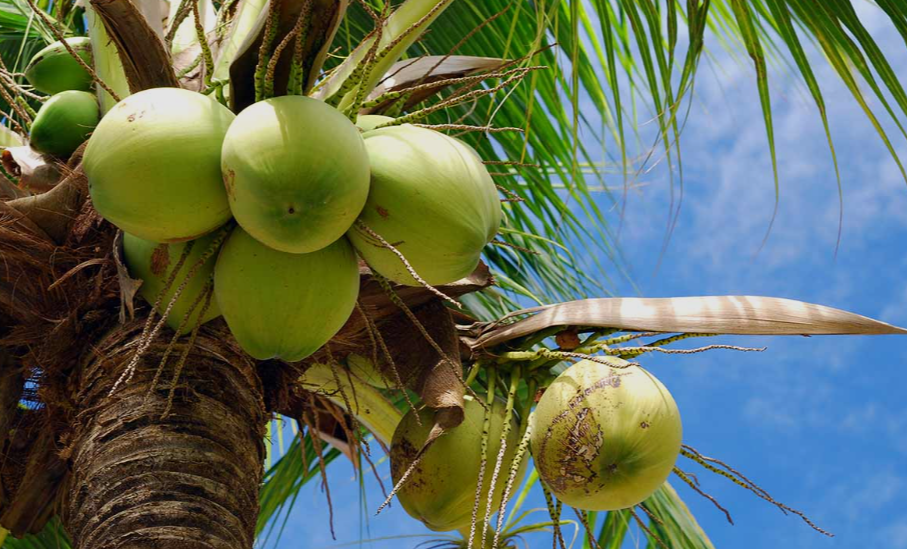
The coconut palm is the most widely grown fruiting palm in the world. Its slender trunk can reach 60 to 100 feet and often leans toward the sea. It carries a crown of long, feathery fronds. The fruit is large and oval, with a thick, fibrous husk. Inside is a hard shell lined with white flesh and filled with clear water. A healthy palm bears 50 to 100 coconuts a year.
Nearly every part of the fruit is used. The flesh is eaten fresh, dried or pressed for oil and milk. The water of young nuts is a popular drink. The husk fiber is made into rope and matting. The palm tolerates salt and sandy soil, which suits it to coastlines. It is grown throughout the tropics, with the largest crops in Indonesia, the Philippines, India, Sri Lanka and Brazil, and it also grows in southern Florida and Hawaii.
2. Date Palm
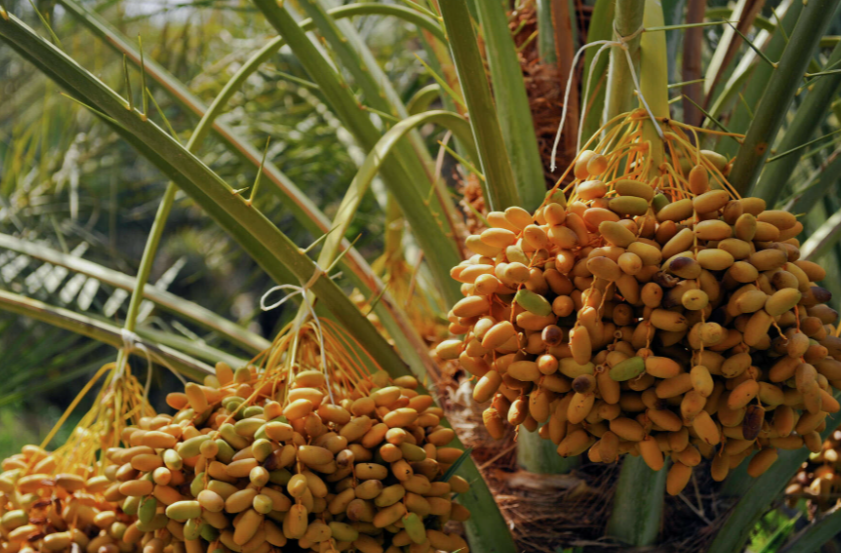
The date palm has been cultivated for thousands of years. It grows 50 feet or taller, with a rough trunk and stiff, gray-green fronds. The fruits hang in huge clusters beneath the leaves. Each date is 1 to 3 inches long, with sweet flesh around a single narrow seed. A mature palm can bear well over 100 pounds a year. Only female palms produce fruit.
The University of Florida notes that the true date palm has tasty fruit and can exceed 50 feet in height. The palm needs long, hot, dry summers to ripen its crop. Growers pollinate the flowers by hand. Dates are eaten fresh or dried and keep for months. The palm tolerates salty soil and desert heat. It is grown in Egypt, Saudi Arabia, Iran, Iraq, Algeria and other parts of North Africa and the Middle East, and in the deserts of California and Arizona.
3. Açaí Palm
The açaí palm is a slender palm of the Amazon floodplain. It grows in clumps of several stems. Each stem reaches 50 to 80 feet. The fruits are small, round and dark purple, like large blueberries. They hang in branched clusters of several hundred. Each fruit is mostly seed, with only a thin layer of pulp.
The pulp is mashed with water into a thick, purple drink. It is a daily staple for people along the lower Amazon. It has an earthy flavor and is rich in fat. Frozen pulp is now exported around the world. The palm is also harvested for its edible heart. It grows wild and in plantations in northern Brazil, especially the state of Pará, and in neighboring parts of the Amazon basin.
4. Peach Palm
The peach palm is a tall, spiny palm grown for food since ancient times. Its trunks reach 60 feet and are ringed with black spines. It usually grows in clumps. The fruits are egg-shaped and about 2 inches long. They ripen to red, orange or yellow. A single bunch can weigh 20 pounds or more.
The fruit is not eaten raw. It is boiled in salted water for an hour or more. The cooked flesh is dense and starchy, with a taste like chestnut or squash. It can also be dried and ground into flour. The same palm is farmed for hearts of palm. It is grown in Costa Rica, Panama, Colombia, Ecuador, Peru and Brazil.
5. Salak Palm
The salak palm is a short, very spiny palm. It has almost no trunk. Its fronds rise directly from the ground and reach 15 to 20 feet. The fruits grow in tight clusters at the base. Each is the size of a fig and covered in brown, shiny scales. The scaly skin gives it the name snake fruit.
The skin peels away to reveal three pale lobes of flesh. The texture is crisp, like an apple. The flavor is sweet and tangy. Each lobe holds a hard, brown seed. The fruit is eaten fresh, pickled or candied. The palm is native to Indonesia and is grown in Java, Sumatra, Bali, Malaysia and Thailand.
6. Betel Nut Palm
The betel nut palm is a slim, elegant palm. Its trunk is straight, green and ringed. It grows 40 to 60 feet tall but only a few inches thick. The fruits are egg-shaped and about 2 inches long. They ripen to orange or red. Each holds a single hard seed.
The seed, not the flesh, is the part used. It is sliced and chewed with lime paste and a pepper leaf. The mixture is a mild stimulant and stains the mouth red. Hundreds of millions of people use it. Health agencies link the habit to mouth cancer. The palm is grown in India, Bangladesh, Sri Lanka, Myanmar, Indonesia, Taiwan and Papua New Guinea.
7. African Oil Palm
The African oil palm is the world’s leading source of vegetable oil. It grows 40 to 60 feet tall with a stout trunk. Its crown holds 40 to 50 large fronds. The fruits are packed into heavy, spiky bunches. A single bunch can hold 500 to 4,000 fruits. Each fruit is plum-sized and ripens from black to orange-red.
Purdue University explains that the fruit yields two oils. The orange-red flesh gives palm oil, and the seed gives colorless palm kernel oil. About 90% of palm oil is used for food. The university calls it the highest-yielding oil crop. Its expansion has also caused large-scale clearing of rainforest. The palm is native to West Africa and is grown mainly in Indonesia and Malaysia, as well as Nigeria, Thailand, Colombia and Brazil.
8. Palmyra Palm
The palmyra palm is a massive fan palm of South Asia. Its trunk can reach 80 to 100 feet. Its leaves are stiff, round fans several feet across. The fruits are large, round and black-purple. Each is the size of a small coconut. They grow in clusters beneath the crown.
Young fruits hold three soft, translucent seed pockets. These are eaten fresh as a cooling jelly. The ripe fruit has sweet, fibrous orange pulp used in cakes and sweets. The sap is tapped for palm sugar and toddy. The leaves were once used as writing material. The palm is grown in India, Sri Lanka, Bangladesh, Myanmar, Thailand, Cambodia and Indonesia.
9. Moriche Palm
The moriche palm is a tall fan palm of South American swamps. It grows 80 to 100 feet tall. Its crown holds large, rounded leaves. It forms dense stands in flooded ground. The fruits are oval and covered in shiny, red-brown scales. Each is about 2 inches long.
Beneath the scales is a thin layer of bright orange flesh. It is very rich in vitamin A. In Peru the fruit is called aguaje and is sold in every market. It is eaten fresh or made into drinks and ice cream. The oil is used in cosmetics. The palm grows across the Amazon and Orinoco basins, in Peru, Brazil, Venezuela, Colombia, Ecuador and Bolivia.
10. Doum Palm
The doum palm is unusual because its trunk forks into branches. Each branch ends in a tuft of fan-shaped leaves. It grows 30 to 50 feet tall. The fruits are oval, glossy and orange-brown. They are about 3 inches long. They hang in clusters and take many months to ripen.
The dry, fibrous rind tastes like gingerbread. That flavor gives it the name gingerbread palm. The rind is chewed, ground into flour or steeped to make a sweet drink. The fruit has been found in ancient Egyptian tombs. The hard seed was once carved into buttons. The palm grows along the Nile in Egypt and Sudan and across the Sahel, East Africa and the Arabian Peninsula.
11. Sugar Palm
The sugar palm is a large, shaggy palm of Southeast Asia. Its trunk is covered in black fiber. It grows 40 to 60 feet tall. Its fronds are long, dark green above and silvery beneath. The fruits hang in long, heavy chains. Each is round and about 2 inches across.
The raw fruit flesh contains crystals that burn the skin and mouth. Only the immature seeds are eaten. They are boiled and soaked to make a soft, translucent sweet. The palm’s main product is its sap. The sap is boiled down into dark palm sugar. The palm is grown in Indonesia, the Philippines, Malaysia, Thailand, Vietnam and northeastern India.
12. Pindo Palm
The pindo palm is a cold-hardy palm with edible fruit. Its trunk is stocky and covered with old leaf bases. Its fronds are blue-gray and curve strongly back toward the trunk. It grows slowly to about 20 feet. The fruits are orange-yellow and the size of large dates. They hang in large, showy clusters.
The University of Florida describes the fruits as juicy, edible and often used for jams and jellies. That use gives it the name jelly palm. The flavor is sweet and tart, like a mix of pineapple and apricot. The fruit ripens in summer and can be messy on paving. The palm survives hard frost. It is native to southern Brazil and Uruguay and is grown across the southeastern United States, California and the Mediterranean.
13. Chilean Wine Palm
The Chilean wine palm has the thickest trunk of any palm. The trunk is smooth, gray and up to 4 or 5 feet across. It can reach 80 feet in height. It grows extremely slowly. The fruits are round, yellow-orange and about an inch and a half across. They hang in large clusters.
Inside each fruit is a small, hard nut. The kernel looks and tastes like a miniature coconut. The nuts are sold in Chile as a snack. The palm’s sap was once boiled into a sweet syrup. Collecting the sap killed the tree, and the species became rare. The palm is native to central Chile and is grown in California, the Mediterranean and other mild climates.
14. Saw Palmetto
The saw palmetto is a low, shrubby fan palm. Its stems usually creep along the ground. Its leaf stalks are edged with sharp teeth. It forms thickets 3 to 6 feet high. The fruits are oval and about an inch long. They ripen from green to blue-black.
The ripe berries have a strong, soapy taste. Native peoples of the Southeast ate them as a staple. Today the berries are harvested for herbal supplements. Bears, deer and raccoons depend on them. Harvesting is regulated in Florida. The palm grows across Florida and along the coastal plain from South Carolina to Louisiana.
15. Nipa Palm
The nipa palm is a trunkless palm of tidal mud. Its stem lies buried and grows horizontally. Its fronds rise straight up to 20 or 30 feet. It forms dense stands along river mouths. The fruits are packed into a brown, woody ball about a foot across. Each segment holds one seed.
The young seeds are soft, sweet and translucent. They are eaten fresh or preserved in syrup. They are a common ingredient in iced desserts. The flower stalk is tapped for a sugary sap. The sap is made into sugar, vinegar and wine. The palm grows along coasts from India and Sri Lanka through Southeast Asia to the Philippines, northern Australia and the Pacific islands.
16. Wild Date Palm
The wild date palm is a close relative of the true date palm. It grows 40 to 50 feet tall. Its fronds are blue-gray and form a dense, rounded crown. The fruits hang in large orange clusters. Each fruit is about an inch long. It ripens to purple-red.
The University of Florida notes that this palm produces edible fruits and that jelly is made from them. The flesh is thin and less sweet than a true date. The palm is better known for its sap. The sap is tapped and boiled into sugar, which explains its other name, the sugar date palm. It is also planted widely as an ornamental. The palm is native to India, Pakistan, Nepal and Bangladesh and is grown in Florida, Texas and California.
17. Macaw Palm
The macaw palm is a spiny palm of the American tropics. Its trunk grows 30 to 50 feet tall and is covered with long, black spines. Its fronds are feathery and gray-green. The fruits are round and about an inch and a half across. They ripen to yellow-brown. They hang in large clusters of several hundred.
Each fruit has a brittle shell, a layer of sticky yellow pulp and a hard nut. The pulp is sweet and is chewed fresh or made into drinks. Both the pulp and the kernel are rich in oil. Brazil is developing the palm as a source of biofuel. It tolerates drier land than the African oil palm. The palm grows from Mexico and the Caribbean south to Brazil, Paraguay and northern Argentina.
18. Babassu Palm
The babassu palm is a large feather palm of Brazil. It grows 50 to 65 feet tall. Its fronds stand almost upright and arch at the tips. The fruits are oblong and about 4 inches long. They look like small, brown coconuts. A single palm can bear several hundred a year.
The shell is extremely hard and is cracked by hand with an axe and mallet. Inside are several oily kernels. The kernels yield an oil much like coconut oil. The starchy layer beneath the husk is ground into flour. The shells are burned for charcoal. The palm grows in northern and northeastern Brazil, especially the states of Maranhão, Piauí and Tocantins.
19. Queen Palm
The queen palm is a graceful ornamental palm. Its trunk is smooth, gray and ringed. It grows 40 to 50 feet tall. Its fronds are long, glossy and drooping. The fruits are oval and about an inch long. They ripen to bright orange and hang in heavy clusters.
The flesh is sweet but thin and very fibrous. It is chewed for its juice, and the fiber is spat out. The flavor is like a mix of plum and banana. Fallen fruit attracts insects and makes paths slippery. The palm spreads easily from seed and is considered invasive in parts of Florida. It is native to southern Brazil, Paraguay and northern Argentina and is grown in Florida, California, Australia and the Mediterranean.
20. Canary Island Date Palm
The Canary Island date palm is one of the most widely planted ornamental palms. Its trunk is very thick and patterned with diamond-shaped leaf scars. It grows 40 to 60 feet tall. Its crown holds more than 100 arching fronds. The fruits are oval and about an inch long. They ripen to orange and hang in large sprays.
The fruits are edible but poor compared with true dates. The flesh is thin and only mildly sweet. In the Canary Islands the sap is tapped and boiled into a dark syrup. The syrup is known as palm honey. Only female palms bear fruit. The palm is native to the Canary Islands and is grown in the Mediterranean, California, Florida, Australia and South Africa.
21. Cabbage Palm
The cabbage palm is the state tree of Florida and South Carolina. Its trunk is straight and grows 40 to 60 feet tall. Its leaves are large fans with a curved midrib. The fruits are round and about a third of an inch across. They ripen to shiny black. They hang in long, branched clusters in fall.
Each fruit has a thin layer of sweet flesh around a single hard seed. The taste is often compared to a prune or a date. Native peoples of the Southeast ate the fruit and ground the seeds into meal. Birds, raccoons and bears feed heavily on it. The palm’s name comes from its edible heart, though harvesting the heart kills the tree. The palm grows from North Carolina through Florida and along the Gulf Coast, and in Cuba and the Bahamas.
Key Takeaways:
- Palm trees produce different types of fruits: Depending on the species, palm fruits may include coconuts, dates, açaí berries, betel nuts, and oil palm fruits.
- Not all palm fruits are edible: While many species produce fruits used for food, others have fruits that are inedible or unsuitable for human consumption.
- Palm fruits vary in size, shape, and color: Fruits may be small and berry-like, oval, round, or large and fibrous, with colors ranging from green and yellow to red, purple, and brown.
- Palm trees grow in diverse climates: Many fruit-producing palms thrive in tropical and subtropical regions, while date palms tolerate hot, dry conditions.
- Palm fruits have significant economic value: Coconuts, dates, and oil palm fruits support food production, cooking oil manufacturing, and other industries worldwide.
- Fruit characteristics help with identification: Examining fruit size, color, texture, arrangement, and the appearance of the palm’s leaves can help distinguish one fruit-producing palm species from another.
Sources:
- University of Florida: Date Palms and Alternatives
- Purdue University: Tropical Oil Palms
- University of Florida: Fact sheet, Pindo Palm
- University of Florida: Phoenix sylvestris, Wild Date Palm
- University of Florida: Phoenix dactylifera, Date Palm
- University of Florida: Palms for Central Florida
- Purdue University NewCROP: Pejibaye
- Purdue University: oil palm reading
- ECHO Community: Peach Palm