Sitka Spruce: The Giant of the Pacific Coast
Sitka spruce is the largest spruce in the world, a towering rain forest conifer that grows in a narrow band along the Pacific coast from northern California to southern Alaska, where it is the official state tree. Trees have been measured at more than 300 feet tall, and the forests it dominates hold more living wood per acre than almost any other forest on Earth.
The tree’s influence reaches far beyond its native forests. Its light, strong, resonant wood went into the Wright brothers’ first airplane and the British Mosquito bomber, it sits under the tops of countless guitars and pianos, and its seed was carried to Britain in the 1830s, where it now supplies about half of the country’s timber.
This guide covers how Sitka spruce is classified, the people and events that shaped its history, how to identify it, where it grows, how big it gets, what its wood is used for, and what it takes to grow one.
Botanical Classification
Sitka spruce belongs to the pine family, in the spruce group, and it is the largest of all the world’s spruces. It is also known as tideland spruce, coast spruce, and yellow spruce, names that hint at its habit of growing close to tidewater. The USDA Forest Service’s Silvics of North America is the standard reference on its biology and forest ecology.
Menzies first collected it in 1791, but it was not formally named until 1832, when a German botanist described it from specimens probably gathered at Sitka, Alaska in 1827. It was moved into the spruce group in 1855, and the common name honors Sitka. Where its range overlaps with white spruce in Alaska, the two species hybridize, and that hybrid, known as Lutz spruce, has become a valued tonewood.
Brief History
Coastal Indigenous peoples used Sitka spruce for food, medicine, and building materials long before European contact. The wood was used for arrows and spears, and coastal peoples used the tree in clothing, household goods, and boats. Some groups also saw the tree’s needles as protective. The Pacific University tree guide notes that the Ditidaht used its powers in ceremonies to protect dancers.
European interest began with the botanist Archibald Menzies, and in 1831 the Scottish plant collector David Douglas sent seed to Britain, launching one of the most successful tree introductions in history. In the 20th century, the tree became a strategic material. During World War I, the U.S. Army’s Spruce Railroad Division built rail lines to haul Sitka spruce out of the forests of Washington and Oregon so that mills could turn it into aircraft parts.
Identifying Characteristics
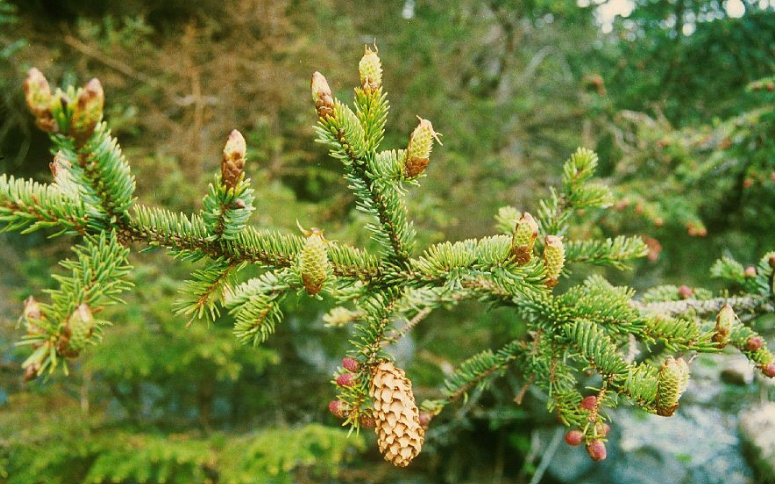
Sitka spruce is easy to recognize by touch. The needles are stiff, flattened, and very sharp, about 1 to 1.5 inches long, yellowish-green to bluish-green, with white lines of pores on the upper surface. Grabbing a branch tip is an unpleasant experience, which makes it a quick way to tell the tree apart from softer-needled conifers. Like all spruces, it can be told from a fir by its hanging cones and from a pine by its shorter, single needles.
Young bark is smooth and gray, and it becomes dark purplish-brown and scaly with age. The crown is open, with pendulous branches that can reach the ground, and the female cones are 2 to 3 inches long, reddish-brown, and found near the top of the tree. According to the North Carolina State Extension Gardener Plant Toolbox, the woody seed cones mature from late August through September, and seed can be harvested in October.
Also Read: Different Types of Spruce Trees
Native Range and Habitat
Sitka spruce grows in a narrow strip along the North Pacific coast, from about 61° N latitude in south-central Alaska to 39° N in northern California, and it is seldom found far from tidewater. In Alaska it grows from sea level to treeline, at elevations up to 3,000 feet in the southeast, while in Washington it rarely grows above middle elevations. It needs year-round moisture and cool, humid air, which is why it thrives in the coastal fog belt. Alaska designated it the official state tree in 1962, and moist ocean air and summer fog are the main reasons it grows so large.
Throughout most of its range it grows with western hemlock in dense stands where growth rates are among the highest in North America. Old-growth forests are characterized by nurse logs, fallen trunks covered with young spruce and hemlock seedlings. The Shoreline Community College Arboretum notes that these forests shelter Sitka deer through the winter and provide habitat for woodland caribou, mountain goats, Roosevelt elk, and Alaskan brown bears, while bald eagles roost in the trees and peregrine falcons nest in them.
The tree is remarkably tolerant of salt spray, and on the Oregon and Washington coasts it follows lodgepole pine onto stabilized sand dunes. On exposed headlands it can be reduced to low, gnarled scrub shaped by wind and salt.
Size and Age
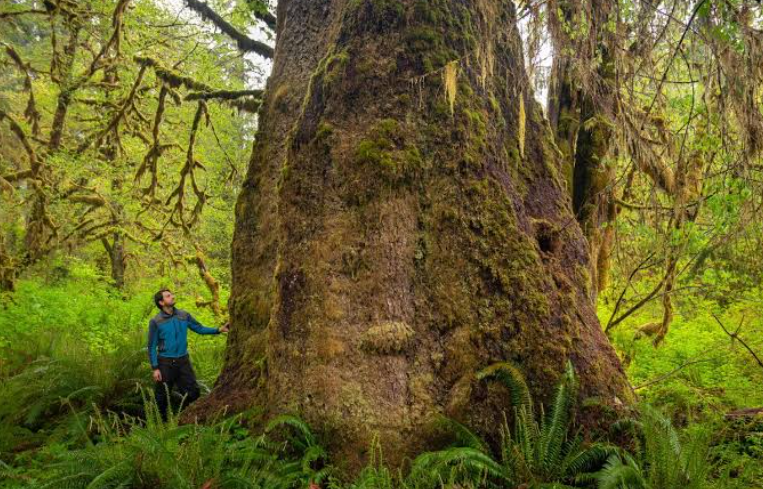
At its best, Sitka spruce is one of the largest trees on the planet. The tallest known specimen is reported to be about 329 feet tall in Redwood National Park in California, and the Carmanah Giant on Vancouver Island stands about 95 meters (312 feet) tall and is reported to be more than 800 years old. The largest by volume is the Queets Spruce in Olympic National Park, reported at 248 feet tall with a trunk 14.9 feet across.
Old-growth Sitka spruce and western hemlock forests carry an average of 1,163 metric tons of living wood per hectare, a figure exceeded only by forests of giant sequoia and coast redwood. The Oregon State University Extension’s Sustainable Tourism Blog notes that Sitka spruce can live more than 700 years, and that the tree thrives on poor soil and exposed sites where other trees fail.
Timber, Aircraft, and Music
Sitka spruce has one of the highest strength-to-weight ratios of any softwood, and that single property explains most of its history. The Wright brothers’ first airplane and the World War II British Mosquito bomber were built with it, and it remains a favorite for masts, spars, ladders, and other structural uses where light weight and strength matter.
The wood is also famous for its resonance, and it is attractive to look at, ranging from creamy white to nearly white with a light pink tinge and very little difference in color between sapwood and heartwood. Sitka spruce is arguably the most common tonewood used for guitar tops, and it is widely used for piano and harp soundboards. Its natural hybrid with white spruce, Lutz spruce, has recently been adopted by guitar makers, including Taylor, for a higher volume ceiling.
The Golden Spruce
The most famous Sitka spruce in history was not typical at all. Known to the Haida as Kiidk’yaas, or “Ancient Tree,” the Golden Spruce grew on the banks of the Yakoun River on Haida Gwaii in British Columbia. It was about 300 years old, and a rare genetic mutation gave it golden needles, which made it sacred in Haida oral history.
In January 1997 a forester named Grant Hadwin cut deeply into its trunk in a protest against logging, and the weakened tree fell a few days later. Cuttings had already been grafted onto ordinary Sitka spruce, producing golden saplings, and timber salvaged from the fallen tree was used for cultural projects and to make a guitar.
Sitka Spruce in Britain and Beyond
No place has embraced Sitka spruce like Britain. Forest Research reports that it accounts for about 21 percent of the UK’s entire forest cover and roughly 50 percent of all timber produced, and the Non-native Species Secretariat reports that it makes up about 50 percent of Britain’s conifer forest area, with 76 percent of that in Scotland. Foresters planted it in huge numbers from the 1950s because it grows quickly on poor, wet upland soils.
That success carries risks. Forest Research has warned that relying on so few species for timber leaves the industry exposed to pests and climate change, and a bark beetle accidentally introduced from continental Europe has become established on Sitka spruce in parts of Britain. The tree has even reached the sub-Antarctic, where a lone specimen about 9 meters tall grows on an uninhabited island.
Landscape Uses
Sitka spruce is a poor choice for a small yard, since it grows huge and needs space and cool, moist air to thrive. It is best suited to large properties in coastal or maritime climates, where its open crown and drooping branches make a dramatic specimen and its tolerance of salt spray and wind makes it useful for shelter planting.
The Oregon State University Landscape Plants database lists it as hardy to USDA zone 7 and describes it as preferring a moist to wet, sandy soil and cool, moist air. It is not a tree for hot, dry climates, and it is vulnerable to windthrow in severe storms.
Growing Considerations
Plant Sitka spruce in full sun, in moist, well-drained soil, where it gets year-round moisture. Trees grow fastest on deep, moist soils, and young trees are available from nurseries within the tree’s range. Seed can be collected in October from cones that mature in late summer. Because it grows so fast, it is often used for reforestation, but that same vigor means a garden tree needs plenty of room to reach its full height.
Pests matter more than most gardeners expect. The green spruce aphid caused high mortality in Washington, Oregon, and California in 2020, and the tree is also vulnerable to white pine weevil, spruce beetle, spider mites, and adelgids. Adelgids cause galls that kill young twig tips, particularly in the Willamette Valley, so it is worth watching new growth each spring.
Key Takeaways
Picea sitchensis, commonly known as the Sitka Spruce, is part of the Picea genus in the Pinaceae family, which includes other conifers like pines, firs, and larches. This species is noted for its tall stature, rapid growth rate, and the quality of its wood. The name “sitchensis” refers to Sitka, Alaska, where this tree was first described to science. It is by far the largest species of spruce and the fifth-largest conifer in the world, and the third-tallest conifer species.
The Sitka Spruce has a native range along the Pacific Coast of North America, stretching from northern California through Oregon, Washington, British Columbia, and into Alaska. It’s particularly dominant in the coastal temperate rainforests where it benefits from the moist, foggy conditions, growing from sea level up to about 3,000 feet in elevation. This range makes it the most widely distributed spruce in western North America.
Historically, Sitka Spruce has been significant for both indigenous peoples and later settlers. Native American tribes used its wood for constructing canoes, homes, and tools due to its strength and lightweight nature. With European settlement, its use expanded significantly, especially for shipbuilding, aircraft construction during World War II (due to its excellent strength-to-weight ratio), and later for musical instruments like guitars and violins because of its resonant qualities. The tree’s ecological importance in the coastal ecosystems, providing habitat for numerous species, has also been recognized, leading to its protection in various natural reserves and parks.
Sitka Spruce is adapted to USDA Hardiness Zones 6 through 8, reflecting its preference for the mild, wet winters and cool summers of its native coastal range. Its lifespan can be quite impressive, often living between 500 to 700 years, with some specimens potentially reaching up to 1,000 years in optimal conditions. This longevity is supported by its ability to grow in harsh, wind-swept environments and its resistance to many diseases that affect other spruces.