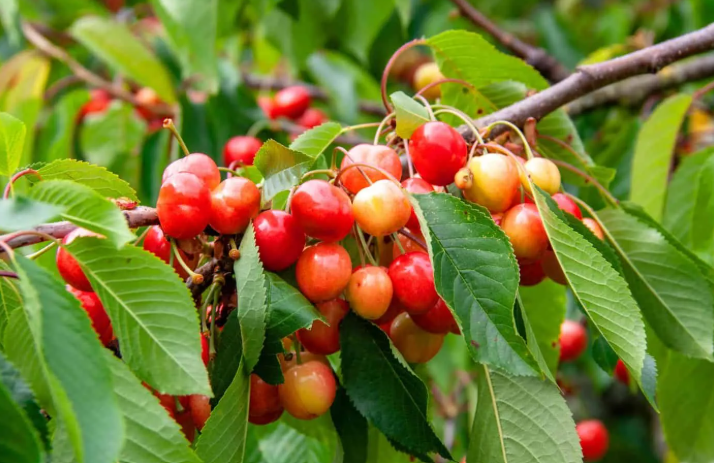
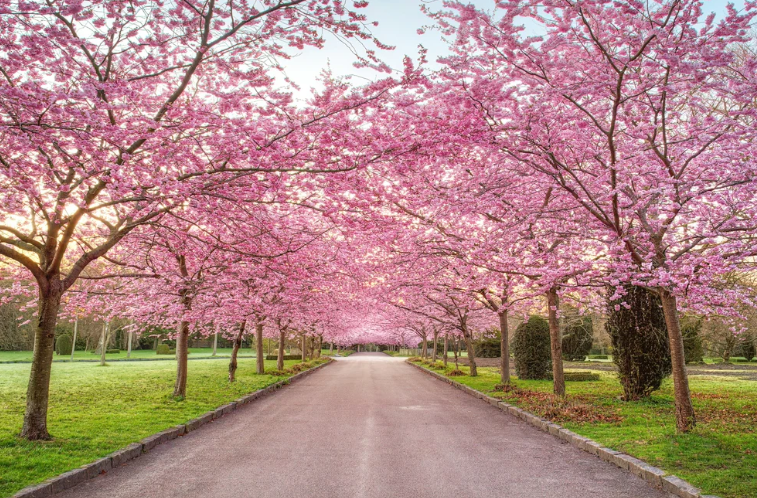
Cherry trees encompass one of the most diverse and beloved groups of flowering and fruiting trees in the plant kingdom — spanning wild forest species, ancient orchard varieties, and the breathtaking ornamental flowering cherries of East Asian horticultural tradition. Belonging to the genus Prunus, they include both flowering varieties grown for aesthetics and fruiting types cultivated for cherries. These trees are widely associated with springtime, when they burst into bloom and create stunning displays of pink and white flowers.
Cherry blossoms, often called “sakura” in Japan, are especially famous for their brief but breathtaking flowering period. The blossoms typically last only a week or two, symbolizing the fleeting nature of beauty and life. During this time, landscapes are transformed into soft clouds of color, attracting visitors, photographers, and nature lovers from all over the world.
Fruiting cherry trees produce sweet or sour cherries, depending on the variety. Sweet cherries are commonly eaten fresh, while sour cherries are often used in cooking, baking, and preserves. These trees require a balance of sunlight, well-drained soil, and a period of winter chill to produce a good harvest, making them best suited to temperate climates.
Cherry trees vary greatly in size and form, from small ornamental trees to larger orchard varieties. Some are bred specifically for compact growth, making them suitable for gardens and urban spaces. Their leaves are typically oval-shaped with serrated edges, and they often turn vibrant shades of yellow, orange, or red in autumn.
In addition to their beauty and fruit, cherry trees play an important ecological role. Their blossoms provide early-season nectar for pollinators such as bees, while the fruit supports birds and other wildlife. This makes them valuable additions to ecosystems, especially in areas where early spring food sources are limited.
Varieties & Cultivars of Cherry Trees
Sweet Cherry (Prunus avium)
The wild ancestor of virtually all cultivated sweet cherry varieties, the Sweet Cherry or Gean is a tall, vigorous forest tree native to Europe and western Asia whose small, dark red to black fruit — sweet and richly flavored — has been eaten by humans since prehistoric times.
In spring it produces masses of pure white blossom that transforms woodland edges and hedgerows into breathtaking displays, and its autumn foliage turns vivid orange, red, and crimson before falling. It is the rootstock upon which most cultivated sweet cherry varieties are grafted.
Sour Cherry (Prunus cerasus)
The Sour Cherry is the species from which all cultivated cooking cherry varieties — Morello, Montmorency, and their relatives — descend, producing smaller, brighter red fruit with a sharp, intensely flavored flesh that is too acid for most palates when raw but transforms into extraordinary jams, pies, liqueurs, and preserves when cooked with sugar.
It is more compact and more cold-hardy than the Sweet Cherry, tolerating shadier positions and harsher winters, and it is self-fertile — producing a reliable crop without a pollination partner nearby.
Japanese Flowering Cherry (Prunus serrulata)
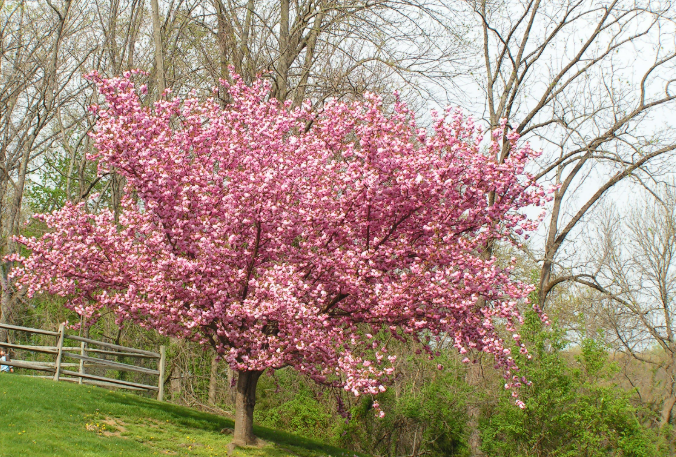
The Japanese Flowering Cherry — Sakura — is the most celebrated ornamental tree in the world, its annual spring blossom display the subject of a thousand-year tradition of hanami flower-viewing in Japan and now a cultural event observed across the globe.
Hundreds of cultivated varieties have been developed from this species over centuries of Japanese horticultural art, producing flowers ranging from pure white through every shade of pink to deep rose in single, semi-double, and fully double forms. Its blossom symbolizes the transient beauty of life in Japanese philosophy.
Yoshino Cherry (Prunus × yedoensis)
The Yoshino Cherry is the most widely planted ornamental cherry in the world — the dominant species of the famous National Mall cherry display in Washington D.C. and the most commonly seen cherry in Japanese urban parks and roadsides.
Its pale blush-pink to almost white flowers open in very early spring before the leaves emerge, covering the entire tree in a soft cloud of bloom that fades to pure white as the flowers age. Its flowers carry a faint, sweet almond fragrance that fills the air around mature trees in full bloom.
Bird Cherry (Prunus padus)
The Bird Cherry is a native European and Asian species of cool, moist woodland and riverside habitats — distinguished from other cherries by its flowers, which are borne in long, pendulous racemes of small white blooms with a powerful almond scent rather than in the clusters of larger flowers typical of most cherries.
Its small, intensely bitter black fruit is readily eaten by birds — giving it its common name — but astringent to the human palate. In northern Britain and Scandinavia it is a characteristic and beautiful tree of upland stream sides and ancient woodland.
Tibetan Cherry (Prunus serrula)
The Tibetan Cherry is grown primarily for the extraordinary beauty of its bark rather than its flowers or fruit — its trunk and branches covered in gleaming, mahogany-red bark that peels in horizontal strips to reveal fresh, brighter red beneath, creating a polished, lacquered effect of remarkable visual richness.
In winter sunlight a mature Tibetan Cherry trunk is one of the most beautiful sights in any garden, and the tree is widely planted as a specimen for year-round bark interest. Its small white flowers and narrow leaves are relatively inconspicuous compared to its spectacular bark.
Higan Cherry (Prunus × subhirtella)
The Higan Cherry — named for the Japanese Buddhist festival of Higan at which it traditionally blooms — is one of the most valuable cherry species for the garden because several of its forms flower in autumn as well as spring, providing blossom at the most unexpected time of year.
The variety ‘Autumnalis’ produces clouds of small, pale pink semi-double flowers on bare branches from November through February in mild spells, making it the only cherry that reliably blooms in the depths of the temperate winter. It is a graceful, moderate-sized tree of great year-round garden value.
Weeping Cherry (Prunus pendula)
The Weeping Cherry produces one of the most dramatically graceful forms of any ornamental tree — its long, arching branches cascading to the ground in a waterfall of pale pink blossom in early spring, creating a tent-like structure of extraordinary beauty.
Several cultivated weeping forms have been developed, ranging from the compact ‘Pendula Rubra’ with deep pink flowers to the pale blush ‘Pendula Rosea,’ and all are grafted onto upright rootstocks to create the characteristic mushroom-shaped weeping crown. A mature weeping cherry in full bloom is one of the most romantic sights in the spring garden.
Morello Cherry (Prunus cerasus ‘Morello’)
The Morello is the definitive cooking cherry — its intensely sour, dark red to almost black fruit the essential ingredient in Black Forest gateau, cherry brandy, griotte confections, and the finest cherry preserves of European culinary tradition.
Uniquely among sweet and sour cherries, Morello is perfectly happy trained against a north-facing wall — tolerating shade far better than almost any other fruit tree — making it invaluable for gardeners with limited sunny positions. It is fully self-fertile, crops reliably, and produces generous yields of its magnificently flavored dark fruit every year.
Montmorency Cherry (Prunus cerasus ‘Montmorency’)
The Montmorency is the most important commercial sour cherry variety in North America — accounting for the vast majority of the tart cherry crop grown in Michigan, Wisconsin, and other Great Lakes states.
Its bright red, clear-juiced fruit has a clean, sharp flavor well suited to pies, juices, and the dried cherry trade, and its cold hardiness makes it reliable in climates too harsh for most sweet cherry varieties. Named for the Montmorency Valley near Paris where it was cultivated for centuries, it remains the benchmark sour cherry of the American market.
Rainier Cherry (Prunus avium ‘Rainier’)
Developed at Washington State University in 1952 by crossing Bing and Van cherries, Rainier is widely considered the finest flavored sweet cherry in the world — its large, golden-yellow fruit blushed with red carrying a honey-sweet, exceptionally rich flavor with very low acidity that sets it apart from all other commercial sweet cherries.
Its thin skin and tendency to crack in rain make it challenging to grow commercially, and its exquisite flavor commands premium prices at farmers markets and specialty grocers. It is named for Mount Rainier in Washington State.
Bing Cherry (Prunus avium ‘Bing’)
The Bing Cherry is the most widely grown sweet cherry in the United States — a large, firm, deep mahogany-red to black cherry of excellent flavor that has dominated North American sweet cherry production since its introduction in Oregon in 1875.
Named after a Chinese orchard foreman named Ah Bing who worked on the farm where it was developed, it produces large, consistently firm, richly flavored fruit with a classic sweet cherry character. Its large, productive trees, good disease resistance, and long shelf life relative to other sweet cherries established it as the commercial standard.
Stella Cherry (Prunus avium ‘Stella’)
Stella was a landmark introduction in sweet cherry growing when it was released by the Summerland Research Station in British Columbia in the 1960s — the first truly self-fertile sweet cherry variety to become commercially available, eliminating the need for a pollinator variety that had previously been essential for any sweet cherry crop.
Its large, dark red, heart-shaped fruit has good, sweet flavor and firm flesh, and its self-fertility combined with reliable heavy cropping made it the most widely planted sweet cherry in Britain and one of the most important worldwide for home garden use.
Lapins Cherry (Prunus avium ‘Lapins’)
Lapins is another self-fertile sweet cherry from the Summerland Research Station — a cross between Van and Stella that combines large fruit size, excellent flavor, and complete self-fertility in a highly productive and relatively compact tree.
Its dark red, firm fruit has a rich, sweet flavor, and its crack resistance — better than many competing varieties — makes it particularly valuable in wetter climates where rain during ripening causes losses in more susceptible varieties. It has become one of the most widely planted commercial and home garden sweet cherries in Europe and North America.
Sweetheart Cherry (Prunus avium ‘Sweetheart’)
Sweetheart is a late-season self-fertile sweet cherry that extends the cherry harvest into August — a full month beyond the peak of most sweet cherry varieties — producing large, bright red fruit of good flavor and firm texture.
Its late ripening is one of its most commercially valuable characteristics, allowing cherry growers to supply fresh fruit long after other varieties have finished. Its self-fertility and moderate tree vigor make it suitable for smaller gardens, and its consistent productivity has made it one of the most popular late-season sweet cherries in the UK market.
Kanzan Cherry (Prunus ‘Kanzan’)
Kanzan is the most widely planted double-flowered ornamental cherry in the world — its spectacular double flowers of deep, vivid pink produced in enormous, hanging clusters in mid-spring creating a display of almost overwhelming floral abundance.
Introduced to Europe from Japan in the nineteenth century, it became the dominant street and park cherry of the twentieth century and is found in virtually every town and city across the temperate world. Its flowers are so densely double — containing up to thirty petals each — that they resemble small pink pompoms hanging from every branch.
Prunus ‘Shirotae’ (Mount Fuji Cherry)
Shirotae — named for its resemblance to the snow-capped Mount Fuji — produces the largest individual flowers of any ornamental cherry, its pure white, semi-double or double blooms reaching five centimeters across and hanging in long, pendulous clusters from gracefully spreading, almost horizontal branches.
The combination of pure white flowers, elegant branch structure, and delicate fragrance — a light, sweet almond scent — makes it one of the most refined of all ornamental cherries. Its wide-spreading, tiered branch structure creates an architectural quality that distinguishes it from more upright cherry forms.
Prunus ‘Ukon’
Ukon is one of the most unusual ornamental cherries — its semi-double flowers opening in a distinctively pale, creamy yellow-green color that is unique among all cherry blossoms and creates an effect quite unlike any other flowering tree in the spring garden.
The yellow-green flowers age to white and then develop pink tints as they fall, and the bronze-green young foliage emerging with the flowers adds a further layer of color complexity. It is a vigorous, spreading tree that produces one of the most subtly sophisticated spring flowering displays in the ornamental cherry canon.
Black Cherry (Prunus serotina)
The Black Cherry is the largest native cherry tree in North America — a tall forest tree of the eastern United States and Canada reaching twenty-five meters or more in mature woodland, its trunk developing dark, rough, blocky bark that has been compared to burned cornflakes.
Its white flowers in pendulous racemes in late spring give way to clusters of small, dark red to black fruit that are intensely bitter when raw but produce excellent jelly, wine, and the distinctive flavoring used in cherry-flavored soft drinks and liqueurs. Its fine-grained, reddish-brown timber is one of the most valued cabinet woods in North America.
20. Chokecherry (Prunus virginiana)
The Chokecherry is a shrubby native North American species of forest edges, stream banks, and disturbed ground whose small, astringent red to dark purple fruit has been used by Indigenous peoples across the continent for thousands of years — dried in pemmican, made into jelly, and fermented into wine. Its name perfectly describes the raw eating experience — its high tannin content causes an intense mouth-puckering, throat-constricting astringency that makes eating more than a few raw fruits uncomfortable. When cooked with sugar the same astringent fruit produces a distinctive, rich-flavored preserve of excellent quality.
Pin Cherry (Prunus pensylvanica)
The Pin Cherry — also called Fire Cherry — is a pioneer species of the North American boreal and mixed forest that specializes in colonizing burned, logged, or otherwise disturbed ground with extraordinary speed, its seeds persisting in the soil for decades until disturbance and light trigger their germination.
Its small, bright red, intensely sour fruit is an important food source for birds and mammals in recovering forest and its early successional role — shading the soil and improving its organic content as it grows — helps prepare conditions for the establishment of longer-lived forest species that eventually overtake and replace it.
Mahaleb Cherry (Prunus mahaleb)
The Mahaleb or Perfumed Cherry is a small, shrubby wild cherry of dry, rocky limestone hillsides and scrubland across southern Europe and western Asia — notable for the extraordinary fragrance of its small white flowers in spring and for the hard, aromatic wood of its stem, which has been used to make pipe stems and small turned objects since ancient times.
Its small, bitter black fruit is of little culinary value, but the stone within the fruit yields a pleasantly fragrant kernel used as a spice in Middle Eastern and North African baking — particularly in the traditional Easter breads of Greece, Turkey, and Egypt.
Fuji Cherry (Prunus incisa)
The Fuji Cherry is a small, delicate Japanese species of mountain woodland that produces masses of tiny white or pale pink flowers on slender, spreading branches in very early spring — one of the first cherries to bloom, often flowering in February or early March in British conditions.
Its small size — rarely exceeding four meters — makes it one of the most suitable ornamental cherries for smaller gardens, and its brilliant autumn foliage coloring — turning vivid orange, red, and purple — gives it year-round garden interest beyond its spring flowering season. It is the parent of many compact ornamental cherry hybrids.
Sargent’s Cherry (Prunus sargentii)
Sargent’s Cherry is widely regarded as the finest large ornamental cherry for year-round garden value — its single, deep pink flowers in early spring, its rich green summer foliage, and its spectacular early autumn coloring — vivid orange and crimson appearing before almost any other tree in September — combining to give it three distinct seasons of outstanding ornamental merit.
Named after the great American botanist Charles Sprague Sargent who collected it in Japan, it is a large, vigorous tree that eventually reaches fifteen meters, making it better suited to parks and large gardens than restricted urban spaces.
Taiwan Cherry (Prunus campanulata)
The Taiwan Cherry — also called the Formosan Cherry or Bellflower Cherry — is the most vividly colored of all the flowering cherries, its deep cerise-crimson to magenta-red pendulous bell-shaped flowers providing an intensity of color that no other cherry species can match.
It blooms in late winter — January and February in mild climates — making it the earliest flowering of all ornamental cherries and providing a dramatic display at the most flower-starved time of year. Its tropical origins mean it requires a sheltered, mild climate to perform well, but in the right conditions it is breathtakingly beautiful.
Prunus ‘Accolade’
Accolade is one of the most celebrated and widely planted ornamental cherries of the twentieth century — a hybrid of Prunus sargentii and Prunus subhirtella that combines the best qualities of both parents in a medium-sized, graceful tree of exceptional beauty.
Its semi-double, deep pink buds open to pale blush-pink flowers in early spring, produced in pendulous clusters that hang like earrings from arching branches, and its early flowering, elegantly spreading branch structure, and brilliant autumn coloring have earned it more awards than almost any other ornamental tree. It is the benchmark against which other ornamental cherries are measured.
Prunus ‘Pink Perfection’
Pink Perfection is a large-flowered double ornamental cherry producing flowers of a rich, warm rose-pink that is deeper and more saturated in color than many of the paler double cherries. Its large, double flowers are produced in hanging clusters that weigh the spreading branches downward as they open, creating an effect of cascading pink.
It flowers slightly later than Kanzan, extending the ornamental cherry season in gardens and parks that contain both varieties, and its warm pink coloring harmonizes beautifully with the red-bronze young foliage that emerges with the flowers in spring.
Prunus ‘Kiku-shidare-zakura’ (Cheal’s Weeping Cherry)
Kiku-shidare-zakura — sometimes called Cheal’s Weeping Cherry in Western horticulture — is the most dramatic weeping ornamental cherry, its long, pendulous branches hanging to the ground and smothered in vivid, fully double deep pink flowers that transform the entire weeping crown into a fountain of rich color in mid-spring.
It is smaller and more compact than many weeping cherries, making it suitable for even modest garden spaces, and its distinctive, strongly weeping habit is one of the most immediately recognizable forms in the ornamental cherry repertoire. The fully double flowers are very long-lasting compared to single-flowered varieties.
Prunus ‘Tai-haku’ (Great White Cherry)
Tai-haku — the Great White Cherry — is the largest-flowered white cherry in existence, its single flowers reaching six centimeters or more across in a display of pure, luminous white against the emerging bronze-red young foliage.
It was lost to cultivation in Japan for centuries before a single surviving specimen was discovered in a Sussex garden in England in 1923 by the great cherry authority Collingwood Ingram, who propagated it and eventually returned it to Japan — one of the most extraordinary plant rediscovery stories in horticultural history. Ingram named it the Great White Cherry, a title it fully deserves.
Cornelian Cherry (Cornus mas)
Technically a dogwood rather than a true cherry, the Cornelian Cherry earns its place in this list through its cherry-like red fruit and its extraordinary winter flowering — small clusters of vivid yellow flowers appearing directly on bare branches in January and February, making it one of the first flowering trees of the year.
Its elongated, glossy red fruit ripens in late summer and, though too astringent to eat raw, makes exceptional jelly, fruit cheese, and the traditional Turkish sherbet drink. Its combination of winter flower interest, summer fruit, and autumn foliage color gives it exceptional year-round garden value.
European Bird Cherry (Prunus padus ‘Watereri’)
The cultivated form ‘Watereri’ of the European Bird Cherry produces exceptionally long racemes of white flowers — up to twenty centimeters — that hang from arching branches in late spring in a display far more dramatic than the wild species.
The powerful almond fragrance of these flower racemes fills the air around the tree when in bloom, and the sheer quantity of white flower racemes covering the spreading crown creates one of the most fragrant and visually impressive spring flowering displays of any medium-sized ornamental tree. Its autumn fruit provides important food for birds.
Prunus ‘Spire’ (syn. ‘Hillieri Spire’)
Prunus ‘Spire’ is a narrowly columnar ornamental cherry of outstanding value for restricted spaces — its upright, flame-shaped crown fitting comfortably into street planting schemes, small gardens, and confined urban situations where the broad, spreading crown of most ornamental cherries would be impractical.
Its pale pink single flowers in mid-spring are followed by good autumn leaf color in orange and red, and its narrow, columnar habit — maintained throughout its life without pruning — makes it one of the most architecturally useful of all ornamental flowering trees for modern garden and landscape design.
Duke Cherry (Prunus × gondouinii)
The Duke Cherries are a group of hybrid fruit cherries produced by crossing Sweet Cherry and Sour Cherry — intermediate in their characteristics between the two parent species, producing fruit that is less sweet than a Sweet Cherry but considerably less sour than a Morello.
Ancient Duke Cherry varieties including ‘May Duke’ and ‘Royal Duke’ have been grown in European gardens and orchards since the seventeenth century and represent some of the oldest cultivated cherry varieties still in existence. Their intermediate flavor makes them dual-purpose cherries — pleasant enough for fresh eating but acidic enough for excellent preserves and cooking.
Van Cherry (Prunus avium ‘Van’)
Van is a Canadian sweet cherry variety of great importance as a pollinator for other sweet cherry varieties — its abundant production of viable, compatible pollen and its reliable, heavy cropping habit making it one of the most useful companion varieties for growing alongside self-infertile cherries like Bing.
Its large, firm, dark red fruit has excellent sweet flavor and good crack resistance, and its cold hardiness — better than many sweet cherries of European origin — makes it particularly valuable for growers in the northern United States and Canada where winter temperatures challenge less hardy varieties.
Burlat Cherry (Prunus avium ‘Burlat’)
Burlat is the most important early-season sweet cherry in European commercial production — a French variety that ripens two to three weeks before the main season cherries, commanding premium prices at markets hungry for the first cherries of the year.
Its large, bright red fruit has good sweet flavor for such an early variety and its consistent, reliable early cropping has made it the dominant early cherry in French, Spanish, and Italian commercial orchards. Its relatively short shelf life compared to firmer mid-season varieties limits its long-distance transport suitability, making it primarily a local and regional market variety.
Sunburst Cherry (Prunus avium ‘Sunburst’)
Sunburst is a self-fertile sweet cherry of Canadian origin that produces very large, dark red to black fruit of excellent, rich sweet flavor with notably firm flesh that gives it good resistance to the skin cracking in wet weather that damages many other large-fruited varieties.
Its self-fertility, large fruit size, good flavor, and crack resistance combine to make it one of the most practical and rewarding sweet cherries for home garden growing in the UK and northern Europe. Its vigorous tree is productive from a young age and crops reliably in most years.
Cherokee Cherry (Prunus avium ‘Cherokee’)
Cherokee is a North American sweet cherry variety valued for its combination of very large, firm, dark red fruit with good flavor and exceptional post-harvest shelf life — its unusually firm flesh maintaining quality for longer after picking than most sweet cherry varieties of comparable fruit size.
This extended shelf life has made it valuable in the commercial cherry trade where transport distances between orchard and consumer can be considerable. Its large, vigorous tree is productive and consistent, and its late-season ripening extends the fresh cherry availability window in orchards that also grow earlier maturing varieties.
Prunus ‘Okame’
Okame is one of the most floriferous early-flowering ornamental cherries available — a compact, small tree smothered in vivid carmine-pink single flowers that open in late winter or very early spring, often in February in mild British conditions, providing intense color at one of the most flower-starved periods of the horticultural year.
Its flowers have the characteristic bell-like form typical of Prunus campanulata — one of its parent species — and their deep, vivid pink color is considerably more intense than most spring cherries, making it one of the most eye-catching early-season flowering trees in any temperate garden.
Wild Himalayan Cherry (Prunus cerasoides)
The Wild Himalayan Cherry is a magnificent tree of the Himalayan foothills from Afghanistan to Yunnan, China — producing masses of pink to deep rose flowers on bare branches in late autumn and winter, making it one of the few truly winter-flowering cherry species.
In its native range at altitudes between 1,500 and 3,000 meters it is an important nectar source for overwintering insects during a season when few other trees are in flower. Its vivid autumn and winter flowering, combined with attractive bark and reasonable hardiness in mild temperate climates, make it an outstanding garden tree for areas with mild winters.
Nanking Cherry (Prunus tomentosa)
The Nanking Cherry — also called the Downy Cherry or Manchu Cherry — is a cold-hardy shrubby cherry species from northern China and central Asia that produces small, bright red fruit of pleasant, sweet-tart flavor that is excellent for jams and fresh eating when fully ripe.
Its extreme cold hardiness — surviving temperatures to -40°C in its native range — makes it uniquely valuable for gardeners in the harshest continental climates of Canada and the northern United States where conventional sweet and sour cherry trees cannot survive. It flowers very early in spring, often before the last frosts, and its small size makes it suitable for garden hedges.
Sand Cherry (Prunus pumila)
The Sand Cherry is a low-growing, sprawling native North American species of sandy, open habitats — lake shores, sand dunes, river banks, and open woodland edges — from New England west through the Great Lakes region.
Its small white flowers in spring are followed by dark red to black fruit of moderate eating quality but good value for jelly-making, and its sprawling, prostrate growth habit makes it valuable as a ground-covering, erosion-controlling shrub for difficult dry, sandy sites where most other fruit-bearing plants refuse to establish. Several purple-leaved ornamental selections have been developed as landscape shrubs.
Western Sand Cherry (Prunus besseyi)
The Western Sand Cherry is the prairie equivalent of the Eastern Sand Cherry — a cold-hardy, drought-tolerant native shrub of the Great Plains that has been used extensively in breeding programs to incorporate extreme cold hardiness into larger-fruited cherry varieties.
Its small, dark purple-black fruit is of moderate eating quality raw but makes excellent preserves, and the species has been crossed with larger-fruited cherries to produce the hardy prairie cherry varieties now grown across the Canadian prairies and northern Great Plains where no other cherry species can reliably survive. It is a parent of several important prairie-hardy cherry varieties.
Prunus ‘Amanogawa’
Amanogawa — meaning Milky Way in Japanese — is the most strongly columnar of all ornamental cherries, its perfectly upright, fastigiate growth producing a narrow pillar of pale pink, lightly fragrant, semi-double flowers in mid-spring that makes it ideal for planting in restricted spaces, formal avenues, and situations where the typical wide-spreading crown of most ornamental cherries would be completely impractical.
Its narrow, upright habit is maintained throughout its long life, and its good autumn leaf color in orange and red gives it additional seasonal interest beyond its spring flowering display.
Prunus ‘Pandora’
Pandora is a graceful ornamental cherry of moderate size producing pale shell-pink single flowers that fade almost to white as they age — a subtle, refined color effect quite different from the vivid pinks of many ornamental cherries.
Its flowers are produced in early spring before those of most double varieties, giving it a place at the beginning of the ornamental cherry season, and its elegant, upright-spreading growth habit with good autumn orange-red leaf color makes it a year-round garden asset.
Prunus ‘Shirofugen’
Shirofugen is a late-flowering double ornamental cherry that extends the cherry blossom season into late April and May — its large, double white flowers that open from deep pink buds being among the last cherry blossoms of the season and therefore among the most precious.
The contrast between the deep pink buds and the pure white open flowers, both present simultaneously on the tree at the height of bloom, creates one of the most beautiful and subtle color displays in the entire ornamental cherry range.
Bitter Cherry (Prunus emarginata)
The Bitter Cherry is a native North American species of western mountain forests and canyons — a variable small tree or large shrub producing white flowers in small clusters in spring followed by small, intensely bitter red to dark red fruit.
Its bitterness makes the fruit inedible to humans without significant processing but it is readily consumed by bears, birds, and other wildlife, making it an important component of western North American mountain forest ecosystems as a wildlife food plant. Its attractive spring blossom, good autumn coloring, and tolerance of a wide range of soil conditions make it a valuable native garden and restoration planting species.
Japanese Bush Cherry (Prunus japonica)
The Japanese Bush Cherry is a small, spreading shrubby cherry of northern China, Korea, and Japan — grown both as an ornamental for its pale pink spring blossom and as a fruiting shrub whose small, red to dark red fruit makes pleasant preserves.
In East Asian traditional medicine its seeds have been used for thousands of years as a treatment for fluid retention and constipation, and it remains an important medicinal plant in Chinese herbal practice. Several ornamental double-flowered cultivars have been developed from this species for garden use, producing more showy spring blossom than the single-flowered wild form.
Cherry Plum (Prunus cerasifera)
The Cherry Plum or Myrobalan is a small, early-flowering tree of southeastern Europe and western Asia — one of the very first trees to flower each spring, its small white blossoms often appearing in February and providing crucial early nectar for emerging queen bumblebees.
Its small, round fruit in yellow, red, or dark purple is sweet, juicy, and pleasant for fresh eating or jam-making. The purple-leaved form ‘Nigra’ — with its dark wine-red leaves and pale pink spring blossom — is one of the most widely planted ornamental small trees in European and North American gardens and streets.
Prunus ‘Sunset Boulevard’
Sunset Boulevard is a modern ornamental cherry selection valued for its exceptional combination of spring blossom, good tree structure, and reliable autumn leaf color — its pale pink flowers in early spring followed by a summer of clean, healthy green foliage and a consistent autumn display of orange and red that makes it one of the most multi-seasonal of modern ornamental cherry introductions.
Its moderate, manageable size and upright-spreading crown make it suitable for street and urban planting as well as garden use, and its good disease resistance distinguishes it from some older varieties more prone to cherry leaf diseases.
Prunus ‘Snow Goose’
Snow Goose is a compact, upright ornamental cherry producing pure white single flowers with a slight but pleasant fragrance in early to mid-spring — one of the finest white-flowered cherries for smaller gardens where a modest-sized, white-flowered spring tree is needed.
Its clean white flowers against dark branches, followed by good autumn orange coloring, give it a classic, understated elegance that contrasts with the showier double pink varieties. It is one of the most reliable and consistent performers among the white ornamental cherries, producing good blossom displays in most years regardless of the vagaries of the spring weather.
Duke of Edinburgh Cherry (Prunus avium — heritage variety)
One of many heritage sweet cherry varieties developed in British and European orchards over centuries of cherry cultivation, heritage orchard varieties like this represent the living genetic heritage of cherry growing — varieties selected before the era of modern commercial cherry breeding for qualities of flavor, local adaptation, and seasonality that modern commercial varieties often sacrifice in favor of uniformity and shelf life.
The collection and preservation of heritage cherry varieties by organizations including the National Fruit Collection at Brogdale in Kent represents an important conservation effort to maintain the full genetic diversity of cultivated cherry.
Prunus ‘Kursar’
Kursar is an early-flowering ornamental cherry of great garden value — its deep pink to carmine-rose flowers opening in March before most other ornamental cherries, providing vivid color at the beginning of the spring flowering season.
Raised by the influential cherry breeder Collingwood Ingram — the same plantsman who rescued Tai-haku from extinction — Kursar inherits from its parent Prunus nipponica var. kurilensis an exceptional cold hardiness that makes it reliable in exposed positions and harsh climates where more tender ornamental cherries perform poorly. Its vivid early color and cold hardiness give it particular value in northern gardens.
Autumn Cherry (Prunus × subhirtella ‘Autumnalis Rosea’)
The pink form of the Autumn Cherry — ‘Autumnalis Rosea’ — produces semi-double flowers of soft, warm pink rather than the near-white of the standard ‘Autumnalis’ form, making it a slightly more visually striking winter-flowering tree for garden use.
Like its white counterpart it flowers on and off from November through March in mild spells, providing precious blossom color through the darkest months of the year. Its combination of winter flowering, moderate size, and graceful, spreading branch structure make it one of the most valuable and consistently rewarding ornamental trees for the winter garden.
Prunus ‘Pink Shell’
Pink Shell is an ornamental cherry of extraordinary delicacy and refinement — its very pale shell-pink, almost white single flowers hanging in loose clusters from gracefully arching branches in early spring, creating an effect of ethereal lightness and elegance that more heavily flowered double cherries cannot replicate.
Its wide-spreading, arching branch structure creates a tiered canopy of great architectural beauty even when not in flower, and its flowers — while individually smaller and simpler than those of double varieties — have a translucent, almost luminous quality in spring sunlight that makes them among the most beautiful of all cherry blossoms.
Prunus ‘Horinji’
Horinji is a Japanese ornamental cherry producing semi-double flowers of soft mauve-pink — a distinctive, slightly cooler pink tone that sets it apart from the warmer pinks of most ornamental cherries and gives it a subtle, refined quality appreciated particularly by those who find the vivid pinks of Kanzan and its relatives too assertive for their garden schemes.
Its moderate size, upright-spreading habit, and distinctive flower color make it a useful ornamental cherry for designers seeking variety within the ornamental cherry palette, and its reliable flowering and good constitution make it a practical garden tree as well as an aesthetically distinctive one.
Prunus ‘Hokusai’
Hokusai — named after the great Japanese artist — is a large, wide-spreading ornamental cherry that produces very large, semi-double flowers of pale pink that open from deeper pink buds, creating a display of exceptional abundance and beauty in mid-spring.
Its wide, horizontally spreading branch structure creates one of the most architecturally impressive crown forms of any ornamental cherry, and the combination of large flower size, abundant production, and elegant spreading habit makes it a spectacular specimen tree for parks and large gardens. Its good autumn coloring in orange and red gives it additional seasonal interest.
Plum-leaf Cherry (Prunus cerasoides var. majestica)
This magnificent variant of the Wild Himalayan Cherry produces exceptionally large, deep rose-pink flowers in late autumn and winter on bare branches, creating one of the most dramatic winter flowering displays of any hardy tree.
Found at higher elevations in the Himalayas and Yunnan, it is slightly hardier than the typical species and has attracted significant horticultural interest for its potential as a garden tree in mild temperate climates. Its winter flowering, when most trees are completely dormant, makes it an almost surreally beautiful specimen in the right garden setting, its vivid pink blossoms appearing at the most unexpected season.
Prunus ‘Ichiyo’
Ichiyo is a distinguished Japanese ornamental cherry producing large, double, shell-pink flowers with a distinctive, almost fringed petal edge that gives each bloom a softer, more delicate appearance than the more formal double flowers of varieties like Kanzan.
Its flowers are produced in hanging clusters from upright-spreading branches in mid-spring, and the overall effect of a tree in full bloom is one of graceful, slightly pendulous pink abundance with a refinement and elegance that reflects the centuries of Japanese horticultural art that produced it. Its good constitution and reliable flowering have established it as a valued medium-sized ornamental cherry.
Greens Cherry (Prunus avium ‘Waterloo’)
Waterloo is one of the oldest named sweet cherry varieties still in cultivation — a heritage British variety whose origin predates the Battle of Waterloo for which it was subsequently named and which has been grown in British orchards since the early nineteenth century.
Its medium-sized, dark red to black fruit has a rich, distinctive flavor appreciated by heritage fruit enthusiasts who value the complex, sometimes astringent depth of old cherry varieties over the simpler sweetness of modern commercial introductions. It represents the living heritage of British cherry orchard culture, maintained by the National Fruit Collection and specialist heritage orchardists.
Prunus ‘Royal Burgundy’
Royal Burgundy is a striking ornamental and dual-purpose cherry combining exceptional purple-bronze foliage — retained throughout the entire growing season rather than just in the spring flush of some purple-leaved forms — with attractive, deep rose-pink double flowers in spring and a small but reasonable crop of dark red sweet fruit in summer.
Its deep, rich foliage color — among the most sustained and intense of any purple-leaved ornamental cherry — provides a dramatic year-round garden presence that makes it valuable as a specimen tree for foliage effect as much as for its spring flowers. It is one of the few ornamental cherries that earns its garden space throughout every season of the year.