Birds often described as having “mohawks” usually have prominent crests—feathers on the top of the head that can be raised or lowered. In North America, these crests can serve for communication, signaling mood, attracting mates, or warning rivals. Their striking appearance makes them easy to recognize in the wild.
Many of these birds are found in forests, where dense trees provide both shelter and food. Woodland habitats across regions like North America offer insects, seeds, and nesting sites. These birds often move through the canopy or cling to tree trunks, using their crests as part of visual displays during interactions.
Some crested birds prefer wetlands and lakesides, where they hunt for fish, amphibians, or aquatic insects. Marshes, ponds, and slow-moving rivers provide rich feeding grounds, and these birds are often seen gliding over water or perched near the edges. Their crests may become more noticeable during courtship displays in open spaces.
Other species thrive in grasslands and open areas, where visibility is key. In these environments, a raised crest can help with communication over long distances. These birds often feed on seeds and insects, blending into the landscape while still using their head feathers to signal alertness or dominance.
Urban and suburban areas across United States and Canada also host birds with mohawk-like crests. Parks, gardens, and backyards provide food sources like feeders and ornamental plants. These adaptable birds have learned to live close to humans while still maintaining their natural behaviors.
Birds With Mohawks North America
Hoopoe (Upupa epops)
The hoopoe is one of the most instantly recognisable birds in the world, bearing a spectacular, fan-shaped crest of cinnamon-orange feathers tipped with black and white that it raises dramatically when alarmed or excited. Found across Europe, Asia, and Africa, it probes the ground with its long, curved bill in search of insects and larvae.
Royal Flycatcher (Onychorhynchus coronatus)
The royal flycatcher of Central and South American rainforests carries what is arguably the most extravagant crest of any small bird — an enormous, elaborate fan of vivid scarlet and blue feathers that is rarely displayed but, when raised during courtship or handling, creates a breathtaking spectacle quite disproportionate to the bird’s modest body size.
Sulphur-Crested Cockatoo (Cacatua galerita)
This large, boisterous white parrot from Australia and New Guinea sports a bold, upswept crest of vivid sulphur-yellow feathers that is raised expressively to communicate excitement, alarm, and aggression. It is one of the most charismatic and intelligent of all parrots and among the longest-lived birds in captivity.
Victoria Crowned Pigeon (Goura victoria)
The Victoria crowned pigeon from New Guinea is the largest living pigeon in the world and bears an extraordinary, lace-like crest of blue-grey feathers with white tips arranged in an elegant, fan-shaped crown that gives it a regal, almost prehistoric magnificence unlike any other bird on earth.
Great Blue Turaco (Corythaeola cristata)
The great blue turaco of African rainforests is a large, spectacular bird bearing a prominent, upright crest of deep blue-black feathers atop a vivid blue and green body, making it one of the most colourful and dramatic birds on the African continent. It moves through the forest canopy with surprising agility despite its considerable size.
Eurasian Jay (Garrulus glandarius)
The Eurasian jay is a handsome woodland corvid with a streaked, erectile crest of white and black feathers on the crown that is raised when the bird is alert or agitated. Its combination of pinkish-brown plumage, vivid blue wing patches, and expressive crest makes it one of the most attractively marked birds of European woodlands.
Pileated Woodpecker (Dryocopus pileatus)
North America’s largest woodpecker is a striking, crow-sized bird with a flaming red, triangular crest that stands out dramatically against its bold black and white plumage. Its powerful, resonant drumming echoes through mature forests, and the rectangular excavations it creates in dead trees provide nest cavities for a wide range of other wildlife.
Cockatiel (Nymphicus hollandicus)
The cockatiel is a small Australian parrot with a slender, pointed crest of yellow or white feathers that serves as an expressive mood indicator — held upright and fanned when excited or alarmed, flattened against the head when content or sleepy. It is one of the most widely kept pet birds in the world and is renowned for its gentle temperament and mimicry ability.
Andean Cock-of-the-Rock (Rupicola peruvianus)
The male Andean cock-of-the-rock from South America is one of the most visually stunning birds alive, bearing a large, rounded, disc-like crest of vivid orange-red feathers that almost entirely covers its bill when viewed from the front, giving it an almost cartoonish, otherworldly appearance. Males gather at traditional display arenas called leks to compete for females with elaborate dances and calls.
Grey Crowned Crane (Balearica regulorum)
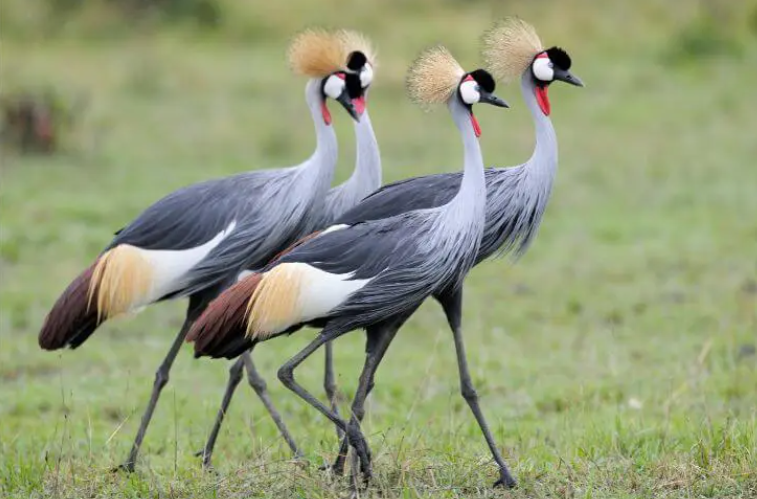
The grey crowned crane of sub-Saharan Africa is distinguished by its extraordinary crown of stiff, golden, bristle-like feathers that radiate outward from the top of the head like a sunburst, complemented by red and white facial patches and a red throat pouch. It is the national bird of Uganda and one of only two crane species capable of roosting in trees.
Palm Cockatoo (Probosciger aterrimus)
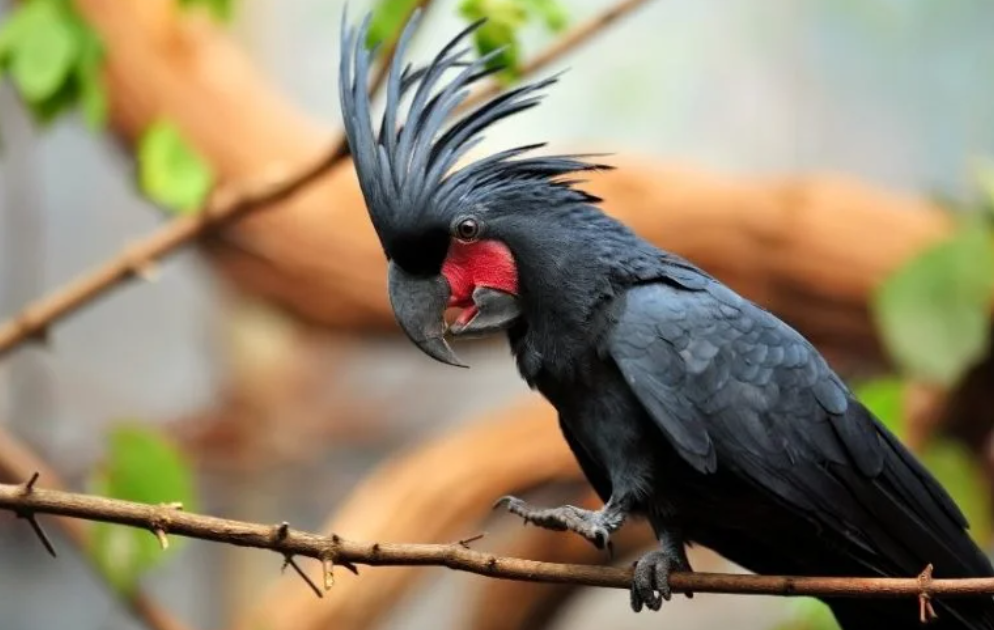
The palm cockatoo of New Guinea and northern Australia is a large, dramatically dark bird with a long, wispy, backward-swept crest of black feathers and vivid bare red facial skin that changes colour with the bird’s mood. Males are famous for using sticks and seed pods as drumming tools to beat rhythmically against hollow trees — one of the very few known examples of tool use in non-human musical behaviour.
Tufted Puffin (Fratercula cirrhata)
During the breeding season, the tufted puffin of the North Pacific develops remarkable golden-yellow plumes that sweep back from above each eye like a pair of extravagant sideburns or a wild mohawk, contrasting dramatically with its black plumage and massive, colourful bill. After the breeding season these ornamental plumes are shed, transforming the bird’s appearance completely.
White-Crested Helmet Shrike (Prionops plumatus)
This striking African bird bears a neat, forward-sweeping crest of white feathers above a bold black and white body, bright yellow eye wattles, and a red bill — a combination that makes it one of the most dapper and distinguished-looking birds on the continent. It lives in noisy, cooperative family groups that move together through the African bush in a continuous, animated procession.
Sunbittern (Eurypyga helias)
The sunbittern of Central and South American rainforests carries a subtly striped crest on its elegant, snake-like head and conceals within its wings one of the most dramatic threat displays in the bird world — when alarmed it fans its wings and tail to reveal large, vivid eyespots of orange, yellow, and black that create a sudden, startling illusion of a huge, staring face.
Smew (Mergellus albellus)
The male smew is a small, exquisitely marked diving duck of northern Eurasian lakes and rivers with a neat, rounded crest of pure white feathers on the back of the head and a distinctive black mask around the eye. In winter, when males are in full breeding plumage, they are among the most elegantly beautiful of all wildfowl, their crisp black and white patterning earning them the nickname “white nun.”
Indian Peafowl (Pavo cristatus)
The male peacock, or Indian peafowl, carries a neat, upright crest of distinctive wire-like feathers each tipped with a small, iridescent blue-green fan, giving the crown a delicate, jewelled appearance that perfectly complements its legendary, shimmering train of elongated tail-covert feathers. It is the national bird of India and one of the most recognisable and celebrated birds in human history.
Bearded Reedling (Panurus biarmicus)
The bearded reedling, also known as the bearded tit despite being unrelated to true tits, is a delightful small bird of European reedbeds whose male sports a distinctive, drooping black moustache rather than a true crest, though the subtle peak of warm buff feathers at the crown gives it a pleasingly tufted appearance. It moves through reed stems with acrobatic agility and produces a distinctive, metallic pinging call.
Nicobar Pigeon (Caloenas nicobarica)
The Nicobar pigeon of Southeast Asian and Pacific islands is a spectacular, iridescent bird with long, glossy, hackle-like feathers cascading down its neck and a small, knob-like crest at the base of its bill. Its plumage shimmers with metallic green, copper, and blue in sunlight, and it is considered the closest living relative of the extinct dodo, which it bears no visual resemblance to whatsoever.
Black-Crowned Night Heron (Nycticorax nycticorax)
The black-crowned night heron is a stocky, compact wading bird with a distinctive black crown from which two or three long, narrow white plumes trail backward like elegant hair ribbons during the breeding season. It is a largely nocturnal hunter that roosts communally in dense vegetation during the day and emerges at dusk to hunt fish and frogs at the water’s edge.
Crested Barbet (Trachyphonus vaillantii)
The crested barbet of southern Africa is a riot of colour — yellow, red, black, and white patterning covering every surface — topped with a short, spiky black crest that gives it an appropriately punk-like character to match its bold, noisy, and assertive personality. Its long, trilling call is one of the most familiar sounds of the African bush and can be sustained continuously for remarkably long periods.
Resplendent Quetzal (Pharomachrus mocinno)
The resplendent quetzal of Central American cloud forests is widely regarded as one of the most beautiful birds on earth, with the breeding male carrying an upright, bristly green crest above its vivid crimson and iridescent green plumage and extraordinarily long, flowing tail streamers that can exceed 60 cm in length. Sacred to the ancient Maya and Aztec civilisations, it remains a potent cultural symbol and is the national bird of Guatemala.
Cedar Waxwing (Bombycilla cedrorum)
The cedar waxwing is a sleek, silky-plumaged North American bird with a neat, swept-back crest of cinnamon-brown feathers that gives it a permanently alert, sophisticated appearance. Its smooth plumage, masked face, yellow tail tip, and waxy red wingtip spots combine to make it one of the most elegantly dressed of all North American birds, and it feeds almost exclusively on fruit for much of the year.
Crested Caracara (Caracara plancus)
The crested caracara is a bold, long-legged falcon of open country in the Americas bearing a flat, black crest on the back of the head that is raised expressively during social interactions and threat displays. Unlike most falcons, it spends much of its time on the ground and is an opportunistic feeder that consumes carrion, insects, and small vertebrates with equal enthusiasm, frequently displacing vultures from carcasses.
Dalmatian Pelican (Pelecanus crispus)
The Dalmatian pelican, the largest of all pelican species and one of the heaviest flying birds in the world, develops a distinctive, curly, straw-coloured crest of frizzled feathers on the back of the head during the breeding season, giving it a charmingly dishevelled, eccentric appearance. It breeds in large colonies in southeastern Europe and central Asia and is classified as vulnerable due to habitat loss and disturbance.
Spangled Cotinga (Cotinga cayana)
The male spangled cotinga of South American rainforests is a small bird of extraordinary beauty, its body covered in brilliant, electric turquoise-blue plumage spangled with deep purple patches, and a subtle but distinct raised crest of blue feathers on the crown that enhances its regal bearing. It sits motionlessly for long periods at the tops of tall rainforest trees, making it simultaneously conspicuous in colour and difficult to approach.
Crested Duck (Lophonetta specularioides)
The crested duck of South America’s high Andean lakes and Patagonian coasts is a lean, elegant dabbling duck with a loose, floppy crest of brown feathers that drapes backward from the crown, giving it a pleasingly casual, wind-blown appearance. It is a hardy bird adapted to cold, exposed, high-altitude conditions and is unusually territorial among ducks, defending its stretches of shoreline with considerable aggression.
Reddish Egret (Egretta rufescens)
The reddish egret of coastal North and Central America develops shaggy, flowing plumes on its head, neck, and back during the breeding season that give it a wonderfully wild, dishevelled appearance quite unlike the neat elegance of most other herons. It is renowned for its uniquely entertaining and energetic hunting behaviour — running, spinning, lurching, and spreading its wings to create shade patches that lure fish within striking range.
Philippine Eagle (Pithecophaga jefferyi)
The Philippine eagle, one of the largest and most powerful eagles in the world, bears a magnificent mane of long, brown and white lance-shaped feathers around the face and nape that can be raised into an impressive, lion-like crest when the bird is alert or agitated. It is the national bird of the Philippines, critically endangered due to deforestation, and widely regarded as one of the most spectacular raptors on earth.
Knob-Billed Duck (Sarkidiornis melanotos)
The male knob-billed duck of tropical Africa, South Asia, and South America is immediately distinguished by the large, fleshy, black knob on top of its bill and the glossy, iridescent blue-black and white plumage, but it also sports a subtle crest of dark feathers on the nape that gives the head a pleasingly angular, sculptural profile. It is one of the largest African wildfowl and nests in tree hollows well above the ground.
Long-Crested Eagle (Lophaetus occipitalis)
The long-crested eagle of sub-Saharan Africa is immediately identifiable by its extraordinarily long, floppy, black crest feathers that bounce comically in the wind as the bird perches or flies, looking almost too large and unwieldy for the compact body beneath. Despite its somewhat dishevelled crest, it is an effective predator of rodents and is considered highly beneficial to agriculture across its range.
Crested Pigeon (Ocyphaps lophotes)
Australia’s crested pigeon is a slender, elegant bird with a straight, upright, needle-like black crest projecting from the crown like a fine antenna. When the bird takes flight it produces a distinctive, whistling sound from its wings that serves as an alarm signal to other pigeons, and it bobs its head and raises its crest expressively during courtship displays on suburban lawns and outback tracks across Australia.
Red-Whiskered Bulbul (Pycnonotus jocosus)
The red-whiskered bulbul of South and Southeast Asia is a lively, musical bird with a tall, pointed, black crest, vivid red cheek patches, and a red vent that together create a bold, colourful combination on a relatively small body. Its cheerful, bubbling song is a familiar sound of gardens, parks, and woodland edges, and it has been introduced to several regions far outside its natural range including Florida, Australia, and Mauritius.
Crested Serpent Eagle (Spilornis cheela)
The crested serpent eagle of South and Southeast Asian forests is a medium-sized raptor bearing a broad, rounded, black and white crest that is raised impressively when the bird is alarmed, giving it a dramatically enlarged, owl-like appearance. As its name suggests, it specialises in hunting snakes and lizards, which it detects from perches above the forest floor before dropping swiftly onto its reptilian prey.
Curl-Crested Aracari (Pteroglossus beauharnaesii)
This remarkable small toucan relative from South American forests has a crest unlike anything else in the bird world — its crown feathers are modified into hard, shiny, curled structures resembling black plastic shavings or wood shavings, giving it an extraordinarily bizarre and unforgettable appearance. The rest of its plumage is typically vivid toucan fare — black, red, yellow, and green — making it one of the most visually astonishing birds in Amazonia.
White Cockatoo (Cacatua alba)
The white cockatoo, or umbrella cockatoo, from the Indonesian islands of Maluku is a large, entirely white parrot with a broad, rounded, umbrella-shaped crest of pure white feathers that can be raised and lowered expressively to communicate a wide range of emotional states. It is highly intelligent, deeply affectionate, and extremely loud, forming intense bonds with its companions and requiring substantial social interaction and mental stimulation to remain psychologically healthy.
Black-Collared Starling (Gracupica nigricollis)
This large, striking starling of Southeast Asia bears a small but distinct crest of glossy black feathers on the crown above bold black and white plumage and bright yellow facial skin. It is a common and conspicuous bird of open country, farmland, and urban areas across its range, foraging boldly on the ground and producing a wide variety of loud, varied calls from prominent perches.
Crested Kingfisher (Megaceryle lugubris)
The crested kingfisher of South and East Asian rivers and streams is the largest kingfisher in Asia, bearing a large, shaggy, black and white speckled crest on the crown that gives it a rugged, formidable appearance well-suited to its powerful, heavily built body. It hunts large fish from riverside perches with the characteristic plunge-dive technique of its family and is generally solitary and wary of human approach.
Ribbon-Tailed Astrapia (Astrapia mayeri)
The male ribbon-tailed astrapia from the highlands of Papua New Guinea carries not only iridescent green and black plumage but also a small, velvet-black crest above its shimmering gorget — and, most spectacularly, two enormously elongated white tail feathers that can reach over a metre in length, making it one of the most extravagantly ornamented birds in the entire animal kingdom.
Crested Auklet (Aethia cristatella)
The crested auklet is a small seabird of the North Pacific whose breeding adults develop a jaunty, forward-curving crest of dark feathers above the bill, giving it a permanently quizzical, punk-like expression. It breeds in enormous, densely packed colonies on rocky North Pacific islands and emits a distinctive, citrus-like scent from its plumage — a rare example of olfactory communication in birds — that is thought to play a role in mate attraction.
Macaroni Penguin (Eudyptes chrysolophus)
The macaroni penguin of the sub-Antarctic and Antarctic Peninsula is the most numerous penguin species on earth and one of the most immediately recognisable, bearing a bold, drooping crest of vivid golden-orange and black feathers that sweeps back from above the eyes like a pair of extravagant, theatrical eyebrows. The name “macaroni” refers to the 18th-century fashion for flamboyant ornamentation — the same cultural reference immortalised in the song Yankee Doodle.
Helmeted Guineafowl (Numida meleagris)
The helmeted guineafowl of sub-Saharan Africa sports a hard, bony, orange-red casque atop its bare blue and red head, surrounded by a ruff of dark, bristly feathers that create a striking, helmet-like mohawk effect quite unlike any other bird. It is a highly social, noisy, and terrestrial bird that roams in large flocks across African savannahs and farmland, and has been domesticated for thousands of years as a source of meat, eggs, and highly effective pest control.
Crested Francolin (Ortygornis sephaena)
The crested francolin of eastern and southern African bushveld is a plump, ground-dwelling game bird with a distinctive dark brown crest that is habitually held erect, giving the bird a permanently alert, upright posture as it scurries through dry scrub and thornbush. Its loud, repetitive, churring call — often delivered enthusiastically at dawn and dusk — is one of the most characteristic sounds of the African bush and far more commonly heard than the secretive bird is seen.
Curl-Crested Manucode (Manucodia comrii)
The curl-crested manucode from the islands of Papua New Guinea is a member of the bird-of-paradise family bearing extraordinarily modified head feathers that are curled and hardened into tight, glossy, plastic-like coils covering the crown and forehead in a dense, textured mohawk of remarkable strangeness. Unlike the more flamboyant birds-of-paradise, its plumage is entirely glossy blue-black, making the bizarre texture of its crest all the more visually striking against the uniform dark background.
Crested Oropendola (Psarocolius decumanus)
The crested oropendola of South America is a large, blackbird-like colonial nester bearing a narrow, pale, straw-coloured crest on the forecrown that contrasts sharply with its dark chestnut and black body and vivid yellow tail. It constructs extraordinary, pendulous woven nests up to a metre in length that hang in dense clusters from the outer branches of tall isolated trees, creating some of the most remarkable nest colonies in the entire bird world.
Salmon-Crested Cockatoo (Cacatua moluccensis)
The salmon-crested cockatoo, also known as the Moluccan cockatoo, is a large, pale peachy-white parrot from the South Moluccan islands of Indonesia that bears a spectacular, backward-sweeping crest of deep salmon-pink feathers revealed in its full glory only when the bird is excited or alarmed. It is among the most affectionate and emotionally sensitive of all parrots, forming intense pair bonds and suffering greatly from loneliness, making it a demanding but deeply rewarding companion bird.
Black-Crested Bulbul (Rubigula flaviventris)
The black-crested bulbul of South and Southeast Asian forests is a neat, handsome bird with a tall, pointed, glossy black crest rising sharply from an entirely black head, set against bright yellow underparts and olive-green upperparts in a colour combination of clean, graphic simplicity. It is an active, vocal bird of forest edges and gardens, feeding on fruit and insects with equal enthusiasm and delivering its melodious, varied song from prominent perches throughout the day.
Crested Goshawk (Accipiter trivirgatus)
The crested goshawk of South and Southeast Asian forests is a medium-sized, powerful raptor distinguished from other forest hawks by the short but distinct dark crest on the crown that is raised alertly when the bird is focused on prey or threatened. It is an agile, determined hunter of the forest interior, pursuing birds, lizards, and small mammals through dense vegetation with the characteristic short-winged, long-tailed manoeuvrability that defines the accipiter group to which it belongs.
Rockhopper Penguin (Eudyptes chrysocome)
The rockhopper penguin of the sub-Antarctic islands is arguably the most charismatic of all penguins, bearing a wild, spiky crest of stiff yellow and black feathers that projects outward from above each eye like a pair of extravagant punk eyebrows, giving it a permanently fierce and indignant expression. True to its name, it navigates impossibly steep, wave-battered rocky coastlines with remarkable agility by hopping energetically with both feet together rather than waddling like most other penguins.