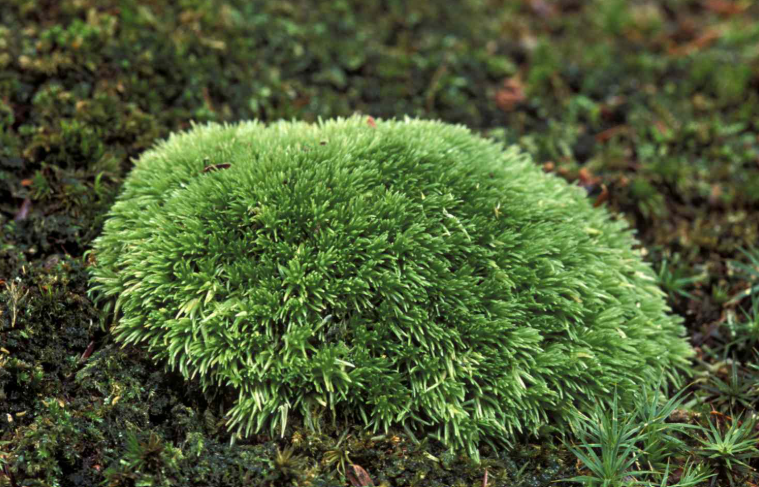
Non-vascular plants, collectively known as bryophytes, are among the oldest and simplest land plants on Earth. Unlike vascular plants, they lack specialized tissue (xylem and phloem) for transporting water and nutrients, and instead absorb moisture and minerals directly through their surfaces. They reproduce via spores rather than seeds and typically thrive in moist, shaded environments.
Non-vascular plants are broadly grouped into mosses (class Bryopsida), liverworts (division Marchantiophyta), and hornworts (division Anthocerotophyta). Look for the absence of true roots (they anchor with rhizoids), lack of woody stems, habitat preference for moisture, spore capsules on stalks, and whether the plant body is a flat thallus (liverworts, hornworts) or has leaf-like structures arranged around a stem (mosses and leafy liverworts).
Types of Non-vascular plants
Sphagnum Moss (Sphagnum spp.)
One of the most ecologically important non-vascular plants in the world, sphagnum moss is the primary builder of peat bogs. It is identified by its pale green, yellow, or reddish spongy masses of soft stems and leaves. Its cells are uniquely structured to hold up to 20 times their weight in water, making it a critical water-retention plant in wetland ecosystems.
Common Haircap Moss (Polytrichum commune)
One of the tallest and most recognizable mosses, haircap moss can reach up to 12 inches in height — remarkable for a non-vascular plant. It forms dense, dark green upright colonies with stiff, lance-shaped leaves that spread when wet and press against the stem when dry. The name comes from the hairy cap (calyptra) that covers its spore capsules.
Sheet Moss (Hypnum curvifolium)
A feathery, carpet-forming moss widely found on forest floors, rocks, and rotting logs. Its slender, curved leaves give branches a distinctly plume-like appearance. Sheet moss forms smooth, flat, bright to yellowish-green mats and is one of the most commonly used mosses in floral arrangements, terrariums, and garden art due to its elegant, dense texture.
Cushion Moss (Leucobryum glaucum)
Easily recognized by its distinctive pale, blue-green to whitish color, cushion moss forms dense, rounded hummocks or cushions on forest floors and rocky outcrops. Its unusual coloration is caused by large, air-filled cells surrounding the chlorophyll-bearing cells. When dry, it turns almost white, and when wet, it returns to its characteristic blue-green hue.
Common Liverwort (Marchantia polymorpha)
One of the most studied and widely distributed non-vascular plants, this liverwort forms flat, ribbon-like, dark green lobed thalli that hug the ground. It is identified by a distinctive surface pattern of hexagonal markings. Umbrella-shaped reproductive structures rise from the thallus — star-shaped in females and disc-shaped in males — making it easy to identify when fertile.
Pellia (Pellia epiphylla)
A simple, thalloid liverwort commonly found along streamsides, ditches, and damp soil. It forms wide, smooth, bright green ribbon-like sheets without the complex surface patterning of Marchantia. A prominent midrib runs along the center of the thallus. In spring, it produces distinctive black, glossy spore capsules on translucent white stalks that burst open to release spores.
Snakeskin Liverwort (Conocephalum conicum)
Named for the distinctive, snake-scale-like hexagonal pattern clearly visible on its large, bright green thallus surface. Each hexagonal segment contains a central pore, visible to the naked eye. It grows in large, overlapping sheets along shaded, wet rock faces, stream banks, and waterfalls. It is one of the largest and most visually striking thalloid liverworts.
Porella (Porella platyphylla)
A leafy liverwort — meaning it has distinct leaf-like structures rather than a flat thallus — Porella forms flattened, overlapping, scale-like green to brownish-green mats on tree bark, rocks, and shaded walls. Each stem bears two rows of overlapping lateral leaves and a row of smaller underleaves. It prefers calcium-rich substrates and is a common bark-dwelling liverwort.
Frullania (Frullania spp.)
A genus of leafy liverworts that cling tightly to tree bark and rock surfaces, often forming dark reddish-brown to purple-green, appressed patches that can look almost painted onto the substrate. The tiny, overlapping leaves have distinctive helmet-shaped water-sacs (lobules) that trap moisture. Some species are known to cause allergic contact dermatitis in forestry workers.
Hornwort (Anthoceros agrestis)
Hornworts are the third major group of bryophytes, distinguished from mosses and liverworts by their unique elongated, horn-like spore-producing structures (sporophytes) that grow upright from a flat, green thallus. The thallus is irregularly lobed, dark green, and often has a slightly oily sheen. Hornworts are notable for containing a single large chloroplast per cell, each housing a pyrenoid similar to those found in algae.
Smooth Hornwort (Phaeoceros laevis)
One of the most commonly encountered hornworts, found on damp, disturbed soil in fields, gardens, and roadsides. Its thallus is smooth-surfaced, pale to mid-green, and forms irregular rosettes on the soil. The erect, yellow-green horn-like sporophytes are a reliable identifier. It is particularly common on recently turned agricultural land in autumn and winter.
Rock Cap Moss (Dicranum scoparium)
Also called broom moss, this is a widespread and abundant moss recognized by its distinctive leaves that all curve or lean to one side — a feature called “falcate-secund.” It forms deep, springy, dark green tufts or mats on forest floors, rocks, and at the base of trees. The strongly one-sided leaf arrangement gives the clumps a wind-swept, brushed appearance.
Feather Moss (Pleurozium schreberi)
One of the most abundant mosses in boreal forests and northern heathlands worldwide. It forms loose, deep, fluffy mats with pinnately branched stems resembling tiny feathers. The stems have a distinctive reddish color that contrasts with the bright green leaves. It plays a vital ecological role in northern ecosystems as a habitat for nitrogen-fixing cyanobacteria.
Stair-step Moss (Hylocomium splendens)
A distinctive and beautiful moss of cool northern and montane forests, recognizable by its unique layered, stair-step growth habit — each year a new tier of branches grows from the middle of the previous year’s stem. This annual layering means you can count the tiers to estimate the age of the plant. Stems are richly branched and feathery, and leaves have a slightly glossy sheen.
Luminous Moss (Schistostega pennata)
One of the most extraordinary non-vascular plants, luminous moss appears to glow with a golden-green light in dark cave entrances, overhanging banks, and rock crevices. The glow is produced by specialized, lens-shaped protonema cells that concentrate and reflect available light. The leafy shoots are delicate and fern-like, and the plant grows only in very dim, sheltered habitats.
Water Moss (Fontinalis antipyretica)
An entirely aquatic moss, one of the few non-vascular plants that lives fully submerged in streams, rivers, and lakes. It forms long, flowing, dark olive-green to blackish strands anchored to rocks and submerged wood. The leaves are keeled (folded along the midrib) and arranged in three rows. It provides important habitat for aquatic invertebrates and fish fry.
Peat Moss (Sphagnum palustre)
A widespread species of sphagnum found in fens, bogs, and wet heaths. It forms compact, flat-topped hummocks and is distinguished from other sphagnums by its relatively large size and pale green to yellowish-white coloration. Like all sphagnums, it has remarkable water-holding capacity and a naturally antiseptic quality, historically used as wound dressing material.
Wall Screw Moss (Tortula muralis)
A highly resilient and drought-tolerant moss found colonizing walls, pavements, rooftops, and dry, exposed rock surfaces around the world. It forms small, compact rosette-like cushions with distinctive leaves tipped with a long, silvery hair-point that helps reflect intense sunlight. When dry it curls up tightly but rapidly revives and greens up when wetted.
Silver Moss (Bryum argenteum)
Arguably the most cosmopolitan moss on Earth, silver moss is found on every continent including Antarctica. It grows in tiny, dense, silvery-green to white cushions on pavement cracks, rooftops, lawns, and disturbed soils in urban environments worldwide. Its silvery appearance comes from the colorless, transparent upper portions of its leaves, which give it a metallic sheen.
Juniper Moss (Polytrichum juniperinum)
A widespread upland and heath moss with stiff, lance-shaped leaves tipped with reddish hair-points. It forms dense, dark green to purplish-green mats on dry, acidic soils, heathlands, and open woodlands. The leaves press tightly against the stem when dry and spread horizontally when moist. Spore capsules are four-angled and covered by a distinctive hairy golden calyptra.
Lesser Meadow Moss (Calliergonella cuspidata)
A common wetland and grassland moss that forms pale yellow-green mats in damp meadows, marshes, and along pond margins. Its most distinctive feature is the tightly clustered, pointed shoot tips (cuspidate) that give each stem a neat, tapered appearance. Leaves are broad, concave, and nerveless, and the plant often grows alongside sedges and rushes in wet habitats.
Flat-leaved Moss (Neckera complanata)
A distinctive moss of shaded, calcium-rich rock faces and tree bases in woodlands. Its stems and leaves are strongly flattened into a single plane, giving the plant a pressed, ribbon-like appearance. The leaves have a slightly rippled or transversely undulate surface that catches the light. It forms overlapping, pale to mid-green patches that drape over bark and limestone surfaces.
Earwort (Frullania tamarisci)
A leafy liverwort with a reddish-brown to dark purple color that forms thin, closely pressed mats on exposed rock faces, bark, and moorland boulders. The tiny overlapping leaves and distinctive helmet-shaped water-retaining lobules are characteristic of the Frullania genus. Its deep reddish coloration intensifies in exposed, high-light environments and helps protect against UV radiation.
Crystalwort (Riccia fluitans)
An unusual liverwort that grows both as a terrestrial plant on damp mud and as a floating aquatic plant in still or slow-moving water. In water, it forms dense, bright green, forked, strap-like thalli with no midrib. It produces no visible reproductive organs when floating and reproduces vegetatively. It is widely used in planted aquariums as a decorative, oxygenating plant.
Overleaf Pellia (Pellia endiviifolia)
Similar to common Pellia but found particularly on calcium-rich, wet substrates such as dripping limestone, chalk stream banks, and calcareous flushes. The thallus is deep green with a strong midrib and more distinctly lobed, endive-leaf-like margins. It forms large, overlapping sheets and is one of the most productive liverworts in base-rich, permanently moist habitats.
Whipwort (Bazzania trilobata)
A large, robust leafy liverwort of ancient, undisturbed humid woodlands and moorlands, often used as an indicator of ecological continuity. Its stems are distinctive — the leaves are arranged in two rows with three-toothed tips, and trailing flagella-like stems extend from the underside. It forms deep, spongy, dark green mats on peaty banks, boulders, and tree roots.
Comb Moss (Ctenidium molluscum)
A beautiful, feathery moss of limestone rocks, grasslands, and woodland floors, forming dense, golden-green to yellow mats with a distinctly glossy sheen. Its stems are intricately pinnately branched and the curved, overlapping leaves give the stems a combed appearance. It is a strong indicator of calcium-rich soils and is one of the most visually elegant grassland mosses.
Bogbean Moss (Calliergon giganteum)
One of the largest aquatic mosses, found in fens, bogs, and the shallow margins of lakes. It forms large, lax, pale green submerged or emergent mats with broad, concave, nerveless leaves. Shoot tips are rounded and hooded. It plays an important role in peat formation in wetland ecosystems and is a key component of rich fen vegetation communities.
Mossy Stonecrop Moss (Racomitrium lanuginosum)
Also known as woolly fringe moss or gray moss, this rugged species is a dominant plant of exposed mountain summits, moorland, and lava fields. It forms loose, pale grey-green to whitish-grey mats over vast areas of upland terrain. The grey color comes from long, silvery hair-points on each leaf. It is highly tolerant of wind, drought, frost, and nutrient-poor substrates.
Tamarisk Moss (Thuidium tamariscinum)
One of the most elegantly structured mosses, tamarisk moss is identified by its richly and precisely tri-pinnate branching — meaning each stem branches three times over, like a tiny, perfect fern frond. It forms bright, vivid green mats on shaded woodland floors, damp banks, and hedge bases. Stems and branches are covered in tiny, hair-like paraphyllia, giving them a fuzzy texture under a hand lens.
Flat Fork Moss (Metzgeria furcata)
A thalloid liverwort that forms pale, yellowish-green, strap-like, forked thalli with a very clear, narrow midrib running down the center. It grows in thin, delicate patches on the bark of trees and shaded rocks. The margins and underside midrib are fringed with single hairs. It is one of the most common and widespread liverworts on tree bark in temperate woodlands.
Greater Featherwort (Plagiochila asplenioides)
A large, leafy liverwort that forms lush, deep green, fern-like patches on damp woodland banks, ravine walls, and shaded stream sides. It has broad, overlapping leaves with toothed margins, giving the stems a full, layered appearance reminiscent of a small fern frond. It prefers humid, sheltered woodlands and is often found alongside ferns and mosses in ravine habitats.
Toothed Plagiomnium Moss (Plagiomnium cuspidatum)
A very common woodland and garden moss with unusually broad, tongue-shaped leaves with distinctly toothed margins — quite unlike the narrow leaves of most mosses. It forms loose, sprawling mats on moist, shaded forest floors, rotting logs, and garden soil. Leaves are a clear, bright green with a distinct nerve running to the leaf tip. Spore capsules hang on long curved stalks.
Common Pincushion Moss (Leucobryum juniperoideum)
Similar to cushion moss (L. glaucum) but slightly smaller and more compact, forming tight, firm, rounded cushions on acidic woodland floors and heathlands. Its characteristically pale, blue-white to grey-green color distinguishes it immediately from most surrounding mosses. The unusual coloration is produced by its unique multi-layered leaf cells filled with air rather than chlorophyll.
Pellia neesiana
A close relative of common Pellia, preferring moist, shaded mountain habitats, upland stream banks, and wet cliff ledges at higher altitudes. The thallus is similar in form — broad, flat, dark green, and ribbon-like — but typically slightly narrower and found in cooler, more montane settings. It is distinguished from P. epiphylla largely on microscopic and ecological grounds.
Apple Moss (Bartramia pomiformis)
Named for its spherical, apple-shaped spore capsules, apple moss is a stiff, greyish-green moss that forms deep, rounded tufts on dry, acidic rock ledges, walls, and sandy banks. The narrow, crisped leaves give the cushions a distinctive frosted or silvery-grey appearance when dry. The perfectly round, ribbed green capsules turning brown with age are its most charming and identifying feature.