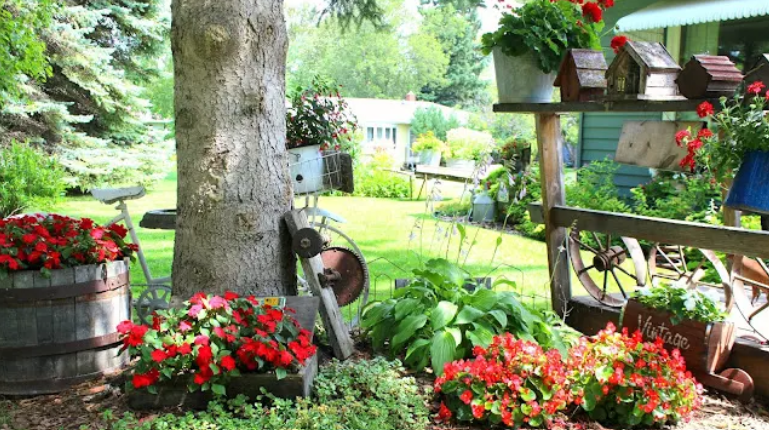
Gardening beneath spruce trees (Picea spp.) presents one of the most challenging environments in horticulture. Spruce trees — including Norway spruce (Picea abies), Colorado blue spruce (Picea pungens), white spruce (Picea glauca), and Sitka spruce (Picea sitchensis) — cast dense, year-round shade from their sweeping, low-hanging branches.
Their shallow, fibrous root systems compete aggressively for every drop of available moisture, and their falling needles create a thick, highly acidic, slowly decomposing litter layer that inhibits germination and lowers soil pH dramatically. Despite these formidable challenges, a carefully chosen selection of tough, acid-loving, shade-adapted plants can not only survive but genuinely thrive in the dry, dark world beneath a mature spruce.
Key Tips for Planting Under Spruce Trees: Always choose plants that are strongly acid-tolerant — spruce needle litter significantly lowers soil pH over time, often to between 4.0 and 5.5. Amend the planting soil with composted pine bark, peat moss, or acidic compost to improve structure and organic matter content.
Do not remove needle litter — instead, plant through it and allow it to continue enriching the soil with organic acids. Avoid digging deeply near the surface roots, which are often extensive and easily damaged. Water new transplants deeply and regularly for the first two growing seasons, then reduce irrigation as plants establish.
Plant in early autumn to give new plants maximum time to root in before summer drought. Mulch lightly with pine bark or wood chip to moderate soil temperature and moisture. Where conditions beneath mature spruce are truly extreme, embracing native mosses as a deliberate ground cover rather than struggling against the environment is often the most rewarding and sustainable approach.
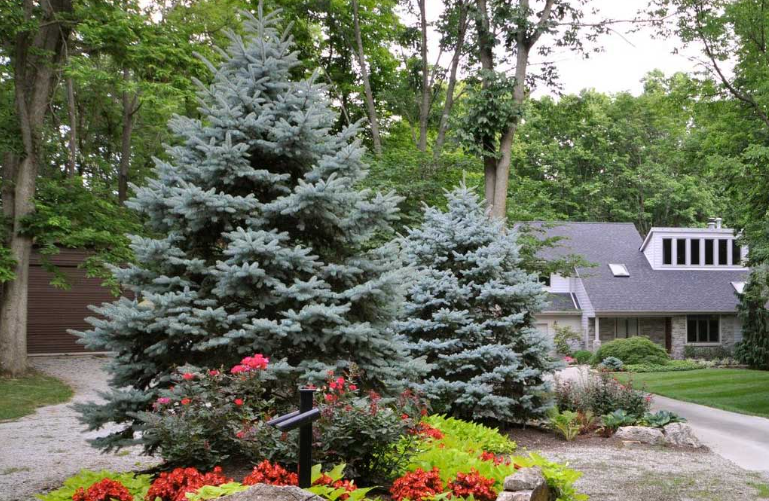
Plants That Grow Well Under Spruce Trees
Epimedium (Epimedium spp.)
Consistently ranked as the single finest ground cover for dry shade anywhere in the temperate world, epimedium is the ultimate companion plant for spruce trees. Its heart-shaped, often bronze-red-tinted leaflets emerge beautifully in spring, become tough, leathery, and completely weed-smothering through summer, and remain semi-evergreen into winter.
Delicate, spider-like flowers in yellow, white, pink, lavender, or orange appear in spring just as the new foliage unfurls. Once established beneath a spruce, epimedium forms dense, impenetrable, self-sustaining mats that require no irrigation, no fertilization, and virtually no maintenance whatsoever.
Lily of the Valley (Convallaria majalis)
One of the toughest and most fragrant ground covers available for the dry, acidic, root-competitive conditions beneath spruce trees. Its paired, broad, lance-shaped leaves emerge vigorously in spring, followed by arching stems of tiny, perfectly bell-shaped, intensely fragrant white flowers that fill the air with their extraordinary scent.
Once established, lily of the valley spreads aggressively by underground rhizomes to form a dense, weed-suppressing carpet. It tolerates the most inhospitable conditions beneath mature spruce — including deep shade, bone-dry soil, and heavy needle litter — with remarkable persistence.
Ajuga (Ajuga reptans)
A fast-spreading, mat-forming, semi-evergreen ground cover that is one of the most reliable performers in the challenging conditions beneath spruce trees. Its rosettes of bronzed, burgundy, or dark green leaves spread rapidly by stolons across the ground, and short, vivid spikes of blue flowers appear in spring.
Ajuga tolerates deep shade, dry and acidic soil, dense needle litter, and aggressive root competition with extraordinary resilience. It is one of the fastest ground covers for suppressing weeds and covering bare ground beneath dense, low-branched spruce trees.
Pachysandra (Pachysandra terminalis)
Japanese spurge is one of the most widely planted and dependable evergreen ground covers for the dry, acidic, deeply shaded conditions beneath spruce trees. It forms a dense, uniform, 6-inch-tall evergreen carpet of whorled, toothed, dark green leaves that completely suppresses weeds once established.
Small, faintly fragrant white flowers appear in early spring. It tolerates the dry, strongly acidic, root-competitive environment beneath spruce better than almost any other broadleaved evergreen ground cover and requires virtually no maintenance once it has knitted together into a solid mat.
Vinca (Vinca minor)
Lesser periwinkle is a vigorous, trailing, evergreen ground cover that forms a dense, weed-smothering mat of small, glossy, dark green leaves beneath spruce trees. Cheerful violet-blue, white, or burgundy pinwheel-shaped flowers appear in spring and sporadically through summer.
It tolerates deep shade, very dry soil, strongly acidic conditions, and intense root competition with great resilience, spreading steadily by trailing stems that root at the nodes to cover large areas of bare ground. It is one of the most dependable evergreen trailing ground covers for the darkest, driest spruce shade.
Wild Ginger (Asarum canadense)
A native North American woodland ground cover superbly adapted to the acidic, dry, deeply shaded conditions beneath spruce trees. Its large, soft, kidney-shaped, deep green leaves form a dense, spreading carpet that completely suppresses weeds.
Hidden beneath the leaves in spring are small, brownish-purple, jug-shaped flowers pollinated by ground-crawling insects. Wild ginger tolerates the difficult combination of dense shade, dry acidic soil, and competitive spruce roots with ease, spreading steadily by rhizomes to fill large areas of the woodland floor.
Bunchberry (Cornus canadensis)
A miniature relative of the flowering dogwood tree and one of the most beautiful native ground covers for the cool, acidic, moist to dry shade beneath spruce trees — particularly in northern and boreal garden settings where it naturally co-exists with spruce in the wild.
Its whorled leaves, white four-bracted flowers identical in structure to a dogwood’s but just inches above the ground, and clusters of brilliant red autumn berries make it one of the most ornamentally complete native ground covers available for spruce woodland gardens.
Sword Fern (Polystichum munitum)
A magnificent, evergreen fern of Pacific Coast coniferous forests where it grows naturally beneath Sitka spruce and other large conifers. It forms large, bold, vase-shaped rosettes of long, glossy, dark green fronds that persist beautifully year-round, providing structural interest even in the darkest shade.
It is superbly adapted to dry shade, strongly acidic needle-litter soils, and root competition. In eastern gardens, Christmas fern (Polystichum acrostichoides) performs the equivalent role with equal grace and reliability beneath spruce.
Wood Fern (Dryopteris spp.)
The wood ferns — particularly autumn fern (Dryopteris erythrosora), marginal wood fern (D. marginalis), and male fern (D. filix-mas) — are outstanding performers in the dry, shaded, acidic conditions beneath spruce.
Their arching, elegantly divided fronds bring lush, tropical-looking texture to bare woodland floors. Many species are semi-evergreen to fully evergreen, providing year-round foliage coverage. Once established, wood ferns are highly drought-tolerant and gradually spread to create beautiful, naturalistic colonies beneath the spruce canopy.
Lady Fern (Athyrium filix-femina)
A graceful, deciduous fern forming large, airy, vase-shaped clumps of finely divided, bright green fronds in the shade beneath spruce trees. It tolerates the acidic, moderately dry conditions beneath spruce and brings a soft, delicate, lacy texture to the woodland floor.
The Japanese painted fern (Athyrium niponicum ‘Pictum’) is a spectacular shade-tolerant relative with silvery-grey and burgundy-marked fronds that provide luminous color in the dark spaces beneath spruce canopies. Both athyriums spread slowly by rhizomes to form weed-suppressing clumps.
Ostrich Fern (Matteuccia struthiopteris)
A dramatic, large-scale fern producing magnificent, vase-shaped rosettes of tall, bright green, shuttlecock-like fronds that can reach 5 feet in height, making it one of the boldest and most architectural plants for the shade beneath large spruce trees.
It spreads steadily by underground stolons to create sweeping, naturalistic colonies. While it prefers moist soil, it adapts to moderately dry conditions once established and is one of the most impressive statement ferns for large-scale planting beneath mature spruce in northern gardens.
Hosta (Hosta spp.)
Among the most celebrated and widely grown shade perennials in temperate gardens, hostas perform well in the partially shaded outer reaches and dripline of spruce trees. Their bold, architecturally striking leaves in shades of blue-green, gold, chartreuse, and white-variegated dominate the shaded garden.
Blue-leaved cultivars such as ‘Halcyon’, ‘Blue Angel’, and ‘Elegans’ are particularly well-adapted to dry, acidic conditions and tolerate the root competition beneath spruce better than gold or green varieties. They return reliably each year, forming impressive weed-suppressing clumps.
Bleeding Heart (Lamprocapnos spectabilis)
A beloved spring perennial producing arching stems of heart-shaped, pendulous pink and white flowers above soft, deeply divided, blue-green foliage in spring.
It thrives in the cool, shaded, acidic conditions beneath spruce trees, emerging in spring when sufficient light still filters through before the tree’s dense canopy reaches full density. Fringed bleeding heart (Dicentra eximia) is a superior choice for drier conditions, blooming repeatedly from spring to frost with rosy-pink flowers above ferny foliage that remains attractive all season.
Hellebore (Helleborus spp.)
Hellebores are among the most prized and beautiful shade perennials for planting under spruce trees. Their leathery, deeply divided, evergreen leaves remain attractive and weed-suppressing year-round.
Nodding, cup-shaped flowers in white, cream, pink, plum, deep purple, and near-black appear in late winter and early spring — often the first flowers of the year beneath the spruce canopy. They tolerate dry, acidic, deeply shaded conditions and self-seed prolifically once established, gradually colonizing the ground beneath the spruce with minimal intervention.
Foamflower (Tiarella cordifolia)
A charming native North American woodland perennial producing frothy spikes of tiny white to pale pink flowers in spring above attractive, maple-like, semi-evergreen, lobed leaves.
It thrives in the acidic, cool, partially shaded conditions beneath spruce trees and spreads by stolons to form a neat, weed-suppressing mat. Many modern cultivars offer striking leaf patterning with dark burgundy markings along the veins that remain ornamental throughout the season. It naturalizes beautifully in spruce woodland gardens, self-seeding gently to expand its colonies over time.
Coral Bells (Heuchera spp.)
Grown primarily for their spectacular, year-round foliage in shades of burgundy, caramel, silver, bronze, lime, and near-black, coral bells are outstanding shade perennials for planting beneath spruce. Many native species originate from rocky, acidic, partially shaded woodland habitats closely resembling the conditions beneath spruce trees.
Airy wands of tiny white, pink, or red flowers rise above the mounded foliage in summer. Modern heuchera cultivars have been extensively selected for improved drought and acidic-soil tolerance, making them increasingly reliable beneath spruce canopies.
Lungwort (Pulmonaria spp.)
One of the earliest-blooming and most attractive perennials for the dry, acidic shade beneath spruce trees. Clusters of funnel-shaped flowers that open pink and age to vivid blue — often both colors present simultaneously on the same plant — appear in early spring.
Its large, semi-evergreen leaves are heavily spotted or splashed with silver, providing striking, luminous foliage interest in the dark spaces beneath spruce through the entire growing season. It forms steadily spreading, weed-suppressing clumps and tolerates strongly acidic, root-competitive conditions.
Creeping Jenny (Lysimachia nummularia ‘Aurea’)
The golden-leaved form of creeping Jenny is particularly valuable beneath spruce trees, where its vivid chartreuse to golden-yellow, rounded leaves create bright, luminous patches that lighten and enliven the dark, shadowed ground beneath the canopy. It spreads rapidly by creeping stems that root at each node, covering large areas of bare, needle-littered ground efficiently.
It tolerates moderately dry, acidic conditions beneath spruce and is one of the most effective plants for quickly brightening the darkest spaces beneath large conifers.
Wintergreen (Gaultheria procumbens)
A charming, low-growing, creeping native evergreen shrub perfectly adapted to the acidic, dry, shaded conditions beneath spruce trees — habitats that closely replicate its natural northern coniferous woodland environment.
Its small, glossy, oval leaves are strongly aromatic with the classic wintergreen scent when crushed, and turn attractive burgundy-bronze in winter. Small, urn-shaped white flowers appear in summer, followed by brilliant red berries that persist through winter, providing vital food for birds during the harshest months of the year.
Linnaea (Linnaea borealis — Twinflower)
One of the most charming and ecologically appropriate native ground covers for the boreal spruce woodland garden. Twinflower forms a delicate, trailing, evergreen mat of tiny, rounded leaves just inches above the ground, sending up pairs of nodding, pale pink, tubular flowers on Y-shaped stems in summer — the paired flowers being the most distinctive and endearing feature of the plant.
It grows naturally in the cool, acidic, humus-rich shade of boreal spruce forests across the Northern Hemisphere and is perfectly adapted to these conditions in cultivation.
Trillium (Trillium spp.)
Native woodland wildflowers of breathtaking beauty, trilliums grow naturally in the cool, acidic, humus-rich shade of northern coniferous and mixed woodlands — including spruce-dominated forests.
Their distinctive three-petaled flowers in white, pink, red, or maroon rise above a whorl of three broad leaves in early spring. They are slow-growing and long-lived, returning reliably each spring as some of the most exquisite woodland wildflowers. Snow trillium (T. nivale) and red trillium (T. erectum) are particularly well-suited to the acidic conditions beneath spruce.
Solomon’s Seal (Polygonatum biflorum)
An elegant, arching native woodland perennial with graceful, horizontally held stems carrying alternating, broadly oval leaves and rows of small, pendant, creamy-white bell flowers hanging below the stem in spring.
Blue-black berries follow in autumn. It tolerates the dry, acidic, shaded, root-competitive conditions beneath spruce with great ease and spreads by underground rhizomes to create sweeping, naturalistic, weed-suppressing drifts on the woodland floor. It requires no maintenance once established and increases reliably each year in spruce woodland settings.
Mahonia (Mahonia repens / Mahonia aquifolium)
Creeping mahonia (M. repens) and Oregon grape (M. aquifolium) are bold, architectural, evergreen shrubs that thrive in the dry, acidic shade beneath spruce trees. Their spiny, pinnate, holly-like leaves take on attractive bronze-purple winter tints, fragrant yellow flowers appear in early spring, and clusters of blue-black berries follow in summer.
Both species grow naturally in coniferous woodland understory and are exceptionally well-adapted to the dry, strongly acidic, root-competitive conditions that spruce trees create.
Mountain Laurel (Kalmia latifolia)
A magnificent native North American evergreen shrub that grows naturally in the acidic understory of coniferous and mixed woodland — habitats closely replicated by mature spruce plantings.
Its glossy, lance-shaped, dark green leaves are attractive year-round, and its intricate, cup-shaped flowers in white, pink, and rose with crimson internal markings are among the most beautiful of any native shrub. It thrives in the dry, strongly acidic, shaded conditions beneath spruce and forms large, billowing masses of evergreen foliage and spectacular spring bloom.
Rhododendron and Azalea (Rhododendron spp.)
Many rhododendrons and azaleas are superb companions for spruce trees, sharing preferences for acidic, humus-rich, partially shaded soil that spruce needle litter helps create over time.
Their spectacular spring flower displays — in every color from white through pink, magenta, orange, and purple — are unmatched among shade-tolerant shrubs. Compact, small-leaved, cold-hardy rhododendrons such as R. catawbiense cultivars, PJM Group hybrids, and native azaleas are particularly well-adapted to the dry, acidic, cold conditions typical beneath mature spruce trees.
Native Blueberry (Vaccinium angustifolium / Vaccinium corymbosum)
Lowbush blueberry (V. angustifolium) is naturally adapted to the acidic, dry, cool, partially shaded conditions beneath spruce trees, growing as a native understory plant across vast areas of northern and boreal forest.
Its small, glossy leaves turn spectacular shades of scarlet and crimson in autumn. Small, white, urn-shaped flowers in spring are followed by sweet, edible blue-black berries beloved by birds and mammals. It spreads by underground rhizomes to form a low, dense, deciduous ground cover perfectly suited to spruce woodland gardens.
Bearberry (Arctostaphylos uva-ursi)
A prostrate, creeping, evergreen native shrub naturally found across boreal forest floors and rocky, acidic, coniferous woodland margins — precisely the environment beneath mature spruce trees.
Its small, spatula-shaped, glossy, dark green leaves remain attractive year-round, turning bronzed in winter. Tiny, pink, urn-shaped flowers in early spring are followed by persistent bright red berries that provide vital winter food for birds and mammals. It forms a dense, slowly spreading evergreen mat just a few inches tall and is highly tolerant of dry, acidic, infertile soils.
Creeping Snowberry (Gaultheria hispidula)
A delicate, mat-forming, native evergreen creeper of boreal and northern woodland, growing naturally across the cool, acidic, mossy floor of spruce-dominated forests across Canada and the northern United States.
Its tiny, rounded, dark green leaves are dotted with bristly hairs and lie flat in an intricate, interwoven mat just a fraction of an inch above the ground. Tiny white flowers are followed by small, white, edible berries with a strong wintergreen flavor. It thrives in the cool, moist, highly acidic conditions beneath mature spruce.
Mosses (Hypnum, Dicranum, Pleurozium spp.)
Rather than fighting the difficult conditions beneath spruce, embracing mosses as a deliberate ground cover is often the most ecologically appropriate and aesthetically beautiful solution.
Sheet moss (Hypnum curvifolium), broom moss (Dicranum scoparium), and feather moss (Pleurozium schreberi) all naturally colonize the needle-littered, acidic, dry ground beneath spruce trees. Together they form a lush, seamless, green carpet that requires absolutely no care, no irrigation, and no feeding — the ultimate low-maintenance, naturalistic ground cover for the spruce woodland garden.
Astilbe (Astilbe spp.)
While astilbe generally prefers moist soil, many cultivars perform surprisingly well in the partially shaded, moderately dry conditions at the outer edges and dripline of spruce canopies. Their feathery, plume-like flower spikes in white, cream, pink, red, and purple light up shaded garden spaces in midsummer, and their deeply divided, ferny foliage is attractive before and after bloom.
The dried flower plumes persist through autumn, providing months of additional ornamental interest. Drought-tolerant cultivars such as ‘Visions’ and ‘Pumila’ are best suited to the drier conditions near spruce.
Siberian Bugloss (Brunnera macrophylla)
A beautiful, shade-loving perennial producing clouds of tiny, forget-me-not-blue flowers in spring above large, heart-shaped leaves that remain attractive through the entire growing season.
The silvery-leaved cultivar ‘Jack Frost’ — with its intricate, frosted silver leaf markings — is particularly valuable for brightening the dark, shadowed spaces beneath spruce canopies. It tolerates the dry, acidic, shaded conditions beneath spruce and slowly spreads by self-seeding to create naturalistic colonies. Once established it is remarkably drought-tolerant and requires minimal care.
Liriope (Liriope muscari)
Lilyturf is one of the most dependable and versatile evergreen ground covers for dry shade beneath spruce trees. Its dark, strap-like leaves form dense, arching, grass-like tufts that suppress weeds and remain attractive year-round.
Spikes of small violet-purple or white flowers appear in late summer above the foliage, followed by small black berries. Liriope tolerates the dry, acidic, root-competitive conditions beneath spruce with remarkable resilience and is virtually indestructible once established. It performs equally well in deep shade or at the lighter canopy margins.
Sedge (Carex spp.)
Various sedge species are among the most ecologically valuable and aesthetically pleasing plants for the difficult conditions beneath spruce trees. Pennsylvania sedge (Carex pensylvanica) tolerates dry, acidic shade and root competition exceptionally well, forming a soft, fine-textured, arching carpet of narrow leaves.
Plantain-leaved sedge (Carex plantaginea) offers broad, pleated, pale green leaves with attractive winter color. Japanese sedge (Carex morrowii) is an evergreen, clump-forming species with arching, glossy leaves that brings refined, grass-like texture to the darkest spaces beneath spruce canopies.