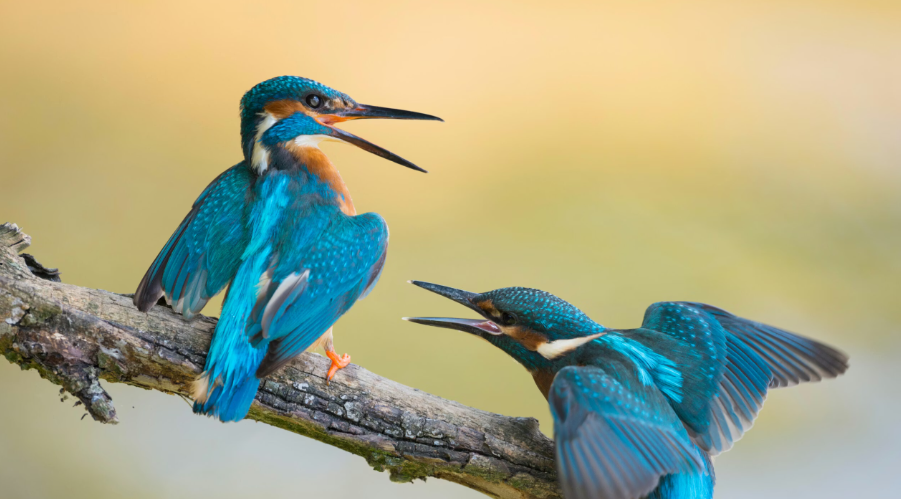
Kingfishers are among the most visually striking birds in the world, renowned for their brilliant, jewel-like plumage. Most species display vivid combinations of blue, green, turquoise, orange, and chestnut, with iridescent feathers that shimmer and shift in sunlight. They have compact, streamlined bodies, short tails, large heads, and long, dagger-shaped bills perfectly adapted for catching prey. Despite their small to medium size, their bold colouring makes them immediately noticeable wherever they appear.
Found on every continent except Antarctica, kingfishers occupy an extraordinarily wide range of habitats. While many species are closely associated with rivers, lakes, streams, and coastal mangroves, a surprising number live far from water in tropical forests, dry savannas, and even urban gardens. The family Alcedinidae contains over 110 species, with the greatest diversity found in Southeast Asia and the Australasian region. From the icy streams of northern Europe to the dense rainforests of Borneo and the open woodlands of Africa, kingfishers have proven themselves remarkably adaptable birds.
The classic image of a kingfisher is one perched motionlessly above water before plunging headfirst to snatch a fish, and for many species this is an accurate picture. Fish-eating kingfishers have specially adapted eyes that correct for the refraction of light at the water’s surface, allowing them to judge depth and distance with extraordinary accuracy. However, a large proportion of kingfisher species are terrestrial hunters, feeding on insects, lizards, snakes, earthworms, and even small rodents, which they beat against a hard surface before swallowing.
Kingfishers are generally solitary and territorial birds, fiercely defending stretches of riverbank or patches of forest from rivals. Most species nest in tunnels, which they excavate themselves by repeatedly flying headfirst into a sandy bank or a patch of soft earth, creating a long burrow at the end of which they lay their white eggs. Both parents share incubation and chick-rearing duties. The chicks are born blind and helpless, but grow rapidly and fledge within a few weeks, after which they are quickly driven from the parents’ territory.
Kingfishers have captivated human imagination for thousands of years. In ancient Greek mythology, the kingfisher was associated with the legend of Halcyon, a figure said to calm the seas during winter, giving us the phrase “halcyon days” to describe a period of peace and happiness.
In many Asian and African cultures, the bird is regarded as a symbol of good fortune and prosperity. Today, while many kingfisher species remain common, a number of island-endemic species face serious threats from habitat destruction and introduced predators, making conservation efforts increasingly important for the survival of some of the world’s rarest and most beautiful birds.

Types of Kingfishers
Common Kingfisher
Perhaps the most iconic of all kingfishers, the Common Kingfisher dazzles with its vivid electric-blue upperparts and rich chestnut-orange underparts. Found across Europe, Asia, and North Africa, it favours clear, slow-moving rivers and streams where it perches motionlessly before plunging headfirst to snatch small fish with pinpoint precision.
Belted Kingfisher
North America’s most widespread kingfisher, the Belted Kingfisher is a stocky, blue-grey bird with a shaggy crest and a distinctive white collar. Females are unique among North American birds in being more colourful than males, sporting a chestnut belly band. It hovers over water before diving, and its loud, rattling call is a signature sound of river habitats.
Malachite Kingfisher
A jewel-like miniature of the African waterways, the Malachite Kingfisher is named for its deep blue-green crown and back, which shimmer in the sunlight. It inhabits reed-fringed lakes, rivers, and papyrus swamps throughout sub-Saharan Africa, perching low over the water on reed stems before making swift, accurate dives for small fish and aquatic insects.
Azure Kingfisher
A small, luminous bird of Australian and New Guinean waterways, the Azure Kingfisher glows with deep azure-blue above and rich rufous-orange below. It clings to low overhanging branches above shaded streams and creeks, darting into the water to seize small fish, crustaceans, and aquatic invertebrates. Its rapid, high-pitched call announces its presence along forest rivers.
Blue-winged Kookaburra
Found in the tropical savanna woodlands of northern Australia and southern New Guinea, the Blue-winged Kookaburra is distinguished from its Laughing cousin by its striking white eye, blue wings, and slightly less frantic call. Like its relative, it preys on reptiles, large invertebrates, and small vertebrates, and lives in noisy, cooperative family groups.
White-throated Kingfisher
One of the most conspicuous and familiar kingfishers of South and Southeast Asia, the White-throated Kingfisher has a brilliant turquoise-blue back, chestnut head and belly, and a clean white throat and chest. It is not exclusively tied to water, often found in gardens, farmland, and woodland edges, hunting grasshoppers, lizards, and small rodents as readily as fish.
Sacred Kingfisher
Widespread across Australia, New Zealand, and many Pacific islands, the Sacred Kingfisher is a medium-sized, green-and-buff bird that migrates within its range in response to seasonal changes. Its name reflects the reverence in which Polynesian cultures once held it. It hunts from exposed perches in woodland, mangroves, and farmland, taking insects, small reptiles, and occasionally fish.
Grey-headed Kingfisher
A slender and elegant kingfisher of open African savanna, the Grey-headed Kingfisher is distinguished by its pale grey head, rich chestnut belly, bright red bill, and vivid blue wings and tail. It occurs from West Africa east to the Arabian Peninsula and is a dry-country species, often found far from water, hunting insects and small lizards on the ground.
Amazon Kingfisher
The Amazon Kingfisher is a robust, dark-green and white kingfisher found along major rivers, lakes, and mangrove coasts from Mexico south through the Amazon Basin. The male is adorned with a rich chestnut breast band, while the female has green spots on the breast. It is one of the most frequently encountered kingfishers along Amazonian river banks.
Rufous-collared Kingfisher
A secretive and rarely observed kingfisher of the dark interior of tropical forests in the Thai-Malay Peninsula, Sumatra, and Borneo, the Rufous-collared Kingfisher is a stunning bird with intricate spotted and barred plumage and a vivid rufous collar. Unlike most kingfishers, it lives deep in the forest understory, foraging on the ground for insects and earthworms.
Shining-blue Kingfisher
One of Africa’s most vividly coloured kingfishers, the Shining-blue Kingfisher inhabits forest streams and rivers in West and Central Africa, where its plumage gleams with an intense, almost metallic cobalt-blue above and rich chestnut below. It is shy and elusive, sitting quietly on low perches over shaded water before making fast, accurate dives for small fish.
Yellow-billed Kingfisher
A charismatic small kingfisher of lowland New Guinea and far north Queensland, the Yellow-billed Kingfisher has a bright yellow-orange bill, a golden-orange head, blue-green upperparts, and white underparts. It lives in the understorey of tropical forest, rarely visiting open water, and feeds primarily on large insects, earthworms, and small lizards taken from the forest floor.
Hook-billed Kingfisher
An oddity among kingfishers, the Hook-billed Kingfisher of New Guinea is named for its peculiarly curved lower mandible, an adaptation thought to help extract invertebrates from rotting wood and leaf litter. It is a secretive forest bird with brown and rufous plumage that blends into the forest floor, and its habits remain poorly studied due to its shy and reclusive nature.
Cerulean Kingfisher
A small and exquisitely coloured kingfisher endemic to Indonesia, the Cerulean Kingfisher is distinguished by its uniform pale sky-blue upperparts and white underparts, giving it a clean, bright appearance unlike its more richly patterned relatives. It inhabits coastal mangroves, rivers, and forest streams across the Indonesian archipelago, and is closely related to the Common Kingfisher.
Tuamoto Kingfisher
One of the world’s rarest kingfishers, the Tuamoto Kingfisher is found only on Niau Atoll in French Polynesia, where the entire population numbers just a few dozen individuals. It is a boldly coloured, turquoise-and-white bird that hunts lizards and large insects in the scrubby atoll vegetation. Its extreme rarity and restricted range make it one of the most threatened birds on Earth.
Micronesian Kingfisher
A critically endangered island kingfisher endemic to the Pacific island of Pohnpei in Micronesia, this species faces serious pressure from habitat loss and introduced predators. It occupies lowland and montane forest, foraging on lizards, insects, and small vertebrates from perches in the forest understory. Conservation efforts are ongoing to prevent its extinction on its tiny island home.
Shovel-billed Kookaburra
The Shovel-billed Kookaburra of the New Guinea highlands is one of the most bizarre kingfishers in existence, possessing an extraordinarily broad, flattened bill quite unlike that of any other species. It uses this shovel-shaped bill to dig through soil and leaf litter in search of earthworms and large invertebrates in montane forest, and is rarely observed due to its shy demeanour.
Banded Kingfisher
One of the most beautifully patterned kingfishers in the world, the Banded Kingfisher of the Thai-Malay Peninsula and Sunda Islands displays dramatically different plumage between the sexes. Males are brilliant blue and black with a rufous crown, while females are richly barred rufous and black throughout. It inhabits the interior of lowland tropical forest, hunting insects far from water.
Brown-hooded Kingfisher
A distinctive and vocal resident of eastern and southern African forests and woodlands, the Brown-hooded Kingfisher has a brown head, blue wings and tail, and a stout red bill. Despite its name suggesting aquatic habits, it is a thoroughly terrestrial hunter, foraging in leaf litter and open ground for large insects, small reptiles, and even young rodents.
Blue-eared Kingfisher
Closely resembling the Common Kingfisher but smaller and more intensely coloured, the Blue-eared Kingfisher is a jewel of the forest streams of South and Southeast Asia. Its distinctive blue ear coverts immediately set it apart from its relative. It favours shaded jungle streams and mangrove creeks, perching low over the water to catch small fish and shrimps.
Green Kingfisher
A small and secretive species, the Green Kingfisher inhabits the edges of clear streams and rivers from Texas and Arizona south through Central and South America. It perches inconspicuously close to the water on low branches and rocks, making short, swift dives for tiny fish and aquatic invertebrates. Males have a rufous breast band, while females show two green-speckled bands.
Ringed Kingfisher
The largest kingfisher in the Americas, the Ringed Kingfisher is a powerful, crow-sized bird with blue-grey plumage, a large shaggy crest, and a broad chestnut belly in the male. Found from the Rio Grande in Texas south throughout Central and South America, it frequents large rivers and lakes, hunting from prominent perches or hovering briefly before plunge-diving.
Woodland Kingfisher
A strikingly beautiful intra-African migrant, the Woodland Kingfisher is adorned with vivid turquoise-blue wings, a grey head, red-and-black bill, and white underparts. It breeds in woodland and forest-edge habitats across sub-Saharan Africa, but is not especially associated with water, hunting insects, small reptiles, and frogs from open perches in the tree canopy.
Collared Kingfisher
The Collared Kingfisher is a highly successful and adaptable species with over 50 recognised subspecies spread across a vast range from the Red Sea to the Pacific islands. Its plumage is typically turquoise-green above with a white collar and underparts. It occupies an unusually wide range of habitats including mangroves, coasts, forests, and even urban parks.
Stork-billed Kingfisher
One of Asia’s largest kingfishers, the Stork-billed Kingfisher is named for its enormous, brilliant-red bill, which is disproportionately large even for a kingfisher. Found in lowland forests and mangroves from the Indian subcontinent to Southeast Asia, it hunts fish, frogs, lizards, and even small birds from a perch over rivers and forest pools.
Laughing Kookaburra
Australia’s beloved Laughing Kookaburra is the world’s largest kingfisher, famous for its boisterous, cackling call that echoes through eucalyptus woodlands at dawn and dusk. Unlike most kingfishers, it rarely hunts fish, preferring terrestrial prey such as lizards, snakes, large insects, and small rodents, which it beats against a branch before swallowing whole.
Pied Kingfisher
The Pied Kingfisher is the world’s largest bird capable of true hovering without the aid of a headwind, a skill it uses masterfully to hunt fish over open water. Boldly patterned in black and white, it is highly gregarious and cooperative, often nesting in colonies. It ranges widely across Africa and South Asia along rivers, lakes, and coastal lagoons.