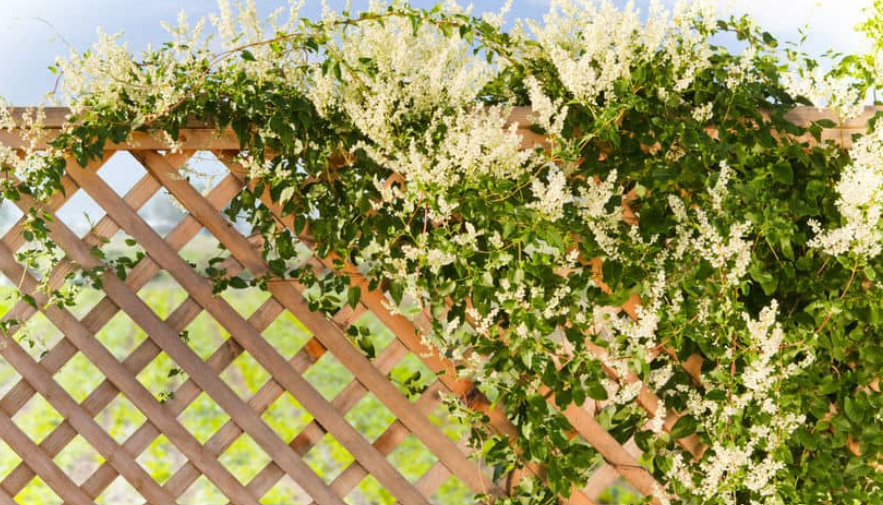
Climbing plants are a fascinating group of plants that grow upward rather than spreading outward. Instead of relying on thick trunks, they use structures like tendrils, twining stems, or adhesive roots to attach themselves to nearby surfaces. This growth habit allows them to reach sunlight efficiently, especially in crowded environments like forests or gardens.
These plants come in many forms, including flowering vines, evergreen climbers, and even edible varieties. Some produce vibrant blooms that add color to vertical spaces, while others are valued for their lush foliage. Their versatility makes them suitable for both decorative and practical uses in landscaping.
Climbing plants also play an important ecological role. They provide shelter and food for insects, birds, and small animals. In natural habitats, they can create dense green layers that support biodiversity and help regulate temperature and moisture levels.
When it comes to fences, climbing plants are especially popular because they transform plain boundaries into living walls. They can soften the appearance of hard materials like wood or metal, making outdoor spaces feel more natural and inviting. Over time, they can completely cover a fence, creating a private and visually appealing barrier.
Climbers for fences are often chosen based on how they grow. Some, like twining plants, wrap around fence posts or wires, while others cling directly to surfaces. Fast-growing varieties are ideal for quickly covering large areas, while slower-growing types are easier to manage and maintain over time.
Evergreen Climbing Plants For Fences
Clematis (Clematis spp.)
Clematis is the undisputed queen of climbing plants, offering an extraordinary range of flower colours, sizes, and flowering seasons across hundreds of species and cultivars that between them can provide colour on a fence from early spring right through to late autumn. From the large-flowered hybrids in purple, pink, red, and white to the delicate, nodding species types, there is a clematis perfectly suited to every fence, every aspect, and every garden style imaginable.
Climbing Rose (Rosa spp.)
Few sights in the garden are as romantic and as timelessly beautiful as a climbing rose in full bloom, its long, arching canes draped along a fence and smothered in fragrant blooms in shades of white, cream, pink, red, apricot, and yellow from early summer through to autumn. Modern repeat-flowering climbers extend the season magnificently, and training the canes horizontally along fence rails encourages the maximum number of flowering sideshoots.
Wisteria (Wisteria sinensis)
Wisteria is one of the most spectacular of all climbing plants, producing cascading racemes of intensely fragrant, pea-like flowers in lilac-purple, white, or pink in late spring that transform a plain fence into one of the most dramatic floral features in the entire neighbourhood. It is a vigorous, long-lived climber that rewards patient, twice-yearly pruning with an ever more generous and floriferous display as the years pass.
Honeysuckle (Lonicera periclymenum)
Common honeysuckle is one of the most beloved of all native climbing plants, its twining stems weaving effortlessly through fence panels and rails to produce clusters of tubular, two-lipped flowers in cream, yellow, and pink whose intoxicating fragrance — particularly powerful on warm summer evenings — is one of the most evocative scents in the entire garden. It is outstanding for wildlife, providing nectar for moths and berries for birds.
Jasmine (Jasminum officinale)
Common jasmine is a vigorous, twining climber whose small, white, star-shaped flowers carry one of the most intensely sweet and universally recognised fragrances in the plant kingdom, billowing in warm waves from a fence-covered plant throughout summer and into early autumn. Fast-growing and relatively undemanding, it quickly covers a fence with attractive, pinnate foliage and an abundance of scented blooms.
Ivy (Hedera helix)
Common ivy is one of the hardest-working and most versatile of all climbing plants, attaching itself to fence surfaces by means of adhesive aerial rootlets and covering them quickly with a dense, evergreen tapestry of attractive, lobed leaves that provides year-round screening, insulation, and invaluable wildlife habitat. It is exceptionally tolerant of shade, dry conditions, and neglect, performing reliably in situations where almost nothing else will grow.
Virginia Creeper (Parthenocissus quinquefolia)
Virginia creeper is a spectacular, self-clinging deciduous climber grown primarily for its outstanding autumn foliage display, when the large, five-fingered leaves turn from green to the most blazing shades of scarlet, crimson, and orange, transforming a fence into a wall of seasonal fire. It clings tenaciously by means of adhesive pads and covers large fences rapidly, providing dense green cover through summer and a magnificent seasonal finale in autumn.
Trumpet Vine (Campsis radicans)
The trumpet vine is a vigorous, self-clinging North American climber that produces large, flared, trumpet-shaped flowers of vivid orange-red in abundance throughout summer and early autumn, creating a bold, tropical-looking display that is irresistible to hummingbirds in its native range and to gardeners worldwide. It is a powerful grower that can cover a large fence quickly and thrives in hot, sunny positions where less vigorous climbers might struggle.
Passion Flower (Passiflora caerulea)
The blue passion flower is a fast-growing, exotic-looking climber whose extraordinarily complex, intricate flowers — combining white petals, a corona of blue and white filaments, and prominent central reproductive structures — create one of the most fascinating and beautiful floral displays of any fence climber in temperate gardens. In mild climates it produces egg-shaped orange fruits after flowering, and its unusual flower structure has inspired centuries of botanical and religious fascination.
Hydrangea (Hydrangea anomala subsp. petiolaris)
Climbing hydrangea is one of the most valuable of all fence climbers, a self-clinging, deciduous plant that produces large, flat, lacecap flower heads of creamy white in early summer above attractive, heart-shaped, glossy foliage. It is exceptionally tolerant of shaded aspects where many other climbers refuse to flower, slow to establish but magnificent once settled, and the peeling, cinnamon-brown bark of mature stems provides attractive winter interest.
Pyracantha (Pyracantha spp.)
Pyracantha, or firethorn, is a supremely hardworking wall and fence shrub bearing white spring flowers, dense evergreen foliage that provides excellent screening and security, and spectacular masses of vivid red, orange, or yellow berries in autumn and winter that are eagerly consumed by birds. Its long, sharp thorns make it an effective security barrier when trained across a fence, and it performs admirably on cold, shaded aspects that defeat many other plants.
Actinidia (Actinidia kolomikta)
Actinidia kolomikta is grown primarily for its spectacular foliage rather than its flowers — the heart-shaped leaves are boldly splashed with irregular patches of white and pink that make the plant look as if it has been liberally decorated with paint, creating a highly ornamental effect on a fence throughout the growing season. It is a vigorous twiner related to the kiwi fruit and performs best with some direct sun to develop the strongest leaf colouration.
Euonymus (Euonymus fortunei)
Climbing euonymus is an evergreen self-clinger that covers fences with a dense carpet of small, glossy leaves in green and gold or green and white variegation, providing excellent year-round screening and colour on north and east-facing aspects where more demanding climbers perform poorly. It is remarkably undemanding, tolerating pollution, shade, dry conditions, and neglect while maintaining its attractive, dense, weed-suppressing coverage.
Trachelospermum (Trachelospermum jasminoides)
Star jasmine, despite being unrelated to true jasmine, produces small, pinwheel-shaped, pure white flowers of an intensely sweet, jasmine-like fragrance that makes it one of the most sought-after of all evergreen fence climbers for mild and sheltered gardens. The dark, glossy, evergreen foliage provides excellent year-round screening, and in autumn many of the leaves turn attractive shades of red and bronze before being replaced by fresh new growth.
Ampelopsis (Ampelopsis glandulosa var. brevipedunculata)
The porcelain vine is a vigorous, deciduous climber related to Virginia creeper that produces remarkable, jewel-like berries in an extraordinary range of colours — white, lilac, turquoise, and deep violet-blue — that appear simultaneously on the same plant in autumn, creating one of the most unusual and beautiful fruiting displays of any fence climber. The deeply lobed, attractive foliage also turns good colours before leaf fall.
Solanum (Solanum laxum)
The potato vine is a vigorous, semi-evergreen climber from South America that covers a fence rapidly with twining stems bearing masses of small, star-shaped flowers of soft white or pale blue with prominent yellow stamens from summer through to autumn. It is a fast, reliable fence coverer for sheltered, mild gardens and flowers with great generosity over an exceptionally long season, with the blue-flowered form ‘Album’ being one of the most popular selections.
Bougainvillea (Bougainvillea spp.)
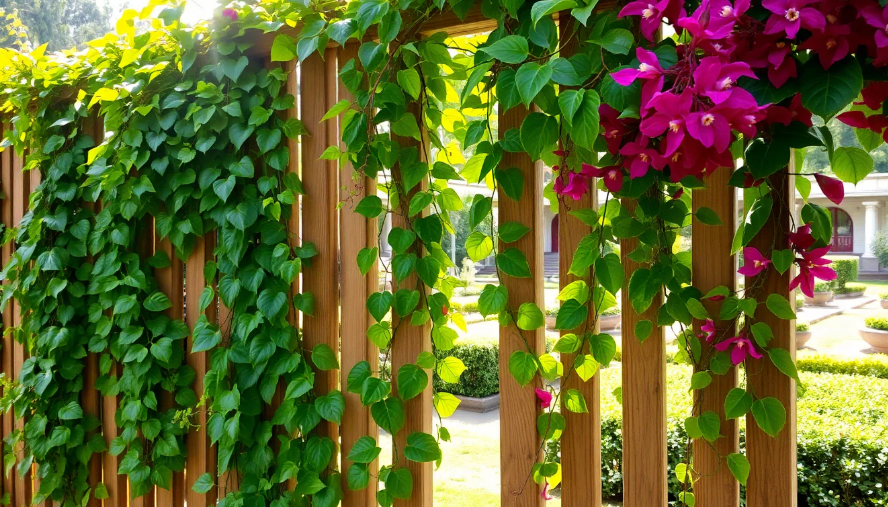
Bougainvillea is the most flamboyant and dramatic of all fence climbers in warm climates, smothering its long, thorny stems in masses of vivid, papery bracts in shades of magenta, orange, red, pink, white, and purple that create a breathtaking display throughout the warmest months of the year. It thrives in hot, dry conditions and performs best when its roots are slightly restricted and watering is limited, as stress encourages the most generous flowering.
Eccremocarpus (Eccremocarpus scaber)
The Chilean glory flower is a fast-growing, tendril-climbing perennial from South America that produces a continuous succession of small, tubular flowers in vivid shades of orange-red, yellow, or pink from early summer through to the first frosts. It is an excellent choice for quickly covering a fence in its first season and is often grown as an annual in colder climates, though it may regenerate from the base in mild winters.
Cobaea (Cobaea scandens)
Cup-and-saucer vine is a vigorous, tendril climber from Mexico that produces large, bell-shaped flowers opening green and ageing through cream to rich purple-violet, each sitting in a wide, green, saucer-like calyx that gives the flower its common name. It is a remarkably fast grower capable of covering a large fence in a single season and flowers prolifically from midsummer through to autumn, providing a bold, exotic-looking display of considerable character.
Akebia (Akebia quinata)
The chocolate vine is an elegant, semi-evergreen twiner from East Asia bearing attractive, five-fingered leaves and unusual, small flowers of a deep chocolate-maroon shade with a subtle, spicy vanilla fragrance in spring. On established plants, large, sausage-shaped, edible purple fruits may develop after hot summers, adding further interest to a climber that provides attractive foliage coverage and subtle seasonal interest throughout the year.
Lathyrus (Lathyrus latifolius)
The perennial sweet pea is a vigorous, herbaceous climber that returns reliably each spring from a deep rootstock, scrambling through fence rails with tendrils and producing masses of pea-like flowers in cerise-pink, white, or pale pink over a long midsummer season. Unlike the annual sweet pea it lacks fragrance, but compensates with robust perennial constitution, considerable vigour, and the ability to naturalise and self-seed gently in suitable conditions.
Lonicera japonica (Japanese Honeysuckle)
Japanese honeysuckle is an extremely vigorous, semi-evergreen twining climber that covers fences rapidly with twining stems and produces abundant, tubular, white and yellow flowers of intense, sweet fragrance from late spring through to autumn, making it one of the longest-flowering and most richly scented of all fence climbers. It provides dense, year-round coverage in mild climates and is particularly valuable for quickly screening an unsightly fence.
Fallopia (Fallopia baldschuanica)
The Russian vine, also known as mile-a-minute, is one of the fastest-growing climbers available and will cover even a large fence with extraordinary speed, producing foamy masses of tiny, white to pale pink flowers in late summer and early autumn above a dense tangle of heart-shaped leaves. It is a plant for where rapid coverage is the primary goal and restraint is not required, as it is one of the most vigorous climbers in cultivation and requires firm management to prevent it overwhelming everything in its path.
Thunbergia (Thunbergia alata)
Black-eyed Susan vine is a cheerful, fast-growing annual climber from Africa that produces a continuous succession of vivid orange, yellow, or white flowers each with a distinctive dark purple-black centre from midsummer through to the first frosts, providing a warm, colourful display on a fence in its first and only season. It is easily raised from seed and grows rapidly enough to provide useful screening within a few weeks of planting.
Vitis (Vitis coignetiae)
The crimson glory vine from Japan and Korea is a large, vigorous, deciduous climber bearing enormous, heart-shaped leaves that turn the most brilliant and intense shades of crimson, scarlet, and orange in autumn, creating what is arguably the most spectacular autumn foliage display of any climber available to gardeners in temperate regions. Its scale and vigour make it best suited to covering large fences and structures where its magnificence can be fully appreciated.
Ipomoea (Ipomoea tricolor)
Morning glory is a fast-growing annual climber that produces large, funnel-shaped flowers of vivid sky-blue, rich purple, or vivid magenta from midsummer onwards, each flower freshly opened in the morning and closing by afternoon in the endearing habit that gives the plant its common name. Easily grown from seed sown in spring, it provides rapid, colourful coverage of a fence and associates beautifully with other annual climbers in mixed plantings.
Schizophragma (Schizophragma hydrangeoides)
Japanese hydrangea vine is a self-clinging, deciduous climber closely related to climbing hydrangea but producing a flower head of greater elegance — each lacecap cluster surrounded by large, single, white or pink-flushed sterile bracts that flutter attractively in the breeze. It is an outstanding climber for shaded or semi-shaded fences where its flat, decorative flower heads create a quietly beautiful, refined display in midsummer above heart-shaped, attractive foliage.
Humulus (Humulus lupulus ‘Aureus’)
The golden hop is a vigorous, herbaceous twining climber that dies back completely to the ground each winter and then regrows with remarkable speed each spring, covering a fence with large, deeply lobed leaves of vivid golden-yellow that provide a cheerful, warm splash of colour throughout the growing season. In late summer it produces the characteristic, papery, cone-like hops that are used in brewing and that make attractive dried decorations, adding a further seasonal dimension to this highly ornamental and useful fence climber.