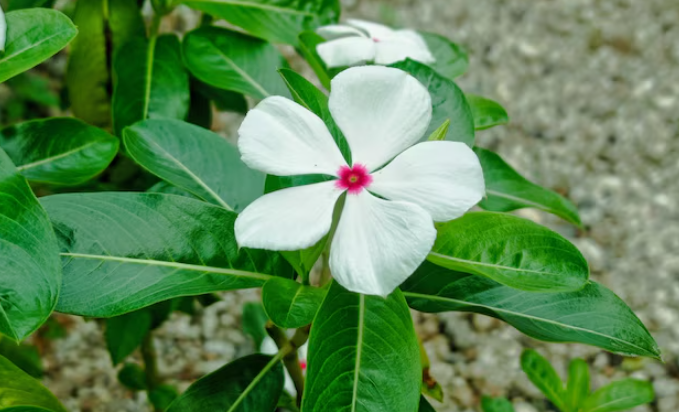
White flowers with red centers create a striking visual contrast that immediately draws the eye. The bright white petals highlight the deep red core, making the center appear bold and prominent even from a distance.
The red center often serves as a guide for pollinators, directing them toward the source of nectar and pollen. This color contrast acts like a natural target, helping insects quickly locate where to land and feed.
These flowers are often associated with a mix of meanings, combining the purity of white with the intensity of red. Together, they can symbolize balance, passion, and clarity, giving them a unique emotional appeal.
In gardens and arrangements, they add depth and interest without overwhelming the overall design. The neutral outer petals blend easily with other colors, while the red center provides a subtle focal point.
White Flowers With Red Centers
White Anemone (Anemone coronaria — white forms)
The white-flowered forms of the poppy anemone are among the most dramatically beautiful of all spring bulbs, their large, papery, pure white petals arranged in a simple, flat circle around a bold, intensely dark red-black to deep crimson central boss of stamens that creates one of the most striking and graphic colour contrasts in the entire floral world.
The intensity of the dark red centre against the snow-white petals gives even a single stem an immediate, commanding presence that no other white-and-red flower quite replicates.
White Cistus (Cistus ladanifer)
The gum cistus is a magnificent, aromatic Mediterranean shrub bearing large, five-petalled, crinkled white flowers of silky, tissue-paper delicacy, each petal marked at its base with a bold, deep crimson-maroon blotch that together create a ring of rich red at the heart of the flower.
Each individual bloom lasts only a single day, the petals falling by afternoon to be replaced by fresh flowers the following morning, giving the plant a fleeting, ephemeral beauty that makes every flower seem precious and worth pausing to appreciate.
White Lychnis (Lychnis coronaria ‘Alba’)
While the common rose campion is celebrated for its vivid magenta flowers, the white form ‘Alba’ produces pure, snow-white flowers above the same beautiful, felted, silver-grey foliage, and certain forms carry a small but distinct red or pink eye at the centre of the five-petalled bloom that provides a subtle focal point of colour within the white.
The contrast between the luminous white petals, the warm silver foliage, and the delicate central marking creates a plant of quiet, refined beauty that is outstanding in dry, sunny border conditions.
White Bindweed (Calystegia sepium — striped forms)
The large white bindweed, particularly in its striped and marked forms, produces large, trumpet-shaped white flowers that may carry pink or red striping radiating from the centre toward the petal margins, creating a pinwheel effect of considerable beauty that somewhat softens the reputation of this otherwise notorious garden weed.
Viewed in isolation and without knowledge of its invasive tendencies, the large, satiny, white flowers with their subtle central markings are genuinely beautiful, and related ornamental morning glory varieties have been selected specifically for their bold, contrasting central star or eye markings.
White Nemesia (Nemesia spp. — red-eyed forms)
Certain nemesia varieties and species produce small but exquisitely detailed white flowers with a vivid, contrasting red or orange-red central patch or eye that gives each tiny bloom a jewelled, bicoloured quality quite remarkable for such a small flower.
These compact, bushy annuals and tender perennials from South Africa flower prolifically over a long season in cool conditions and are outstanding for containers, hanging baskets, and border edges where their delicate, intricately marked flowers can be appreciated at close range.
White Plumbago (Plumbago auriculata ‘Alba’)
The white form of Cape plumbago produces clusters of phlox-like, five-petalled, pure white flowers whose slender, tubular bases and flat, open petal faces occasionally show subtle red or crimson veining and central marking that adds depth and botanical interest to what might otherwise be a simply clean white flower.
The overall effect is of a refined, slightly luminous white flower with a delicate internal structure that rewards close examination, and the plant’s vigorous, sprawling habit covers walls and fences with long-lasting floral abundance in warm climates.
White Maltese Cross (Silene chalcedonica ‘Alba’)
The white form of Maltese cross is a tall, upright perennial bearing dense, domed clusters of small, deeply notched, five-petalled flowers of pure white, and certain forms carry a subtle red or pink central zone where the petals meet at the base that adds a delicate blush of contrasting colour at the heart of each individual bloom.
The plant blooms in early to midsummer on strong, upright stems above rough, lance-shaped foliage and is a reliable, if somewhat old-fashioned, cottage garden perennial of straightforward, undemanding character.
White Phlox (Phlox paniculata — red-eyed forms)
Among the most beautiful and most fragrant of all summer perennials, certain white garden phlox cultivars produce their large, flat, five-petalled flowers in pure white with a small but intensely vivid red or crimson central eye that creates a clean, bold, high-contrast focal point within each bloom.
The combination of the rich, sweet, evening fragrance, the pure white petals, and the jewel-like red eye makes red-eyed white phlox one of the most romantically beautiful flowers of the midsummer border, and the large, domed panicles carry dozens of individual flowers simultaneously.
White Echinacea (Echinacea purpurea ‘White Swan’)
‘White Swan’ and other white-flowered coneflower cultivars produce large, classic coneflower blooms with flat to slightly reflexed, pure white ray petals surrounding a prominent, domed, spiky central cone of warm orange-red to deep reddish-brown that provides a richly coloured, bold focal point against the clean white of the surrounding petals.
The combination of white and warm red-brown is one of the most naturally harmonious and botanically satisfying in the plant world, and the seed-filled cones provide food for goldfinches through autumn and winter.
White Hibiscus (Hibiscus rosa-sinensis — white with red eye)
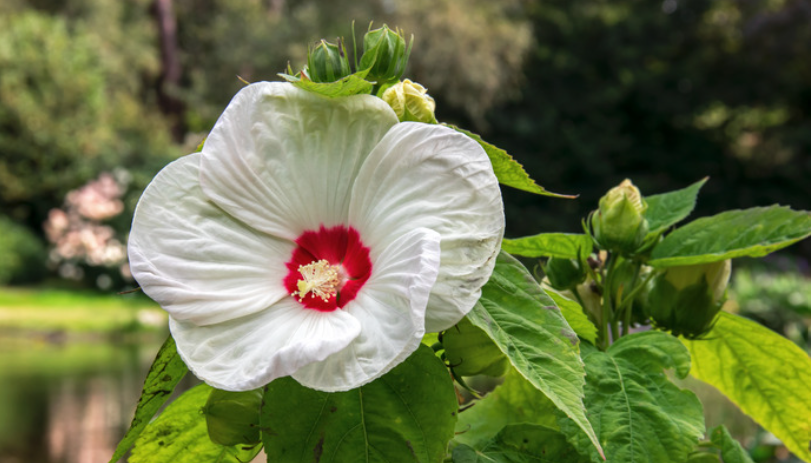
Certain white hibiscus cultivars produce enormous, dinner-plate-sized blooms of pure, satiny white petals with a deep, rich crimson or red central zone around the prominent staminal column at the heart of the flower, creating a flower of tropical magnificence whose colour contrast is as bold and dramatic as any in the plant kingdom.
Each breathtaking bloom lasts only a single day but is produced in continuous succession on vigorous, evergreen shrubs in warm climates, ensuring an uninterrupted display of exotic beauty throughout the flowering season.
White Nigella (Nigella damascena — white forms)
White love-in-a-mist produces its intricate, star-like flowers of pure white, each bloom embedded within a delicate ruff of fine, feathery, bright green bracts, and the central zone of the flower is occupied by a cluster of prominent stamens and carpels that are often tipped or flushed with deep red or crimson, adding a subtle but rich central colour note to the otherwise white and green flower.
The overall effect is of extraordinary botanical complexity and delicacy, like a tiny, intricate botanical illustration made three-dimensional.
White Oxalis (Oxalis spp. — red-veined forms)
Several species of white-flowered oxalis produce their five-petalled, cup-shaped flowers in pure white with distinctive red or deep pink veining radiating from the yellow-green centre of the flower toward the petal margins, creating an intricate, hand-painted quality of great delicacy on a very small and modest flower.
The funnel-shaped blooms sit above the characteristic trefoil foliage — which folds neatly at night and in dull weather — and the veining pattern is most clearly visible when the flowers are viewed in transmitted light, revealing an internal structure of considerable beauty.
White Impatiens (Impatiens walleriana — red-eyed forms)
Certain white busy lizzie cultivars produce their flat, five-petalled flowers in pure white with a small but distinct red or deep pink central spot or eye where the petals meet at the centre of the bloom, adding a subtle focal point of contrasting colour that prevents the white flowers from appearing bland or featureless when viewed en masse.
White impatiens with red centres are particularly effective as bedding plants in shaded positions where their luminous white flowers with contrasting eyes glow with a quiet but persistent brilliance in conditions that defeat most other flowering plants.
White Dianthus (Dianthus spp. — laced forms)
Laced pinks and certain white dianthus cultivars produce their fringed, intensely fragrant flowers in pure white with a bold, contrasting zone or eye of deep crimson-red at the centre of each bloom, the red markings sometimes extending outward along the petals as delicate veining or lacing that creates patterns of extraordinary intricacy and beauty.
The combination of the crisp, fringed white petals, the clove-like fragrance, and the jewel-red central markings makes laced white dianthus one of the most sophisticated and historically cherished of all cottage garden flowers, with a tradition of cultivation and competitive showing stretching back centuries.