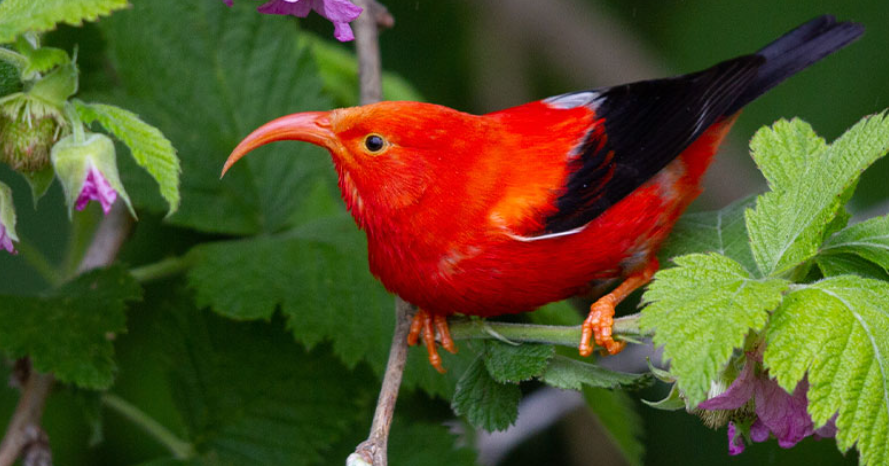
Honeycreepers are among the most brilliantly coloured of all small birds, dazzling observers with plumage that spans the full spectrum of vivid hues — deep purples, electric blues, blazing scarlets, shimmering turquoises, and bright greens. In most species, males are the more strikingly adorned, while females tend toward more subdued, camouflaged greens and browns.
Their bills vary remarkably across species, from short and stout to long and elegantly curved, reflecting the diverse feeding strategies different species have evolved. Despite their small size, their jewel-like colours make them some of the most sought-after birds among birdwatchers and naturalists in the tropics.
Honeycreepers are found primarily in the tropical and subtropical regions of the Americas and the Hawaiian Islands, occupying habitats that range from dense lowland rainforests and forest edges to high-altitude volcanic slopes and even urban gardens. The Neotropical honeycreepers, including the dacnis and Cyanerpes species, thrive in the lush forest canopies of Central and South America and the Caribbean.
The Hawaiian honeycreepers, by contrast, represent one of the most celebrated examples of island evolution in the natural world, having diversified from a single ancestor into dozens of species uniquely adapted to the isolated ecosystems of the Hawaiian archipelago.
As their name suggests, nectar forms a central part of the honeycreeper diet, and their bills have evolved in close relationship with the flowers they feed from. Many species have long, curved bills ideally shaped for probing tubular blossoms, while others have shorter, more generalised bills suited to a broader diet of fruit and insects.
Some, like the Bananaquit, have even developed the habit of piercing flower bases to steal nectar without pollinating the plant. Insects and small invertebrates supplement the diet of most species, providing essential protein, particularly during the breeding season when chicks require high-energy food to grow.
Honeycreepers are generally active and acrobatic birds, moving restlessly through the forest canopy in search of food, often hanging upside down from branches and flower clusters to reach nectar. Many species are highly social and regularly join mixed-species flocks alongside tanagers and other small birds, a strategy that improves foraging efficiency and offers protection from predators.
Breeding behaviour varies across the family, but most species build small, cup-shaped nests in trees or shrubs, where the female lays a small clutch of eggs and takes primary responsibility for incubation, with both parents sharing in feeding the chicks.
While many Neotropical honeycreepers remain relatively common in suitable habitat, the Hawaiian honeycreepers present one of the most urgent conservation stories in the entire bird world. Catastrophic losses caused by introduced avian malaria, carried by non-native mosquitoes, have driven numerous Hawaiian species to extinction since the arrival of humans, and several surviving species now cling to existence only in high-elevation forests where cool temperatures limit mosquito populations.
Habitat destruction, introduced predators such as rats and mongooses, and the effects of climate change pushing mosquitoes to higher altitudes continue to threaten remaining populations, making the conservation of Hawaiian forest ecosystems one of the most pressing wildlife priorities in the United States.
Types of Honeycreepers – (Birds of Hawaii)
Purple Honeycreeper
One of the most jewel-like birds of the South American tropics, the Purple Honeycreeper is a small tanager in which the male is cloaked in deep violet-purple plumage with jet-black wings, tail, and throat, and vivid yellow legs. Found from Trinidad and Colombia south through the Amazon Basin, it forages in the forest canopy for nectar, fruit, and insects, often hanging acrobatically from flower clusters.
Red-legged Honeycreeper
A strikingly beautiful bird widespread from southern Mexico to Brazil, the male Red-legged Honeycreeper is dressed in brilliant turquoise-blue with a violet-blue crown, black back and wings, and vivid scarlet legs that give the species its name. Females are cryptically green. It inhabits forest edges, gardens, and secondary woodland, feeding on nectar, small fruits, and insects with its slender curved bill.
Green Honeycreeper
The male Green Honeycreeper is a vivid, grass-green bird with a glossy blue-green sheen, a black head, and a bright yellow bill that contrasts sharply with its plumage. It ranges from southern Mexico through Central America and into the Amazon Basin, foraging in the forest canopy for nectar and fruit. Despite its bold colouration, it can be surprisingly difficult to spot among the dense tropical foliage.
Shining Honeycreeper
Closely related to the Red-legged Honeycreeper, the Shining Honeycreeper is a small, vivid bird of humid lowland forests from southern Mexico to Panama. The male shimmers with deep purple-blue plumage and yellow legs, while the female is streaked green and buff. It is most often seen in pairs or small flocks feeding on nectar at flowering trees, and readily joins mixed-species foraging flocks in the forest canopy.
Apapane
The Apapane is one of the most abundant and widespread of the Hawaiian honeycreepers, a group of birds that evolved from a single finch ancestor into a spectacular diversity of forms. Dressed in brilliant crimson-red with white undertail coverts and a slightly downcurved bill, the Apapane feeds almost exclusively on the nectar of native ohia lehua flowers, whose blooming season directly governs its movements across the Hawaiian forests.
Iiwi
The Iiwi is one of Hawaii’s most iconic native birds, instantly recognisable by its blazing scarlet plumage, black wings and tail, and long, dramatically curved salmon-pink bill perfectly shaped for probing the tubular flowers of native lobelias and ohia. Once abundant across the Hawaiian Islands, it has declined sharply due to introduced avian malaria, mosquitoes, and habitat loss, and now survives mainly at higher elevations where temperatures remain too cool for disease-carrying mosquitoes.
Amakihi
The Hawaii Amakihi is one of the most adaptable and resilient of the Hawaiian honeycreepers, and uniquely among its relatives has begun to develop genetic resistance to avian malaria, allowing some populations to survive at lower elevations where the disease is rife. It is a small, yellowish-green bird with a slightly curved bill, feeding on nectar, insects, and fruit across a wide range of forest habitats on the Big Island of Hawaii.
Akiapolaau
The Akiapolaau is one of the most extraordinary birds in the world, possessing a bill unlike that of any other species: the lower mandible is short and straight for hammering into bark like a woodpecker, while the upper mandible is long and dramatically curved for probing the excavated holes for wood-boring insects and grubs. Found only in the upland ohia and koa forests of Hawaii’s Big Island, it is critically endangered due to habitat loss and introduced disease.
Palila
The Palila is a critically endangered Hawaiian honeycreeper with a large, finch-like bill specially adapted for opening the tough pods of the mamane tree, whose seeds and flowers make up the bulk of its diet. Confined to a single volcanic slope on the upper flanks of Mauna Kea on Hawaii’s Big Island, it faces immense pressure from habitat degradation caused by feral sheep and goats, and is the subject of intensive conservation and legal efforts to protect its habitat.
Bananaquit
The Bananaquit is a small, energetic, and highly adaptable nectar-feeder found throughout the Caribbean, Central America, and northern South America. It has bold black-and-white plumage above with bright yellow underparts and a distinctive white supercilium. Unlike many honeycreepers, it often pierces the base of flowers with its curved bill to steal nectar without pollinating the plant, and is a regular and cheeky visitor to outdoor tables and sugar dispensers across the Caribbean islands.
Blue Dacnis
A gem of South American forest edges and gardens, the male Blue Dacnis is a stunning combination of turquoise-blue and black, with a vivid blue body, black back, wings, and throat, and pale blue-green eyes. The female is a soft mossy green. Found from Nicaragua through the Amazon Basin to Argentina, the Blue Dacnis forages actively in the canopy for nectar, small fruits, and insects, and is a frequent visitor to gardens and forest clearings.
Scarlet-thighed Dacnis
A beautiful and slightly lesser-known relative of the Blue Dacnis, the male Scarlet-thighed Dacnis is a brilliant turquoise-blue bird adorned with contrasting black on the back and wings, and a distinctive patch of scarlet-red on the thighs that can be glimpsed as it moves through the forest canopy. Found from Costa Rica to western Colombia, it inhabits humid lowland and foothill forests, feeding on nectar, berries, and small insects.
Black-faced Dacnis
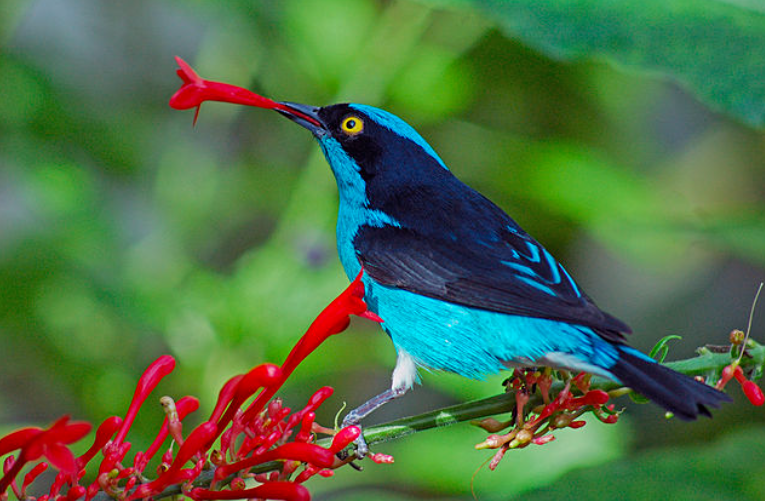
The Black-faced Dacnis is a small, striking honeycreeper of South American lowland forests, in which the male displays bright turquoise-blue plumage set against a bold black face, throat, and back, with pale yellow eyes that give it a piercing expression. It ranges across the Amazon Basin and the Guianas, foraging in the upper canopy for nectar, fruit, and insects, often in the company of other tanagers and honeycreepers in mixed feeding flocks.
Short-billed Honeycreeper
The Short-billed Honeycreeper is the smallest and least commonly observed member of the Cyanerpes genus, distinguished from its relatives by its noticeably shorter, straighter bill. The male is a rich, deep purple-blue with black wings and a turquoise crown patch, while the female is streaked greenish below. It inhabits humid lowland forests of the western Amazon Basin in Colombia, Ecuador, Peru, and Bolivia, foraging quietly in the canopy for nectar and small invertebrates.