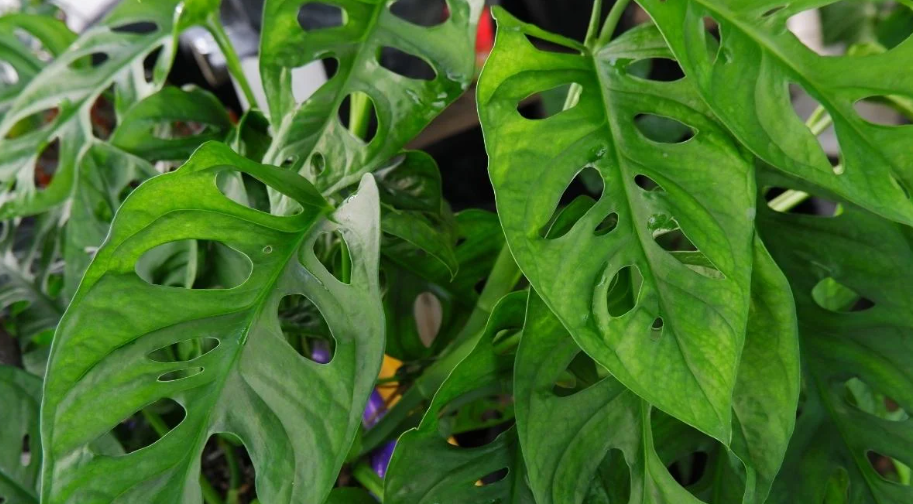
Fenestration — from the Latin fenestra, meaning window — refers to the natural holes, perforations, or splits that develop in the leaves of certain plants. Far from being a sign of damage or disease, these openings are extraordinary evolutionary adaptations.
In tropical rainforest species, fenestrations allow wind to pass through large leaves without tearing them, reduce the amount of leaf surface that casts shade on lower leaves, and may help rainwater reach the roots below more efficiently. In desert succulents, leaf windows allow light to penetrate into underground or partially buried leaf tissue. Whatever their ecological function, fenestrated plants are among the most visually dramatic and architecturally striking plants in the world.
The evolutionary reasons for fenestrated leaves are still debated among botanists, but the leading theories include wind resistance reduction — allowing air to pass through rather than around large leaves; light filtering — allowing sunlight to reach lower leaves and understory plants beneath the canopy; water channeling — directing rainfall toward the plant’s root zone; and camouflage — breaking up the leaf silhouette to reduce recognition by herbivores.
In desert succulents, leaf windows serve the entirely different purpose of light conduction — funneling sunlight into buried or semi-buried leaf tissue where conventional photosynthesis would otherwise be impossible. In all cases, fenestration represents one of nature’s most elegant and visually spectacular solutions to the challenges of leaf design.
Fenestrated Plants
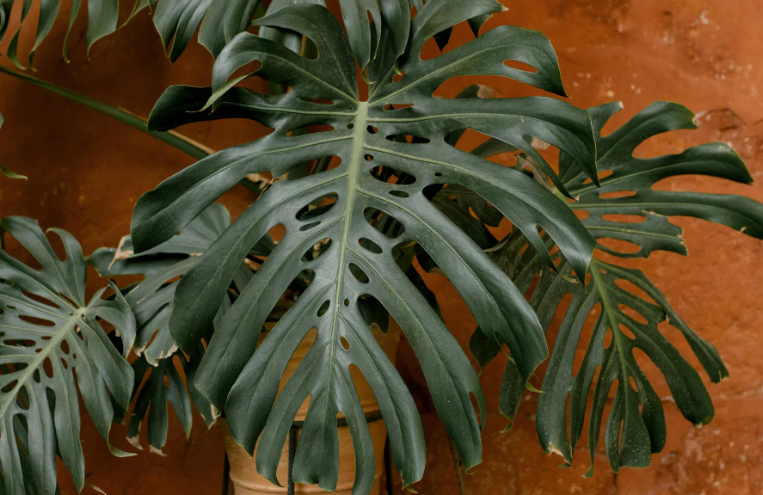
Swiss Cheese Plant (Monstera deliciosa)
The most famous and widely recognized fenestrated plant in the world, Swiss cheese plant produces enormous, glossy, heart-shaped leaves that develop distinctive oval holes and deep splits along the margins as the plant matures.
Young plants produce entirely intact leaves, and the characteristic fenestrations only develop as the plant ages and grows toward higher light in its native tropical rainforest habitat. The holes are believed to allow light to filter through the large leaf to lower leaves below and to reduce wind resistance. It is one of the most popular and enduring houseplants globally.
Monstera adansonii (Adanson’s Monstera / Swiss Cheese Vine)
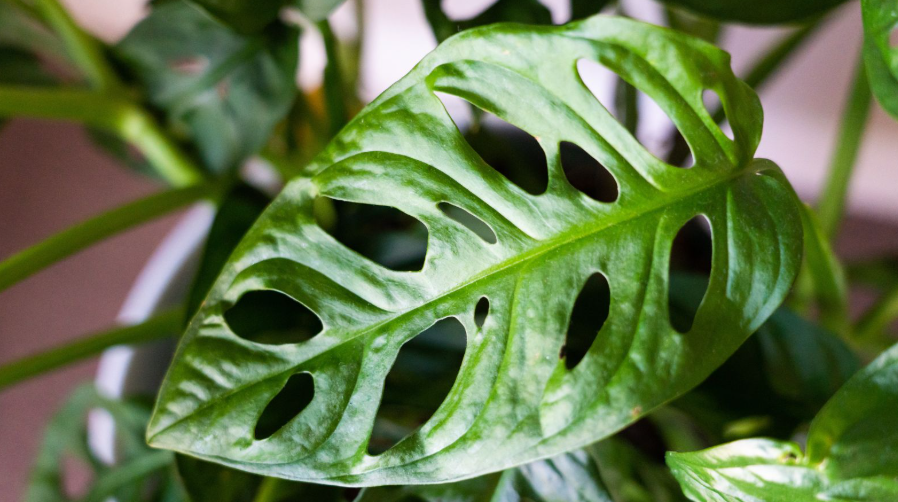
Often confused with Monstera deliciosa but considerably smaller and more delicate in scale, Monstera adansonii produces oval to heart-shaped leaves liberally perforated with numerous oval holes arranged in neat rows on either side of the central midrib.
Unlike M. deliciosa, the holes in M. adansonii do not extend to the leaf margins, giving each leaf the appearance of an intricate piece of lacework. It is a vigorous, fast-growing climbing or trailing vine and is one of the most popular houseplants for hanging baskets and plant shelves.
Monstera obliqua
One of the most extreme examples of leaf fenestration in the plant kingdom, Monstera obliqua produces leaves that are so heavily perforated with holes that the leaf tissue itself appears to be almost entirely absent — the leaf is more hole than leaf, with only a delicate network of green tissue remaining between the perforations.
It is significantly rarer and slower-growing than other Monstera species and far more challenging to cultivate. True M. obliqua is extremely rare in cultivation, and many plants sold under this name are actually M. adansonii.
Monstera dubia
A lesser-known but fascinating climbing Monstera species that displays dramatically different leaf forms at different stages of its life — a phenomenon called heterophylly. Juvenile plants produce small, entire, dark green leaves that press flat against a tree trunk in a shingle-like pattern.
As the plant matures and climbs higher into the forest canopy, the leaves enlarge dramatically and develop the characteristic Monstera fenestrations and splits. The contrast between the juvenile and adult leaf forms is so extreme that the two stages were once classified as entirely different species.
Split-Leaf Philodendron (Thaumatophyllum bipinnatifidum)
Formerly classified as Philodendron selloum and closely resembling a giant Monstera, split-leaf philodendron produces enormous, deeply lobed and pinnatifid leaves that are cut almost to the central midrib into numerous finger-like, wavy-edged segments.
While the divisions in the leaves are more accurately described as deep lobes and cuts rather than true perforations, the overall effect of the dramatically divided leaf surface is one of the most spectacular examples of leaf fenestration in cultivation. It forms a large, bold, architectural rosette of leaves on a thick, trunk-like stem.
Dragon Tail Plant (Epipremnum pinnatum)
A vigorous, climbing aroid related to pothos (Epipremnum aureum), the dragon tail plant produces leaves that transform dramatically as the plant matures and climbs. Juvenile leaves are small, oval, and entire.
As the plant ascends and enters its adult phase, the leaves enlarge dramatically and develop deep, irregular pinnate cuts and perforations along the midrib that give the leaf its dragon-tail silhouette. It is a fast-growing, adaptable houseplant that performs equally well as a climbing plant on a moss pole or as a trailing plant in a hanging basket.
Rhaphidophora tetrasperma (Mini Monstera)
Widely known as mini Monstera or Monstera minima despite belonging to a completely different genus, Rhaphidophora tetrasperma produces leaves with deeply pinnate splits running from the leaf margin toward the central midrib — closely resembling a miniature version of Monstera deliciosa.
It is a fast-growing, vigorous climbing plant that has become one of the most popular houseplants of recent years due to its Monstera-like appearance in a much more compact and manageable size. It thrives on a moss pole or trellis in bright, indirect light.
Window Leaf (Monstera punctulata)
A large-growing, high-climbing Monstera species of Central American tropical rainforests, producing enormous adult leaves with both deep marginal lobes and interior perforations — giving the leaf a combination of cuts and holes simultaneously.
As with most Monstera species, juvenile leaves are entirely intact and only develop fenestrations as the plant matures and climbs toward the forest canopy. It is less commonly available in cultivation than M. deliciosa or M. adansonii but is highly prized by collectors for its dramatic, large-scale leaf architecture.
Monstera siltepecana (Silver Monstera)
A dimorphic Monstera species producing dramatically different leaf forms in its juvenile and adult stages. Juvenile leaves are small, silvery-blue-green, entire, and unmarked — quite unlike a typical Monstera. Adult leaves are larger, darker green, and develop the characteristic Monstera fenestrations and splits.
The silvery juvenile foliage makes it particularly prized as a trailing houseplant, and many growers deliberately keep the plant in its juvenile phase by growing it as a trailing vine. When allowed to climb, the adult fenestrated leaves emerge and reveal its true Monstera identity.
Platycerium (Platycerium bifurcatum — Staghorn Fern)
The staghorn fern produces two completely distinct types of fronds — flat, rounded, entire shield fronds that anchor the plant to its host tree, and dramatic, antler-like, deeply forked and divided fertile fronds that extend outward from the center of the plant.
The fertile fronds are deeply and repeatedly divided into strap-like, finger-like segments — creating a fenestrated, perforated appearance quite unlike any other fern. The divisions allow the large fronds to move in air currents without tearing. Staghorn ferns grow epiphytically on trees in tropical and subtropical forests and are widely grown mounted on wooden boards as living wall art.