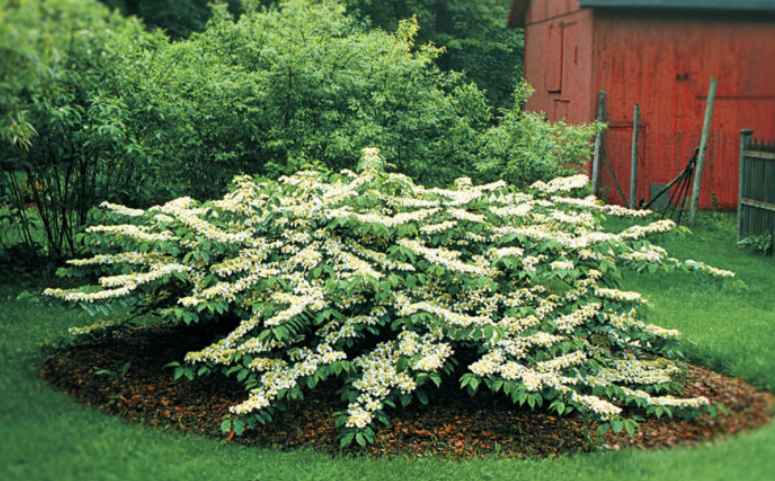
Viburnums, in the honeysuckle plant family, comprise a diverse group of approximately 150 species of shrubs and small trees. Several species viburnums shine in the home landscape with either especially attractive flowers or fruit. Viburnums may be deciduous or evergreen, with their handsome foliage contributing to the garden’s charms. The intensely fragrant flowers of many viburnums attest to their honeysuckle family heritage, and fruiting varieties delight birds with autumn and winter berries.
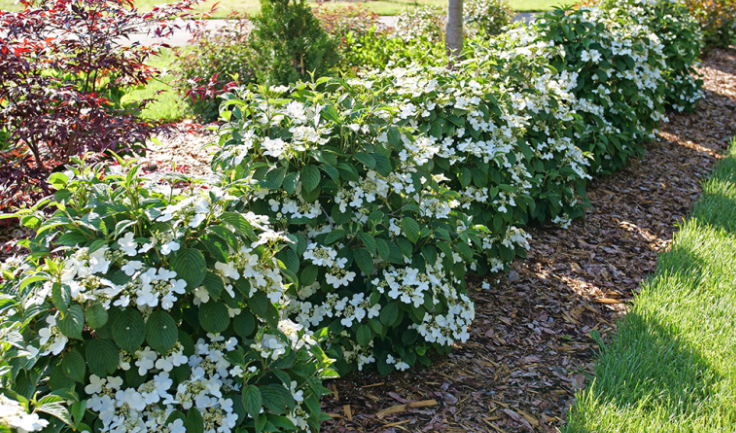
Viburnums are characterized by opposite, simple or palmately lobed leaves and clusters of small, often fragrant white or pink flowers, followed by red, blue or black berries. Viburnums are versatile in the landscape and many works well when planted to form a viburnum hedge or screen. There exist many varieties of viburnums and they vary in their height, spread and style of flower but are similar in preferring sun to part shade and in being disease and pest resistant.
Note: Most viburnums share opposite leaf arrangement on the stem, five-petaled white or pink flowers in flat-topped or domed clusters, and fleshy single-seeded fruits (drupes) that ripen through red, blue, or black. Key identification features to focus on are leaf shape and texture, presence of fragrance, flower cluster form (flat lacecap vs. rounded snowball), fruit color, and deciduous vs. evergreen habit.
Varieties/Types of Viburnum Bushes
Viburnum opulus (European Cranberrybush)
Viburnum opulus, commonly known as the guelder-rose, or guelder rose, is an Old World species of flowering plant in the family Adoxaceae. The common name ‘guelder rose’ relates to the Dutch province of Gelderland, where a popular cultivar, the snowball tree, supposedly originated.
It is a vigorous shrub growing 8–12 feet tall with distinctive three-lobed, maple-like leaves. In spring it produces large, flat-topped white flower clusters with showy sterile outer florets. By autumn, it bears drooping clusters of bright red, translucent berries that persist well into winter.
Viburnum trilobum (American Cranberrybush)
Viburnum trilobum is a species of Viburnum native to northern North America, from Newfoundland west to British Columbia, south to Washington state and east to northern Virginia. Although often called “highbush cranberry”, it is not a cranberry. The name comes from the red fruits which look superficially like cranberries, and have a similar flavor and ripen at the same time of year.
It has the same three-lobed leaves and lacecap-style white flowers, but its red berries are more tart and are actually edible — traditionally used in jams and jellies. The fall foliage turns a striking deep red.
Viburnum dentatum (Arrowwood Viburnum)
Named for its straight stems, which Indigenous peoples once used for arrow shafts. Identified by its coarsely toothed, oval leaves with prominent veins, clusters of small creamy-white flowers in late spring, and clusters of blue-black berries in fall. It’s highly adaptable and very cold-hardy.
Also Read: Different Types of Hydrangeas
Viburnum Dentatum (Southern Arrowwood)
Viburnum dentatum also referred to as arrowwood is a small shrub, native to the Eastern United States and Canada. It is upright, rounded, multi-stemmed, deciduous shrub which typically matures to 6-10 feet tall with a corresponding spread, but may reach a height of 15 feet in optimum growing conditions.
In spring, small, white flowers mature in flat-topped clusters up to 4 inches wide. It also produces a bluish-black drupe that matures in late summer and early fall. This shrub makes a greet screen, informal hedge and is useful in groupings and masses or as filler in the border.
Viburnum Lentago (Nannyberry)
Viburnum lentago also referred to as Nannyberry or sheepberry is a large shrub reaching 15-20 feet high, known for its dark, lustrous green leaves which turn maroon-red in the fall. Also, there are ivory flowers that appear in late spring, flat-topped inflorescence as wide as the hand-palm. Each group has numerous tiny blossoms. These flowers develop into a colorful mixture different colored fruits, some light green, others pale yellow or red-pink and all in the same cluster.
Also Read: Flowering Shrubs For Your Yard
Wayfaring Tree (Viburnum lantana)
Viburnum lantana commonly referred to as the wayfarer or wayfaring tree is native to central and Western Europe, northwest Africa and southwestern Asia. Wayfaring tree is a perennial shrub with multiple stems growing from 8 to 15 feet high forming a dense rounded shape. The thick, dark green leaves, white spring flowers and beautiful clusters of red to yellow to black berries add to the ornamental appeal.
Leatherleaf Viburnum (Viburnum rhytidophyllum)
Viburnum rhytidophyllum also referred to as leatherleaf viburnum is an attractive shrub native to Asia. This vigorous coarsely textured evergreen shrub has an upright habit and 8-inch long, lustrous, deeply veined oval leaves with dark blue-green surfaces and pale green undersides. The leaf stems are fuzzy brown. While the creamy white flowers light up the spring landscape, this species offers no fall color change. Bright red berries appear after the flowers fade, gradually changing to shiny black. The berries attract birds and last well into December.
Viburnum carlesii (Koreanspice Viburnum)
The koreanspice viburnum is a medium sized deciduous shrub that is popular for fragrant white spring flowers as well as their good fall color. They tend to grow to between 3 and 5 feet tall and wide, but they can reach as high as 8 feet in ideal growing conditions. The 4-inch leaves are ridged and deep green. In autumn, they turn deep red to purple.
Koreanspice viburnum plants produce 2 to 3 inch wide clusters of small flowers that begin pink and open to white in early to mid spring. The flowers give off a rich scent that is similar to spice cake. These flowers are followed by blue-black berries. This shrub is a perfect choice as specimen, in a shrub border and as a foundation plant.
Also Read: How to grow and care for Oakleaf Hydrangeas
Viburnum prunifolium (Blackhaw)
A large, multi-stemmed shrub or small tree with smooth, oval leaves resembling those of a plum (hence prunifolium). White flowers appear in flat-topped clusters in spring. The fruits ripen from green to rose-red to blue-black and are sweet and edible. Bark on older stems is scaly and blocky.
Viburnum rufidulum (Rusty Blackhaw)
Closely related to Blackhaw but native to the southeastern U.S. It is easily identified by the distinctive rusty-brown hairs (pubescence) on its leaf buds, petioles, and undersides of young leaves. Leaves are thick and glossy. Fruits are dark blue, and the shrub is notably drought-tolerant.
Viburnum acerifolium (Mapleleaf Viburnum)
A compact, shade-tolerant native shrub growing 4–6 feet tall. As the name suggests, its three-lobed leaves closely resemble maple leaves. Creamy-white flowers appear in rounded clusters. One of its most striking features is its spectacular fall color, ranging from rose-pink to deep magenta and purple.
Viburnum lantanoides (Hobblebush)
A woodland native of eastern North America, recognized by its large, heart-shaped leaves with a finely toothed margin. Sprawling, arching stems that root where they touch the ground give it a “hobbling” habit. Flat lacecap flowers have large outer sterile florets. Fruits turn red then black-purple.
Viburnum nudum (Possumhaw / Smooth Witherod)
A native shrub of wetlands and moist woods, notable for its extremely glossy, dark green leaves with a slightly wavy margin. Creamy-white flowers appear in domed clusters. The berry clusters are especially showy, ripening through pink, rose, and blue in the same cluster simultaneously. Fall color is burgundy-red.
Viburnum cassinoides (Witherod Viburnum)
Similar to V. nudum but with a slightly duller, more leathery leaf surface. Creamy flower clusters bloom in early summer, and the multi-colored berry display — green, white, pink, rose, blue, and black all at once — makes it one of the most ornamentally valuable native viburnums. Thrives in moist, acidic soils.
Viburnum recognitum (Northern Arrowwood)
Closely related to V. dentatum and sometimes treated as a variety of it. Distinguished by its mostly hairless leaf undersides (except along the veins) and its habitat preference for moist, northern woodlands. Creamy-white flower clusters and dark blue-black berries are typical identifiers.
Viburnum rafinesquianum (Downy Arrowwood)
A smaller, less common native arrowwood distinguished by the dense, soft hairs on the underside of its coarsely toothed leaves. It tends to grow in drier, rocky, or sandy habitats compared to other arrowwoods. White flower clusters and dark berries follow the typical viburnum pattern.
Viburnum edule (Squashberry / Mooseberry)
A northern, subarctic species with three-lobed, shallowly toothed leaves. Small white flower clusters are followed by clusters of sour red berries prized for jams in northern Indigenous and settler cuisines. It is a low, spreading shrub well-adapted to cool, moist forests and streambanks.
Viburnum ellipticum (Western Viburnum)
The only viburnum native to the Pacific Coast of North America. It has elliptical to oval leaves with coarse, rounded teeth on the upper half of the blade. Small clusters of white flowers appear in spring. The fruits ripen to black. It grows in dry, rocky slopes and chaparral habitats in Oregon and California.
Viburnum plicatum (Doublefile Viburnum)
One of the most dramatically beautiful viburnums, bearing its white lacecap flower clusters in perfectly symmetrical double rows along horizontal branches — hence “doublefile.” The pleated, prominently veined leaves are another strong identifier. The form tomentosum is the wild type; plicatum refers to the sterile, snowball-flowered garden form.
Viburnum macrocephalum (Chinese Snowball)
Famous for its enormous, spherical, pure-white flower heads that can reach 6–8 inches across — among the largest of any viburnum. The sterile flowers do not produce berries. Semi-evergreen in mild climates, it has oval, slightly leathery leaves. It is a bold, dramatic specimen shrub for warm-temperate gardens.
Viburnum × carlcephalum (Fragrant Snowball)
A hybrid between V. carlesii and V. macrocephalum, combining the fragrance of Koreanspice with larger, rounded flower heads. The blooms are pink in bud and open white, in clusters up to 5 inches wide. Larger and more vigorous than V. carlesii, with good fall red-purple foliage color.
Viburnum × juddii (Judd Viburnum)
Another fragrant hybrid, this one between V. carlesii and V. bitchiuense. It is slightly more open in habit than V. carlesii and is considered more disease-resistant. Hemispherical clusters of pink-budded, white-opening flowers are powerfully fragrant in spring. Berries are red turning black.
Viburnum farreri (Fragrant Viburnum)
A Chinese species notable for blooming in late winter to early spring, even before the leaves emerge. The pink-to-white tubular flowers are clustered along the bare branches and emit a sweet fragrance. Semi-deciduous with small, prominently veined, toothed leaves. Red fruits rarely develop in cultivation.
Viburnum × bodnantense (Bodnant Viburnum)
A hybrid of V. farreri and V. grandiflorum, producing fragrant deep-pink flower clusters on bare stems from late autumn through early spring — making it one of the most winter-blooming of all shrubs. Tubular flowers are dark rose-pink in bud and fade to pale pink. ‘Dawn’ is the most popular cultivar.
Viburnum tinus (Laurustinus)
A Mediterranean evergreen species with glossy, dark oval leaves and a dense, rounded habit. Flat-topped white to pale-pink flower clusters bloom from late autumn through spring. Distinctive metallic blue-black berries follow. It is one of the most widely grown evergreen viburnums for hedging and screening in mild climates.
Viburnum rhytidophyllum (Leatherleaf Viburnum)
An imposing semi-evergreen or evergreen Chinese species recognized by its long, deeply corrugated (rugose), dark green leaves with a dense gray-white felt on the underside. Flat-topped, creamy-white flower clusters appear in late spring. Oval fruits ripen from red to black. Its bold, coarse texture is highly distinctive.
Viburnum × rhytidophylloides (Lantanaphyllum Viburnum)
A hybrid between V. rhytidophyllum and V. lantana, with semi-evergreen, leathery, wrinkled leaves that are less dramatically corrugated than the leatherleaf parent. Creamy-white flowers and red-to-black fruits are typical. It is hardier than V. rhytidophyllum and widely used as a screening plant.
Viburnum davidii (David Viburnum)
A compact, low-growing evergreen species from China, rarely exceeding 3–4 feet. The bold, deeply three-veined, glossy dark green leaves are its most distinctive feature. Small white flowers appear in flat clusters. Most notably, it produces stunning turquoise-blue berries — among the most vivid of any viburnum — but requires both male and female plants for fruiting.
Viburnum japonicum (Japanese Viburnum)
An evergreen shrub with large, thick, glossy, dark green leaves that have a leathery texture and slightly wavy margins. Fragrant white flowers are carried in dense, rounded clusters. Red fruits ripen in autumn. It is a handsome screening or specimen plant for mild-winter gardens, tolerating coastal conditions well.
Viburnum suspensum (Sandankwa Viburnum)
A subtropical evergreen species from the Ryukyu Islands, widely planted in the deep South and California. Identified by its thick, glossy, oval to elliptic leaves with slightly toothed margins. Fragrant pinkish-white flower clusters appear in late winter to spring. Red fruits ripen to black. It makes an excellent hedge in warm climates.
Viburnum awabuki (Mirror-Leaf Viburnum)
Sometimes confused with V. japonicum, this Japanese evergreen species has exceptionally glossy, mirror-like leaf surfaces — perhaps the shiniest of all viburnums. Large, rounded white flower clusters appear in spring, followed by red berries. ‘Chindo’ is a popular cold-hardier cultivar widely used in the Southeast U.S.
Viburnum sieboldii (Siebold Viburnum)
A large, bold shrub or small tree from Japan that can reach 15–20 feet. Identified by its large, heavily textured, deeply veined, oblong leaves that emit an unpleasant odor when crushed. Creamy-white flat-topped flower clusters are large and showy. Fruits ripen from red to glossy black on bright red stalks — a very ornamental combination.
Viburnum dilatatum (Linden Viburnum)
An Asian species with broadly oval, coarsely toothed leaves that superficially resemble linden leaves, giving it its common name. Flat-topped creamy-white flower clusters in late spring are followed by an exceptionally prolific display of bright cherry-red berries that persist well into winter and are among the showiest of any viburnum.
Viburnum wrightii (Wright Viburnum)
A Japanese and Chinese species similar to V. dilatatum but with glossier, less hairy leaves and a more refined appearance. Its bright red berries ripen early and are held in neat, flat-topped clusters. The fall foliage turns a vivid red. It is less widely grown than V. dilatatum but considered very ornamentally refined.
Viburnum betulifolium (Birchleaf Viburnum)
A tall-growing Chinese species distinguished by its birch-like, diamond-shaped, coarsely toothed leaves. It is best known for its extraordinarily prolific berry production — drooping clusters of tiny, brilliant red currant-like fruits weigh down the branches in autumn and persist for months, making it a spectacular fruiting shrub.
Viburnum sargentii (Sargent Viburnum)
An Asian cousin of the European cranberrybush with similar three-lobed, maple-like leaves, but with a distinctly mounded, more spreading habit. Lacecap white flowers with prominent sterile outer florets appear in spring. Red translucent berries follow. The cultivar ‘Onondaga’ is noted for its burgundy-red new foliage.
Viburnum harryanum (Harry’s Viburnum)
An unusual and less commonly grown species from China, notable for its distinctive, very small, nearly round, deep green leaves — quite unlike most viburnums. White flowers are small and tubular, carried in small clusters. Black fruits are small and globose. It forms a dense, arching shrub with a refined, delicate texture.
Viburnum × pragense (Prague Viburnum)
A vigorous hybrid between V. rhytidophyllum and V. utile, producing a large, fast-growing evergreen shrub. The leaves are long, glossy, and dark green on top with a gray-white felted underside, though less corrugated than leatherleaf viburnum. White flower clusters appear in spring. It is widely valued as a tough, wind-resistant evergreen screen.
Viburnum carlesii (Koreanspice Viburnum)
Prized above almost all other viburnums for its intoxicating, spicy-sweet fragrance. The flowers are pink in bud, opening to white, in dense rounded clusters in mid-spring. Leaves are dull green and somewhat fuzzy. Fruits are black but sparse. It is a compact shrub ideal for planting near walkways or windows.